Property Matters – The Housing Gap

Property Matters – The Housing Gap

“…Whereas the People of Trinidad and Tobago—…(b) respect the principles of social justice and therefore believe that the operation of the economic system should result in the material resources of the community being so distributed as to subserve the common good…”

—From the preamble of our Republic’s current Constitution (1976)

In this, my Season of Reflection, I return to my constant concern with our national housing polices and the outcomes of the State’s housing program for our neediest citizens. The quality of discourse and understanding is in my view rooted in the quality of the questions one poses. How we define the problem allows us to improve our chances of seeing and solving.

hdclogoThe inescapable challenge for our national housing program is to provide sufficient affordable housing options of a decent quality. The HDC’s waiting-list is now in excess of 176,000 individual applicants, which excludes co-applicants or dependents. Over 90% of those applicants cannot afford a mortgage or to ever buy their own homes. They are just too poor to do so.

So this is the big question which our Housing program must answer.

How do we house those who can least afford good-quality housing? Continue reading “Property Matters – The Housing Gap”

AUDIO: Interview on Business Corner on Power 102 FM, Housing Policy – 20 August 2018

business-corner-power-102Afra Raymond, based on his research on the effectiveness and delivery metrics of the existing housing policy, was interviewed on the Power 102.1FM ‘Business Corner‘ by Sandrine Rattan on Housing Policy and outcomes.
Programme Date: 20th August 2018
Programme Length: 00:12:48

Property Matters – Invaders’ Bay again

The 17th recommendation of the Uff Report states –

“…User groups and other interest groups should be properly consulted on decisions regarding public building projects, to ensure that relevant views can be expressed at the appropriate time and taken into account before decisions are made…” (emphasis is mine)

On 27th July 2018, UDECOTT advertised for Expressions of Interest for development of the controversial Invaders’ Bay lands, in West POS.

invaders-bay-artist-rendering
Continue reading “Property Matters – Invaders’ Bay again”

Property Matters – the Stormwater Management Committee

Property Matters – the Stormwater Management Committee

The recent heavy rainfall and the accompanying flooding prompted me to revisit some items from the past which I had not written on before. It always makes me flinch to hear the statements on flooding from the UNC, for whatever reason. This is all part of my Season of Reflection.

Austin 'Jack' Warner, MP, Minister of Works & Transport
Austin ‘Jack’ Warner, former Minister of Works & Transport

This article takes us back to May 2010 at the point when the PP won 29 seats to form the government. On the night of the celebrations there was heavy flooding in south Trinidad due to heavy rainfall earlier that day. The PM-elect, Kamla Persad-Bissessar and the Minister of Works (in waiting) Jack Warner left the session at Crowne Plaza Hotel to tour the affected districts. The striking statement from Jack Warner was widely-reported – ‘Flooding would be a thing of the past under his watch.

So what happened? What attempts were made to deal with this national scourge? That is the topic of this article. Continue reading “Property Matters – the Stormwater Management Committee”

VIDEO: Interview on CNC3 Morning Brew -7 August 2018

CNC3 LogoThis morning on CNC3’s the Morning Brew Hema Ramkissoon spoke with Afra Raymond about HDC. Mr Raymond said the plan under the National Housing Authority which was developed in 2002 was to build 100,000 homes in 10 years, he said the HDC has built approximately 12,000 homes. This is from 2003-2015. Video courtesy CNC3

Programme Date: 7 August 2018
Programme length: 00:18:34

Property Matters – Sandals MoU? Part three

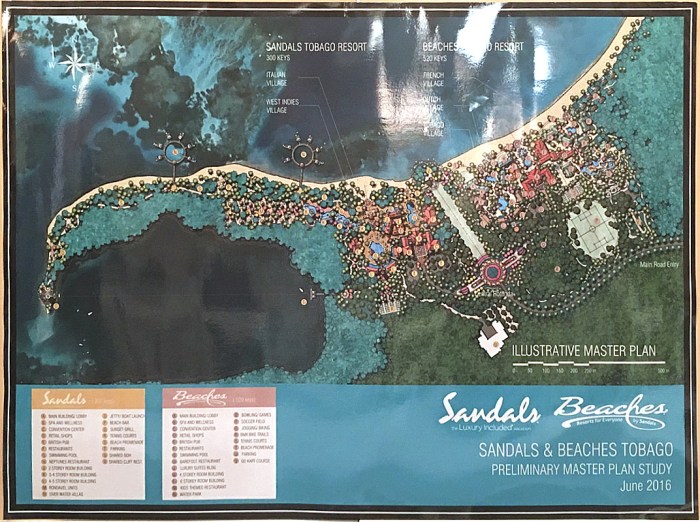
Sandals/Beaches Tobago Illustrative Master Plan

The previous article delved into the published information on the three existing State-owned hotels and juxtaposed that with the proposals for a Tobago Sandals. Apart from the unsatisfactory position with the State’s existing hotel investments and the reluctance to give details, I also updated readers on the missing MoU for the Tobago Sandals project.

My dismal readings were based on the very limited publicly-available information, nothing else. I did not refer to any rumours or ‘inside information‘, my work is all based on the published record. The PM and his colleagues surely have ready access to a better quality and quantity of information than the public. That being the case, it begs the question as to what is really happening here.

If indeed, the Sandals project has significant upsides and benefits, those ought to have been estimated and shared by now. If the existing State-owned hotels are doing well, why aren’t the management agreements or accounts published? If those hotels are doing poorly, why are we persisting with that same model? Continue reading “Property Matters – Sandals MoU? Part three”

Property Matters – Sandals MoU? Part two

Sandals MOU_ (3)

The previous article updated readers on my attempts to obtain the Sandals Memorandum of Understanding for the proposed high-end, large-scale resort development in Tobago. That proposed development is said to be a significant part of our country’s diversification efforts so it requires our sober attention if we are to understand what is at stake.

The model for this project is one in which the State either pays for or guarantees the financing of the new resort. The State would pay for the cost of design, financing, construction, fitting and furnishing of the new resort, all to the standards set by Sandals. The completed resort will then be operated by Sandals under a management agreement. T&T is unique in the Caribbean in that our largest hotels were funded by Public Money with the operators working via Management Agreements.

That is the model which has been used thus far in our State-owned hotels. That fact has been cited several times by the PM, quite likely to offer a degree of comfort to those who are unsure about this project. After all, we have done this model before, so what could be the harm if we go along the same road once more?

That approach to a major investment of this type does not offer me any comfort at all. Since September 2016 I have been pursuing a detailed research program into the State-owned hotels, with my colleagues from Disclosure Today and we have been solidly resisted. In my view, we do not have enough information about the existing State-owned hotels – Trinidad Hilton (1962); Magdalena Grand (originally Tobago Hilton, opened in 2000) and Hyatt Regency (2008) – to be confident about this approach. Continue reading “Property Matters – Sandals MoU? Part two”

Property Matters – Sandals MoU?

Adam Stewart, CEO Sandals

This is a continuation of my 8 March 2018 article on the Sandals MoU. That MoU was declared as no secret by our PM to the Parliament on 12 October 2017 and that was confirmed by the then CEO of the Sandals group, Adam Stewart, as reported on 27 February 2018 in the T&T press.

My 27 February 2018 request for that MoU under the Freedom of Information Act (embedded below) was therefore made against that background of both parties’ declaration that there was no secret. The Office of the Prime Minister responded on 22 March 2018 to refuse my request, citing that the MoU contained a confidentiality clause which prevented its disclosure at this time. I have since written to the OPM to request a reply in conformity with the provisions of the Freedom of Information Act – I am still awaiting a reply to that letter.

I have now written to Mr Adam Stewart of Sandals Resorts International to request from him a copy of the MoU. (See below)

This is a proposal of high public importance as it is being advanced as an important part of our country’s diversification strategy, so the correspondence is set out in this article.

From: Afra Raymond
Date: Fri, Jun 15, 2018 at 3:41 PM
Subject: Request for Memorandum of Understanding with Sandals Resorts
To: Adam Stewart

Dear Mr Stewart,

I am writing to request a copy of the signed Memorandum of Understanding between Sandals Resorts International and the Government of the Republic of Trinidad & Tobago – it was recently reported that this MoU was signed on 10th October 2017.

There is no doubt that the proposed 750-room Sandals/Beaches Resort for Tobago will be a large-scale, high-impact development, so there an understandable public interest in those proposals. I was therefore greatly encouraged by your emphatic statements that there is no secrecy in relation to the business arrangement or the MoU and that you refuted any secret deals – as reported in the Trinidad & Tobago press on 27th February 2018.

I was therefore astonished that the Office of the Prime Minister replied on 22nd March 2018 to my request for that MoU by citing a confidentiality clause to refuse its disclosure at this time. I wrote to the OPM on 11th April 2018 requesting a clarification and their reply is still awaited. In the interim, I am requesting from you a copy of the MoU in the public interest of transparency in this large-scale development proposal.

For your information, my earlier article on the Sandals MoU was published in the Express Business on 8th March 2018 and can be accessed here. The related correspondence is attached for ease of reference.

Please let me have your reply in due course.

Afra Raymond

afraraymond.net


Property Matters – more Property Tax FAQs part three

property-tax-logoApart from the strong objections to the re-introduction of property tax, there are tantalising points emerging on the need for those taxes to be used to pay for local government services. Local government is one of the sectors which is in most frequent contact with the needs of communities, such as maintenance of drains and playing-fields; garbage collection; road repairs and many other such services.

One of the common positions on this tax is one in which there is no real objection to property tax as such, but there are local government and property valuation concerns expressed. Most of those persons seem to have a strong preference for the property tax to be used to fund their local government services, which then leads to an objection to the valuation approach. Those persons seem to hold the view that the extent to which one property is more valuable than another ought not to be the basis for setting the property taxes, if those properties are using broadly similar levels of local services. One can understand that this approach would appeal to those who own the more valuable properties, but one can equally say that those who own more modest properties would be displeased if their property tax bills were the same as their neighbours with larger and more valuable properties. It is complicated. Continue reading “Property Matters – more Property Tax FAQs part three”