We all know of single persons who get new three-bedroom HDC homes, while entire needy families remain trapped on the waiting-list.
We have all seen nifty HDC developments and known that ‘That development is way too nice for any poor person to live in there’.
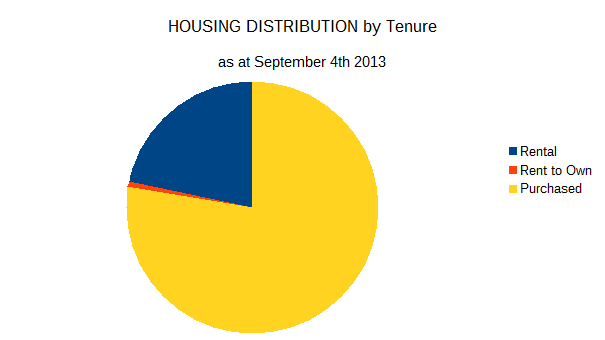
The actual distribution of new HDC homes shows the actual targets. HDC figures on distribution of new homes as at September 4th 2013 show 22% for rent and 78% sold (approx).
In 2014 the monthly income limit to apply for a new HDC home was increased to $45,000. According to the Salaries Review Commission’s 2013 Report, that figure exceeds the salaries paid to Ministers in our Cabinet, Appeal Court Judges, The Ombudsman, The Auditor General and the Head of the Public Service/PS to the OPM. That is how far astray our housing policy has gone.
The Housing policy is being implemented so as to promote home-ownership. This approach does not benefit the poorer applicants who cannot afford mortgages.
This week I will be examining the allocation policy in greater detail.
The PP administration took issue with the housing policy, very late in their term of office and only in reference to disabled persons and persons whose life had been threatened –
“…Moonilal said Government has been satisfying the Cabinet-approved National Housing Allocation Policy 2008, which allows for 60 percent of housing to be distributed by random draw, 25 percent by ministerial discretion, ten percent by protective services, and five percent for senior citizens and the physically challenged….”
Those intentions to review housing policy were limited and in any case, the PP lost the September 2015 general election.
It was staggering to learn that the monthly income limit for HDC housing had been increased to $45,000 at some point in 2014. That significant and detrimental policy shift must have been done very quietly.
One of the early policy announcements of the new PNM administration was that the monthly income limit would revert to the previous level of $25,000. That policy change caused some controversy and even sparked some baseless talk of lawsuits. One of the concerns was as to the status of those persons who had qualified under the $45,000 limit – Would they lose their place in the queue? The decision was made to preserve the entitlements of those who had qualified under the $45,000 income ceiling.
The previous column outlined the provisions of the current housing policy and some of the implications arising from those. I provided data on housing distribution by tenure and also stated a preliminary view, dismissing the major allegations made against Marlene McDonald – the current Housing & Urban Development Minister.
To understand just how a supposedly-redistributive policy could be used in this fashion, it is necessary to examine how it was changed and how those changes work with the provisions of the Housing Development Corporation Act 2005.
What is the Housing Policy?
‘Showing Trinidad & Tobago a new way home‘ was launched on 18th September 2002 by then Housing minister, Senator Danny Montano. At that stage, the policy for allocation of the new homes produced by HDC were –
…How is housing allocated?
All housing that becomes available is allocated in the following way:
75% is reserved for public applicants through a random selection system.
10% is reserved for the Joint Protective Services – Police, Army, Prisons and Fire Services.
15% is assigned to deal with special emergency cases, senior citizens and physically challenged persons…
The rules to qualify for these homes were –
…Do I qualify?
To qualify for a new home, applicants must be:
A resident citizen of Trinidad and Tobago.
Twenty-one years of age or over.
Neither owner nor part owner of a house or land.
In possession of a Board of Inland Revenue tax file number…
These details are from ‘Applying to Buy a Government House‘ on the TTConnect website, but they are outdated, as they refer to the 2002 position. I was very critical of this ambitious new housing policy, since it was located within this context –
“…The Housing Policy of the Government of Trinidad & Tobago is based on the understanding that every citizen should be able to access adequate and affordable housing regardless of gender, race religion or political affiliation”
Those are important policy guidelines, but they are inadequate to the task, given that they are silent on the single common cause of housing need or homelessness. The point is that all homeless persons, or those with serious housing needs have one thing in common, poverty. Yet the policy is silent on that. That silence was a fatal one since the allocations were being made in accordance with a lottery amongst those who fit the four criteria set out above. I recall attending the 2007 conference of the Caribbean Association of Housing Finance Institutions (CASHFI) and the PS of the Housing Ministry stating that about 95% of the applicants in the system did not qualify for a mortgage.
With no specific allocation numbers for rental units and no weight given to poverty or housing need in the process, the results were predictable. The poorest applicants, the ones who could only afford to rent, were sidelined, as shown in the distribution figures shown.
As I wrote in August 2007 – “…This is a flawed policy which gives you a ticket in the lottery for a new home, only if you can afford one. But, as the old National Lottery slogan used to say ‘if you haven’t got a ticket, you haven’t got a chance‘…”
In January 2008, the new Housing Minister, Dr Emily Gaynor-Dick-Forde, announced a housing policy review with the specific aim of making housing need a part of the assessment criteria. Despite this encouraging news, it was a case of ‘giving with one hand and taking away with the other’, since the category for ministerial discretion was increased to 25%.
The outcomes are shown in these diagrams, with the greater number of units going to those who could afford to purchase. The perverse policy reached its nadir with the recent revelations that the maximum qualifying monthly income for HDC new homes had been increased to $45,000 at some point in 2014. This was obviously done to cater for persons who were in no housing need whatsoever. I tell you. At least the monthly income limit has now been returned to $25,000 – still way too high for a program which ought to be serving the needy persons in our society, but a step in the right direction.
These charts show just how the housing has been distributed, in terms of tenure.
The table of data from which those charts were derived is here –
HDC ALLOCATION of New Homes
Tenure Type
August 8th 2011
Percentages
September 4th 2013
Percentages
Rental
256
3.3%
1,962
21.7%
Rent to Own
111
1.4%
66
0.7%
Purchased
7,290
95.2%
7,029
77.6%
Totals
7,657
100
9,057
100
The Minister’s powers
A Statutory Corporation is a public body established under a special law to perform specified functions. The HDC is a statutory corporation and under the HDC Act – The powers of the Minister are specified at S.12 as –
“…12. The Minister may give to the Board directions in writing of a specific or general nature to be followed in the performance of its functions or the exercise of its powers under this Act, with which the Board shall comply…”
That means that the Minister has the power to order the HDC to perform specific tasks and the HDC has to comply with those directions. As such, the HDC would be required by law to follow a direction from the Housing Minister, as seems to have been the case in the Marlene McDonald episode.
Policy monitoring
SIDEBAR: Secret Policy in Public Bodies
The housing policy is not available online. The allocation policy which is shown online is 14 years out-of-date. The HDC does not issue annual reports as it is required to do by law, but that is for later in the series.
I had enquiries made at HDC last week, but when my staff requested the housing allocation policy, the reply was ‘we don’t know what you are asking us for’. Take that, it is almost like an echo of the widespread official denial of the existence of the 1992 National Land Policy, which became evident in my 2015 ‘Land for Everybody‘ series. I also personally contacted the top person at HDC to request the allocation policy, but got no reply.
All of this points to the question of how well can public policy be monitored in the current situation of a ‘virtual vacuum’ in terms of any details as to actual decisions taken. As demonstrated in the distribution figures shown last week, the outcome can be strikingly different from what one might think from reading the declared policy.In the absence of readily available data, it is possible for applicants who already own property to sign false declarations and obtain houses to which they are not entitled, further depriving the needier citizens. Applicants to the protective services have their names and photos published in the newspapers, as a safety-check against any unsuitable persons being admitted. Despite that safeguard, we all know that unsuitable persons do get admitted to the protective services, so just imagine for a moment what has taken place within the secretive arena of public housing.
Open data is a useful approach which would require all the critical data to be easily available in relation to our public housing program. That approach would enable anyone to get these details –
Identity of Applicants, together with the details of the category of their applications – i.e. is the person applying as a member of the protective services, a disabled person or a person in housing need.
Identity of those persons to whom housing has been allocated, together with the category of their applications, as outlined above.
Numbers of new homes built by HDC.
Numbers of new homes distributed by HDC.
Analysis of distribution of new homes by tenure, category of application and development.
The advantages of a system which promoted the routine online release of this information are obvious. Equally obvious are the kinds of strong objections which would be raised by such a proposal, after all, sunlight is the best disinfectant.The key questions which arise on the issue of the Ministerial discretion are –
Rationale – what is the rationale for allowing a politician to have direct control over such important and scarce resources? Is that an acceptable arrangement?
Proportion – If one assumes that there is a case for some Ministerial discretion, what part of the output of new homes should be subject to that? Is 25% too high a proportion?
Monitoring – In the current secretive arrangements, how can we really know just how many new homes have been distributed by Ministerial discretion? Is that complete secrecy an acceptable way to proceed?
Conclusion
Next, the land use implications of the HDC program will be addressed together with the potent estate management issues.

The ongoing and serious allegations against Housing & Urban Development Minister, Marlene McDonald, and UDECOTT Chairman, Noel Garcia, are obvious distractions launched for plainly political reasons. That is not to dismiss the details of those serious allegations, since at this early stage it is impossible to make any real judgment as to guilt or blame. The current furore over these allegations detracts from any serious discussion of real issues about public housing, while at the same time being emblematic as to the depth of the problem.
Subsidised housing is an important part of the ‘welfare state’ provided by our Republic’s wealth and it is therefore necessary to establish the most effective policies and operational arrangements to maximise the benefits to the most needy.
It is now time for us to convene a comprehensive and transparent review of our housing policies and delivery mechanisms.
The current housing policy was published in September 2002, with a headline proposal to build 100,000 new homes in a decade. Since late September 2012, I have been proposing a full policy review to the various responsible officials, but the responses were lukewarm. Once again, I am proposing that we now undertake a full review of national housing policy. I have been in recent preliminary discussions on this review with the principal policy advisers and it seems likely that this will be commenced shortly.
On the operational side, the Housing Development Corporation (HDC) was established on 1st October 2005, so after a decade of operations, it also seems timely to examine HDC’s operations and performance, especially in light of the serious allegations now emerging. The HDC was closely examined in a 174-page Joint Select Committee Report laid in Parliament on 24th June 2014 – that Report contains very interesting material and recommendations which I will delve into later in this series. Continue reading “Property Matters – Housing Issues – part 1”→
On 5 January 2016 the Business page of the Trinidad Express newspaper carried an article titled ‘Millions to be saved from rent‘ in which the UDeCOTT Chairman, Noel Garcia, advised on the progress in completing the State-owned offices in Port of Spain. That was also the topic of last week’s Property Matters column, so this week I will be trying to reconcile the two sets of information and make some further points.
The program for completion of these offices, as announced on 18 July 2014 by then Minister of Housing and Urban Development, Dr Roodal Moonilal, was to have had them all occupied by the end of 2015, with some substantial completions due at a far earlier date. Garcia stated that the last of these buildings would be ready for occupation in June and also that ‘all works with respect to the project were on schedule‘. Obviously there was significant slippage in the projected completion of this huge series of offices, originally described by Moonilal as ‘an unprecedented feat in the Caribbean‘.
NEW STATE OFFICES IN POS
BUILDING/LOCATION
SIZE (sq. ft.)
Scheduled Completions Dr Roodal Moonilal (2014)
2016 PROGRAM
Noel Garcia (2016)
Customs & Excise HQ, Richmond St.
189,000
October 18th 2014
April 2015
Board of Inland Revenue, Richmond St.
374,000
August 28th 2015
June 2016
Ministry of Legal Affairs, Richmond St.
332,000
August 31st 2015
February 2016
Immigration Division, Richmond St (Formerly Ministry of Social Development)
The PM’s address to the nation on the evening of 29 December 2015 was an official announcement as to the need for shared sacrifice and reduced State expenditure to tackle the decline in our collective fortunes.
I also took particular note of the statement by new Central Bank Governor, Dr Alvin Hillaire, during his first meeting with the media on 31 December 2015 – “…I won’t distance myself from the recession statement. The situation is serious and demands attention…“. Dr Hillaire was of course referring to the 4 December disclosure of a recession by his predecessor, Jwala Rambarran.
The proposals for public housing to be provided by private sector investment were certainly interesting, but this column will be making additional proposals for decisive cost-savings within relatively easy reach. Low-hanging fruit, so to speak.
The State embarked upon a huge program to construct offices in Port of Spain during the pre-2010 term of the then PNM government. A staggering total of 2.3M square feet of offices were constructed by the State via its implementing Agency, UDECOTT, in that surge of construction activity. That total does not include the 1,800-space Queen Street ‘Parkade’ which spans the block between Richmond and Edward Streets (see Sidebar for details). Continue reading “Property Matters – State Offices”→
Afra Raymond is interviewed on the ‘Showdown‘ show on i95.5FM by Jennifer Baptiste-Primus and Ralph Maraj on the former PP government’s ‘Land for the Landless’ policy and bill. 7 June 2015. Audio courtesy i95.5FM
The 2016 budget statement was made on Monday 5 October 2015 by newly-appointed Minister of Finance & the Economy, Colm Imbert MP. Imbert is a professional engineer, so the fact that he lacked any formal certification in the financial field sparked much debate. The budget proposals have been made, so we are well past that point now.
These expenditure and revenue figures are from the Budget Statements, so no account has been taken of either actual outcomes or supplemental appropriations – this is the process used by the Government to obtain authorisation from the Parliament to exceed the approved spending limits in the national budget.
“…A small State such as Trinidad & Tobago must accord a very high priority to the judicious management and utilization of its land resources or perish. All elements of land policy must be designed to ensure that these finite resources are efficiently utilized and husbanded in such a manner as to serve the long term interests of the national community…”
—Conclusion of “A New Administration and Policy for Land” (19 November, 1992)
The PNM won national elections on 7 September 2015 by 23-18.
Two key themes emerged during the PNM’s successful campaign –
Firstly, there was a strong emphasis on the critical need to restore proper standards of Accountability, Transparency and Good Governance;
Secondly, a commitment was given to ‘keep the various promises made by the PP government’.
When one considers the various promises, policy changes and actions of the PP in relation to land and property, it seems clear to me that those two campaign commitments made by the PNM are entirely incompatible.
Our country has a very high population density and the previous Minister of Land and Marine Resources estimated that some 63% of our country’s land belongs to the State. It is therefore a cardinal State responsibility to properly manage those critical resources so that short and long term interests can be reconciled in a sustainable manner. The present situation is so serious and damaging to our collective interests that I am calling for a halt to any attempt to keep promises with respect to land and property while a fact-finding and policy review is conducted.
The opening quotation is from the National Land Policy 1992, which is now a virtually unknown document since its very existence is denied by all the relevant agencies. This Policy provides critical guidance for how this scarce resource should be best managed in the Public Interest.
The severe crisis now evident in relation to our State Lands resembles a ‘Tragedy of the Commons‘ in which this crucial resource which should offer long-term collective benefits is effectively abused by self-seeking individuals. The pattern of abuse is facilitated by gross mismanagement, in profitable partnership with deliberate obscurity in how the State Land system actually operates.
Food Security
This remains elusive since in March 2012 the Ministry of Agriculture, Land & Marine Resources published itsFood Production Action Plan 2012-2015. The major goal of that Action Plan was to halve the country’s annual $4.0 Billion food import bill. Yet in March 2014, the Food Production Minister, Senator Devant Maharaj, stated that the food import bill had been reduced by only 2% since 2010.
The significant reduction of our food import bill will require a flexible plan, with dedicated implementation and continuous monitoring. The one inescapable requirement is for farmers to have access to land of suitable quantity, quality and location. Without a good supply of land, no food security plan can succeed.
Land for the Landless
The proposed revisions to the State Lands Act 1998 were approved by the Lower House of Parliament on 3 June 2015 and withdrawn after the JCC raised certain objections. The proposed change in the ‘Land for the Landless’ policy were approved by Cabinet on 19 March 2015 with these main elements –
Occupation Date – Was moved from January 1998 to June 2014, which means many more persons would qualify.
Income Limits – Previously the maximum monthly family income was $8,000, this was now revised to $30,000.
Definition – the 1998 Act defined a landless person as one who was ‘disadvantaged’ according to the Ministry of Social Development, that word was deleted from the revised proposals.
Designated Areas – these were specified in an extensive list of over 400 areas covering the entire country.
The Numbers – The total number of persons identified was 250,000 and a commitment was given to regularise some 60,000 of those.
A policy which was originally intended to alleviate the plight of our poorest citizens has now effectively been extended to offer ‘Land for Everybody’. The existing commitment in respect of 60,000 lots will consume about 8,000 acres of land.
EMBD
https://vimeo.com/7987617 The EMBD website states that it is responsible for the development of the former Caroni lands – some 7,500 residential lots are being prepared for ex-Caroni workers as part of their retrenchment package, with a further 8,400 agricultural leases of 2-acre parcels reportedly being processed. That means about 940 acres are to be used for the residential lots, with at further 18,500 additional acres for the agricultural plots. The total land area to be used would be about 19,420 acres, which is about a quarter (26%) of the estimated area of the Caroni lands.
Caroni Lands
Caroni Lands were leased to ex–Caroni workers as part of their retrenchment compensation – they were entitled to one residential lot and a two-acre parcel for food-crop farming. The use of those lands for those purposes was intended to be controlled by the restrictive covenants in those leases. For instance, the residential lots were to be developed by a residential building within three years and the agricultural lots were to be held by the ex-workers for food-crop farming. In the 2015 budget, the restriction on sale of those agricultural lands was removed (pg 14). In addition, Cabinet Minute 3093 of 6 November 2014 approved the removal of the restrictive covenants in the leases to ex-Caroni workers – both agricultural and residential. No restriction on sale and no requirement to build on the lots.
This is tantamount to the State entirely gifting the development and transactional rights to these lessees, with no effective means of ensuring the originally desired results.
Housing Development Corporation (HDC)
The HDC sells new homes at heavily-subsided rates to middle-income families, subject to restrictive covenants which prohibit open-market sale within the first ten years. Under the terms of that clause, the owner of one of these homes is required to offer the property to the HDC at the original price. It now seems that the HDC has relinquished those restrictive covenants. I have seen several letters signed by the HDC which authorise the open-market sale of those homes within the ten-year embargo period. I am not aware of any policy decision which supports that pattern of approvals and none of the vendors I have spoken with have paid any penalties of profit-share to the HDC.
This is yet another example of the State or its agents abandoning its fundamental duty to properly manage the public property rights within its remit.
Property Tax
The proposed Property Tax would require a live, open-access database which would allow anyone to examine the details of any property in the country. Those details would include land area, building area, number of bedrooms/bathrooms and other facilities, transaction history, ownership and assessed taxes. One of the strongest sources of opposition to the Property Tax is persons who would wish to keep the details of their property holdings and dealings as secret as possible.
The new Property Tax system and the modern database is in fact a key element in unearthing the facts of our country’s property ownership and occupation.
Property Tax must therefore be a priority in this arena.
The unrealistic policy of homes with gardens consumes too much land and will jeopardise our country’s sustainable future.
Two important laws were partially-proclaimed by the President at the end of July –
The Public Procurement and Disposal of Public Property Act, which is intended to control transactions in Public Money, and the
Planning & Facilitation of Development Act, which is intended to provide for effective control of physical development.
Both those laws would be critical in controlling the worst excesses in terms of waste and theft of Public Money as well as the scourge of unplanned development. There is still substantial work to be done to properly implement those new laws, neither of which will actually come into effect before elections on 7 September, so our stern attention will therefore be essential.
The campaigning and committee-work to achieve those new laws has been demanding, so it Is important to re-state our fundamental concern as to the sheer hostility of high-level public officials to the truth. This is a fundamental point since the new laws create modern, transparent and participative processes. If the key public officials maintain their hostility to the truth, we would be entering a period of serious struggles to implement these new laws.
This is a short video (courtesy of TV6) in which the Minister of Land & Marine Resources, Jairam Seemungal, responds to questions on the occupation of State lands in Couva by SIS Ltd, one of the main financiers of the Peoples Partnership.
The ‘Land for the Landless’ program, which is being implemented by the Land Settlement Agency (LSA), has now been redefined in such stark terms that I have decided to call it by a more appropriate title ‘Land for Everybody’.
The previous article set out the main points of the revised program. That detrimental law was approved by the House of Representatives on Wednesday 3rd June. Although we have now heard that the new law to amend the State Lands 1998 Act was withdrawn just before the close of our Parliament on Friday 12th June 2015, we are also being told that it will be approved if the Peoples Partnership is returned to office after the national elections in September.
This change to our country’s squatter regularisation law is therefore now being held out as an expansive election promise to regularise the status of some 60,000 landless people. That proposed program is a severely detrimental one which will likely lead to greater problems in the important question of our country’s human settlement policy. It is therefore necessary to highlight the dangers this new ‘Land for Everybody‘ program poses to our collective interests.
The Minister of Land and Marine Resources, Jairam Seemungal, gave several interviews which attempted to rebut my criticisms, so it is important that that these fundamental issues be properly understood. The public interest demands nothing less.
Food Security
Food security is that elusive state in which we can feed ourselves at a decent standard of nourishment and at an affordable price, without heavy reliance on imported food. The very issue of how food security is defined is hotly debated, but it is clear that we are far away from even the simple one I offered.
In March 2012 the then Ministry of Agriculture, Land & Marine Resources published its Food Production Action Plan 2012-2015. The major goal of that Action Plan was to halve the country’s annual $4.0 Billion food import bill. Yet in March 2014, the Food Production Minister, Senator Devant Maharaj, stated that the food import bill had been reduced by only 2% since 2010. That is a sobering reflection on how serious is the challenge of moving to some significant degree of food security, even for an administration with substantial links in the agricultural sector.
The significant reduction of our food import bill will require a flexible plan, with dedicated implementation and continuous monitoring. The one inescapable requirement is for farmers to have access to land of suitable quantity, quality and location. Without a good supply of land, no food security plan can succeed.
The issue is a long-term one, so it is clear from the failure to achieve the targets that a deeper commitment of resources and monitoring is needed if we are to improve our collective position. The Food Production Action Plan 2012-2015 is now up for thorough review which must include serious input from the public and stakeholders.
Shiraz Khan, President of the Trinidad United Farmers’ Association, has spoken out about the disastrous land use policies now unfolding and I have also heard Omardath Maharaj join the calls for a holistic discussion of agriculture policy.
What is the policy?
We are reliably informed that the new ‘Land for the Landless’ policy was approved by Cabinet on 19th March 2015, but there is no clarity as to whether this policy conforms to the existing 1992 Land Policy. The recently-approved policy ought to be subordinate to the wider Land Policy, which states at page 9 –
“4. LAND USE POLICY
4.2 The New Land Policy proposes:
(a) that the existing system of land use zoning be strengthened to ensure that prime agricultural land is not mis-managed or converted to non-agricultural uses except on the basis of a significant spatial or economic development rationale…”
It is imperative that our country’s human settlement policies take proper account of the need to preserve our limited supply of arable land, so that we can maintain some degree of food security.
The critical point is that our total supply of land is very limited, due to the tiny size of our country. The supply of arable land which has not been developed is even more limited, so the choices are stark. There is not enough land for us to continue with this reckless policy of land distribution or large-scale building of houses with gardens. To continue with those policies would be watching a disaster unfold before our very eyes.
I have heard occasional statements from the HDC or Housing Ministry, in this and previous administrations, but that is merely to mention a major issue. This is a serious issue with dire long-term consequences for our society and a proper, wide-ranging policy review is urgently required. That review must include the 2002 Housing Policy, the 2003 UWI Report on the future of Caroni lands, the 1992 Land Policy and the Land for the Landless policy.
How many people will be affected by this policy?
There was some dispute over numbers, with the PM claiming that 30,000 squatters were to be regularised, the Minister of Land & Marine Resources doubling that to 60,000, all while the LSA website states that there are 250,000 squatters.
At one point, the official rebuttal seemed to be that there were 60,000 households with 250,000 inhabitants, but since the three cited statements were referring to ‘squatters’, that line has now been abandoned. We are now told that the intention is to regularise 60,000 of an estimated total of 250,000 ‘squatters’.
How are the 60,000 eligible persons to be selected?
So, which 60,000 people are to be regularised out of the 250,000? How is that selection to be made? Even after all this defensive talk, I am not at all clear on that.
Will the decisive point be the date of application or the length of time a squatter community has been established? The date-based approach would have some legal weight, given that squatters’ rights have usually accrued in accordance with the period of occupation. To my mind, that would be a weak basis on which to proceed, given the shortage of land and variety in its quality.
In the alternative would the choices of communities to be regularised be based on an assessment of alternative uses or land value? What role would the fertility of the soil play in making these important decisions? If we are to have a reasonable chance of tackling the food security issue, it is critical that these factors play an important part in making these decisions. That is not negotiable.
Finally, one has to mention the elephant in the room. Could it be that the selection of those 60,000 squatters is a political one? Are marginal constituencies to be favoured? Is that a possible outcome we ought to guard against? Which are the constituencies in which the selected communities are located?
The Bill to amend the State Lands Act 1998 comprised 24 pages and we need to note that 20 of those pages was an expansive list covering at least 500 areas or districts in our country. I quipped ‘Charlotteville to Los Iros‘, but the point is that with so expansive a list of areas, just about anywhere could be eligible for regularisation. You see?
The point of how these critical selections are being made is one which must be answered as soon and as clearly as possible.
Who qualifies as ‘landless’?
SIDEBAR: The LSA’s abortive meeting with JCC
In March 2015, the LSA wrote informally to seek dialogue with JCC on this revised ‘Land for the Landless’ program and we responded by requesting an agenda and a formal invitation. Despite our constant efforts, we are still awaiting a response.
This is the most damaging part of this proposed policy shift, with the new income levels having shifted to a monthly maximum of $30,000, together with the elimination of ‘disadvantaged’ as a decisive criteria having the combined impact of making these scarce lands available to anyone. The fact is that a family with a monthly income in the $30,000 can readily qualify for a mortgage in the $1.6-1.7M range and there are plenty of good-quality homes in that price range for sale in our country.
The CSO’s 2009 data on monthly Household Income shows a national average in the $8,000 range. Yet we have a Minister, supported by his professional staff, advancing a policy which is seeking to extend a program intended for the benefit of our neediest citizens to just about anyone.
One can only wonder what was the research on which this bizarre policy was based.
This is no time for inadvisable and ill-considered electoral promises, from either side. Our children’s children will wonder just what kind of intentions did we have. History will judge us harshly if we continue with this foolhardy basket of policies.