JCC President Afra Raymond speaks on Procurement revelations in the Parliamentary debate on No-Confidence in the Prime Minister on First Up with Paul Richards and Jessie-May Ventour.
- Programme Air Date: 6 March 2012
- Programme Length: 0:26:32
JCC President Afra Raymond speaks on Procurement revelations in the Parliamentary debate on No-Confidence in the Prime Minister on First Up with Paul Richards and Jessie-May Ventour.
 The way the Ministry of Planning & the Economy (MPE) is persisting in their course of action on the Invader’s Bay development is perturbing in terms of the long term consequences of short-term decision-making.
At Section 2.0 of the Request for Proposals (RFP) for Invader’s Bay we read
…For Trinidad and Tobago this is a “major waterfront transformation” along the line of other signature waterfront developments such as Darling Habour (sic) in Sydney, Baltimore Inner Habour (sic), the Habour-front (sic) in Toronto, London Docklands and Teleport City in Tokyo. Although the genesis of the projects may vary, the result has generally been bold and dramatic. With the change in the manner in which ports operate and cargo is transported, waterfront property is now more valuable for its residential, retail and recreational function than simply for port activity with heavy industry, docks and fenced off warehouses, as is the case currently in Port of Spain…
We are being asked to consider the Invader’s Bay initiative ‘along the line’ of other leading international examples, which in itself is a good place to proceed from. The reality is that those developments cited by the MPE all took decades to conceive and what is more, the authors of the RFP know that. Yet we are also being asked to believe that a workable concept/s could be devised for Invader’s Bay in an RFP which is silent on the current strategic plans for the capital and only gives proposers 6 weeks to prepare.
Of course the lack of consultation will severely limit the participation of many important developers, not to mention the public.
The point is that in all those cities cited by the RFP, there is a serious commitment to consultation, which means that those large-scale transformations took considerable time to conceptualise.
In the city of New York, for example, there has been a long-standing commitment to community-based development. Check this 6 October webcast from The New School – the introduction is instructive –
For decades, deliberations over land use in New York City have included developers, community boards, elected officials, the Department of City Planning and other city agencies. Do the people who live and work in city neighborhoods have a sufficient voice? Do residents improve the process, or impede progress? Who is best positioned to determine a neighborhood’s needs, and what are the best structures for public participation? New York has long been a leader in community-based development but as the city recovers from the Great Recession, what does the future hold?
And that is just one reference, readers can ‘Google’ to find the many other supportive examples. In the very RFP, as well as in the recent budget, there is a clear commitment to consultation in national development. Except in this case.
But there is more.
As I wrote in the opening of ‘Reflections on Republic Day’, on the Raymond & Pierre website on 27 September 2007 –
The best example I can think of for the kind of broad commitment to consultation is, of course, the site of the World Trade Centre in Lower Manhattan: Ground Zero. This is a very interesting example since the site is privately owned and the City of New York is controlled by the Democrats while the Republicans control the national government of the USA. Against this background of different players we have the fact that the destruction of the WTC was a most severe blow to US prestige and power. The entire defense apparatus was rendered useless by that attack. Arguably, there could be no site in the world with a more urgent claim to large-scale redevelopment.
Yet, the fact is that a sort of compact has been arrived at between the parties to the effect that no redevelopment will take place unless and until everyone has had their say. For example, there was a recently concluded international competition for the design of the 911 Memorial. There were over 5,000 entries from more than 60 countries and a winner was just selected.
As expected, the consultations have been controversial and emotional but the fact is that an environment existed in which such an understanding could work. Whatever one’s view of the American imperium, there is a potency to the existence of that huge crater at the heart of their main city while the necessary conversations go on. Time for us to think again.
At that time I was protesting the haste and waste of the then PNM regime, a consequence of their pattern of proceeding with huge developments without any consultation.
At Section 3.1 of the RFP –
TENURE ARRANGEMENT
The proposed Developer will be chosen via this RFP process and shall then enter into a Memorandum of Understanding (MOU) with the Government of Trinidad and Tobago (Ministry of Planning and the Economy) for an agreed lease rate. It is expected that this activity would be finalized within one (1) month of the submission of the said RFP.
Which means that we can expect the choice of the proposed Developer will be made and the lease agreements completed in one month from the closing date. Yes, Friday 4 November.
Sad to say, there is even more. The RFP also specifies –
“…If financing has to be sourced from an external source, the Developer MUST submit a letter of guarantee from the financier as well as a profile of the financier. Failure to comply with this requirement will result in disqualification…”
When we raised the point that this is an impossible condition for new bidders to satisfy, given the sheer scale of the proposed development, both Ministers – Tewarie and Cadiz – attempted to indicate that this mandatory condition was flexible. Unbelievable, but true.
As leaders, whether in government or non-governmental organisations, we have an obligation to learn from the past. This is an effort to document the events in this episode, so that there will be a record, when the Invader’s Bay matter comes to be critically examined in the future.
The clear inconsistency of the position taken in the budget on urban planning was highlighted in last week’s column. With respect to this project, we noted the attempt to cast this development in the same light as other examples which all involved long-term consultation, the silence on the existing plans, the impossibly-short timetable to elicit fresh proposals, the even-shorter timetable for selection and agreement of lease terms, the wobbling on the financial requirements and incredibly, that the scoring criteria were to be finalized after the proposals were submitted.
It is literally impossible to determine which of these is worse than the others and it is beyond the imagination of any fiction writer I know to take a plot this far. But this is what is happening in our country today.
In my mind, all of these, taken together, show that the publication of the RFP is a form of sham dialogue and openness. If this is the genuine attempt by the MPE, to properly seek the public interest, then I am giving them an ‘F’ for effort.
What we are seeing here is a recipe for disaster, we already have all the ingredients of corruption, so what is next?
It really does make me wonder who runs this country and when, if ever, can we achieve consistent and equitable government. Who is the real power?
The Ministry of Planning & the Economy (MPE) announced last week that 10 proposals had been received in response to its RFP for Invader’s Bay.
 Given that MPE has not carried out a Needs Assessment for this prime property, for whatever reason, I will continue to outline the relevant elements for the Invader’s Bay property. This is not intended to be complete, just a list of what I consider to be the critical items a proper Needs Assessment would include –
There is always the question of who controls the terms of these public debates. The intention from this side is to have that flawed RFP withdrawn. To proceed as things stand is to continue on a path which lacks the necessary transparency and public participation. The quantities of money involved and the absence of those critical elements means that we would be proceeding with all the ingredients for corruption.
This RFP amounts to an invitation to tender, so the bogus idea that this is just a discussion or consideration of proposals must be discredited. It is nothing of the sort. This RFP is a tender process to put these valuable public lands into private hands, which is quite different from a consultation. We have to stop any attempt to mix-up the two processes.
The State and its agencies have an over-riding obligation to be exemplary in their conduct.
The 2012 budget sets out three urban development projects, at pages 31 and 32 –
- Invader’s Bay – “…significant interest has been expressed in the transformation of the waterfront along Invader’s Bay. This development has great potential for promoting commercial activities in the services sector and will benefit the country significantly. Such projects are meant to be private sector initiatives utilizing green building technologies and will assist in making Trinidad and Tobago an attractive destination for new investments…”
- Sustainable City Project – East Port of Spain – “…This initiative, is part of a wider “Emerging and Sustainable Cities Initiative” supported by the Inter-American Development Bank of which Port of Spain has been chosen as one of the five pilot cities from170 eligible cities in the hemisphere…This project is being developed in partnership with the East Port of Spain Council of Community Organizations, the Caribbean Network for Urban and Land Management at UWI, the East Port of Spain Development Company, and other key stakeholders. This exercise has also engaged the Making Life Important Initiative of the Ministry of National Security…”
- Chaguaramas – “…the Chaguaramus Development Authority is spearheading development in the North-Western region and a master plan detailing land use proposals for that region will soon be subject to public discussion…”
Of course those three proposals are favouring Trinidad’s north-west peninsula, which returns to the theme of balanced development, but a further description of their relative merits is beyond the scope of this article. I am inviting readers to consider the varying approaches to an important long-term large-scale issue such as urban development.
In the cases of east POS and Chaguaramas, the commitment to widespread consultation is manifest, yet there is no such commitment evident in the case of Invader’s Bay, which seems to me to be ‘the jewel in the crown’. The three current strategic plans for POS, all paid for by Public Money, are being ignored by the very Ministry responsible for Planning.
Good Public Administration requires actions which foster the confidence and trust of the public, that is indisputable. Those policies and actions must be transparent, reasonable and, above all, consistent, if the public is to place real trust in the hands of the administration.
For all those reasons, it is unwise for any administration to operate in an inconsistent fashion.
In the case of Invader’s Bay, with the stakes so very high, it would be reckless to continue in this manner.
My last column addressed the imperative of controlling State expenditure as an element in the national budgeting process. I made the point that a new Public Procurement system needs to come into effect to give us the tools to control these huge expenditures.
The Ministry of Planning & the Economy (MPE) published a Request for Proposals (RFP) at the end of August for the development of Invader’s Bay, a 70-acre parcel of State-owned reclaimed land – shown in this plan below: 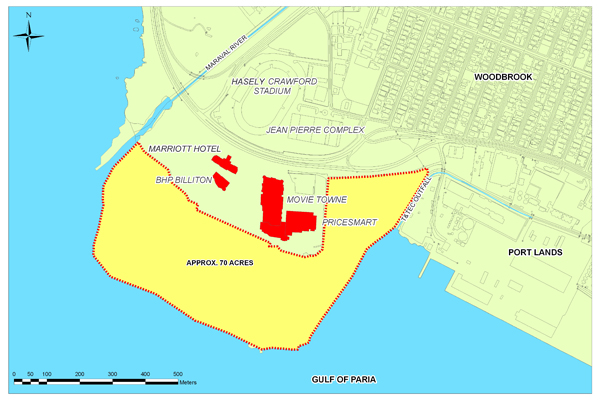
The Invader’s Bay lands are absolutely prime property – flat, waterfront land with easy access to highways and all the urban infrastructure of water, electricity and sewers. These are valuable public lands, with an estimated value of at least $1.0Bn.
That RFP invited proposals with a closing-date of 4 October, which is an entirely inadequate 6 weeks. The Joint Consultative Council for the Construction Industry (JCC) has taken a strong position against that RFP process, including writing the MPE and meeting with the Minister, Sen. Dr. Bhoendradatt Tewarie and Minister of Trade and Industry Stephen Cadiz, MP.
The JCC wants work for its members, but that must be after a proper process, it is not our intention to stop any particular project
The JCC wants a proper participatory process.
The first “official” response to our publicity was an article in the Newsday of Monday 3 October – ‘Cadiz: JCC jumped the gun‘, the leading point being that the government was trying to open-up the procurement process so as to invite suitable proposals.
Cadiz is reported to have said
…What the Government has done is asked interested parties for proposals for concepts,” he said. “I don’t see that there is any issue at all. There were proposals made and the Government felt that this is public land and we should open it up and we gave people six weeks, we feel that is enough time…
Public Procurement can be described as the process which results in the spending or earning of ‘Public Money’. Public Money is money which is due to or payable by the State, or any debts for which the State is ultimately liable. Therefore Public Money must include the contracts entered into by the State as well as the disposal, by sale or otherwise, of State assets. The Invader’s Bay RFP is the start of a large-scale Public Procurement process, since its stated intention is to lease land to developers who make ‘suitable proposals’.
The publication of the RFP and those statements all give the impression that a proper procurement process is underway at Invader’s Bay.
Nothing could be further from the truth. Let me explain.
The first step in the Procurement cycle is the ‘Needs Identification’. The two main questions in the case of Invader’s Bay would be –
For example, the answer to the ‘What’ question could be that the property would be used for recreation or parkland. The answer to the ‘Why’ question could be either for private profit or to create new recreational facilities as a ‘public good’, those being free facilities which increase the amenity of a district or city. The Brian Lara Promenade and the San Fernando Hill facility are two examples of that.
Without a Needs Assessment it is impossible to objectively assess what is a ‘suitable project’. To carry out a Needs Assessment, it would have been necessary for the MPE to have consulted widely with the public and stakeholders. The Invader’s Bay lands are in our capital and are about one-third the size of the Queen’s Park Savannah. My point being that any proper Needs Assessment must involve substantial public and stakeholder consultation.
There has been no consultation whatsoever. None.
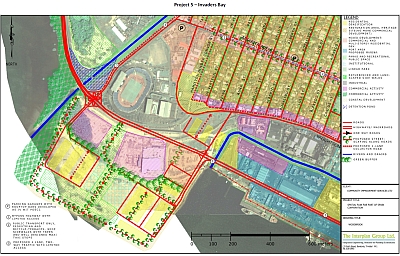
What is even more unacceptable is that the RFP, which was published by the Ministry of Planning & the Economy, is silent as to the 3 existing strategic plans for the Port-of-Spain area. The 3 plans are:
All of those plans paid for with Public Money. A straight case of – ‘nearer to Church, further from God’.
So, how are the proposals to be assessed? How will the decisions be made?
At para 3.5 of the RFP, at ‘Project Assessment’, we read –
“Proposals will be scored using the “Invader’s Bay Development Matrix and Criteria Description”.
We asked for that document when we met with the Ministers, but were told that it would be completed after the closing-date.
In the absence of these rules, how can developers know the ingredients of a winning proposal? Given that the evaluation rules are due to be completed after the closing-date, how can we be sure that this is a transparent process?
This could be an opportunity to demonstrate best-practice for public procurement, as promised by the People’s Partnership.
What is happening here is a recipe for accusations, blunders and confusion, just like in the previous decades of ‘old politics’. All the ingredients for corruption are present and that is why the JCC has made this call for the immediate withdrawal of this deeply-flawed RFP and its revision, after wide consultation.
We need to move away from the pattern of the biggest projects being set-up in secret , so that by the time the public gets to hear about it, all the vital details are fixed.
Expediency taking precedence over proper process has long been a costly constant in the governance of our society.
We must do better and it is not too late to do the right thing.
Expenditure of Public money – Accountability – Transparency = CORRUPTION

It is instructive to consider the criticisms of the JCC which were reportedly made by Cadiz.The headline accused the JCC of ‘jumping the gun’, implying undue haste and thoughtless speed. Cadiz is quoted as saying, “…I think the JCC jumped the gun,” he said. “If you cannot do it by six week then how long? Six months?”.
At another point in the same article, Cadiz is quoted as saying, “We need to get these things going,” he said. “The JCC only made representation of their disappointment four weeks into the RFP…” The implication being that the JCC were tardy and should have acted more swiftly.
If this Invader’s Bay situation were not so serious, it would be comical. The question in my mind is ‘Which of those explanations does Minister Cadiz believe?’
What seems clear is the hostility with which the Minister views the intervention of the JCC.
Discussion is revolving around the country’s earnings from our energy resources and the likely size of the next year’s budget, expected to be delivered in early October.
Given the fact that our energy resources are reported to be declining in both quantity and value, it is very important that we make best use of that stream of resources to both sustain the existing arrangements and create a new series of industries to replace those declining earnings.
In my view, our focus in this critical transitional period has to be on making best use of those limited tax dollars. Although that is an objective on which we can assume broad consensus, there seems to me to be far too little discussion on the ways in which that can be achieved.
When we consider that most of the capital expenditure in the country takes place via the State and its agencies, it is clear that proper control of that expenditure is key to making the transition for our society. The other parts of State expenditure are recurrent, such as salaries and rents.
The growth of corruption in State expenditure is a clear danger to good order and national development. White-Collar crime, as it is sometimes called, is a growth industry because there is almost zero chance of being detected or punished and huge rewards.
The danger to good order is the fact that merit has a declining role in the way State spending decisions are made. It is clear that other factors have become dominant – things like friends, family and political affiliation are now well-understood to be the ingredients of success in getting work from the State. That is the case for all political administrations so far in our country, but it must change if we are to make the transition to a sustainable economy in which different values and income sources take the lead.
The budget of the present financial year is the largest in our country’s history and it is true that the major part of that expenditure could be classed as exceptional items, having to deal with settling large debts of State Enterprises and the huge CL Financial bailout payments. The point here is that those huge expenses arose in situations with a distinct lack of transparency and accountability, from the lack of accounts at UDECOTT and HDC to the naked corruption of the CL Financial bailout, there is a pattern.
If there is no transparency and no accountability, there will be corruption and that is inescapable.
Public Procurement
Public Procurement refers to any expenditure or receipt of public money, which is money due to, or ultimately payable by, the State. That definition covers all the Ministries and State agencies as well as modern arrangements such as BOLT, PPP, concessions and so on. In the PP’s first budget, there were disclosed plans to spend almost $14.0Bn in the capital program of the Ministries and State Agencies. We need a proper Public Procurement system to manage these vast sums of money.
It is for this reason that the People’s Partnership commitment to implementing a new and effective Public Procurement system is to be welcomed. The JCC and its partners – the Chamber of Commerce, the Manufacturers’ Association and the Transparency Institute – have submitted a draft Bill for consideration of the Joint Select Committee established by Parliament.
Finance Minister Winston Dookeran made good on the PP’s pre-election promise to lay in Parliament the new Public Procurement proposals within one month of the election.
The level of political support for this initiative has been encouraging, but there is the issue of priorities to confront in this matter.
I am referring to the fact that the second part of the PP commitment to a new and effective Public Procurement system was that it was to have taken effect on the anniversary of the election.
That target has been missed and the work of the Joint Select Committee has been preserved so that it can proceed when the Parliament re-opens at the Waterfront.
The challenge we have to confront is the race to implement public projects in a manner which reminds me of the phrase I had coined for the last administration – ‘Project Fever’, like a new strain of political dengue.
The need to stimulate economic activity is something everyone appreciates and the perceived competition between Ministers is becoming part of the new reality. Provided that there are effective local content provisions, the more projects the country is doing, means more work for our professionals, contractors, workforce and suppliers. No one would argue against an increase in economic activity.
The problem is that, in the absence of proper controls, those short-term imperatives can lead directly to the dire long-term consequences which I referred to earlier. The State now has to spend immense sums to clear up debts which arose during an earlier spending frenzy, with operatives, who would have all said at the time that this or that project was essential.
These frenzied moments of activity are the correct place for the application of real leadership in terms of the national priorities, particularly in relation to the issue of expenditure. I am calling on Finance Minister Dookeran to make this issue of controlling expenditure a number-one priority in this budget.
Given that the ongoing flow of projects is strong and constant, a proposed program would look like this –
Without proper control over expenditure, we will continue to lurch from crisis to crisis. We need to stabilize the economy and restore the importance of merit in our public decision-making.
 State Enterprises were created to enhance the pace and quality of Public Procurement, yet they are now the scene of the most bedeviling paradoxes in the entire system of public administration.
Some of the key procurement issues which arise in this arena flow directly from the split character of the governance model.
The basic rationale for the existence of State Enterprises is they can be more effective because they are not bound by the strict rules which control the conventional civil service. The absence of those rules is supposed to allow more latitude in terms of hiring, borrowing and contracting. State Enterprises can hire professional staff at market rates, enter complex commercial arrangements and borrow on commercial terms, all of which should amount to significant improvements in public services.
The typical State Enterprise is owned by the State, with the shareholding held by the Corporation Sole, an exceptional legal creature which exists within the Ministry of Finance. Apart from its owner, the State Enterprise will sometimes have a ‘line Ministry’, which would be its sole or main client. For example, the Ministry of Housing & the Environment is the sole client of the Housing Development Corporation (HDC) and the Ministry of Education is the sole client of the Education Facilities Company Limited (EFCL).
State Enterprises can operate within the existing Companies Act or be established by a separate Act of Parliament, as is the case with the HDC. That legal framework ought to ensure that a satisfactory standard of corporate governance and accountability is maintained.
The fact is that many of the Directors and Officers of State Enterprises are political appointees, which puts the entire rationale onto a doubtful footing. Because the salaries and perks are so attractive, not to mention the commercial opportunities, the State Enterprises are prize targets for political appointments and favours.
Some of the main issues which arise when one is considering this sector are –
Proceeding along the Procurement Cycle and using the International Waterfront Centre (IWC) as an example –
As a result we have a completed project which is said to have been built on time and under budget, yet makes no economic sense and has a break-even point at some uncertain point in the future, if ever.
Some collateral damage needs to be noted, to quote one of the former PM’s notable phrases. Contrary to his statement to the Senate which is cited here, UDeCOTT did not publish its accounts since 2006, which is a breach of both the Companies Act and the Ministry of Finance guidelines. A total breach of the elementary norms of good corporate governance, which is the protection the private sector structure was supposed to give us taxpayers as a safeguard. Because of the political element in the operation, we can see clearly that UDeCOTT was carrying-out the instructions of the Cabinet and those Directors have not been punished or censured in any way, apart from their public dismissal. The consequence of those breaches being condoned at the largest State Enterprises – UDeCOTT and HDC – how does one get the smaller and less-visible State Enterprises to conform to good governance?
If the priest could play, who is we?
This is why we need a complete review of our procurement controls.
This special publication is dedicated to the important issue of Public Procurement. It is written by the a private sector group, headed by the Joint Consultative Council for the Construction Industry (JCC). The JCC consists of:
The private sector group consisted of –
The members of that Private Sector group were part of the Working Party on the Public Procurement White Paper, which was published in August 2005 and laid in Parliament the following month.
The Peoples’ Partnership’s manifesto, at page 18, commits to –
Procurement
- Prioritise the passing of procurement legislation and appropriate rules and regulations
- Establish equitable arrangements for an efficient procurement system ensuring transparency and accountability by all government departments and state enterprises…
In keeping with those campaign promises, the Minister of Finance tabled two legislative proposals in Parliament on 25 June 2010. Those were a Bill to amend the Central Tenders’ Board Act (originally prepared in 1997, when Ramesh Lawrence Maharaj was Attorney General) and the Public Procurement Bill (originally prepared in 2006, after publication of the White paper). A Joint Select Committee (JSC) was established on 1 October 2010 to examine those proposals, invite submissions and make recommendations.
The stated target of the PP government is to have the new Public Procurement legislation in place by the first anniversary of their electoral victory – i.e. by 25 May 2011.
Our Private Sector/Civil Society group reconvened last year and made a joint submission to the JSC in December 2010 – it is available here from the JCC‘s website. Our Private Sector group has had several meetings with the JSC – which was chaired by Education Minister, Dr. Tim Gopeesingh – but the results of those are not featured in this publication.
This special publication is intended to inform readers of the necessity for new Public Procurement legislation in our country and to set out the objectives of our proposals.
These are –
One of the most serious findings of both the Bernard Enquiry (Piarco Airport Project) and the Uff Report (UDeCOTT and HDC) was the extent to which the largest State projects were being executed outside of any normal system of accountability. The very purpose of setting up these companies and procurement methods was to bypass the Central Tenders Board. The natural consequence of that way of proceeding being that if the CTB could be sidelined as a deliberate act of public policy, then other important elements of the regulatory framework are violated as a matter of course. In the case of both UDeCOTT and NHA/HDC, accounts were not filed for years – since 2006 for the former and 2002 for the latter – in flagrant violation of the rules and laws.
These were the largest State projects – often described as being the flagship or centre-piece of this or that government’s policy – yet they were breaking the main rules and getting away with it. The ‘getting away with it’ is the cloudy part of the picture, because we never hear of any penalty being sought against those State Enterprise Directors who broke the governance rules.
But that is the very centre of the puzzle and we need to understand it before we can try to unlock it. So, we are told, time and again, that the only way to really get important and urgent projects done in the correct fashion is to go outside the rules. The stated reasons are that the old rules are too cumbersome, slow etc… and yet, we end up, time and again, in the same mess.
Some of the features of these fiascos are –
What all that tells us is that the existing rule-book seems to be blocking progress and the attempts to bypass it have done little better, if not far worse.
The dismal picture on public procurement is not limited to construction projects and can be found in all the other areas.
A new approach is needed and that is what is at the foundation of these legislative proposals.
Central to the new proposals is that any new Public Procurement system must be in full effect whenever Public Money is spent.
‘Public Money’ is defined at page 5 of our proposals as money which is either due to, or ultimately payable by, the State.
Our proposals are intended to form part of a financial management reform package to include for a National Audit Office and a Financial Management and Accountability Bill.
The intended move is towards a greater transparency and duty of care in terms of how taxpayers’ money is spent. Our citizens, particularly the unborn ones who will have to pay for some of the wasteful schemes which are littering the landscape, deserve no less.
The new equation confronting us is –
Expenditure of Public Money
minus Accountability
minus Transparency
equals CORRUPTION
We must fix that.
Our society is beset by large-scale corruption, which sustains wrong-headed decision-making. The wider social consequences of that toxic culture are now hatching, with a vengeance, in the naked violence and wily crimes which pre-occupy our head-space.
The killing-fields of East POS, the decimation of African urban youths, the URP and CEPEP gangs and the battle for turf are all part of this picture.
As long as our society continues to applaud and reward dishonest, corrupt behaviour, we will continue sliding downhill.
The structure of our economy is that most of the country’s foreign exchange is earned by the State in the form of oil & gas earnings. The rest of the society relies on the State and its organs to recycle those earnings for the benefit of those of us not directly engaged in the energy sector.
For that reason, the State casts a very long shadow in our country, far more so than in other places. Virtually every substantial business relies on the State and its organs for a significant part of its earnings. A healthy connection with the State is essential for good profits.
But that is where the particular problem is, since the conduct of the State and its organs is often found to be lacking in the basic ingredients of fairplay, accountability and transparency.
If the State is the biggest source of funds in the place and the State is not playing straight at all, a serious question arises – How can we hope to uplift our society?
The State has an over-riding duty to behave in an exemplary fashion in its policy and operations.
Due to its tremendous footprint, the State has to behave in that exemplary fashion if we are to move out of this mess. A positive shift in State conduct will have a salutary effect on the commercial culture and wider society, one that is long overdue.
We have a vast, expensive and confusing array of organs, all of which are authorized to spend our money. For a country of about 1.4M people, we have 26 Ministries. Just consider that the UK, with a population of about 65 million, has 19 Ministries and the USA, with a population of about 300 million, has 16 Ministries. For a Caribbean example, Jamaica has twice our population and 16 Ministries.
Quite apart from the number of Ministries, there are two further layers of agencies which also have the power to spend – our country has 73 Government Bodies and 58 State Enterprises.
Given the vast range of operations undertaken by these agencies, any new system would have to be flexible in order to cover all those types of transactions.
The main features of the new system
Three new independent organs will be created –
All expenses are to be drawn on the Consolidated Fund, with the Procurement Regulator and Advisory Council required to report annually to Parliament.
A vital part of our proposals is that Cabinet, Government Ministers or politicians are prohibited from instructing or directing these new agencies in any way.
They are intended to be entirely independent of political influence, which conforms to the proposals in the White Paper.
That freedom from political influence was also specified in both the 1997 and 2006 draft legislation.
The proposed system will create clear rights to make complaints or report wrongdoing. Those rights are an important aspect of any modern procurement system and we propose three types of complaints/investigations –
There are strict time-limits for acknowledgement and resolution of complaints.
Our proposal is for the Public Procurement Commission to have powers to punish both frivolous complainants as well as parties found to be in breach of the new system. Those can range from fines to embargoes, during which offending parties can be banned from tendering opportunities. Offending public officers can be subject to both fines and/or imprisonment.
One of the most frequently expressed criticisms is that as critics of the rationale and operations of significant State Enterprises, we seem to be proposing a new series of state-funded agencies. Some people have pointed out that these offices are unlikely to be cheap, particularly the PPC, which is to be constituted as a standing Commission of Enquiry under those existing legal provisions.
Yes, there will be new agencies and yes, they will cost money.
Given the recent revelations as to the cost of the Uff Enquiry – already estimated to exceed $50M – there are genuine concerns that we could soon have three new state-funded agencies which could absorb maybe $100M a year.
The challenge here is to move beyond the obvious and factual observations so that we can consider the decisive factors. Our proposals have the promotion of Value for Money as one of its founding principles and that is good for the public. So, how can we measure the value for money of these proposals, at this stage?
In the case of expenditures direct out of the Ministries, the 2011 Budget has an anticipated capital expenditure for the Ministries of $7.050Bn, as per para 8 at page 4 of the Public Sector Investment Program (PSIP).
Also in that Budget there is an anticipated capital expenditure for the State Enterprises of $6.725Bn, as per the Foreword at page 4 of the Supplementary Public Sector Investment Program (Supplementary PSIP). The combined figure of $13.775Bn is only for projects, so it excludes the salaries, rents and normal running expenses. Please note that other elements in public expenditure, beyond just capital projects, will be covered by these proposals. The guiding principle being that those activities involve the expenditure of Public Money.
There are very limited exemptions from the proposed provisions and those can be viewed at the JCC website.
I am also sure that there are other ways in which Public Money is being expended which are not shown in the national Budget, so the amounts are surely larger than that estimate.
The scale of the public transactions, involving Public Money, which will come under the control of this new system is huge, at least $14Bn in size. Even if the new system only saves 5% of that sum every year, we can easily justify an annual running expense in the $100M range, as mentioned earlier. 5% of $14Bn is $700M.
In the next 30 days, we expect our Legislators to make the crucial decisions on this series of proposals and we all need to be vigilant to preserve the key points.
Those key points would include –
The ultimate question, given what we know now, is – Can we afford not to take this step?
At this unique and challenging moment in what has been a long, twisted journey, the prospects of more corruption and waste are grim.
For these proposals to succeed, the legislators will have to vote in favour of a new law which reduces their power and discretion. To some, that might be an impossible contradiction and an unreasonable thing to expect, but there will be considerable political credit to the account of those who make this change happen. Our citizens deserve no less.
 AfraRaymond.net