The State of the Media

The recent series of changes at CNMG have sparked a series of evolving discussions.  I was one of the three people ‘let go’ from CNMG and that was reported briefly on my blog.

I am starting to reflect on some aspects of all this recent interest, but no, this not an anti-PP column or one about how wicked politicians are and so on.

What kind of talk is that?
The first thing that occurred to me is how the media conversation has blown up in sheer size and how that has had an effect on the quality of our national conversation.

In the so-called ‘good old days’, before the shift I am about to describe, the only people who really had a voice in our society were those who were approved, such as government ministers and their spokespersons, established journalists, the ‘great and good‘ and of course the brave and imaginative ones who were our activists.  In fact, the last-named group were the voice of the voiceless, who fought to uplift our society.  Of course in that group you would have to include the leading calypsonians and ‘troublemakers’ of their era.

From its beginnings about 20 years ago, we have moved far from the post-independence period in which the voices heard on the national media of Radio and TV were very limited.  The NAR regime 1986-1991 decisively brought that to an end with the grant of more broadcast licences and the real birth of ‘talk radio’.  TV call-ins soon followed and of course, the internet/email broke onto the scene in the mid-1990s.  The final stage in this progression is the growth of new-wave social media – such as Facebook, YouTube, Twitter etc. – to the point where they have now eclipsed the older formats like web-pages.

As a result of all that, we now have many people, who never had a voice as individuals, being able to project their ideas onto a huge stage.  That is literally unprecedented.  The new conversation has opened up serious new challenges and opportunities.

One of the most detrimental of our habits is mauvais langue – just plain bad-talking people behind their back, but not showing it when you meet those same people.  As young people would say – Pure hate, just acting normal.

I hold the view that mauvais langue is the biggest cultural obstacle to our development as a nation.  I say that because it is my view that without an open exchange of ideas, the possibility of change is very limited.  In this new situation, someone can add a mischievous or irrelevant comment to the discussion, without ever identifying themselves or backing-up what they are saying.  As a result of those possibilities and its combination with our habits, we now have most of our blog commentators and callers-in choosing to remain  anonymous.

But what are we saying to each other?  The essential message of a large number of the comments on these T&T blogs boil down to ‘Shut Up…I don’t agree with you and don’t want to hear what you have to say…Go away!‘  Our new national conversation is on a huge scale and on a range of issues which is extremely fertile, but the dominant habits of that conversation are perturbing.

To be fair, there is a solid body of research to show that anonymous conversations of this type are extremely effective at finding-out the views of the public, workers or customers.  Indeed, this social media is now a very important part of how progressive states and corporations take their bearings as to where things stand.

One important difference I have seen is that the blogs for newspapers and news-sites in the advanced world have almost no anonymous content – people actually write as themselves.

opm websiteMore to the point, we have a situation where we have embraced the new situation and its possibilities, while our leaders and organisations lag far behind.  Just as an example, the website for the Prime Minister is http://www.opm.gov.tt/ – the last officeholder had no publicly-available email address and that website is now temporarily offline, being under re-construction.

There is also the secondary aspect of all this, the essence of our commitment  to a free press.  Of course, I am talking about the silence of Newsday – ‘The People’s Newspaper which offers daily news from Trinidad & Tobago’.  There was a huge response to the news on Monday 8th November, that Fazeer Mohammed was removed from CNMG’s morning line-up.  I think that article in the Express of the next day had over 825 comments – which must be some kind of local record. It is staggering to me that Newsday had nothing to say about this, until the Thursday after, even as a pure item of news. Just unbelievable.

It is easy to criticise the politicians and their mistakes, but this silence by Newsday is just another level of irresponsibility which would make any right-thinking person pause. Newsday have their own patchy track-record in that they forced-out Kevin Baldeosingh over his challenge to Fr. Henry Charles for plagiarism. The parliament discussions on Friday 12th and the news releases from both the Media Association of Trinidad & Tobago (MATT) and the Congress of the People (CoP) formed the basis of articles on the issue from Thursday 11th. Given that behaviour it is interesting to watch them, as The People’s Newspaper, minimizing a matter of such great concern to so many people. A matter concerning an apparent threat to freedom of the press.

We have to be honest and admit that a significant part of the national conversation is the impatient snarl to ‘shut-up’ the person we do not agree with.  That tendency has borne some strange fruit in the case of Newsday and Fazeer.

Yes, I think Fazeer was forced-out too – given his popularity, it all seems very wrong-headed to me. At several levels, but the pregnant question here is how come the State owns companies which are in competition with private ones.  The notion of the State Enterprise was originally one which performed some specialist task which the private sector did not provide, but the discussion is an involved one.

One of the criticisms of our State Enterprises is that in significant cases, they they are in competition with private business interests.  For example, First Citizen’s Bank, Udecott, HDC, EFCL and so on.  Of course the closest example of this is CNMG.  Ironically enough, the Special Purpose Entities/State-owned sector were the topic of my last show on CNMG and we did discuss this issue of competition.

So, exactly why does the State own CNMG?  How fair is it for the other media houses to have to compete with a State-funded entity?  In my view, CNMG had established a solid reputation as a topical and fearless current affairs and news source.  Of course, all of this is going to damage the brand, so its private sector rivals would be smiling to themselves.

Returning to one of my earlier discussions on the ‘Two Tendencies‘ – published in this space on 16th May 2010 – it seems clear that these are a big part of this story.  The first tendency is to say that our State Enterprises are too important to be run by anyone but the best people.  The second tendency says that, having won an election, all these bodies are ours to command and that is all.  The second tendency can distort good sense and professional standards to the bizarre extent we saw in the Udecott case.  This case of the Fazeer Mohammed ‘re-assignment’ is definitely one in which both tendencies have battled it out on the blogs and the airwaves.

It is unlikely to be settled anytime soon.

The big questions for me are –

  1. Which of the Two Tendencies is in control?
  2. How committed are we to a conversation with people who hold different views?

Termination of services

CNMG termination letterThis is the letter CNMG sent to discontinue the two programmes I was contracted to do with them – a weekly editorial on Friday mornings and a one-hour current affairs program on alternate Sundays .  It was FAXed to me at 16:13pm on Thursday 4th November, but backdated to 1st November.

So, let us see…

  1. Ingrid Isaac, the former CEO was said to have ‘resigned’ on Wednesday 27th October – the same day Ken Ali is said to have started as Interim CEO – see CNMG’s version of events here – http://www.ctntworld.com/LocalArticles.aspx?id=24248
  2. I was ‘discontinued’ on 4th November and
  3. Fazeer Mohammed was re-positioned/offered a new position etc on 6th November…
Ken Ali

All to say that nobody was fired, is just that a number of people are no longer there, but no one was fired and more to the point, I see a report in this morning’s Express newspaper that Ken Ali said “I really have nothing more to say to the media on this matter.”  I could scarcely believe what was on the page before me and hopefully there is a misprint.

Ken, please do confirm to us that you did not say that…

CL Financial bailout: A Season of Unreason

We are now entering a bizarre endgame in this rounds of musical chairs.  The children’s game has returned for us adults, but with a vengeance.

As I wrote on 10th September in this space, the real question is ‘When exactly did the CL Financial group collapse?’.

To understand this huge matter we need to put things in the correct order –

  1. Firstly, the CL Financial chiefs left others holding the risks.  Some dates and names, to support the theory –
    •  L.A. Monteil – retired at the end of March 2008
    • M.A. Fifi – retired in August 2008
    • Robert Mayers – retired in December 2008.

    What did they know and when did they know it?

  2. Secondly, there was a series of large-scale, rapid withdrawals of funds which preceded the start of the bailout.  That pattern of activity would have speeded-up the collapse.  It would be very interesting to see details of who broke their deposits and failed to ‘roll-over’ in that crucial final stage.
  3. Thirdly, post-January 2009, we have the massive payout of State funds, as detailed in the Guardian editorial of 25th October.  Who was the recipient of those funds?  Who benefited?  On 1st October, the Prime Minister promised to publish that list and we await with interest.
  4. Now, with the PP government taking the decision to review the bailout process, we have entered a truly bizarre stage of this matter.  This is the part where all those trusting people who were told to wait and have faith, are realizing that the people in the know have already withdrawn and secured themselves.  Some of those people in the know were the same ones who were telling the faithful to keep on waiting.  What a thing.

There now appear to be at least four groups representing these investors –

  •  The Clico Policyholders’ Group (CPG) – which is the most visible one with Peter Permell, Manny Lawrence and Norris Gomez etc.
  •  The Clico Policyholders’ Protection Association (CPPA), which is the one with Harold Sookhan and Ramesh Lawrence Maharaj.
  •  South Action Group – with Solomon Hem Lee
  •  Denbow Group – a small number of Clico investors who are being represented by Dr. Claude Denbow SC.

Some of the positions being taken by the various groups are indicative of the degree of desperation of the parties, hence the title of this article. The general view emerging from these groups seems to be that the CL Financial group is basically healthy and profitable, so there should be no issue about returning their investment. 

I do not know what those views are based on and it is impractical to continue basing our discussions on the series of rumours and draft reports and suchlike.  We need good quality information to make a quality decision and that is not negotiable.  We need to insist on that as a minimum.

After the first round of organizing and attorneys’ letters, followed by the Prime Minister’s important address on 1st October, we are now into what appears to be an even stranger place.

Two of the stranger proposals emerging from the CPG’s Port-of-Spain meeting on 24th October were –

  •  Prem Beharry of the CPG was reported in the Trinidad Guardian to have said – “…Ryan ALM are saying they would take US$600 million and would convert it to the best debt instrument in the world which is US Treasury Bills,” Beharry said.
    “The Ryan ALM group is saying, within three months if they are engaged, they would be able to sell those bonds and get in cash of US$1.8 billion which is equal to the debt of TT$10.5 billion—that money would be used to pay all the policyholders…” That is literally too good to be true.  It is the same approach that created this mess in the first place – both at the CL Financial group and Hindu Credit Union.  It seemed to me that the CPG was recommending that the government put $600M USD of our taxpayers’ money into this scheme.  Yes, I said scheme.  Maybe if it was really so good they should have just accepted the discounted rates being offered in the budget and invested those funds with Ryan ALM.  After one time is really two times, yes.  I recently read that one Prem Beharry was appointed to the National Gas Company Board. 
  •  Another proposal, this one reportedly stated by Peter Permell, the CPG’s most prominent spokesperson was for the state to pay 40% immediately with the balance being payable in 5 to 7 years.  The persons waiting for delayed payments would earn interest of 4-4.5% on those unpaid balances and also be entitled to a 51% share of any uplift in the value of sold assets.  No, there was no proposal for those CPG members to share in any losses if assets had declined in value.

It may all just be a series of negotiating positions, but it seems pretty clear that no one from these various investors’ groups intends to take a discount or ‘haircut’ on the monies owed to them.  The unstated assumption is that if someone has to stand the bounce or take a haircut, that someone must be the taxpayer.  That could never be the correct position.  So, we need the facts.

The most startling development is the Central Bank’s full page adverts on Thursday 28th October, repudiating the claims that it had offered any guarantees in this situation.  The reaction was immediate, with the CPPA publishing large adverts in opposition the next day and a new anti-bailout group emerging for the first time – at last!  The CPG’s response was a nadir in their campaign, with the Trinidad Guardian reporting that – “…Permell went on to say that they do not care where the Central Bank gets the money from once they guarantee the policyholders’ contracts…” – I could scarcely believe what was on the page before me.  Even the most militant Trade Unionists use more reasonable language.

Which brings us right to the meat of the matter, the order of things.  What is the reason that the investors’ groups are now at the front of the line for assistance from this government?  I could be wrong, but it is easy to get that impression when one hears of Cabinet discussing the matter twice in one week, certain groups giving threatening timetables and so on.  I do not know if our Cabinet – PNM, UNC or PP – has ever given such a total priority to any matter in the past.

There are other claims on the limited monies available to the State.  All of those claims existed before these investors groups.  All.

Many people have poor water supply.  Outstanding payments to contractors and suppliers are in excess of $7.0Bn, according to Central Bank estimates. Insufficient money for OPVs – the estimated cost of $3.0Bn is too much for the country to bear, so national security is falling behind.  More guns and drugs entering our homeland.  Public Servants claims are about $3Bn and that is also a strain on the Treasury.  Not enough police cars.  Sad situation in the public hospitals.

The CPG issued a 2 page advert in the Guardian on Thursday 4th November and it deserves careful reading.  It was good to see their call for the publication of the correct financial information before making a decision.  They set out their proposals for the relief of CPG members – those are the latter of the two above, with the added condition that they be given two seats on the boards of CL Financial and Clico.

The CPG claims that its proposals place no additional burden on the taxpayers, which is a good thing, if that is truly so.  The CPG’s proposals are silent as to how the monies already spent are to be recovered.

The real test will be if the accounts and asset valuations reveal the group to be insolvent.  Will the various investors’ groups accept that or are we in for a long, bitter fight?

SIDEBAR: The Commission of Enquiry

The Attorney General recently announced that he had withdrawn Sir Gavin Lightman QC as the sole Commissioner, due to an apparent conflict of interest.  Lightman had appeared for Clico in a 1991 court case and the PNM did well to have stopped this before it went too far.

Two important further points, though –

  1. Firstly, this is the second such occasion.  In the first case, the Commission of Enquiry into 1990 was announced with retired Appeal Court Judge Mustapha Ibrahim as its chair, until he pointed out that he too had a conflict of interest.  There needs to be some more care taken on this count.
  2. Secondly, the terms of reference need to be qualified, since the AG was reported to have said that “…The COI, he said, covers CL Financial, Colonial Life Insurance Company (Clico), Clico Investment Bank, British American Insurance Company and the HCU…” Having been frustrated in my efforts for the past fortnight to get confirmation of the Terms of Reference from the AG’s Ministry, I am forced to rely on press reports.  Question being, why is CMMB being omitted?

CL Financial bailout: These Turbid Times

Last week I wrote about the Code of Silence observed by our ruling class.  I gave examples to support my idea, but there was not enough space to mention everyone.

The Bankers Association of Trinidad & Tobago (BATT) and the Association of Trinidad & Tobago Insurance Companies (ATTIC) are also part of the situation.
We have a long history of our rulers making huge, stupid, destructive decisions without any commitment to transparency or accountability.  That lack of transparency is what allows corrupt to flourish.  We can never eliminate corruption, but if we are serious about reducing it, we need to proceed differently.

Maybe, just maybe, this is the kind of colossal event which could force some of us to drastically change our ways, despite the positions we now assume.  This is a moment of national peril and the continued observance of the Code of Silence is going to cost our country plenty money.

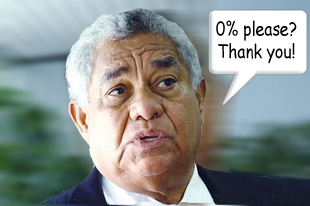
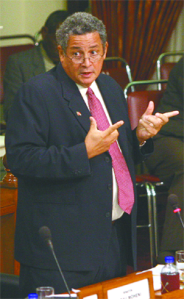
lawrence dupreyAs it is, we already have been bound to a rotten bailout of the wealthiest individual in the Caribbean by our Treasury at ZERO interest.  Anybody looking to set up a small business has to face the bank and pay interest. None of that for Lawrence Duprey and the CL Financial chiefs.  They have been able to enrich themselves and when the entire thing went wrong, they were able to negotiate a handsome handshake for themselves and then leave the mess for our government to clean-up.
That is the plain meaning of the bailout.  Is not policyholders we bailing-out, is the richest, smartest characters in the country.  The bailout script is unfolding so well that almost the entire discussion is now about the fairness/unfairness of the government’s position with respect to retired policyholders etc.

Real Anansi antics.

The CLICO Policyholders Group (CPG)
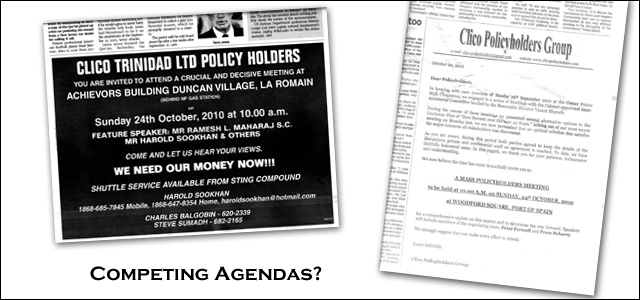
Competing agendas?There was an EFPA group and a CLICO Policyholders group formed just after the budget on 8th September, but they soon merged under the latter name.  I am now seeing what appears to be a substantial split with 2 competing meetings being organised for 10am today – one in Port-of-Spain and the other in San Fernando.

The CPG group has been very successful at getting their views known and making the media circuit, with the eventual meetings with the advisory group set up by the PM.

The main concern being advanced by the CPG is for the recovery of the funds deposited with CLICO and there has been no reply whatsoever to the point that, despite its labelling, the EFPA was largely sold and understood as a deposit.  The accounting rule of thumb as to ‘substance over form‘ in interpretation is an irrefutable part of the debate on this, but CPG have been silent on this point.

Almost all the many people with whom I have discussed this issue, have been very plain in their language – ‘I had my money deposit with CLICO‘ and so on.  But the word Policyholder is more likely to attract sympathy, so the games continue.

We already spent $7.3Bn in cash since the bailout was announced.  Please note that nobody is even talking about how the State is going to recover that loan.  The only talk is about how are they, the depositors, going to recover their monies.

There is a real principle of financial equity being shredded to pieces in the conduct of this bailout and it was disappointing that Mr. Dookeran, as an Educator in the field, did not take the opportunity to expand on this.

The intent is plainly to deprive the Treasury of its limited funds so that the assets of 15,000 people can be preserved.

So, What about those negotiations?

Sen. Vasant Bharath
Sen. Vasant Bharath

When the Prime Minister spoke on 1st October, she created an advisory group (headed by Minister of Food Production, Vasant Bharath)  to meet with the policyholders to seek other options.

The Prime Minister was to meet with concerned persons and activists on Wednesday 7th October in Chaguanas, but that meeting was cancelled at short notice, with no alternative dates given.

What we are left with is lengthy, secret meetings to discuss the review of the bailout terms, with no concrete information emerging.  That secrecy is totally unsatisfactory.  It smacks of secret deal-making and does nothing to inspire the confidence which is supposedly the very purpose of this exercise.

The last regime, with all of their noble intentions and devout Ministers, lost their way in a morass of muddled purposes, secret deals, mixed-up with misleading and false public statements from the highest office in the land.  We all know how that ended.  The question is whether we have learned anything from that bitter experience.  The Peoples’ Partnership were the main beneficiaries of those PNM errors, have they learned from that?

Our money is being spent on this massive exercise and it is not good enough to emerge from these closed meetings with agreed phrases like ‘constructive or meaningful’.  This emerging pattern speaks of disrespect for the acumen of our people.

To re-state my equation:

Expenditure of Public Money – Accountability and Transparency = CORRUPTION

Imagine these bold-faced people declaring that when they are done and settled, the terms will be announced to us who paying for the whole thing.  The first sign of a bad marriage is when the husband is the last to know – some say, the wife.  But the main point is that the public cannot be the last to know.

The simple and painful fact is that public confidence in our leaders is at an all-time low.  The time-honoured notion that a leader is someone wiser, more mature, less reckless and  of overall higher ideals has been tested to destruction by events.  In this particular case, it is easy to understand the charged atmosphere, hence the need for extra ventilation and transparency.

I was recently emailed by a well-meaning group asking that I start setting out some ideas of how CLICO might be rescued and I had to remind them that without basic information, all we can do is argue emptily with each other.  All to the amusement of the masterminds of this, the greatest economic crime in our nation’s history.

I was even ‘phoned, while writing this, by an acquaintance who is a leading member of the CPG to join him and an un-named UK guest in a TV studio on Monday morning to discuss all this.  Yes, I dismissed the request – too much secret-thing for my taste – and challenged the caller to name the person, supposedly a top UK expert.

What would be ‘constructive and meaningful’ would be to publish these long-outstanding reports so that we in the public can inform ourselves on the vital issues –

  • The original Duprey letter of 13th January 2009.
  • The audited accounts of the CL Financial group for the years ending 31st December 2008 and 2009 – Have PwC completed that?  When are they to be published?
  • Wendell Mottley, Colin Soo Ping Chow, Steve BideshiThe Mottley Report – There was a team of three advisers – Wendell Mottley, Colin Soo Ping Chow and Steve Bideshi – appointed to examine the CL Financial group and we need to know what were the findings of this group.
  • Given that we are being asked to bailout and clean-up Mr. Duprey’s crisis, I feel we need to be told  the names and details of those who benefitted from the $7.3Bn paid out so far, as well as those details for the borrowers of the $1.0Bn of ‘non-performing loans’ in CIB’s portfolio.
  • Finally, we also need to have the position of the CLICO Policyholders’ Group published.  What exactly are they claiming?

We have seen reports in the press about the very long Cabinet meeting on Thursday 21st at which the CLICO issue was said to be part of that agenda.

It would be totally unacceptable for a deal to be sealed without properly informing us, the taxpaying public, as to the true background.

The People’s Partnership has already distinguished itself, positively, by announcing Commissions of Enquiry into the attempted coup in 1990 and the Financial collapse (CL Financial and HCU).  This is no time to get diverted into back-room deals.

I am working for betterment and from you, our elected rulers, I expect better.

Barbados Free Press spreads the word for AfraRaymond.com


Code of Silence was an article in two parts – the first dealing with the agents and effects of that Code and the second dealing with the unfolding case of AIC.

As usual, I sent the article to my main blogging-collaborator Barbados Free Press (BFP) who split it apart into those halves. Maybe they felt that the bond default by AIC Barbados in the second half deserved a separate focus for their readers – who knows?

So, BFP published Code of Silence surrounds CL Financial bailout on Saturday 16th and Michael Lee-Chin’s AIC Finance – Another CL Financial CLICO situation in progress? on Monday 18th.

Later that day, the AIC story was picked-up by Forbes.com and that story is here, Forbes picks up Barbados Free Press news feed!

CL Financial bailout: The Code of Silence

Throughout this series of articles on the CL Financial bailout I have touched on the existence and effect of a Code of Silence amongst our ruling elite.

This is sometimes called the Information Age, with the latest news and ideas being ‘pinged’ or ‘tweeted’ across the Social Networks.  The new reality demands a complete shift in our attitudes to information.  Our leadership class has blatantly refused to share their information and insights at moments of crisis, which shows the challenge facing us if we are to progress.  Just to give two examples, think of the many secret reports from all the Commissions of Enquiry before the Uff Commission and the steadfast refusal of our political leaders, for many years, to even consider a Commission of Enquiry into the Coup.  It is widespread and literally sickening to all right-thinking people.

We have had a new start and some reason to hope for change, by the PP government’s appointment of Commissions of Enquiry into the 1990 Coup and the financial collapse (CL Financial and Hindu Credit Union).

Even now, alongside those hopes, the new government has still not published the Bernard Report into the Piarco Airport Project.

Despite the progress, we cannot be complacent, the slope is slippery and the stakes are high.

The Code of Silence is deep and powerful in the case of the CL Financial bailout.

On 3rd October, I set out a few of the failures on the part of the regulators.  Those failings are real and serious, but sometimes a shift in focus can be beneficial.

If we look beyond the legally-empowered regulators, there are other informal ‘regulators’ upon whom society relies to make decisions.  Those would include Civic Society Organisations, Trade Unions, Institutions of Higher Learning and Professional Bodies.  Society has been able to rely on these because they are seen to represent collective knowledge and insight, rising above individual interests to attain broader perspectives.

Those bodies, with one notable exception, have been silent throughout this CL Financial fiasco and have failed the broader society in this colossal matter.  I am being forced by these events to re-examine my fundamental assumptions on the degree of our reliance on these bodies.  This is the real nadir of corruption, when we seem to have lost our way in the long grass and we not even talking about the politicians and so on.  This one is not about them.  It is about us and our feet of clay.

Let me explain –

  • Law AssociationThis is one of the leading Professional Bodies and their silence has been deafening.  The President of the Law Association is former Independent Senator, Sunday Express columnist and eminent Senior Counsel, Martin Daly.  Daly is widely regarded as a fearless and irreproachable voice on many matters.

    The tangled web in this CL Financial bailout has included early withdrawals, overlapping Directorships between depositors and bankers, payment of dividends after asking for state financial assistance, misleading negotiating positions taken by the CL Financial chiefs, a huge zero-interest payout to the CL Financial chiefs which left their shareholdings intact, attempts to sell assets in breach of the MoU.  Most of all, the serious and inescapable conflict of interest of the then Minister of Finance, who is an attorney – every single attorney I have spoken with agrees that this was a clear case of conflict of interest.

    Yet, not a word from the Law Association.  Am I alone in expecting any better?

  •  

  • Institute of Chartered Accountants of Trinidad & Tobago (ICATT)The entire collapse is shot through with a failure of accountants at several levels and yet this professional body has been silent on all this.  After ignoring my open letter and other attempts to start some dialogue on this, Anthony Pierre, ICATT’s President, agreed to appear on a TV interview with me on CNMG.  That interview was broadcast on Sunday 26th September 2010 – it can be viewed at http://wp.me/pBrZN-qW – in the ‘Sunday Morning Politics’ slot.  When I put the question to him as to the errors and/or omissions of the professional accountants in this huge collapse, Pierre took the position that there was no cause for concern. I do not accept that position, but of course the Commission of Enquiry and hopefully the publication of those long-overdue accounts will shed some more light.
  •  

  • University of the West Indies (UWI)There has been very limited engagement from UWI on this matter, which is a pity when one considers that the areas of study there include economics, finance, law, business management and accounting.
    Of course, the former Campus Principal and now Director of UWI’s Institute of Critical Thinking is Dr Bhoendratt Tewarie, who was also a member of CL Financial’s pre-collapse Board.  That is the same Board which approved payment of a dividend 3 days after CL Financial’s Executive Chairman wrote to the Central Bank for urgent financial assistance.  Dr Tewarie is also reported to have been at the final Annual General Meeting of CL Financial, held at Trinidad Hilton on 23rd January 2009.  The timing couldn’t be better for a report to shareholders – after all, the Central Bank had been written to 10 days before, the dividends approved a week before and the bailout itself was just 7 days away.  So what happened at that AGM?  Were shareholders given an honest report from the custodians of their capital?

    The late Professor Dennis Pantin did write several times on the CL Financial collapse and bailout in his Sunday Guardian column.  Dennis made the early call for a Commission of Enquiry into this entire mess and that has now been acted upon.

    Sen. Patrick Watson
    Sen. Dr. Patrick Watson
    Another UWI figure in the whole mess is Dr. Patrick Watson, who is Professor of Economics and Director of the Sir Arthur Lewis Institute for Social and Economic Studies (SALISES).  Professor Watson is a government Senator in the current Parliament, who after maintaining his silence on this economic catastrophe since January 2009, has now become most vocal since the budget speech.

    Is a straight case of nearer to Church further from God.

  •  

  • Trade UnionsThe two groups which one can normally expect to have a public position on these long-term, large-scale issues are the Oilfields Workers’ Trade Union (OWTU) and of course, the Federation of Independent Trade Unions and NGOs (FITUN).  Neither of those bodies rose to the challenge and we are the poorer for it.
  •  

  • Trinidad & Tobago Transparency Institute (TTTI)Yes, the TTTI did make a strong statement calling for improved accountability in the bailout process.  That is a Civic Society body doing its job.

What really happened?
But apart from us in the Civil Society, there is another level of the Code of Silence being practiced in that some of the very people who were in charge of this huge crash have rejoined public life, saying nothing about the crash.

They have been recycled.  Yes, I know that recycling is good, but this one is toxic.

Caribbean Money Market Brokers (CMMB)Robert MayersRobert Mayers was the former Managing Director of CMMB, who retired on 8th December 2008 – see http://legacy.guardian.co.tt/archives/2008-12-09/business2.html – which is less than two months before that company collapsed.  Mayers is a most articulate and willing public speaker, who was recently discussing the national budget on the electronic media.
We have heard nothing from Mayers on how the collapse presented itself and there is no concerted attempt to pass on any lessons learned to a younger generation of citizen.

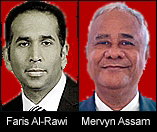
Clico Investment Bank (CIB)Faris Al-Rawi and Mervyn AssamCIB was chaired by Mervyn Assam, recently appointed as a Special Ambassador with responsibility for Trade and Industry.  Faris Al-Rawi, attorney-at-law, was a Director on that Board and he is now a PNM Senator.

Neither man has made any attempt to publicly explain CIB’s shocking insolvency, which was estimated by the Central bank to be of the order of $4.7Bn.

All those people appear to have been anointed, in what must have been a private ceremony, then re-presented as ready to serve.  We deserve no less than a proper explanation from these Directors and Officers and I was pleased to see PNM Senator Penelope Beckles recently joining me in calling for them to be questioned publicly.

The case of AIC Finance
Ian Narine, writing in the Business Guardian on Thursday 14th October – http://guardian.co.tt/business/business-guardian/2010/10/14/there-enough-everyone – attempted to point out the way he had tried to warn the investing public on the perils of CL Financial.  That column made interesting reading, but what would be the position of the press if any such situation were unfolding right now?
Just as an example, AIC Finance is owned and run by the Jamaican billionaire, Michael Lee-Chin, who came in for mention in Anthony Wilson’s 15th October 2009 BG View ‘Will Lee-Chin avoid Duprey’s fate?’ – see http://guardian.co.tt/business/business-guardian/2009/10/15/will-lee-chin-avoid-duprey-s-fate.  I commented on that in the Trinidad & Tobago Review of 2nd November 2009 in ‘Duprey’s fate’ – see http://wp.me/pBrZN-43 or http://www.tntreview.com/?p=887 and the points are once again pertinent.

AIC Barbados, the regional holding company for the group, defaulted on a USD bond in 2009 – in other words, they were unable to pay their debts – see http://guardian.co.tt/business/business/2009/06/06/lee-chin-late-us47m-bond-payment or http://www.jamaica-gleaner.com/gleaner/20100818/business/business1.html.

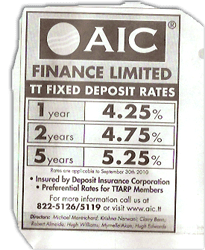
AIC advertIn the last part of September, AIC Finance has been advertising surprisingly high rates of interest in daily newspaper adverts which also offer ‘Preferential rates to Trinidad & Tobago Association of Responsible Persons (TTARP) members’.
COMPARISON TABLE for 12-month fixed deposit rates for amounts up to $500,000 as at 30th September 2010

Financial Institution Range of interest rates
First Citizens’ Bank 1.25% to 2.1%
RBTT 0.2% to 1.45%
Scotiabank Up to 0.75%
Republic Bank 0.30% to 0.75%
Unit Trust Corporation (Money Market Fund) 2.15%
First Citizens’ Bank Abercrombie Fund 1.90%
Fidelity Finance (part of the Maritime group) 1.8%
AIC Finance 4.25%

If CL Financial could not sustain this strategy, how can AIC continue to offer these rates in today’s market?

That is the question.

According to recent press advertisements, the Board of Directors of AIC Finance Limited comprises –
Michael Montrichard
Krishna Narwani
Clarry Benn
Robert Almeida
Hugh Williams
Myrnelle Akan
Hugh Edwards

Further details are at http://www.aic.tt/page.asp?page=Board+of+Directors

A version of this commentary appeared in print on October 17, 2010, on page A31 of the Sunday Guardian.

CL Financial bailout – Closing the circle

Inquiring What Went Wrong. Illustration by NiCam GraphicsAmidst the raging debate on the rights of the disappointed depositors versus those of the anxious taxpayer, I am continuing to examine some more of the fundamental issues. Yes, I accept that there are depositors amongst the taxpayers, but those interests are not in alignment, hence the discussion.

By making a legislative proposal to frustrate the CLICO Policyholders Group (CPG) litigation, the government seemed to have conceded the merit of the protestors’ case. Those proposals have now been withdrawn and on Friday 1st October, the Prime Minister gave an extensive reply to the CPG. The strategic decision seems to have been to retreat from the narrow corridors of legality and strive for the broad perspectives of the entire nation. The apparent decision is to favour an act of persuasion over one of sheer power. Given our norms of governance in these parts, that is no small shift and it is a welcome sign, quite apart from my agreeing with the stance taken.

Most importantly, the Prime Minister announced a Commission of Enquiry into the collapse of both CL Financial and Hindu Credit Union (HCU).

Once again, I am going to refrain from discussing the legal issues, despite the tempting developments in this aspect of the matter. I am going to keep deepening this discourse so that we can have a better quality of discussion

What was the EFPA?

Firstly, it is necessary to spend a little time on the true nature of the Executive Flexible Premium Annuity (EFPA), since that product is what the majority of this dispute is about. The product was approved for marketing by the Supervisor of Insurance in 1990.

An annuity is an investment product for an individual, to save for a specified future expense by means of periodic payments. CLICO had an approval for a Flexible Premium Annuities, which was attractive to those people who had fluctuating incomes, but soon led to the sale of Single Premium Annuities. Those are investments in which the investor pays a single premium and receives the benefits after CLICO had held the funds for a short term.

So the single premium can be viewed as a deposit, which is what many of the agents called it. While the annuity, traditionally a long-term investment product, then assumed a norm in which most EFPAs were held for 5 years or less.

In saying so, it is interesting to consider the question of just how an organisation can purchase an annuity, which is an investment product for an individual. The fact that so many organisations did so, does damage to the notion that this EFPA was sold in conformity with its true nature.

So, in summary we have an approved annuity, which is mainly sold as a single-premium, short-term, high-interest investment product to anyone who wants one, including Credit Unions, private companies – several CLICO agents tried, repeatedly, to get deposits from our firm – and State-owned corporations. At some point that annuity morphed, by this series of changes, which seem, to me at least, to have fundamentally altered the character of the approved instrument

All of which returns to the basic accounting principle that when one is trying to interpret a situation such as this, the correct procedure is to be guided by the substance rather than the form of the transaction. That is the background to my assertion that the correct interpretation of the EFPA is as a deposit.

When you consider the very high interest rates offered and the unique way that CLICO altered the EFPA, one has to wonder how the regulator viewed these activities. But more on the regulators later.

What did CLICO become?

Even beyond the changes which the EFPA underwent in the hands of CLICO, the reverse was also to take place. That happened because CLICO changed the EFPA to suit the strategy of its parent company, CL Financial, but the parent group (and ultimately CLICO) in the end were irreversibly changed and then destroyed by the EFPA’s success. Let me explain –

In our system, there are 3 species of financial institution –

  • Banks and other Financial Institutions (approved as Deposit-taking Institutions by the Deposit Insurance Corporation);
  • Insurance Companies and
  • Credit Unions.

CLICO’s liabilities, as stated by the Finance Minister, were $6Bn to traditional insurance policyholders and $12Bn to depositors. The question being, given that two-thirds of their liabilities are non-insurance, how could it be legitimate to consider CLICO an insurance company? More to the point and looking forward, where does a company like CLICO fit into our regulatory framework? That is an important aspect for us to consider for the future of our financial services market.

What were the Regulators doing?

The Regulators! Coulda, Woulda, Shoulda!That is the burning question at this time and a large part of the blame for the CL Financial collapse must lay with the regulators.  In this case it seems that the Governor of the Central Bank and Inspector of Financial Institutions both have serious questions to answer.  The situation is really too much to even imagine, but a few examples –
  • The Governor repeatedly stated his doubts on the stability of the CL Financial group, yet admitted later, in a written statement – see http://www.central-bank.org.tt/news/releases/2009/mr090204.pdf – that he had deposited money at CLICO Investment Bank (CIB).
  • The Governor stating his strong disapproval the conduct of the CL Financial chiefs – The Governor spoke on 23rd April 2009 – “If you ask me whether CL Financial did everything that was honourable and beyond reproach, the answer is no! The answer is no!”  see – http://guardian.co.tt/business/business/2009/04/24/cl-financial-bailout-cost-5-billion-over-two-years .  Yet he has not invoked ‘fit and proper’ regulations to disqualify those offending people from holding office in any financial institution, which is within his ambit.
  • Carl Hiralal, Inspector of Financial Institutions, swears an affidavit in the CIB winding-up action in which, at para 23, he confirms that CIB had filed no Corporation Tax Returns in 2007, 2008 or 2009.  The plain meaning of which is that they did not pay their taxes, yet  were able to keep their banking licence and when it all went wrong, were also able to get a bailout.
  • The Statutory Fund – We have heard many statements since this collapse that the CLICO Statutory Fund was not paid-up in full and yet they too were able to retain their licences.
  • When, if ever, did the CLICO sales force stop selling?   Answer is they never did, and have continued to remain open for business despite their self-confessed insolvency.  Is it true that CIB was seeking deposits up to the last?
  • Mismatch of funding tenor and risk – It was clear that CL Financial, in addition to morphing an approved product beyond recognition, then ballooning those receipts up to over-balance the entire company, operated with a fundamental ill at the heart of the thing.  Having coaxed many investors to place their eggs in one basket, the very company they had trusted with their savings turned around and broke yet another fundamental financing rule.  CL Financial used short-term/high-interest funds to finance long-term investments, which was evident from its accounts.  Did the regulators have a risk ranking or some other tool to allow closer monitoring of these activities?
  • The Nature of the thing – Finally, we have the issue raised above – i.e. the EFPA that became something else and the insurance company that also became something else. Like some bizarre horror or science fiction movie, but is our country.  My question being that there must be some point at which an approved product stops resembling the original one, to the extent that the regulator needs to have the clarity and integrity to stop those sales.  In consequence of the prior failure, CLICO stop resembling CLICO and also became something else.

What is to become of these self-confessed, slack regulators?  The state has already saddled a considerable burden in assisting these depositors, but are we to have a continuation of this disastrous performance?

I ask the question because the CLICO pattern is not over, not at all.  There are still other doubtful financial institutions offering incredible rates of interest, with special incentives for the vulnerable.  Yes, it is still going on – see the sidebar.  Do we have the will to do differently?  Can we do better?

As a matter of urgency, we need to have published the full details of those who gained from the $7.3Bn already spent in this scandalous bailout.  We need names, addresses, amounts of capital and interest and date of payments as a minimum.  Those monies are public monies and if it was correct to insist on disclosure in the shocking case of the ‘Secret Scholarship Scandal‘ last year, it is equally right in this disgusting case.

What is good for the Goose is Good for the Gander’.

Expenditure of Public Money – Accountability and Transparency = CORRUPTION

We also need to have published the full details of the $1.0Bn of ‘non-performing’ loans on CIB’s books.

The Impossible Claim – denied?

The size of the outstanding claims is a total of about $18Bn, which is colossal when compared to the largest pool of money available to the state – i.e. the Heritage and Stabilisation Fund, which itself holds about $18Bn.  The state cannot bankrupt itself

SIDEBAR: The case of AIC Finance

AIC Finance is owned and run by the Jamaican billionaire, Michael Lee-Chin, who came in for mention in this debate in Anthony Wilson’s 15th October 2009 BG View ‘Will Lee-Chin avoid Duprey’s fate?’ – see http://guardian.co.tt/business/business-guardian/2009/10/15/will-lee-chin-avoid-duprey-s-fate.  I commented on that in Trinidad & Tobago Review of 2nd November 2009 in ‘Duprey’s fate’ – see http://wp.me/pBrZN-43 or http://www.tntreview.com/?p=887 and the point is again pertinent.

AIC Finance defaulted on a USD bond last year – in other words, they were unable to pay their debts – see http://guardian.co.tt/business/business/2009/06/06/lee-chin-late-us47m-bond-payment or http://www.jamaica-gleaner.com/gleaner/20100818/business/business1.html.

AIC advertIn the last fortnight or so, the same company has been advertising surprisingly high rates of interest in daily newspaper adverts which also offer ‘Preferential rates to Trinidad & Tobago Association of Responsible Persons (TTARP) members’.  Those interest rates range from three to four times the rates being offered by the commercial banks.  If CL Financial could not sustain this strategy, how can AIC continue to offer these rates in today’s market?

That is the question.

SIDEBAR: Two points in the PM’s speech need emphasizing

The First, is in the positive, democratic interpretation of the revised bailout being offered to the estimated 250,000 people affected as policyholders and depositors.  All 225,000 policyholders – those with life, pension and health insurance policies – will have their claims honoured by the State.  10,000 of the 25,000 depositors are owed amounts less than $75,000 and those claims can be settled now.  Which leaves 15,000 depositors to choose between litigation or accepting the present offer of a discount on their monies.

In summary, 235,000 of the 250,000 claimants are being fully settled and that is 94%.

The Second, is in relation to the erroneous portrayal of the impact of discounting on the claimants who accept the government’s offer.  There seems to be an error in the calculations upon which the PM relied in making her statement –

…We are going to give some help.  These installment instruments I am saying can be cashed in early at financial institutions.  Yes, they will be cashed in at a discount. But I have been informed by the hon. Minister of Finance, Mr. Winston Dookeran, that based on discussions with local financial institutions, that if the first five years of installment notes were cashed in, the discount could be as high as or as low as—when we look at it the glass is half-full or half-empty, depending on how you look at it—5 to 10 per cent.  What this means is for every dollar, you could get between 90 to 95 cents per dollars if you decide to discount.  I am so advised…

Apart from my not understanding the selection of the first five years of investment notes as a point for discussion, the calculations are misleading, since the actual discount at those rates (with which I concur) will have a far greater impact – see http://wp.me/pBrZN-qh for a detailed explanation.

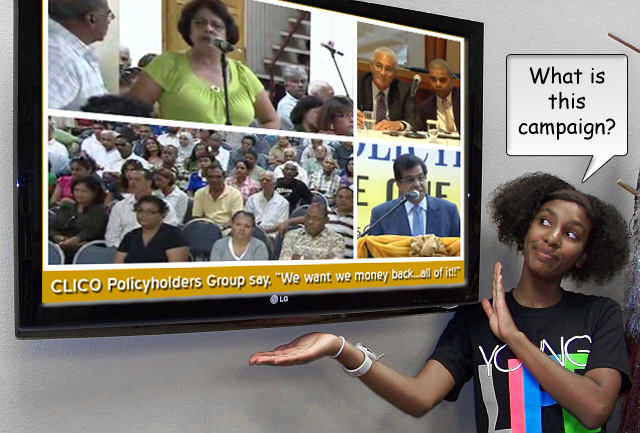
CL Financial bailout: What is this campaign?

Clockwise from top right, Norris Gomez and Peter Permell; Ramesh Lawrence maharaj; CLICO Policyholders Group meet; a speaker at CLICO Policyholders meeting. Illustration by NiCam Graphics.We are witness to a second wave of assault on our Treasury.  Let us be sure, those of us who are not in line to benefit directly from the bailout, that the picture is complicated and it contains perils for the entire country.

The original bailout was an unjustifiable and colossal facility granted to the CL Financial Chiefs and the shareholders of that failed, privately-owned, group.  I say facility because the taxpayers’ money in our Treasury was pledged to repay the debts of the CL Financial group.  The deal was hatched in secret and fact is, upon reflection, its terms were never formally debated in our Parliament.  What was debated was a series of amendments to the laws governing distressed Banks and Insurance companies.  A lot was said about the issue and many notable contributions were made to the debate in Parliament, but the agenda item for debate was not the terms of the bailout.

The 30th January 2009 Memorandum of Understanding had already been signed and was on its way to implementation when our Parliament debated and agreed to amend the legislation.  The nation had witnessed a ‘Quiet Coup’ to draw from the title of Professor Simon Johnson’s seminal article (in the May 2009 edition of The Atlantic) on this process in the USA – see http://www.theatlantic.com/magazine/archive/2009/05/the-quiet-coup/7364/.

I have no intention of arguing the legal merits of the case being advanced by the CLICO Policyholders’ Group (CPG), leave that to the learned.  I just note that we are yet to hear the voice of the traditional policyholder in the declarations of this Policyholders’ Group.

The bare facts need to be laid out for consideration, it would be far better to conduct this discussion in a more informed manner, with some of the missing details requested at the close of last week’s column.  But is best to start from where we are.  So, the bare facts –

  • CIB’s insolvency is estimated, according to the winding-up petition being heard in the High Court, to be of the order of $4.7Bn
  • According to the Finance Minister in his budget speech, the combined insolvency of British American and CLICO is of the order of $7.2Bn.  It is not possible to tell from that speech if those estimated figures included the monies already drawn from the Treasury in pursuance of this bailout.
  • The amount said to be spent on the bailout, up to May 2010, was $7.3Bn.
  • The amount being owed to the 225,000 policyholders is estimated to be $6Bn.  That covers traditional insurance products such as pensions, health plans and life insurance – it works out at an average of $26,666 owed to each person.
  • The amount being owed to the 25,000 depositors is estimated to be $12Bn, which works out at an average of $480,000 owed to each person.  But there is another way to look at that information and that is in the sidebar.
  • The Governor of the Central Bank, the very official the CPG is seeking to have affirmed as the proper decision-maker in this matter, in April last year made public statements that all the assets of the group are encumbered.

In the absence of the accounts and operating with the available information, it seems reasonable to believe that the CL Financial group is insolvent and further that our Treasury has swallowed an impossible series of obligations.  Furthermore, there is no obligation on the borrowers – the CL Financial shareholders – to pay one cent of interest. Even worse, Para ‘A’ of the 12th June 2009 CL Financial Shareholders’ Agreement actually obliges the State to protect the interest of the shareholders – see http://wp.me/pBrZN-bP.

Of course this leads to yet another ‘$57,000 question’ – ‘If the CL Financial group is insolvent, then how are we paying for all this?’  Yes, that is the big one.

It seems that the CPG is intent on advancing its sectoral interest and while we know that is how things work, it is even more important to be watchful of our nation’s wealth.  We are actually being asked to put out an additional $12Bn to rescue the 15,000 CPG members, with no reasonable hope of recovering those monies.

For the record, no one from the previous government or the Central Bank, for that matter, has ever even attempted to justify the rotten terms of this bailout.  Not even an attempt to explain the interest-free, unlimited, unsecured loan to that lucky group of 325 CL Financial shareholders.

Even now, with the new terms being hotly debated, please note carefully that no new terms are being announced for the ultimate borrowers, the CL Financial shareholders.

Selwyn Ryan
Selwyn Ryan

Professor Selwyn Ryan of UWI, who was, last year, a strong critic of the bailout process and its glaring conflicts of interest, now appears to have become a leading party in the CPG, calling for that suspect deal to be honoured.  A deep contradiction in terms, I tell you.  How do you honour a rotten deal?  Politics does make strange bedfellows and yes, history is truly rich in irony.

Emmanuel "Manny" Lawrence

Even stranger still, is the presence in the CPG of Emmanuel ‘Manny’ Lawrence, former Sales Director of CLICO and now head of one of its sales agencies.  In the three years before the CL Financial group collapsed, all the CLICO agents I knew made intense efforts to get deposits from me.  Not once did these agents even attempt to sell me a life insurance plan or health plan.  These agents consciously and deliberately coaxed many of those people who are now protesting to place all or most their investments in this one instrument.  That is the kind of irresponsible behaviour which led many people to be in breach of the basic investment guideline against over-concentration of risk – to avoid putting all ones eggs in one basket.  That is the kind of biased and unsound advice which no proper professional would render to a client.   It is a decisive factor in this entire scenario.

The ingredients included the requirement for cash by an expanding industrial/commercial group, the resulting lucrative commissions being paid, the trust of the investors and the poor level of general financial literacy.  Those factors all contributed to this appalling picture.  To be fair, despite the titles adopted by some of these salesmen, they were not true Investment Advisers, since they were selling CLICO products.

Also, as to the discussion about the sophistication of the investors, the fact is that even an organisation as large as the National Gas Company, could be seen to have placed undue reliance on the high-interest/high-risk products being offered by the CL Financial group.  At one point, according to its 4th February 2009 Press Release, over 45% of NGC’s funds were in CL Financial – see http://wp.me/pBrZN-ec .

SIDEBAR: The depositors re-examined

I just made the point that the 225,000 ‘traditional, long term policyholders’ are owed an average of $26,666 per policyholder.

Also, that the 25,000 depositors are owed an average of $480,000 per depositor. It is interesting that if you subtract the maximum of $75,000 which would be due to each of the 10,000 ‘small-scale’ depositors, the total owed to the remaining 15,000 depositors is reduced to $11,250,000,000.  That adjustment carries the average amount due to the real protestors in this CPG to no less than $750,000 per depositor.  Yes, that is twenty-eight times the amount due to the traditional policyholders.

Ironically enough, the voice of the traditional policyholders, who outnumber the depositors nine-to-one, is virtually silent in all this.  I am yet to hear anything from the CPG on behalf of those traditional policyholders.  But then again, it is clear that by far the larger amount is owed to the depositors and further, that they appear, on average at least, to be owed about 18 times more than the typical policyholder. Yes, as Growling Tiger did sing “Yuh know very well that Money is King’’.