AUDIO: Election Hardtalk interview on Power 102FM – 16 Jul 2015

Power 102 FMAfra Raymond and Peter Permell are interviewed on the ‘Election Hardtalk‘ show on Power 102FMFM by Tony Fraser about the continuing impact of the CL Financial bailout on the economy and the request to get back the company by Lawrence Duprey. 16 July 2015. Audio courtesy Power 102FM

  • Programme Date: Thurday, 16 July 2015
  • Programme Length: 1:19:47

CL Financial Bailout – Impunity Insanity?

© 2015 Dion Jennings
© 2015 Dion Jennings. Used with permission.

The headline ‘Duprey wants back CLICO‘ in the Sunday Express of June 28th 2015, did not surprise me at all. That is exactly the threat against which I have been warning throughout my campaign against this appalling and unprecedented bailout.

To allow Lawrence Duprey to regain control of CLICO would do serious violence to the fundamental notions of the law not allowing persons to benefit from their wrongdoing.

Already, we can see various positions being taken – the Movement for Social Justice and Peter Permell of the CLICO Policyholders’ Group stating their objections, while Mariano Browne (former PNM Treasurer and Minister in the Ministry of Finance) and Mary King (economist and former Minister of Planning) setting out what seem to be supportive positions.

Continue reading “CL Financial Bailout – Impunity Insanity?”

CL Financial Bailout – False Firing?

Prime Minister Kamla Persad-Bissessar greets former Clico chairman Gerard Yetming, second left, and former Senate president Timothy Hamel-Smith, second right, after they showed up at a UNC “foot soldiers” mobilisation meeting in Debe on Tuesday. Also in photo are Oropouche East MP Dr Roodal Moonilal and UNC campaign manager Rodney Charles, left. PHOTO: RISHI RAGOONATH

I smiled at the page three photo in another newspaper of the Prime Minister holding hands with recently-dismissed CLICO Chairman, Gerald Yetming, at a UNC meeting in Debe on Tuesday 23 June 2015. As serious as the situation is, I just couldn’t help myself.

Yetming was a UNC Minister of Finance during the Panday administration and had been appointed on 28 September 2010 as Chairman of CL Financial Ltd, the parent company of the ‘CLICO group’ being bailed-out by the State.

I declined many requests for comment on this controversial episode, since something about it did not seem quite right. The actual CLICO dismissals were incredible to my mind, not only because there did not seem to be any conflict between the stipulations in the CBTT’s 3 June Press Release and the reported beneficiaries – that is explained in the sidebar. It is even more bizarre when one considers that Yetming, in whom all confidence was apparently lost after allegedly-unauthorised payments to former CLICO Directors, still serves as Chairman of the parent company, CL Financial Ltd.

There is a widely-held view that the CL Financial chiefs should not be recovering any of their money from this huge collapse before the completion of the Colman Commission and the publication of its Report. I share the public concern that no money should be paid to the persons who were in charge of that sinking ship. Not one cent. Nothing should be paid to the CLF chiefs until we have had the proper opportunity to consider the findings of the Colman Commission. Even with its severe limitations, that Colman Report would be our closest opportunity to understand this epic financial crime. To pay out money to those Directors and Officers who were responsible before the Report is published would be reckless in the extreme and jeopardises the public interest. Continue reading “CL Financial Bailout – False Firing?”

Our Land – Land for Everybody? Part 2

SIDEBAR: The Minister responds

This is a short video (courtesy of TV6) in which the Minister of Land & Marine Resources, Jairam Seemungal, responds to questions on the occupation of State lands in Couva by SIS Ltd, one of the main financiers of the Peoples Partnership.

The ‘Land for the Landless’ program, which is being implemented by the Land Settlement Agency (LSA), has now been redefined in such stark terms that I have decided to call it by a more appropriate title ‘Land for Everybody’.

The previous article set out the main points of the revised program. That detrimental law was approved by the House of Representatives on Wednesday 3rd June. Although we have now heard that the new law to amend the State Lands 1998 Act was withdrawn just before the close of our Parliament on Friday 12th June 2015, we are also being told that it will be approved if the Peoples Partnership is returned to office after the national elections in September.

This change to our country’s squatter regularisation law is therefore now being held out as an expansive election promise to regularise the status of some 60,000 landless people. That proposed program is a severely detrimental one which will likely lead to greater problems in the important question of our country’s human settlement policy. It is therefore necessary to highlight the dangers this new ‘Land for Everybody‘ program poses to our collective interests.

The Minister of Land and Marine Resources, Jairam Seemungal, gave several interviews which attempted to rebut my criticisms, so it is important that that these fundamental issues be properly understood. The public interest demands nothing less.

Food Security

Food security is that elusive state in which we can feed ourselves at a decent standard of nourishment and at an affordable price, without heavy reliance on imported food. The very issue of how food security is defined is hotly debated, but it is clear that we are far away from even the simple one I offered.

In March 2012 the then Ministry of Agriculture, Land & Marine Resources published its Food Production Action Plan 2012-2015. The major goal of that Action Plan was to halve the country’s annual $4.0 Billion food import bill. Yet in March 2014, the Food Production Minister, Senator Devant Maharaj, stated that the food import bill had been reduced by only 2% since 2010. That is a sobering reflection on how serious is the challenge of moving to some significant degree of food security, even for an administration with substantial links in the agricultural sector.

The significant reduction of our food import bill will require a flexible plan, with dedicated implementation and continuous monitoring.  The one inescapable requirement is for farmers to have access to land of suitable quantity, quality and location.  Without a good supply of land, no food security plan can succeed. 

The issue is a long-term one, so it is clear from the failure to achieve the targets that a deeper commitment of resources and monitoring is needed if we are to improve our collective position. The Food Production Action Plan 2012-2015 is now up for thorough review which must include serious input from the public and stakeholders.

Shiraz Khan, President of the Trinidad United Farmers’ Association, has spoken out about the disastrous land use policies now unfolding and I have also heard Omardath Maharaj join the calls for a holistic discussion of agriculture policy.

What is the policy?

We are reliably informed that the new ‘Land for the Landless’ policy was approved by Cabinet on 19th March 2015, but there is no clarity as to whether this policy conforms to the existing 1992 Land Policy. The recently-approved policy ought to be subordinate to the wider Land Policy, which states at page 9 –

“4. LAND USE POLICY
4.2 The New Land Policy proposes:
(a) that the existing system of land use zoning be strengthened to ensure that prime agricultural land is not mis-managed or converted to non-agricultural uses except on the basis of a significant spatial or economic development rationale…”

It is imperative that our country’s human settlement policies take proper account of the need to preserve our limited supply of arable land, so that we can maintain some degree of food security.

The critical point is that our total supply of land is very limited, due to the tiny size of our country. The supply of arable land which has not been developed is even more limited, so the choices are stark. There is not enough land for us to continue with this reckless policy of land distribution or large-scale building of houses with gardens. To continue with those policies would be watching a disaster unfold before our very eyes.

I have heard occasional statements from the HDC or Housing Ministry, in this and previous administrations, but that is merely to mention a major issue. This is a serious issue with dire long-term consequences for our society and a proper, wide-ranging policy review is urgently required. That review must include the 2002 Housing Policy, the 2003 UWI Report on the future of Caroni lands, the 1992 Land Policy and the Land for the Landless policy.

How many people will be affected by this policy?

There was some dispute over numbers, with the PM claiming that 30,000 squatters were to be regularised, the Minister of Land & Marine Resources doubling that to 60,000, all while the LSA website states that there are 250,000 squatters.

At one point, the official rebuttal seemed to be that there were 60,000 households with 250,000 inhabitants, but since the three cited statements were referring to ‘squatters’, that line has now been abandoned. We are now told that the intention is to regularise 60,000 of an estimated total of 250,000 ‘squatters’.

How are the 60,000 eligible persons to be selected?

So, which 60,000 people are to be regularised out of the 250,000? How is that selection to be made? Even after all this defensive talk, I am not at all clear on that.

Will the decisive point be the date of application or the length of time a squatter community has been established? The date-based approach would have some legal weight, given that squatters’ rights have usually accrued in accordance with the period of occupation. To my mind, that would be a weak basis on which to proceed, given the shortage of land and variety in its quality.

In the alternative would the choices of communities to be regularised be based on an assessment of alternative uses or land value? What role would the fertility of the soil play in making these important decisions? If we are to have a reasonable chance of tackling the food security issue, it is critical that these factors play an important part in making these decisions. That is not negotiable.

Finally, one has to mention the elephant in the room. Could it be that the selection of those 60,000 squatters is a political one? Are marginal constituencies to be favoured? Is that a possible outcome we ought to guard against? Which are the constituencies in which the selected communities are located?

The Bill to amend the State Lands Act 1998 comprised 24 pages and we need to note that 20 of those pages was an expansive list covering at least 500 areas or districts in our country. I quipped ‘Charlotteville to Los Iros‘, but the point is that with so expansive a list of areas, just about anywhere could be eligible for regularisation. You see?

The point of how these critical selections are being made is one which must be answered as soon and as clearly as possible.

Who qualifies as ‘landless’?

SIDEBAR: The LSA’s abortive meeting with JCC

In March 2015, the LSA wrote informally to seek dialogue with JCC on this revised ‘Land for the Landless’ program and we responded by requesting an agenda and a formal invitation. Despite our constant efforts, we are still awaiting a response.

This is the most damaging part of this proposed policy shift, with the new income levels having shifted to a monthly maximum of $30,000, together with the elimination of ‘disadvantaged’ as a decisive criteria having the combined impact of making these scarce lands available to anyone. The fact is that a family with a monthly income in the $30,000 can readily qualify for a mortgage in the $1.6-1.7M range and there are plenty of good-quality homes in that price range for sale in our country.

The CSO’s 2009 data on monthly Household Income shows a national average in the $8,000 range. Yet we have a Minister, supported by his professional staff, advancing a policy which is seeking to extend a program intended for the benefit of our neediest citizens to just about anyone.

One can only wonder what was the research on which this bizarre policy was based.

This is no time for inadvisable and ill-considered electoral promises, from either side. Our children’s children will wonder just what kind of intentions did we have. History will judge us harshly if we continue with this foolhardy basket of policies.

Our Land – Land for Everybody?

A detrimental ‘land grab’ is almost upon our country and we all need to be alert to prevent the destruction of our patrimony and prospects.

Hon. Jairam Seemungal, MP. Minister of Land and Marine Resources

The State owns most of the land in the country – recent estimates by Minister of Land & Marine Resources, Jairam Seemungal, place the proportion of State-owned land in the 63% range – and as such those lands are critical national assets with which a progressive government could seek to address issues of poverty in a sustainable fashion. Those policies would have to be redistributive in nature if they are to effectively address the serious poverty faced by some of our citizens. That means the State using our resources to provide affordable land and housing to those who are unable to do so in the open market. It is critical to ensure that these redistributive programs operate properly so that the benefits will go to the needy persons for whom they are intended. Those are objectives which I fully support.

I quipped that the ‘Land for the Landless’ program should be re-named ‘Land for Everybody’, but recent developments have turned that quip into a growing reality.

There have been three big changes which have effectively undermined the very meaning of these important redistributive programs –

  1. THE CARONI AGRICULTURAL LANDS

    The Trinidad Express reported that the Minister of Finance & the Economy, Larry Howai, announced a significant change in the original policy in the 2015 budget, in that the ex-workers receiving agricultural leases were now free to sell these lands. Those lands which are sold will likely leave the agricultural use for which they were allocated, representing a significant and detrimental ‘alienation’ of those limited lands.

  2. THE NEW ‘LAND FOR THE LANDLESS’ PROGRAM

    This important program has been revised to now provide for an annual target of 3,000 to 4,000 lots at an estimated annual cost of $1.0 Billion. Even if one makes the most optimistic assumptions that the upper target of 4,000 lots is achieved at the estimated cost of $1.0 Billion, the cost per lot is $250,000. I do not know if the cost of the land is included in those estimates, but experience suggests that it would have been excluded, which would be a serious gap in the planning for the development of these important public assets.Most alarmingly, the income limits have now been increased in a manner which suggests that this program is no longer intended for the benefit of the disadvantaged in our society. The original ‘Land for the Landless’ program set an upper limit of $8,000 on the family’s monthly income, but that has now been increased to $30,000. A family with a monthly income of $30,000 can readily afford to buy a home with private mortgage financing. Apart from that, there are serious questions as to whether the inclusion of those upper-income applicants would force-out the poorer people this program is intended to assist.

    It is just impossible to reconcile the new family income limit of $30,000 for the ‘Land for the Landless’ program, which is only for residential lots, with the Housing Development Corporation’s (HDC) $25,000 limit on the monthly family income of applicants for homes.

  3. THE NEW LAND REFORMS

    The government laid the State Land (Regularisation of Tenure) (Miscellaneous Amendments) Bill, 2015 in Parliament on Friday 29 May and those proposed amendments were passed in the House of Representatives on Wednesday 3 June 2015.

    The main points of this proposed new law, which still has to be approved by the Senate, are –

    • Application date – formerly, persons who had illegally occupied State Lands up to January 1998 were entitled to be regularised – the new law would move that date to June 2014. That means that more persons will be regularised;
    • The numbers – There are serious questions arising about the numbers to be regularised in this process – the PM said recently that 30,000 were to be given Certificates of Comfort, Minister Seemungal is now saying that it is really 60,000, while the LSA website gives estimates of 250,000 persons. So, just what are we counting? Do these numbers represent inhabitants or is it the number of lots? We have no real clarity on just how much additional land is to be allocated in this new process.
    • Who is ‘Landless’? – In the original 1998 Act, a ‘landless’ person is defined at S.2 (1) as –

      “…“landless” refers to a person who falls within a category designated as disadvantage (sic) by the Minister to whom responsibility for Social Development is assigned and who has no legal or equitable interest or any other interest or claim to such an interest, in a dwelling house, residential land, or agricultural land upon which a dwelling house is permitted to be built…”

      Obviously, the original law was intended to assist the most needy persons in our society.In the proposed amendment, just approved by the House of Representatives, ‘landless’ has been redefined as follows –

      “…(c) in the definition of “landless”, by deleting the words “who falls within a category designated as disadvantage by the Minister to whom responsibility for Social Development is assigned and…” (the emphases are mine)

      The landless class has now been expanded by our Parliament to eliminate any mention of disadvantage. I tell you.

    • Where is the land? – The Schedule of the new law is an A to Z list of designated areas in every district of our country, so these are really expansive proposals. All areas will be affected, from Charlotteville to Los Iros.
    • The rationale – Minister Seemungal stated that there are extensive aerial surveys from 2014 and other information being used to guide this process, but I think significant caution is necessary. The lack of an open process of policy review and formation in this important matter is proving very expensive for our collective interests. Have other State agencies and stakeholders been consulted? These critical policy changes must be underpinned by substantial research and consultation which can earn the required degree of public confidence.
    • Who benefits? – We do not have any open database on the allocation of public housing, state land or any property at all. These records must be open and searchable so that the potential for serious improper behaviour amounting to a ‘land grab’ is minimised. In the present opaque arrangement the real beneficiaries could remain unknown for too long. Of course that is a recipe for the misallocation of State lands on an epic scale, so it is important to establish some transparent mechanism to examine what is happening.

When one considers the numbers involved, there is a clear sense that these programs, which were intended to benefit the poorer class of citizen, are being systematically ‘gamed’. It is even possible that officials are assisting those elements for the advancement of their own political agendas. The numbers wrangle is beyond the scope of this column, but I will be exploring it in the near future to explain how they relate a particular story.

The degree of confusion is immense, with LSA officers denying the existence of the national Land Policy. If we are to go by his evasive response to simple questions on the SIS occupation of State lands at Couva in disputed circumstances, the very Minister Seemungal can be seen as hostile to providing essential facts. The PM told the Parliament the next day that the Minister had denied making those televised statements.

We need to be alert to protect our patrimony, particularly in relation to property.

Integrity Inquiry

ic-logo

“…The question really is integrity, and if he or she does not have it he or she should not be a Commissioner in the first place. The simple fact is that try as we might, we cannot legislate for integrity…”

From Press Release of 21 June 2013 by then Integrity Commission Chairman, Ken Gordon, in response to strong criticisms of his meeting privately and alone with opposition Leader, Dr Keith Rowley.

Once again we are beset by what appears to be yet another fiasco at the Integrity Commission, so Ken Gordon’s fateful words echo in my mind.

Given the current political season, there is every temptation to discuss this crisis as being caused by the impending election, together with either the improper behaviour of the present Peoples Partnership government or the ‘PNM operatives’ who infest the public service. You can take your pick from those prevailing theories, but I think these recent and alarming events were preceded by earlier ones. So much so that when the entire situation is placed in context, we are facing a troubling scenario in terms of the extent to which we can trust high public officials.

The current crisis is serious enough grounds to require a full Commission of Enquiry into the conduct of the Integrity Commission since the 2000 revisions to the Integrity in Public Life Act (IPLA).

I do not agree with those who call for the abolition of the Integrity Commission, since it is critical that any progressive society establish what are its aspirations and work towards those. Despite the social, religious and legal restrictions on murder, robbery and rape, those acts occur all the time. That sobering truth is no reason at all to retreat from putting strong legal and social prohibitions in place. Society needs laws and institutions to promote its values, so I am not calling for any move towards abolition of the Integrity Commission at all.

Such a Commission of Enquiry is necessary to clear the air on strategic issues and its Terms of Reference would cover aspects such as –

General

  • What is the record of the Integrity Commission in deterring corrupt and improper behaviour by Public Officials?
  • To what extent would the amendments to the IPLA, as proposed by the Ken Gordon-led Commission in its 2012 Annual Report, be effective in improving the Commission’s performance?
  • Given their growing importance of Public Private Partnerships in large-scale projects and commercial enterprises, to what extent should the IPLA apply to those organisations.
  • Apart from the legal framework as outlined above, how can the limited resources of the Integrity Commission be best applied to promote ‘Integrity in Public Life’?

The specific issues

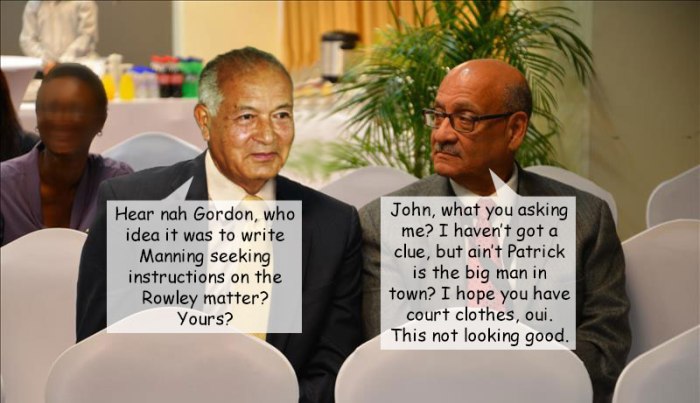
  • 19th October 2004 – The Integrity Commission wrote to then PM Patrick Manning seeking detailed instructions on how to handle Ganga Singh’s complaint against Dr Keith Rowley. According to the ruling in the case brought by Dr Rowley against the Commission – “…The Court does not accept the Integrity Commission’s explanation as to why it wrote to the Honourable Prime Minister on the 19th October, 2004, to ascertain whether an inquiry was to be undertaken and if so, the names of the persons to man the enquiry and their terms of reference…”. The public needs a full and proper explanation as to how and why the Integrity Commission took such an extraordinary decision.
    gordondeane-johnmartin
  • The TSTT exemption – In 2006 the Commission was alleged to have written to TSTT Directors to confirm that they were exempted from filing declarations as required by the IPLA. That letter was the subject of Freedom of Information litigation at both High Court and Appeal Court levels – Magdalene Samaroo vs TSTT CV 2006-0817 and CA 180 of 2010 – and it is fundamental that at no point was the existence of that letter denied. A simple denial would have readily defeated the request for that letter since the Court cannot order publication of a document which simply never existed. The matter was ‘compromised’ by agreement between the parties at an Appeal Court hearing on 28 October 2013, which means that both sides agreed to discontinue the lawsuit. There is obviously something substantial and improper at work here, so an Enquiry can force publication of that suppressed correspondence.
  • The TSTT litigation – Since 2005 TSTT has been in prolonged litigation to remove its Directors from Integrity Commission oversight. The High Court ruled in 2007 that TSTT’s Directors were required to file declarations under the IPLA. That judgment was reversed in the Appeal Court ruling of 27 June 2013 that TSTT was not a State Enterprise, with its Directors therefore not required to file declarations to the Integrity Commission. Upon careful reading of those judgments it seems clear that the Integrity Commission offered little, if any, resistance to the TSTT challenge. This sustained collaboration between the Executive, the supposedly-independent Integrity Commission and the Public Private Partnership also known as TSTT is nothing less than remarkable, given the challenges in getting agreement on important and beneficial matters. A proper account is also required for how and why the Commission agreed to this course of action.
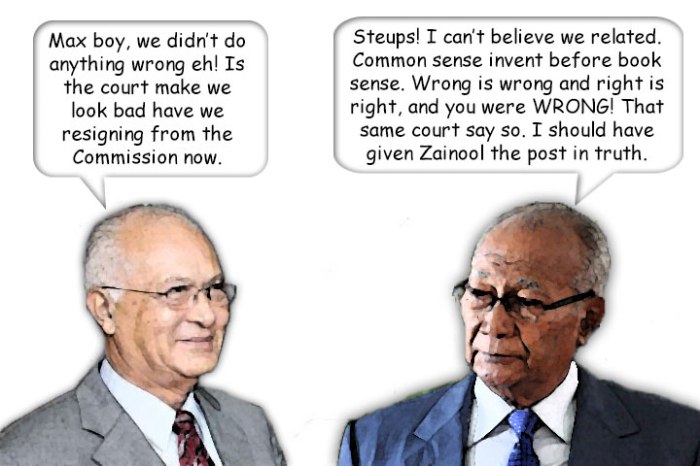
  • The 2009 collapse – The newly-appointed Commission collapsed in early 2009 due to disastrous appointments by then President Max Richards. One of the several outstanding issues at that time was the strong complaint from Justice Zainool Hosein who claimed that President Richards had promised him the position of Deputy Chairmanship and then reneged on that commitment. President Richards proceeded on an extended leave before deigning to make a public statement on 29th May 2009 which amounted to a stunning ‘I don’t have to explain myself’. An important part of this Enquiry would be to establish just how this series of unfortunate appointments were made.
    max-and-martin
  • CL Financial group of companies – The Commission has never explained its failure or refusal to seek declarations from the Directors of the CL Financial group of companies, which have been under State control since June 2009. I have personally checked and those Directors do not submit declarations to the Commission. CL Financial is the largest by far of the ‘bodies under the control of the State’, yet the Commission has not exercised its lawful duties in respect of proper oversight, so a full and public examination is necessary.
    3-wise-monkeys
  • Emailgate Fiasco – The Commission’s role in this charged affair certainly needs a full, public Enquiry if trust is to be restored. Fixin’ T&T claimed, in its 7 May 2015 letter to the Commission, that the PM had claimed to have had possession of certain files ‘containing information which the IC had requested from Google’. The Commission was asked in that letter whether it was aware of any information being passed onto the PM or any other person. The Commission’s response on the same day was remarkable, in that there was neither confirmation or denial of any information being passed to anyone else. That reticence on such a critical point is even more remarkable when one examines the Commission’s letter of 19th May 2015, which confirmed the end of its ‘Emailgate’ investigation. The first part of that letter states that the provisions of S.35 (1) & (2) of the IPLA prohibits any release of information unless charges are to be recommended. On the one hand, the Commission declines to say if information was released to the PM or anyone else, yet, on the other hand, it stresses the legal rules against such a release. So what is really happening here? What is more, the resignation of two of the IC’s five Commissioners can only add to the sense of confusion in the air. The first resignation came from Dr Shelly Ann Lalchan, supposedly for personal reasons, but the clear statements from the second Commissioner to resign, former Deputy Chairman, Justice Sebastien Ventour, are worrying to say the least. Can it be true that the media was the first place the Commissioners were made aware of that important letter of the 19 May? If that is indeed so, it is clearly unacceptable for a public body to conduct itself in that fashion.

A final issue for an Enquiry to consider would be the role of whistleblowing within bodies such as the Integrity Commission. On the one hand the Commission could not perform its work without reports from people who are reporting suspected wrongdoing, probably in breach of their employers’ rules, yet the very officers within the Commission are prevented from reporting wrongdoing in its own operations. That is the true irony at work and a proper Enquiry will be able to take evidence and make recommendations to deal with this.

A full and urgent Commission of Enquiry into the Integrity Commission is now required.

Land for Everybody?

My letter to the Editor was published in the Trinidad Express on 3 June  2015 as “Protecting our patrimony.”

The Editor,

The government laid the State Land (Regularisation of Tenure) (Miscellaneous Amendments) Bill, 2015 in Parliament on Friday 29 May and I am reliably informed that it is due to be approved at today’s sitting (Wednesday 3 June 2015).

Given the continuing absence of the Opposition PNM from our Parliament and the sporadic coverage in the media, it is important that the main points of these new proposals be exposed –

  • Application date – formerly, persons who had illegally occupied State Lands up to January 1998 were entitled to be regularised – the new law would move that date to June 2014. That means that more persons will be regularised;
  • The numbers – There are serious questions arising about the numbers to be regularised in this process – the PM said recently that 30,000 were to be given Certificates of Comfort, Minister Seemungal is now saying that it is really 60,000, while the LSA website gives estimates of 250,000 persons. So, just what are we counting? Do these numbers represent inhabitants or is it the number of lots? We have no real clarity on just how much additional land is to to be allocated in this new process.
  • Where is the land? – The Schedule of the new law is an A to Z list of designated areas in every district of our country, so these are really expansive proposals. All areas will be affected.
  • The rationale – Minister Seemungal stated that there are extensive aerial surveys and other information being used to guide this process, but I think significant caution is necessary. The lack of an open process of policy review and formation in this important matter is proving very expensive for our collective interests. Have other State agencies and stakeholders been consulted?
  • Who benefits? – We do not have any open database on the allocation of public housing, state land or even all property. Which means that the real beneficiaries could remain unknown. Of course that is a recipe for the misallocation of State lands on an epic scale, so it is important to establish some transparent mechanism to examine what is happening.

Just remember that Minister Seemungal was the one who refused to provide details on the terms under which SIS occupied certain State lands at Couva, claiming that those details were private. The PM told the Parliament the next day that the Minister had denied making those televised statements. As I wrote recently in the ‘Our Land’ series, the new rules for the ‘Land for the Landless’ program, make it seem that the real name should be ‘Land for Everybody’.

We need to be alert to protect our patrimony, particularly in relation to property.

Afra Raymond
JCC President

Our Land – The Caroni case Part 2

The previous article outlined the size of the Caroni lands and some of the intended uses to which that land would be put. I contrasted the positions taken by UWI in 2003 and my own from 2004, with the current situation.

UWI’s July 2003 Position Paper – ‘A Framework for National Development: Caroni Transformation Process‘ – was developed by diverse contributions, mostly made at a special seminar on 27 April 2003. At that time there were strong rumours that the then PNM government, headed by Patrick Manning, intended to close Caroni (1975) Ltd. The expressed fears at the time were that PNM supporters, friends, family and financiers would all benefit from a ‘land grab’. Caroni was a State Enterprise which had made heavy losses in the virtually 30 years since it had been purchased from its British owners, sugar giant Tate & Lyle.

The UWI Seminar was most timely since their Position Paper was issued in July 2003 and presented to the then Minister of Agriculture, Land & Marine Resources, John Rahael, in September 2003. Caroni (1975) Ltd was closed on Emancipation Day 2003.

The UWI study took a long-range view of the Caroni issues and as such it is an important document which set a framework for these Caroni lands. The land area was determined, at Appendix 1, to be 74,780 acres. At page 30, ‘Consultation’ is specified as the first requirement for the development of these lands.

The UWI Position Paper sets out its Recommendations at Chapter Eight on pages 71 & 72 –

  1. Govt to prepare & publish a comprehensive plan for Caroni.
  2. Govt to convene an urgent National consultation on the Caroni resources and the published plan.
  3. Any departure from the National Physical Development Plan be done through the legally- stipulated process which includes bringing those proposals to Parliament.
  4. That all terms and conditions for the leasing and tenure of the Caroni lands be detailed to the public in a public document, to meet the requirements of transparency.
  5. That Govt establish a skills bank so that the Caroni workers would have choices as to how they would be integrated in future planned enterprises.
  6. That the State establish an independent Screening Committee to stringently screen potential investors who seek Caroni lands as their location of business.
  7. That the Ministry of Agriculture Land and Marine Resources establish an independent authority charged with the implementation of plans for agriculture and agriculture-related industries.
  8. That Govt establish a comprehensive system of water control on the Caroni lands, in order to facilitate irrigation, as an essential pre-condition for the establishment of agricultural enterprise on the Caroni lands.
  9. The the Govt establish a Lease Income Funding Enterprise System and embark upon a comprehensive joint funding venture with companies in the heavy industrial sector, in order to fund national platforms for development, such as the following ones proposed by this Position Paper:
    1. A Botanical Plan
    2. A Technological & Vocational Institute
    3. A Buffalo Reconstruction program
    4. A Model Program for Untenured Residents
    5. A Food Park Plan
    6. A Research and Development Mandate, for the University of the West Indies and other research institutes in order to support Agro-Industrial Development.

As far as I am aware, none of those sensible recommendations have been implemented.

Dr. the Honourable Roodal Moonilal, Minister of Housing and Environment

After Caroni was closed, there was a serious debate in the Parliament – here is Dr Roodal Moonilal MP, speaking in the Agricultural Census Order debate on Friday, 14 May 2004

“…We want to challenge the Government yet again, as we did with the Member for Port of Spain North/St. Ann’s West to come to the House and bring the plan for Caroni (1975) Limited to the House. Let us debate their plan for Caroni (1975) Limited…” (pg 601)

Chandresh Sharma MP, speaking in the same debate (pg 637)

Chandresh Sharma MP
Chandresh Sharma MP

“…Mr. Speaker, I was talking about UWI ’s recommendations based on the Caroni (1975) Limited lands that say there should be no land grabbing. These qualified minds thought of the process and they have looked at what obtains in the Government. Some of the best agricultural lands in this country were taken by the PNM —Aranguez and Trincity—and some of the best sugar came from there, and also cocoa in the earlier days. They built houses to secure PNM votes. They must not forget that the East-West Corridor—stretching from Chaguanas to Arima—has 14 seats, which the PNM hopes to control all the time. The seats that they do not control are the ones involved in agriculture like Barataria/San Juan, St. Augustine, St. Joseph, and Tunapuna would return to us soon. So they took the best agricultural lands and built houses on them. The thinkers saw the PNM at work…”

Also –

“…I have just identified some of the thinking from the University Position Paper which is A Framework for National Development Caroni Transformation Process produced by UWI in July 2003. It is instructive to note that to date the Government has not responded to any of the proposals obtained in this document. This is another clear demonstration of how they intend to treat with agriculture and those who are involved in agriculture…” (pg 638)

So, the UNC’s key speakers were insisting, in 2004, that the UWI plan must be considered.

It is striking to consider the identity of some of the Contributors listed at page i of the UWI Position Paper –

  • Winston Dookeran (then an MP, now Minister of Foreign Affairs, after serving as Minister of Finance)
  • Dr Roodal Moonilal (then an MP, now Minister of Housing and Urban Development)
  • Rudranath Indarsingh (then President of the All Trinidad General Workers’ Trade Union Union, now Minister in the Ministry of Finance)
  • Professor Clement Sankat (then at the Engineering Faculty, but now UWI Principal)
  • Dr Asad Mohammed (then a UWI academic, now Chairman of the National Planning Task Force)

It seems clear to me that the Caroni lands were identified as critical national resources which needed an urgent, strategic intervention from our leading thinkers to preserve the Public Interest. That UWI Position Paper is extremely important for our long-term collective interests. Sad to say, but it seems to have been sidelined and forgotten, just like the 1992 Land Policy.

What is more, we do not have any clear account as to what happened to those Caroni lands in either the period between 2003 and the PP’s election victory in May 2010, or the period between May 2010 and now.

After one time, is really two times.

UWI must, as a matter of urgency, reconvene a seminar to examine what has happened to the Caroni lands. That is imperative.

Next, I will consider the role of EMBD and the LSA in developing our lands, particularly the Caroni area.

SIDEBAR : The SIS episode

Hon. Jairam Seemungal, MP. Minister of Land and Marine Resources

One of the controversial episodes arising recently in relation to Caroni land is the occupation of 35 acres of land at Couva by SIS Ltd, the contractor company linked to many controversial State projects. There were claims by farmers who had been in occupation of the land that SIS had put them off the site before fencing it, with further statements by the Commissioner of State Lands (who has responsibility for management of State Lands) that SIS did not have a tenancy for that land and were in illegal occupation. To add to the brew, the Minister of Land & Marine Resources, Jairam Seemungal, was reported in the Trinidad Express newspaper on 12 March 2015 as denying that there was no agreement for SIS to occupy that land. When asked what were the terms of that lease or tenancy, the Minister is reported to have said –

“…When you enter into an agreement the arrangement in the agreement itself is private, the State land is State land but when you enter into an agreement when the Commissioner enters into an agreement or anybody enters into an agreement with any person whatsoever then the process itself whatever documentation all these things inside of the agreement those become a private matter unless it is registered in the Ministry of Legal Affairs where one can go and do a search…”

A private agreement for Public Lands. I tell you.

To crown-off the entire episode, the Prime Minister told Parliament, on Friday 13 March 2015 –

“…I have spoken to the hon. Minister of Land and Marine Resources. He has indicated that at no time did he state that lease or other agreements with regard to state lands entered into between SIS and the Government is a private matter and therefore should not be disclosed…”

Complete denial. What is clear is that there is a serious hostility to the truth on display here. Simply appalling.

Our Land – The Caroni case

EMDB Agricultural Development Site Map
EMDB Agricultural Development Site Map. Click this link to see a Google Earth Map of the EMBD Agricultural Development Sites.

Caroni (1975) Ltd, the loss-making sugar conglomerate which was also a State Enterprise, was closed on 1 August 2003. The Caroni estate has to be located within the wider context of our national Land Policy, if we are to make sense of what is happening.

“The now-defunct Caroni (1975) Limited includes lands the size of Tobago whose value has been under-stated and which now could fall prey to a land grab……The current Caroni Transformation Process is about converting national assets into private assets. In the main it is serving the interest of those who wish to generate private capital from public wealth stocks; for this reason the current process is exploitative and fraught with inequity.

“The historical model is being excruciatingly exacted on Caroni lands. The current transformation clones the historical model.” The Report criticised areas of the current restructuring process which echoed those of the exploitative historical model. It said: “The enterprise is conceived to control land space. To control land space especially prime property near the port is to control the socio-economic agenda. Land is leased on gratuitous terms, 99 years for example, without publication of the terms of the lease or tenure. This leaves the process open to political and economic opportunism and speculation…”

These extracts are from UWI’s Position Paper – ‘A Framework for National Development: Caroni Transformation Process’ dated July 2003 as reported in the Trinidad and Tobago Newsday.

At that time, my academic colleagues at UWI were placing on record their serious concerns at the implications of the procedures being adopted by the Manning government in relation to the Caroni lands.

How many of those concerns are justified today, with the Peoples Partnership government in office since May 2010?

The best estimates of the land area of the Caroni Estate at 2003 were in the 76,000 to 77,000 acre range, which would equate to about 6% of our country’s entire land area. The Caroni lands stretch from Orange Grove in the north – just south of Trincity – to the outskirts of Princes Town in south Trinidad. The lands belonging to Caroni (1975) Ltd also included property at Mayaro and ‘Down-the-Islands’.

EMDB Residential Sites

The EMBD website states that it is responsible for the development of the former Caroni lands – some 7,500 residential lots are being prepared for ex-Caroni workers as part of their retrenchment package, with a further 8,400 agricultural leases of 2-acre parcels reportedly being processed. By my estimation, that means about 940 acres are to be used for the residential lots, with at least 16,800 additional acres to be used for the agricultural plots. The total land area to be used in these programs would therefore be of the order of 17,740 acres, which is just under a quarter (about 23%) of the estimated area of the Caroni lands.

There are significant struggles becoming evident in relation to the EMBD land distribution exercise, with these lands being allocated free to former Caroni workers as part of their retrenchment compensation.

The Trinidad Express reported that the Minister of Finance & the Economy, Larry Howai, announced a significant change in the original policy in the 2015 budget, in that the ex-workers receiving agricultural leases were now free to sell these lands. This announcement in September 2014 sparked a sharp response from Shiraz Khan, President of the Trinidad United Farmers’ Association, who labelled the new policy as ‘nonsensical‘ and ‘destructive to the agricultural sector.‘ One has to wonder if this important shift in land policy was discussed with the Farmers’ Association.

The split in positions became glaring with the swift response of Lily Herai, an ex-Caroni worker who is President of the Couva/Point Lisas Chamber of Commerce, who is reported to have “welcomed the move because it will add to the business development of the area.” Ms. Herai was also quoted as saying – “…We are in the Couva/Point Lisas area. There are a lot of service type business that have emerged recently and it keeps growing. It gives the leaseholders an opportunity to sell their lands…

To my mind, the most startling statements on the EMBD lands came from Minister in the Ministry of Finance & the Economy, Rudranath Indarsingh, former President of the All Trinidad General Workers’ Trade Union (ATGWTU). His comments are reported in the Trinidad Express on 12 December 2014:

“…Despite being given permission to sell their lands on the open market, ex-Caroni (1975) workers were urged yesterday not to sell by Minister in the Ministry of Finance Rudranath Indarsingh.

Indarsingh, a former president of the All Trinidad General Workers’ Trade Union (ATGWTU), said the union worked hard to get the lands for the workers, and land value can only increase.

He was speaking yesterday at a ceremony in Couva to distribute more land leases to the ex-employees.

Speaking to the Express afterwards, Indarsingh said there were rumours Government ministers were preying upon the recipients, encouraging them to sell their recently received land…”
(The emphasis is mine.)

I tell you.

The State Agencies responsible for land

This is a listing of the key Ministries and the relevant State Agencies which manage our country’s lands. The sheer number of bodies with overlapping responsibilities makes understanding the land question a major challenge.

  1. Jairam Seemungal, MPMinistry of Land and Marine Resources
    Minister: Jairam Seemungal MP

    Agencies

    • Lands & Surveys Division
    • Commissioner of State Lands
    • Land Settlement Agency (LSA)
  2. Hon Dr Roodal MoonilalMinistry of Housing and Urban Development
    Minister: Dr Roodal Moonilal, MP

    Agencies

    • Estate Management & Development Company Ltd (EMBD)
    • Housing Development Corporation (HDC)
    • Urban Development Corporation of T&T (UDECOTT)
    • Sugar Industry Labour Welfare Committee (SILWC)
  3. Bhoe TewarieMinistry of Planning & Sustainable Development
    Minister: Senator Dr Bhoendradatt Tewarie

    Agencies

    • Town & Country Planning Division (TCPD)
    • Chaguaramas Development Authority (CDA)
    • East Port-of-Spain Development Company Ltd.
  4. Hon Devant Maharaj, MPMinistry of Food Production
    Minister: Senator Devant Maharaj

    Agencies

    • Agricultural Development Bank
    • Agricultural Society of T&T
    • Cocoa & Coffee Industry Board of T&T
    • Livestock & Livestock Products Board
    • National Agricultural Marketing and Development Company (NAMDEVCO)
    • Sugarcane Feeds Centre
  5. Sen. Ganga SinghMinistry of the Environment & Water Resources
    Minister: Senator Ganga Singh

    Agencies

    • Environmental Management Authority (EMA)

Apart from this battle on the EMBD projects, we have to consider the ‘Land for the Landless’ program which is intended to provide some 3,000 to 4,000 residential lots each year. That is the strain being put onto the limited lands available in our country, as we fight for clarity on what is happening to our country’s lands.

The lack of the database proposed in the 1992 Land Policy means that we are operating in an information vacuum which appears to be deliberate.

Every public official is accustomed to the world of today, with the instantaneous access to detailed information on an astounding range of issues, worldwide. We all know that the banks and insurance companies have all the relevant details of many millions of accounts and transactions available at our virtual fingertips. We all know that, so why are we continuing to permit this rapid disposal of our country’s land without some public system to provide the details for our consideration?

As I wrote in May 2004 –

“…Our nation’s interest demands that we recognise that the Caroni lands are too big, too important and too valuable to be the preserve of any single group or political party…”

At that time, I was criticising the short-sighted policy of the Manning government in relation to the Caroni lands.

After one time, is two times.

Next, I will delve further into the EMBD situation and the features of the land/property information system we so urgently need.