Learning the Lessons of the UdeCOTT fiasco

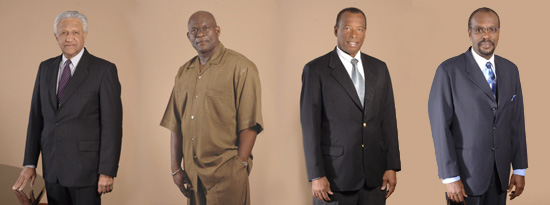
Former UDeCOTT Board
Former UDeCOTT Board, (l-r) Dr. Krishna Bahadoorsingh, Sen. Michael Annisette, Mr. Anthony Cherrie, Mr. Wendell Dottin

The leaking of the Uff Report, the delayed dismissal of the remaining, ‘squeaky-clean’ UdeCOTT Board members and the dissolution of Parliament are all part of a major distraction operation. The fallout from suppressing the Uff Report would have been huge and unpredictable, so the name of the game was spin. That spin is what we have been getting from government ever since we entered the end-game. The ultimate attempt to distract us was of course the dissolution of the Parliament by FAX on Thursday 8th April.

The strategy seems to be an attempt to provide the media and the population with even more interesting talking points, so that the Uff Report slips into obscurity. I expect that if the incumbent party is returned to office, there will be attempts to claim that the ‘mandate’ granted by that vote is a justification for the matters revealed in the Uff Report. Already a large slice of attention has been shifted to the impending elections, as expected.

I have no intention of allowing those distractions to take hold. I will continue to write on the lessons of the UdeCOTT fiasco.

This entire series of revelations is historic in that finally we have a Report by a Commission of Enquiry published. The second note for us is that it raises once again sobering governance issues, including matters of professional integrity and Directors’ responsibility. Those are aspects into which Property Matters will delve in the coming series.

Some main points for us to consider –

  • Cleaver Heights – The Uff Report makes it clear that there is no missing money. None. There are other serious concerns addressed in the Report as to the change in the form of contract and the fact that some $140M was paid to the contractor without title having passed to the State. I do agree that those are matters worthy of further investigation. To be clear, the questions would have to be whether any undue benefit was enjoyed by the contractor and, if so, how did the HDC’s checks and balances fail to detect and arrest this? Please note that the entire contract sum was never estimated to exceed $150M for this project. That said, we still have two mysterious parts of the puzzle to figure out – firstly, now that, under cross-examination, everyone has denied doing so, ‘Who told the Prime Minister that blatant untruth about ‘missing money’? Secondly, the renowned Forensic Accountant, Bob Lindquist, has been investigating the Cleaver Heights project for some considerable time now, so what are his findings? Note well that I am not asking for his report, since some ‘bright’ person would be quick to say that he never submitted his report or that it is incomplete. I am asking for his findings, even the interim ones, before we spend more money on more investigations.
  • The non-gazetting of the Uff Commission – We were all shocked to learn, at the end of August 2009, that the Enquiry had not been properly set-up, due the failure to ‘Gazette’. A special, one-man Enquiry into that episode was launched by the AG, with a final report handed into the AG on 9th December 2009 by retired Judge, Anthony Lucky – see http://guardian.co.tt/news/politics/2009/12/10/lucky-report-goes-cabinet-today-lead-pg3. What are the findings of the Lucky Report, Mr. AG? I think that we need to know and now, please.
  • Was there any evidence of criminal wrongdoing by UdeCOTT? – According to Para 14.41 of the Uff Report – “…there should be an investigation by an appropriate criminal law Authority into the award of the MLA contract to CH Development to include the role of Mr. Calder Hart and the conduct of the Board in not ensuring that an enforceable guarantee was given by the parent company of CH Development….”
  • Calder Hart – Was Calder Hart a good executive manager, who may have just ‘over-reached’ his authority in an effort to meet his demanding targets? According to Para 12.55 of the Uff Report – “…We have noted the apparent absence of any note of criticism or dissent within the UdeCOTT staff and the dominant influence of the Executive Chairman, Mr. Calder Hart. To the extent the failure of senior staff and directors to raise any voice in opposition to the level of financial irregularity found on the Brian Lara Project amounts to loyalty, such loyalty is clearly misplaced…”
  • That UdeCOTT Board – It was a relief to see the dismissal of these Directors. In fact, the more one considers their bizarre and reckless statements, the more obvious it was that this was indeed a large corporation in crisis. Problem was, that it was our money they were wasting and worse yet, failing to publish audited account for three years. A sad example of wrong and strong. The AG said, on 1st April as he announced that the Uff Report would be published in full, that Calder Hart was just ‘an ordinary citizen’. It seems to me that Calder Hart enjoyed benefits far beyond those extended to the ‘ordinary citizen’. I have never heard of the PM tipping off anyone else under serious investigation. The other UdeCOTT Board members were not given the ‘tip’ to resign and have had to be fired. There must be a lesson in there, somewhere.
  • The Model – This colossal failure is such as to prompt a serious re-examination of the idea that the Special Purpose Entity (SPE)is the preferred vehicle for our national development. The continued down-sizing and sidelining of Ministries and the promotion of SPEs have continued apace, most recently in the TTRA proposals. I am saying that it is time to soberly re-examine these ideas against the actual results, so that we can chart a better way forward.

Next, I will be examining the implications of the SPE model and its effects on the nation.

An overview of the Uff Report

Professor John Uff. Photo courtesy Trinidad Guardian
Professor John Uff

The Attorney General announced at the Post Cabinet press briefing on Thursday 1st April that the full Uff Commission Report will be laid in the Senate on Tuesday 6th April – see http://guardian.co.tt/news/politics/2010/04/02/uff-report-senate-tuesday.  I was pleased to hear that, but there remained a widespread attitude of skepticism as to the outcome of the AG’s promise.  One can hardly blame people for having those feelings since, as TTTI’s President, Victor Hart, has recently reminded us, PM Manning broke his promise to publish the report of the Bernard Commission into the Piarco Airport project.  That was over 6 years ago and still no Bernard Report yet.

I received a copy of the Uff Report in my email on Saturday and several other concerned citizens as well, so it seems that some publicly-minded person wanted to ensure that it was not either suppressed or edited.  Thank you, whoever you are.

The Uff Report is 512 pages long and contains 91 recommendations, so its sheer volume and the limited time available mean that I am unable to give a detailed review.  This week’s column will therefore comprise an overview of the main concerns raised in the Enquiry and the way in which the Report has handled those.

CORRUPTION

Q – Does corruption exist in the manner alleged by the government’s critics?

A – At para 59. the Uff Report states that “…It is accepted that corruption is a problem of serious proportions in Trinidad & Tobago…to which the construction industry is particularly prone…

Was there actually something corrupt or wrong at UDeCOTT?
Q – Is there good reason for concern at UDeCOTT’s operations, or is it a case of politically-motivated attacks?

A – Para 14.36, from the Commission’s discussion of the Ministry of Legal Affairs Tower/CH contract, is a classic of understatement – “…UDeCOTT’s application of its own rules discloses a worrying lack of transparency as well as inconsistency…

Para 14.37 states – “…the appearance of Mr. Calder Hart’s fax number on the notepaper, which was no doubt hurriedly printed by CH Development, remains unexplained…

Para 14.41 –“…there should be an investigation by an appropriate criminal Law Authority into the award of the MLA contract to CH Development, to include the role of Mr. Calder Hart and the conduct of the Board in not ensuring that an enforceable guarantee was given by the parent company of CH Development…

LOCAL VS FOREIGN

Q – Are local contractors being unfairly replaced by foreign contractors or do the foreigners really deliver better performance?

A – Para 6.18 states that – “…no convincing comparison has yet been presented from which reliable conclusions can be drawn as to the relative performance of local and foreign contractors or consultants…

PROCUREMENT

Q – Is it better for the government to try using Design and Build or should they stick with the traditional Design and Tender method of procurement?

A – Para 7.20 states that – “…there is no single system of procurement which should be preferred in all circumstances…

The Hart legacy –
According to Para 12.55 – “…We have noted the apparent absence of any note of criticism or dissent within the UdeCOTT staff and the dominant influence of the Executive Chairman, Mr. Calder Hart.  To the extent the failure of senior staff and directors to raise any voice in opposition to the level of financial irregularity found on the Brian Lara Project amounts to loyalty, such loyalty is clearly misplaced…

The Property Matters critique of UDeCOTT started in 2008 on the theme ‘A considerable concentration of power’, which attempted to draw lessons from the Cadbury Commission as to the perils of the Executive Chairman.

The role of UDeCOTT’s Board and its Executive Chairman came in for heavy criticism, with the Report calling for full investigations into the Ministry of Legal Affairs Tower and the Brian Lara Cricket Academy.  Furthermore, there is a recommendation that the roles of Chairman and CEO should be separated.

The Rowley saga –

Q – Was there really any money missing at Cleaver Heights?

A – Para 27.11 – “…the entirely erroneous addition of $10,000,000…

SIDEBAR: Notes to Jearlean John

Jearlean John. Photo courtesy Trinidad Guardian
Jearlean John, Chairman UDeCOTT

On Tuesday 16th March, I spoke at a JCC press conference and took the opportunity to issue two calls to Ms. Jearlean John – the MD of the Housing Development Corporation and newly-appointed Chairwoman of UDeCOTT.  See http://www.caribdaily.com/article/267861/publish-udecott-accounts/.

On the question of the HDC’s fundamental role and its performance, I again raised the issue of their output.  In the course of the Enquiry and in this column, I have pointed out the serious output shortfall of the HDC, the primary function of which is contained in its name.  Housing Development.  At the press conference I was openly skeptical about the often-repeated figure of 26,000 new homes built by the HDC in the execution of the present national housing policy (implemented in 2003) which set a target of 100,000 new homes in a decade.  I doubted that even half that amount had actually been built and requested that Ms. John should publish a list of where and how many new homes were completed.  On Sunday 28th March, this newspaper carried a two-page ‘Special Report’ on UNC claims of voter-padding and that included the requested information.  The article was probing another aspect of the housing riddle, but the two figures which struck me were ‘15,394 housing units constructed by the government in 2003-2009’ and the table detailing the locations and unit numbers with a closing total of 13,677 units.  Either way, the total is far less than that claimed thus far and using the upper figure equates to an average of just about 2,200 new homes per year.  That is a far cry from the original annual target of 10,000 new homes and even the revised target of 8,000.  One can only wonder where the wrong, inflated figure came from and, those having been fed into the budget process, how accurate is our planning?  It is all reminiscent of the outstanding query from the Uff Commission as to the Cleaver Heights housing project and the false claims as to missing money – Who told the PM that false information for him to have made those baseless and misleading statements to the Parliament?  No one ever admitted to that in the course of the Uff Commission.

Thank you for releasing that info, Ms. John, even if it was in response to another call.  Given our persistent culture of secrecy, especially in public matters, it is a welcome change.

My second call to Ms. John at that press conference was to publish the UDeCOTT accounts without further delay.  As I put it – ‘Ms. John, if you want to be noted for integrity and transparency, you must publish the UDeCOTT accounts without delay.  UDeCOTT has published no audited accounts since the end of 2006 and I was pleased to see the Ms. John’s positive response to those calls.  See – http://www.caribdaily.com/article/268401/john-udecott-will-publish-accounts/.

Ms. John was reported to have been appointed and met with UDeCOTT’s Board on 25th March – See http://guardian.co.tt/news/general/2010/03/26/udecott-pushes-complete-priority-jobs.  That report in this newspaper concluded with a telling quote from the Deputy Chairman – “Bahadoorsingh said John was an excellent chairman, “Highly competent, very knowledgeable, no nonsense and to the point and very friendly, a pleasure to work with. “It’s a new era with this new chairman. I’m very impressed,”

We are waiting for either the prompt publication of UDeCOTT’s Annual Report, accompanied by audited accounts, or some cogent public explanation for the unacceptable delay in so doing.  For all this time to pass, with neither of those events to taking place, can only deepen the atmosphere of distrust.  We, the taxpaying public, expect better from you, Ms. John.

VIDEO: First Up Interview – 17 March 2010

VIDEO: First Up Interview – 17 March 2010

Afra Raymond sits with Fazeer Mohammed and Jessie May Ventour to discuss, among other things, the “battle” between the Government & the construction industry in Trinidad and Tobago. Video courtesy CNMG

  • Programme Air Date: Wednesday, 17 March 2010
  • Programme Length: 0:38:03

M

VIDEO: First Up Interview – 09 March 2010

VIDEO: First Up Interview – 09 March 2010

Afra Raymond sits with Fitzgerald Hinds and Jessie May Ventour to discuss an updated in-depth look at UDeCOTT subsequent to the resignation of its Executive Chairman, Calder Hart. Video courtesy CNMG

  • Programme Air Date: Tuesday, 9 March 2010
  • Programme Length: 0:43:23

The UDeCOTT finale

Calder Hart. Photo courtesy Trinidad Guardian
Calder Hart

The resignation of Calder Hart as Executive Chairman of UDeCOTT and all four other major Boards he chaired is no surprise to me. None whatsoever. I had already noted in this space the consistent false claims and bogus rationales emerging from that individual.

One of the main ones is the ‘Anancy-story’ that all these new buildings would reduce the rents paid by government for offices. Those false claims of savings to the public purse were often repeated by the PM and his then Minister of Planning and Development, Camille Robinson-Regis, but they were withdrawn when challenged to let us have some figures. By my calculations, the UdeCOTT offices will cost this country about 3 times MORE per square foot than the space now occupied. Hart has consistently declined/refused or ignored my several requests for information on the touted savings.

We need to locate this moment firmly in context, so that we are not fooled, again, into seeing these issues too narrowly. Some main issues are –

  • Rationale – If we are to do better with our limited resources, we need to behave differently. Before we can behave differently, we need to think differently. This entire UDeCOTT/Calder Hart/JCC/Imbert/Rowley/Uff scene has been useful in that huge areas, previously hidden, have now been revealed. It is an opportunity for us to learn from our mistakes. In my view, the weak spot in the link is that we have no proper system for project origination, selection and ranking. We need to start asking the essential questions – ‘What are we proposing?’ and ‘Why are we proposing that?’
  • Cabinet-Approved? – We need to be mindful of the PM’s address to the Senate on 13th May 2008 – see http://www.ttembassy.org/051308.htm – in which he emphasised that all UDeCOTT’s projects were carried out with proper Cabinet approval – after a thorough process – and that that organisation enjoyed his full confidence. One is now bound to reflect on the implications of the doctrine of Cabinet solidarity – one for all and all for one. Does the Cabinet as a whole share in the political cost of Mr. Manning’s vote of confidence? If Mr. Hart’s actions were indeed Cabinet-approved, why the need for him to resign? If he is guilty of ‘going too far’, does the doctrine of collective responsibility apply here? Do his fellow Board Directors share in that responsibility? How far does the stain spread? Are the other companies Hart chaired OK?
  • UDeCOTT’s procedures – For example, UDeCOTT was shown at the Uff Commission to have separate tendering rules from those applicable to other State Enterprises. Even with that special approval in hand, UDeCOTT found it necessary to breach its own tender procedure. Other shocking evidence of improper practices emerged at the Uff Commission, so one can understand their strong attempts to derail that enquiry. The public should brace for a critical report with many unpleasant revelations. The report of the Uff Commission must be published without delay or dilution.
  • UDeCOTT’s board – On Monday morning, I was disgusted, but not surprised, to read about the flat refusal of the other UDeCOTT directors to step down. Some real predictable alibis there – ‘Innocent until proven guilty’, ‘needing more information before a statement could be made’ and, of course, the classic one, ‘squeaky-clean’. The most worrying aspect of UDeCOTT’s shambles is the steadfast silence on its audited accounts. I published End-notes on the Uff Commission in this space on 17th December 2009 – that article highlighted Hart’s opaque explanation for the lack of accounts for UDeCOTT. UDeCOTT is the largest State Enterprise and, at the Uff commission, its attorneys stated it to be a $20Bn + company. We have all heard over and over from the PM that it is the best-performing State Enterprise. The lack of audited accounts since 2006 is shocking. No accounts for 2007, 2008 or 2009 and that could never be exemplary or squeaky-clean. It is obvious, to anyone with a shred of sense, that a company which was unable or unwilling to publish audited accounts for three years has serious issues, none of them likely to be positive. I doubt that the Unit Trust would buy, or continue to hold, shares in a company which had failed to publish accounts for three years. I doubt that any prudent or proper investment house would do so. What is worse, UDeCOTT has offered no cogent explanation for its failure to publish accounts. The difference with UDeCOTT is that we are constitutionally unable to divest ourselves of those shares. It seems to me that the contemptuous attitude of those at the top is informed by this reality.
  • Hart’s testimony – Calder Hart, under oath, denied the allegations made by Carl Khan as to the link between the owners of CH Limited and himself. Given what has transpired here, is Hart guilty of lying to the Commission? Is that a criminal offence? Readers need to note that the instant Calder Hart’s and UDeCOTT’s attorneys refused to question testimony of Carl Khan, it was tantamount to an admission of the truth. That refusal to cross-examine Carl Khan was almost 6 months ago, so this trusted civil servant was given time to prepare before his resignation. Not everyone is offered that sort of courtesy and consideration, as Dr. Rowley’s case shows. It is a clear case of double-standards. Calder Hart appears to have enjoyed a most favoured status, for whatever reason.
  • Manning’s judgement – This entire sorry episode casts a shadow of doubt over the quality of judgement exercised by our Prime Minister. Consider that since Carl Khan filed his evidence in May, Calder Hart must have known that his days were numbered. Did Hart tell Manning that there was truth to the accusations? Yes or no? Did Manning ask him? Did they just keep on with the relationship long after a wise person would have broken it off?

Finally, we need to deal with the widespread belief that after all is said and done, the country is better off as we have gotten many new buildings for our money, even if a few things went wrong, or too far. I do not support those views, for three reasons –

  1. Firstly, none of the UDecott projects make any commercial sense. Even NAPA, which is supposedly of some cultural or artistic importance is now being seriously questioned by many responsible groups.
  2. Secondly, what we are hearing is a version of ‘the ends justify the means’ and that is not an acceptable path to developing any modern country. Every time we have tried that, the costs far outweigh the benefits. That is the strategic and moral bankruptcy which took us to this sorry place.
  3. Lastly, we need to remember that most of UDeCOTT’s projects were paid for with borrowed monies, which we are only now starting to repay.

AUDIO: High Noon Interview – 26 February 2010

AUDIO: High Noon Interview – 26 February 2010

Power 102 FM

Afra Raymond is interviewed on the “High Noon” show on Power 102 Fm in Trinidad and Tobago, hosted by Larry Lumsden, on the CL Financial bailout and its possible ramifications for the the society.

  • Programme Date: 26 February 2010
  • Programme Length: 0:43:17

PODCAST: RICS Americas Interview – 14 January 2010

PODCAST: RICS Americas Interview – 14 January 2010

RICS logo
This is a podcast Afra Raymond did while in New York on Thursday 14th January at the offices of RICS Americas, the regional HQ of the international professional body, the Royal Institution of Chartered Surveyors.

As you will hear, Afra Raymond was speaking from his positions as a Chartered Surveyor, Managing Director of Raymond & Pierre Limited and of course, President of the Institute of Surveyors of Trinidad & Tobago. He focused on 2 matters

  1. the new Property Tax recently passed by our Parliament and,
  2. the Uff Commission of Enquiry into the Public Sector Construction Industry.

He concluded by reminding listeners that the RICS’ principal cause was that of “serving the public interest” and that that was one of the main engines for him as a campaigning surveyor.

  • Programme Date: Thursday, 14 January 2010
  • Programme Length: 0:05:34

End-notes on the Uff Commission

The Uff Commission ended its hearings last week, amidst even more ‘amazing scenes’.

There are so many examples to draw on, but here are a few choices –

  • Dr. Keith Rowley, MP. Photo courtesy the Trinidad Guardian
    Dr. Keith Rowley, MP

    Cleaver Heights missing money – The entire reason this HDC project was included on the Uff Commission’s agenda is PM Manning’s $10M question to his former Housing Minister, Dr. Keith Rowley ‘Where the money gone?’ After months of evasion, the purging of an HDC Board, the resignation of the HDC’s CEO and the rustication of the UK-based expert, Gerry McCaffrey, the truth is out.  No money missing. Simple so. Given the denials by Noel Garcia, the then-CEO of the HDC, and his principal assistants, the question remains who informed the PM of that missing money. I do not expect our PM to either apologise to or re-appoint Dr. Rowley.

  • Cleaver Heights contract type – Another point which emerged recently is that Cleaver Heights started off as a Design, Finance and Construct and became a modified Design/Build contract without a financing component, seemingly without a corresponding adjustment in the contract sum.  If that is the case, it would be grounds for serious concern.
  • Carl Khan – The ‘surprise witness’, Carl Khan was unchallenged by either Calder Hart’s or UDeCOTT’s attorneys.  They adopted the ambiguous course of trying to cast doubt on that testimony, but yet declining to cross-examine Mr. Khan.  It seems that these attorneys are so ‘bright’, they want to have their dinner ‘both boiled and fried’.  We not so easy to destabilise.  We too have eyes.
  • The new creature – Lastly, it is interesting to consider the new creature all of this has laid bare.  There is now a species of Super State Enterprise, who seem to enjoy an exemption from the rules, norms and guidelines which would apply.  A State Enterprise which can mount a legal challenge to a Cabinet decision and the President of the Republic.  Imagine that.

More questions than answers – The open process adopted by this Enquiry was refreshing, so much so that it has yielded a real ‘windfall’ in terms of public awareness.  Even the least-interested or most-loyal citizens are now aware that something huge is wrong here.  We now see that our PM dismissed a Cabinet Minister on grounds which have all proven baseless, yet continues to publicly defend one of his key lieutenants, whose behaviour is now revealed to be questionable.  That outcome would have been entirely unthinkable to the government at the outset of this bizarre year.  It is a prime example of the Law of Unintended Consequences.

‘Who is Calder Hart?’

Calder Hart. Photo courtesy Trinidad Guardian
Calder Hart

Calder Hart is Executive Chairman of UDeCOTT, Chairman of the Home Mortgage Bank, Trinidad & Tobago Mortgage Finance, the National Insurance Board (NIB) and the National Insurance Property Development Company (NIPDEC).  He obviously enjoys the highest level of trust from the government.  So consider this extract from Calder Hart’s cross-examination, under oath, at the Enquiry on Wednesday 28th January 2009.  Hart is being questioned by Gilbert Peterson SC, attorney for Dr. Keith Rowley –

Continued Cross-Examination By Mr. Peterson:
Q.      Mr. Hart, I am examining your CV.  I see that you attended St. Francis Xavier University.  What degree did you obtain from that University?
A.       Bachelor of Arts in Economics.
Q.      Bachelor of Arts in Economics.  And I also see that you attended a course at MIT?
A.       That’s correct.
Q.      What was the scope of that course?
A.       Well, I think it’s down there as Urban Economics and Public Policy.
Q.      What was the duration of that course?
A.       I think it was either two or three weeks.
Q.      And the one at Alberta?
A.       The University of Alberta I gained managing human resources; the same amount of time, two or three weeks.
Q.      You would not describe yourself as a financial expert, would you?
A.       No, I would not describe myself as a financial expert.  But I would describe myself as a person with a body of experience.
Q.      Yes.  But your lawyers misdescribed you in these proceedings as a financial expert.  You would not agree with that description?
A.       I would not describe myself as an expert of anything.

That cross-examination can be found at page 53 of that day’s transcript – http://www.constructionenquiry.gov.tt/getattachment/6f957486-f0f4-4aad-b585-d644f3212806/COE-Construction-Industry-20090128-Merged-doc.aspx.

‘UDeCOTT’s accounts’

We have repeatedly been told that UDeCOTT is an exemplary and highly-efficient State Enterprise.  In light of those assertions, coming from the PM and his colleagues, we are entitled to be concerned as to their lack of financial transparency.  On 28th January 2009, Calder Hart was cross-examined, also under oath, by Alvin Fitzpatrick SC, attorney for the JCC.  Consider his testimony on the specific issue of UDeCOTT’s audited accounts –

Continued Cross-Examination By Mr. Fitzpatrick

Q.      Now, rather than go through all of them, would you accept that in respect of the audited accounts for the periods which are due at 31st December of each year and the all the accounts from 2003 to 2006 were signed off by your external auditors prior to the end of March of the following year?
A.       That’s correct.
Q.      That’s correct.  And your external auditors are Price Waterhouse?
A.       Yes.
Q.      Now, I notice that there are no audited accounts for the period ending December 2007?
A.       That’s correct.
Q.      Now, that is close to two years ago they are overdue.  Is that so?
A.       Just one year.
Q.      Just one year.
A.       Not quite a year.  Normally they would have been due in March.
Q.      They would have been due in March and they are now overdue?
A.       Yes.
Q.      Now, the period 2007 would have included a number of costs related to the Brian Lara Cricket Academy?
A.       Yes.
Q.      Would you agree that external auditors will not sign off on statements where they are not satisfied with the records or they have some concerns about the records?
A.       No, that’s not my understanding at all.  My understanding is that there were issues surrounding the notes to the accounts in terms of some of the areas where they wanted to change some of the interpretation of what we had been doing.  So there was a long discussion.  I think some of the problems had to do with getting all of the information reconfigured.  So my understanding is that probably before the end of next week we shall have our 2007 accounts.
Q.      I will be very glad to hear that.  So what you are saying is that the accounts have not been signed off by your external auditors, because they did not agree with the existing configuration of some of the figures?
A        Well no, I mean, you have to understand that PWC have been doing our accounts from day one.  But I think that what they wanted to do was to deal with some of the notes as well as the manner in which the structure of our operations—I think what has happened is that as we have moved to expand our financing in the international markets.  My understanding is that they are obviously ensuring that international standards are followed and in looking at them they want to restate some of the elements in it.
And my understanding is that has all been agreed between the accountants.  There were some issues surrounding some of the information and that sort of thing which they have now been satisfied with.  And we are expecting it obviously within the next couple weeks.
Q.      Let me see if I can summarize that.  It was quite a mouthful.  PWC have not signed off because there were some unresolved issues which have now been resolved?
A.       As I understand it, yes.
Q.      And, of course, PWC will not sign off on any financial statements unless they are satisfied that all the issues remain unresolved (sic)?
A.       Mr. Fitzpatrick, let me assure you, there is no flight of fantasy eh.
Q.      Thank you.  Well, I assume before we resume on the next occasion we will have those audited accounts?
A.       Yes.

This part can be found at pages 37 to 39 of the same day’s transcript.

No accounts yet for 2007, none for 2008 and we are near to the end of 2009.  If this is exemplary performance, what next?

Afra Raymond is Managing Director of Raymond & Pierre Limited and President of the Institute of Surveyors of Trinidad & Tobago.  Comments can be sent to afra@raymondandpierre.com.

The Uff Commission – The Final sitting

John Uff. Photo courtesy Trinidad Guardian
John Uff
The controversial Uff Commission is to start the final round of its hearings tomorrow. Please click here for the timetable. This Commission of Enquiry was established to examine and report on the Public Sector Construction Industry, with particular reference to UDeCOTT and the HDC’s Cleaver Heights housing project in Arima.

The huge sums of money involved and the egos of the parties all combined with irregular practices in this matter. The combination produced an unflattering and unforgettable picture of our nation’s leading players under the bright lights of the Uff Commission.

The legal challenge against and resulting resignation of Israel Khan as a Commissioner was just one outcome of the bold stance taken by the UDECOTT Board in this matter. The continuing legal challenges mounted by UDeCOTT against the Uff Commission have greatly diluted the credibility of this government, even in the eyes of its most loyal followers.

The failure to gazette the Enquiry was yet another strange aspect of the matter and, although that lapse has now been rectified, we are yet to hear a cogent explanation as to who was responsible and what was the reason for the failure. On this count alone, we are nurturing irresponsible behaviour by allowing this to pass quietly.

The Commission of Enquiry can only make findings based on the evidence which is properly submitted to it and that is where my concern is rooted. We are down to the final few days of hearings and it is my view that the proposed agenda for the final week of hearing is deficient since it leaves some seminal issues outstanding.

These are key points which could be addressed, even at this late stage, by the Commission issuing the necessary legal notices to have these items placed in evidence.

In order of importance, the outstanding issues are:

  1. UDeCOTT’s missing accounts – The main subject of the enquiry is the operation of UDeCOTT and we have not had their audited accounts for 2007 or 2008. The Performance Monitoring Guidelines for State Enterprises, published by the Investment Division of the Ministry of Finance, requires that these should have been published by now. UDeCOTT’s Executive Chairman, Calder Hart, while testifying to the Commission under oath on 28th January, stated that all the outstanding issues with the audit had been resolved and that those accounts would be published in “…a week or two…”. That testimony can be accessed from the CoE website at http://www.constructionenquiry.gov.tt/getattachment/6f957486-f0f4-4aad-b585-d644f3212806/COE-Construction-Industry-20090128-Merged-doc.aspx on page 43. For any Enquiry into the operation of UDeCOTT to make sound findings, those accounts need to be published now. At the least, UDeCOTT should write to explain the breach of the guidelines issued by its shareholder and the undertaking, given under oath by its high-performing Executive Chairman. Again, I ask, “Is UDeCOTT insolvent?”
  2. Bob Lindquist’s missing report – The original concern on the Cleaver Heights housing project arose when the Prime Minister raised concerns as to ‘Where the Money gone?’ and much was made of $10M or $20M which was said to be missing. The PM used the Budget debate in Parliament last year to ask the question of the former Minister of Housing – Dr. Keith Rowley. We were told that the Housing Development Corporation had appointed the respected forensic accountant, Bob Lindquist, to probe the project in question. The Minister of Planning, Housing and the Environment was reported to be silent on details when questioned on the results of that probe by reporters. [See – ‘Not me and the bacchanal’ published in Newsday on August 29th 2009 – http://www.newsday.co.tt/news/0,106338.html That is simply not good enough and the Commission needs to get Mr. Lindquist’s findings into evidence. We cannot have a satisfactory Enquiry if the government is able to control the flow of evidence.
  3. Housing Development Corporation’s output deficit – The Uff Commission’s terms of reference include ‘project delivery’ and the HDC has failed to account for this chronic deficit in satisfying its prime objective – Housing Development. The entire time spent by this Enquiry on housing has been only in respect of the Cleaver Heights project, but the HDC has never produced more than 50% of its target output in terms of the numbers of new homes built each year. The question remains as to whether the HDC is aware of the reasons for this continuing shortfall. This is a flagship state policy and the shortfall in numbers of new homes produced is itself deserving of proper attention from this Enquiry and the responsible State Enterprise. I submitted a series of written questions on this to the Enquiry and one would hope that some written response is forthcoming from the HDC or the Ministry.

The remaining Commissioners can take steps to preserve their reputations and have the key elements of outstanding information put into evidence. We await with interest.

Afra Raymond is Managing Director of Raymond & Pierre Limited and President of the Institute of Surveyors of Trinidad & Tobago. Comments can be sent to afra@raymondandpierre.com.