CL Financial bailout: The Peoples’ Partnership position

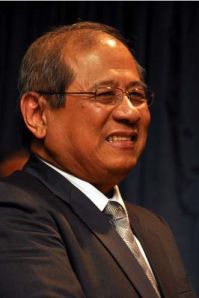
Kamla Persad-Bissessar, M.P. Photo courtesy Guardian Media
Kamla Persad-Bissessar, M.P., leader of the Peoples’ Partnership and newly elected Prime Minister

The CL Financial bailout has been a major public concern since it was announced on 30th January 2009 and I have been critical of the steps taken by the current administration to deal with the collapse of what was the Caribbean’s largest conglomerate.  The leader of the Peoples’ Partnership (PP), Kamla Persad-Bissessar, has been noted for her strong criticism of the actions of the then Minister of Finance in making early withdrawals from the CL Financial group before the collapse.  Her arguments in the Parliament are an important part of the story of this fiasco.

National elections are tomorrow, with the distinct probability of a victory by the united PP, so it is timely to consider the way in which that group might handle the bailout.

In addition to her major contribution to this debate, the opposition leader has recently promised to revisit the terms of the bailout and that is an intriguing development.

It is impossible at this stage to know what the PP will do on this important public matter, but I have been considering the role of certain major players.

The Insiders

For example, these are prominent people, formerly from the highest level of the CL Financial group –
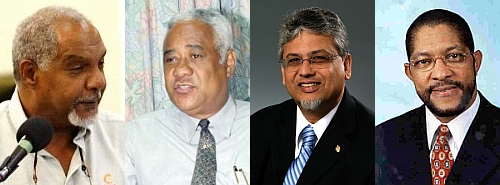
The Insiders
The Insiders: (l - r) Robert Mayers, Mervyn Assam, Dr. Bhoendradatt Tewarie, Carlos John
  • Robert Mayers – Deputy Leader of CoP and former Managing Director of CMMB – Mayers retired in November 2008 and was reportedly the financial adviser to Lawrence Duprey.  Mr. Mayers is not listed in the CL Financial Annual Return of 17th February 2009 as a shareholder.
  • Mervyn Assam – Former Trade Minister with UNC in the 1995-2000 period and UNC Senator up until the dissolution of Parliament in April.  Assam was a founder of CLICO Investment Bank (CIB) and its last Chairman before the collapse.  Despite the heat and temper of the election campaign, we have heard nothing on the role of Assam in the collapse of CIB.  Yet again, the ‘Code of Silence’ is suspected, by negative inference, as it were.  There seems to be some tacit agreement between the contending parties on this controversial matter. Mr. Assam is listed in the CL Financial Annual Return of 17th February 2009 as #22 of the 325 shareholders, holding 7,500 shares.
  • Dr. Bhoendradatt Tewarie – Former Principal of UWI (St. Augustine), Director of CL Financial and Republic Bank Limited at the time of the collapse.  The Foundation for Politics and Leadership, which was founded by some of the leading figures in the Congress of the People (CoP), headlined Dr. Tewarie to speak at their January 16th conference ‘Thinking Ahead – Governance in the 21st Century’.  Tewarie is reported to have been one of the Directors who was present at the last Annual General Meeting of CL Financial on 23rd January 2009 at Trinidad Hilton.  Yes, that is 7 days after they paid the final dividend; 10 days after they wrote the Central Bank and 7 days before announcing the bailout.  Again, Tewarie is also silent on those events in the CL Financial Boardroom. Dr. Tewarie is listed in the CL Financial Annual Return of 17th February 2009 as #290 of the 325 shareholders, holding 1,171 shares.
  • Carlos John – Former close aide of Lawrence Duprey and Director of CL Financial.  Now visible at political meetings and has reportedly been recently canvassing in support of the PP’s St. Joseph candidate, recently-retired High Court Judge, Herbert Volney.  Mr. John is not listed in the CL Financial Annual Return of 17th February 2009 as a shareholder.

It is easy to imagine these men playing an important part in any future PP government.

The Outsiders
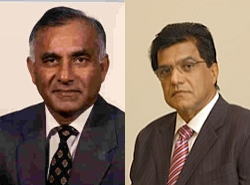
The Outsiders
The Outsiders: (l - r) former MPs Trevor Sudama and Ramesh Lawrence Maharaj

In contrast, the two UNC MPs who, publicly and in advance, voiced serious concerns over the CL Financial group were economist, Trevor Sudama and  former Attorney General, Ramesh Lawrence Maharaj.  Both of those courageous individuals suffered the wrath of Mr. Panday and eventually found themselves sidelined.  Ramesh was an MP in the last Parliament and ended up backing the very Basdeo Panday in the UNC’s recent leadership contest.  A twisted road indeed, but ultimately, with Kamla’s victory, Ramesh has now been excluded from the ranks of PP candidates in tomorrow’s  election.  Only those two individuals in our public life had the foresight and fortitude to sound the alarm on CL Financial.  For whatever reason, we have now come to an arrangement of forces which has no room for those two men.

What is at stake?

Apart from the crucial Special Purpose Entities (SPEs), the CL Financial bailout has placed the entire group under State control.  There are  therefore substantial Directorships and contracts, within the very CL Financial group, to be dispensed.

SIDEBAR: FIXING the bailout

Some of the main issues which must be dealt with if the bailout terms are to be normalised would be –

  • Audited Accounts – There is an immense variance between the asset value of the group as per their 2007 audited accounts ($100.7Bn as published on 18th November 2008) and as stated in their letter of 13th January 2009 requesting urgent financial assistance (a mere 56 days later, the asset value was stated to be $23.9BN). We need to have the audited accounts for 2008 and 2009 published without further delay. In any case, that publication is mandated by clause 4.4.5 of the Shareholders’ Agreement.
  • Payment of CL Financial dividend – CL Financial paid a dividend of $3.00 per share to its shareholders on 16th January 2009, 3 days after writing to seek the urgent financial assistance of the State.  Steps need to be taken to recover those dividends from the shareholders.
  • Role of the Regulator – The Governor of the Central Bank has repeatedly told of the long-term concern over the risks inherent in CL Financial’s operations.  We need to know if those regulators were at fault and to what extent could all of this have been avoided.
  • Fit and Proper conduct of the Directors – The ‘Fit and Proper’ criteria which are essential qualifications for Directors and Officers of Financial Institutions, were clearly not followed, if we are to believe the public statements of the Governor.  What is to be done with the offenders? Will a PP administration be willing or able to dis-qualify those Directors?
  • Taxpayers’ protection for CL Financial shareholders – The Shareholders’ Agreement of 12th June 2009 extended the bailout protection to the shareholders of the collapsed group.  For the interests of shareholders to be protected in this situation is contrary to good sense and violates elementary principles of good public policy.  It is unprecedented anywhere else in the world, including Nigeria, as shown in ‘Finding the Assets‘, published in the Business Guardian on 19th November 2009. Literally, it is a case of ‘Only in Trinidad & Tobago’.  Question is, will a PP administration be reversing that corrupt decision?
  • The strategy behind the bailout – Most importantly – ‘What is the strategy behind the bailout?‘  On 31st March, there was a major press conference of the CL Financial leadership to announce the resignation of Dr. Euric Bobb and the appointment of Marlon Holder as the group’s new CEO.  The promise to provide accounts and a strategy was a key feature of that event and it is awaited.

SIDEBAR: The role of SPEs

There are about 65 SPEs and the terms of the CL Financial bailout bring another 65 companies in that group within the umbrella of State control.  That is a total of 130 companies and this could be an opportunity to re-shape the corporate culture of the place.

The opposition leader has been noted for her sharp questioning of the real role of the SPEs, even going so far as to suggest that they are deliberately used to avoid the norms of proper accountability in the spending of public monies.

The PM, Mr. Manning, also told us in his interview last Sunday that in some cases, the SPEs may have ‘cut corners’.

Both those statements seem to signal an acceptance of the need to change, but we will have to wait to see what actually happens.

Change, not Exchange: The Two Tendencies

In view of the season and the issues raised so far in this series, I am setting out some ideas about the scale of challenge we must overcome to achieve change, not exchange.

The State-owned Special Purpose Entities (SPEs) are an important part of the picture in the provision of goods and services to our country.

“The idea that important SPE/State jobs and contracts are available for those in political favour is one of the things we have to change.”

Who is to run these important entities?  In what manner?  These questions of “w” are central to the sharp public concerns over the level of corruption at and performance of, these agencies.  My contention is that there are two contending tendencies in the minds of those who make that sort of decision.

  1. The first of these is the professional, sensible idea that some elements of the SPE-world are so complicated and important that the best people have to lead them, regardless of their political affiliation.  In this space I am sketching, that would include elements like First Citizens’ Bank, Unit Trust Corporation, National Insurance Board (including its affiliates NIPDEC and TTMF), UDeCOTT, HDC, NIDCO, WASA, TTEC, TSTT and so on.  It seems reasonable to take the position that these companies should be run by the most competent staff of integrity and along ‘best-practice’ guidelines.
  2. The second of these is the idea that having been victorious in a national election, the ruling party has the right to appoint whomsoever it wants to key positions.  Some would go so far as to say, it is not just a right, but a duty, given the sacrifice and contribution of certain supporters.  The rationale here being that we exist in a democratic system and the best positions in the State empire rightfully belong to the ruling party, to give to those in political favour.  Those people may be seen as being more sympathetic to the objectives of the ruling party.

The two ideals exist in fundamental tension, moreso since other aspects of the question are also in flux.

There is no clear agreement as to the boundary between the critical SPEs and the rest.  Some of the players believe that every SPE should be subject to their political whims, while others have clear ideas as to which ones must be managed professionally.

Also, it is quite likely that the two ideas co-exist in the minds of some of the main players.  That is, they are themselves severely conflicted on the entire subject.

The idea that important SPE/State jobs and contracts are available for those in political favour is one of the things we have to change.

At this moment we are poised before a snap election, with a highly-charged atmosphere on the issue of SPE corruption.  Even devotees of the ruling party seem to be shocked by the scale of the problem.  Whatever the outcome of this election, there is likely to be considerable action on this aspect of public affairs.

If the present ruling party wins convincingly, we are likely to see a triumphant return to the stated policy of Expediency in Public Affairs.  Those winners could declare that the policy approaches which brought us to this sorry place are the right ones, which were endorsed by the electorate, so we return to mismanagement and dishonesty.

The possibility of a victory of the Peoples’ Partnership also holds challenges in this area, since they could return to old habits.  By that I intend to remind readers that when UNC took office in 1995, there was a widespread series of dismissals of top-level staff at SPEs.  It was so large-scale that the late Grand Master wrote a 1997 calypso on it – ‘De No-Work Band’.  It was never a very popular one of Kitch’s numbers, but those people who suffered sudden and unjustified dismissal will remember the tune, as well as the words.  Plenty names and bitter-sweet too bad.  PNM did much the same thing when they returned to office in 2001.  No kaiso for PNM, though.

That pattern of brusque dismissals and crude exchange is highly questionable, given that both parties have fundamentally similar economic and social policies.  It seems to me that the dismissals are motivated more by by vengeance and a desire to control the vacated jobs, than by any actual difference in ideology or approach..

This is what I mean, in saying that we need change not exchange.

It might seem unlikely, but we could very soon be confronting these issues of who runs our SPEs and how, in what is likely to be a harsher, sharper fashion than ever before.

The ingredients are all there –

  • High stakes in terms of highly-paid jobs;
  • Huge contracts to be distributed;
  • The atmosphere of hubris which seems to fill the highest chambers of our Republic;
  • Either the thrill within the Peoples’ Partnership upon winning this snap election or the sheer triumphalism of the current ruling party to have beaten all its united detractors;
  • The poor moral fibre of those involved.

Yes, come 25th May, we could be seeing a situation which eclipses all the wildness which has gone on so far in this country of ours.

It is clear that there are certain SPEs which must be forensically investigated, with people charged under the law with a view to recovering the stolen funds and restoring a healthy atmosphere to public life in this country of ours.  I have already given a lot of detail on those SPEs.  My point holds ‘irregardless’ of who wins the election.  The situation of gross mismanagement and unpunished corruption is too dangerous to our good health as a nation to be allowed to continue just so.

It is equally clear to me that there are serious, capable and committed people in our SPEs.  Those people have been exemplary in the execution of their duties and added real value to the public service in this country.  They are all now at risk of suffering the fate of other ‘political appointees’ when the other side wins.

It is not good enough for us to shrug and murmur that that is how these things go.  We are a small country, with limited human resources and we cannot spare the intellectual capital which is evaporated every time we go through these purges.

Seeing the Big Picture – Learning the Lessons of the SPE fiasco: Part 5

I have set out the key findings of the Uff Report, insofar as the elements of governance go.  Those were combined with recently published news to offer a picture of the manner in which our leading Special Purpose Entities (SPEs) are being governed.

The picture is an unflattering one, which few could seriously seek to emulate. It brings to mind the question raised here some time ago – ‘What was it really all for?‘  I continue to believe that the State must behave in an exemplary fashion, but that is not all.

The concerns over governance being raised in this series ‘Learning the Lessons’ are part of an attempt to query the true purpose and effect of the SPEs.  The point I am making in this final installment is that there are pre-conditions which ought to eclipse even important points like missing years of audited accounts, unsigned contracts, ‘back-fitted’ financial documents, publication of massively-inflated achievements, bogus feasibility studies and the like.  Just listing the important principles which have been violated, the whole situation seems incredible.

Important as it is to eradicate those unprofessional and dishonest practices, there has to be more to the development process.  Yes, even if the main ingredients of good corporate governance were practiced at our SPEs, it would all be for naught, unless those companies are operating in accordance with a sound strategy for national development.  Good corporate governance is necessary, but not sufficient, if we are to achieve the sound development which every right-minded citizen would desire.

nidcoTo illustrate this point as to the importance attached to strategy, I am going to shift focus from UDeCOTT and the HDC.  I am going to consider the operations of NIDCO in terms of examining this issue.
In her maiden budget speech on 22nd September 2008, the Minister of Finance set out the main elements of this government’s ambitious transportation plans.  These were in four parts – the rapid rail project, the coastal water taxi, the building of more highways and a significant expansion of PTSC’s fleet.  The Rapid Rail, Coastal Water Taxi and Highway building program are all being handled by NIDCO.

“…another slew of ambitious, extremely expensive and long-range plans being carried out supposedly for our benefit, but once again, we are witness to fundamental dishonesty on a huge scale.”


In ‘P3 and the Proposals’- published in this space on 23rd October 2008, see http://www.raymondandpierre.com/articles/article58.htm – I wrote –

The National Infrastructure Development Company’s (Nidco’s) high-profile advertisements for rapid rail are now giving one pause. Hear this: “As part of a holistic plan to ease traffic congestion and create a more modern, efficient, transportation network, the Ministry of Works & Transport…signed a design-build-operate-maintain contract on April 11, 2008, for the implementation of the Trinidad Rapid Rail Transit System.

Where is this holistic plan?

Were public comments ever invited on that plan?

Where can the public see that plan?

It was plainly the intention of NIDCO, in this series of advertisements, to promote the belief that these four huge, expensive initiatives are all part of a comprehensive strategy.

I was very sceptical and continued to call for the ‘Holistic Plan’ to be published.  All to no avail.

On 27th November 2008, I submitted my application, under the provisions of the Freedom of Information Act (FoIA), for a copy of the said ‘Holistic Plan’.  My application was sent to both the Ministry of Works and Transport (MoWT) and NIDCO, its implementing agency.

That FoIA application and NIDCO’s reply also dealt with the Rapid Rail contract, but that is for another time.

On 2nd January 2009, I was ‘phoned by a civil servant from MoWT, who advised that they were ‘working on my application’; she confirmed by email later that day that “…we are still gathering the information and working on your request…”.

Just imagine that.  9 months after signing a major contract, reportedly ‘…as part of a holistic plan…’ and three months after publishing advertisements to that effect, I get an email from MoWT to say they are putting the plan together.

On March 6th 2009, the Permanent Secretary of MoWT wrote me to apologise for the delay (these FoIA applications are supposed to be dealt with in a month) and direct me to pursue NIDCO for a reply.

On 4th August 2009, NIDCO’s Vice-President Legal, Nirad Samnadda-Ramrekersingh, wrote in reply to my application for the ‘holistic plan’ –

…please note that same does not exist either as a formal document or series of documents and that the term as used in the newspaper advertisement to which you have referred is simply a descriptive reference to the Rapid Rail Transit System, the Water Taxi Service, the Interchange Project and the existing PTSC and Maxi Taxi networks also described in the said advertisement.  We are satisfied that this is the case…

“…simply a descriptive reference…”  Take that.

So there we have it, another slew of ambitious, extremely expensive and long-range plans being carried out supposedly for our benefit, but once again, we are witness to fundamental dishonesty on a huge scale.  Just like UDeCOTT, with its bogus feasibility studies, we can see that NIDCO’s claims are also highly questionable.  In the absence of real development strategy, we can only hope for a lucky accident.  That is no proper road to national development.  Particularly in the arena of physical development, where decisions have long-term physical, environmental and financial consequences.

As our servant with special responsibilities, the State is responsible for carrying out those developments in accordance with some sound strategy.  We must raise questions which are fundamental if we are to do better.  If we are to do better, we have to think and act differently.  Big changes are essential if the State is to deliver the future we need.

SIDEBAR: National Infrastructure Development Company (NIDCO)

NIDCO is a State-owned company, established in 2005 and under the control of the Ministry of Works and Transport.

According to its website – www.nidco.co.tt – its vision is –

Vision
To be a key enabling vehicle for the development of infrastructure that enhances and sustains Trinidad and Tobago’s economic development and quality of life.

Its core values are –

  • Transparency.
  • Professionalism & Quality.
  • Integrity, Trust, & Honesty.
  • Meritocracy.
  • Teamwork.
  • Commitment.
  • Communication & Participation.

No reasonable person could object to those principles.

The Chairman of NIDCO is Professor Chandrabhan Sharma, of UWI’s Engineering Department; Professor Sharma is also a Director of Republic Bank Limited, TTEC and several other companies.

NIDCO’s President is Kaisha Ince, Attorney-at-Law.

The CL Financial bailout and the Special Purpose Entity fiasco – Joining the dots

Here we are…In the Land of the Mimic-Men,
You run from the pain,
But the jokes pull you back again,
But home is home,
So you say ‘Hail la Trinity!’,
Then yuh talk about the Love of Liberty,
But then ‘Forge’ is the first word of we Anthem,
Yuh see we so damn corrupt,
That is the problem,
So now dey tief but you ignore,
So now you workin,
And for yuh Children sake, man yuh eh jokin…
–David Rudder – ‘Another Day in Paradise’.
Lyrics © 1996, Lypsoland Music. Used by permission. All Rights Reserved.

On 12th March 2009, the Business Guardian published ‘Sagacity and Veracity’ as my attempt to compare the aspects being revealed by the unfolding collapse of CL Financial and the Uff Enquiry into the public sector construction industry.  At the time, quite frankly, it felt like a bit of a stretch to compare the two….what do we know now?
CLICO vs UDeCOTT
No need to burden readers, the last few months have been crammed full of shocking details of these situations.  Time for me to try putting them into some perspective.

Some threads to start pulling together –

  • CLICO, the biggest part of the Caribbean’s largest and most successful conglomerate, had not reconciled its bank statements for 3 years or established an audit committee.
  • UDeCOTT, the exemplary Special Purpose Entity, ‘back-fits’ invoices and is unable to publish its accounts for three years.
  • The Housing Development Corporation knowingly and massively over-states the numbers of new homes they have built – they have no signed contracts for any of their projects.
  • We have an entire Integrity Commission resign; having ignored expert advice only to lose a damaging court case, yet to date there is not even an attempt to offer an explanation for their bizarre, unseemly actions.
  • To cap it all, we have the sitting President of our Republic appoint a slate of candidates to replace that Integrity Commission.  That slate was questionable, including an intellectual accused of flagrant plagiarism and a prohibited person (being Chief of a State-controlled Agency).  So much so in fact that it caused me to question seriously, for the first time, the mental capacity of that office-holder.  I could scarcely believe my ears, when the President, addressing the nation after his month-long holiday in some undisclosed location, told us all that he did not have to explain anything.

In addition to the absence of consequence, there exists a potent Code of Silence…Only whistleblowers are punished in our Republic…Is almost like gangster business, where witnesses need special protection. Gangster politics.


What is obvious to me is that the absence of consequences is proving inimical to our national development.

In addition to the absence of consequence, there exists a potent Code of Silence which prevents us from getting a reliable account of what really went on inside any of these many situations.  I am speaking here of attributed interviews which can form part of our understanding the problems.  Nobody on the CL Financial or UDeCOTT or HDC Boards has spoken openly.  No one in any of the previous Cabinets.  Is like we walking in de dark (Thanks, Brigo).

There is no point in citing Cabinet secrecy or commercial confidentiality as reasons for the silence.  That would involve an attachment to principle which is not part of our situation.  In other countries with far more at stake – USA in its ‘War on Terror’, for example – it is normal to see detailed, open accounts of what has taken place at Cabinet and other top-level commercial meetings.  Our Code of Silence is a different thing.

One thing, we all know for sure, even with the national absence of consequence, is that one type of person will definitely be punished.  Yes, that is the ‘whistleblower’, the seeker after truth.  Only whistleblowers are punished in our Republic.

Is almost like gangster business, where witnesses need special protection.  Gangster politics.

Can we escape our culture?  Can we escape our culture?  Can we eclipse ourselves?

Do we need a big Witness Protection program?  Who is to Guard those guards?

A good example is worth a thousand words’, so my teachers used to say.  What kind of example are we setting for our young people?

The people responsible for this mess are our Leadership Class.  These are the people – yes, I know that I am one of them – who had the best schooling and opportunities.  We are witnessing a lack of responsible behavior by our leadership class – the best and the brightest.

We are living with the consequences of an absence of consequence.

Careless Chiefs

Imagine a parent, becoming aware that something improper is happening between one of their children and a responsible adult, someone like a teacher or coach.  Someone whose job it is to nurture your child in a responsible fashion.

A responsible parent will take immediate steps to deal with the problem.  Try to imagine what kind of parent will deal with a coach behaving improperly with one child, but leave their other children in that class, with the said ‘interfering’ coach.

Yes, we have a ‘Father of the Nation’ who has done just such a thing.  The fact is that the dismissed UDeCOTT Directors have not been removed from their other positions at State-controlled organizations.

That is the scale of the problem.

For the Party People

Some readers might see these columns as being critical of the PNM government and to some extent they would be right, since that is the party in power during these various episodes.  It being election season, nobody should be surprised that this stream of damaging revelations – on UDeCOTT, HDC, CL Financial etc – is very useful to the Peoples’ Partnership in the campaign.

As bad as the revelations of corruption, I am not at all sure, given their recent and indisputable record on these questions, whether the UNC would have done differently had they been in power in the last 8 years or so.  I can clearly recall the rejection suffered by Maharaj, Sudama and Maraj when they spoke out against corruption in the last UNC government.  The dissolution of Parliament and the calling of fresh elections soon followed, just like in this rounds.

No, this is not a political column, just an attempt to set out some points of view on our situation.  To stay on point, I agree with Transparency’s Chairman, Victor Hart, that the non-publication of the Bernard Report into the Piarco Airport project was a pity.  Hart, who was a Commissioner on that Enquiry, has also said that, had it been published, we would have been unlikely to have had the UDeCOTT situation.  Interestingly enough, PM Manning promised to publish it, but over 6 years later it remains concealed, for whatever reason.

The Peoples’ Partnership seems to be forging ahead on the winds of public disgust with large-scale corruption, so I am now calling on the leader to make us a public pledge to publish the Bernard Report into the Piarco Airport project immediately upon taking office.

The outline from ‘Sagacity and Veracity

https://afraraymond.wordpress.com/2009/03/12/sagacity-and-veracity/

An easy guide to the CL Financial and UDeCOTT Fiascos

Six quick pointers for our readers –

  1. Ambitious Empire-building
  2. Other peoples’ money
  3. Excessive borrowings
  4. No cogent planning or feasibility checks
  5. Real Profits? – Is it possible for CL Financial to pay dividends at the same time as writing to seek the State’s urgent financial assistance?  How could UDeCOTT be declaring improving profits as a property-development company, if every one of their projects is not feasible?
  6. Strategic Agenda – The common agenda is to privatize the benefits and profits while being careful to nationalize the losses.  We reject that agenda.  Moral hazard has to be upheld as a reality if we are to develop a progressive nation.

Learning the Lessons: Part 4

Last week I promised readers some details of the scale of the failure at the HDC and UDeCOTT.

The failure is systemic and exists at every level.

“That is nothing less than scandalous and deceptive behavior from those we trusted with our national wealth. It is like doing a business plan to open a ‘Chicken and Chips’ outlet and leaving-out the cost of the chicken. Bogus.”

The Special Purpose Entities (SPEs) were established to achieve a more rapid rate of national development.  The idea was that we, the public, would benefit from the ‘best of both worlds’, so to speak, in that the ‘best practice’ of the private sector would be used in the SPEs to satisfy the requirements of the public for better roads, housing or other goods or services.

Starting at the level of underlying purpose of these SPEs –

  1. HDC was established in 2005 as the successor agency to the NHA.  The target set in the 2002 National Housing Policy is for 100,000 new homes to be built in a decade, but that annual target was reduced in the first year to 8,000.housinginside

    In the seven years between 2003 and 2009, there should have been an output of 56,000 new homes, but the total output claimed was repeatedly given by the PM and the Minister of Planning, Housing and the Environment as being about 26,000.  In March, I publicly challenged the accuracy of those claims and the new MD of the HDC, Jearlean John, released revised figures – see http://guardian.co.tt/news/politics/2010/03/28/unc-claims-hdc-voter-padding-opposition-strongholds-marginals – which showed a total of 15,394 new homes built in the period.  An annual average of about 2,200 new homes, about a quarter of the reduced target.

    That is at least 10,000 less new homes than the HDC’s chiefs had been claiming.  What trouble is this?!  Now, at the same time as we thanked Ms. John for setting the record straight, just try to imagine the record-keeping and integrity of an organization which could repeatedly overstate its achievements in this fashion.

    That is the scale of the problem.

  2. UDeCOTT’s mission is to develop the structures that form part of Vision 2020 and which “will be achieved in accordance with…commercially viable principles…” – see http://www.udecott.com/index.php/cc/cc_sub_level/C6.  Those claims are equally baseless, since Calder Hart admitted under my cross-examination that only one of UDeCOTT’s many projects had been the subject of a feasibility test.  Only one.  That was the International Waterfront Complex and my further questioning revealed that the value of the land had been omitted from the equation.  That is nothing less than scandalous and deceptive behavior from those we trusted with our national wealth.  It is like doing a business plan to open a ‘Chicken and Chips’ outlet and leaving-out the cost of the chicken.  Bogus.  Our PM went to great lengths when he addressed the Senate on 13th May 2008 to point out that UDeCOTT’s projects were all approved by Cabinet, after a thorough review process – see http://www.ttembassy.org/051308.htm.  Additional claims were also made as to the ways in which Cabinet monitored UDeCOTT’s operations.  As I wrote in this column, early in my critique of UDeCOTT – There is either a sobering naivete or a lack of rectitude in the highest chambers in our Republic.

    That is the scale of the problem.

In both cases, we are witness to fundamental dishonesty on a huge scale.

Moving on to the findings of the Uff Report –

Looking at the controversial Cleaver Heights project, at para 25.30, the Report states

…The absence of a written contract was put in context in the cross-examination of Minister Dick-Forde when she confirmed advice from HDC to the effect that none of their large projects and none of the small projects either had a signed contract .   It was subsequently confirmed that as at January 2009 HDC had 64 large projects ongoing and 591 small projects, none of which had a signed contract. Large projects were those over $50m in value. Thus, while there appeared to be no good reason why a formal contract was not signed between NHA and NHIC, it seems clear that to have done so would have been a highly unusual step and one which was presumably regarded, both by NHA and HDC, as unnecessary.…”

Not one HDC contract has been formally drawn up or executed.    Not one.

My colleague, Ken Ali, put out a hard-hitting exclusive on the ‘HDC’s Silent Projects’, published in last Monday’s Guardian at http://guardian.co.tt/news/general/2010/04/26/capacity-firms-weak-non-existent.

UDeCOTT was also involved in its own widespread and unconventional practices, namely ‘back-fitting’ of data, as described in the sidebar.

On the blighted Brian Lara Cricket Academy (BLCA), being built by Hafeez Karamath Ltd. (HKL), we are told –

  • Para 16.16 – referring to advance payments to the contractor –

    …As a result money was advanced in circumstances which do not appear to have been governed by any ascertainable rules and amounted effectively to very substantial loans to HKL. Such a procedure is quite unique in the experience of the Commissioners. It calls for explanation but none has been offered…

  • Para 16.17 – referring to UDeCOTT’s accounting system –

    …UDeCOTT’s administration and recording of the payment process was “appalling” and required a great deal of detective work to get to the bottom…

  • Para 16.21 – referring to UDeCOTT’s attempts to explain its management of the BLCA –

    …does not by any means explain why UDeCOTT staff had gone to such extraordinary lengths to ensure that HKL was paid as soon as the money became available; why UDeCOTT was seemingly so anxious to make payments substantially beyond the value of work carried out (and in circumstances where the contractor was already in default such that TAL had long since recommended termination); and why UDeCOTT chose to disregard the opinions of the appointed engineer (TAL)…

  • Para 12.45, citing the work of MacCaffrey –
    1. Of 79 Certificates issued for advance payments, 39 were wrong in relation to the sum for payment of advance payment, 60 were wrong in relation to the amount of advance payment made to date and only 4 out of 79 correctly recorded the advance payment and the amount of repayment.
    2. UDeCOTT’s contemporaneous reporting of advance payment is materially wrong (i.e. under-reported) by tens of millions of TT$ for the vast majority of the duration of the project.
    3. UDeCOTT decided to back-fit Payment Certificates in February 2008. Those back-fitted Certificates also materially under-reported the amount of advance payments made. All the back-fitted Certificates have been endorsed by at least two signatories and in some cases three.

Little wonder that UDeCOTT’s audited accounts have not been published since the end of 2006.

The Cancerous Cozy Consensus

Given the scale of the bobol revealed in this single Enquiry, one can only wonder what else is taking place at other SPEs.  The relationships are so cozy that one seldom, if ever, hears of anyone being made to repay the monies stolen or even face the Courts.  I am repeating my call that it is time for us to review the performance and proper role of the SPEs.

It might also be useful at this stage, for those of us who exist in the ‘comfort zone’ of private sector superiority to reflect on how seldom, if ever, we act against ‘White-collar’ crime.

SIDEBAR: ‘Back-Fitting’ of Financial Documents

One of the hidden practices of UDeCOTT which was revealed in the Uff Report was that of ‘back-fitting’ of payment certificates so that various erratic and unsupported payments could continue, all under the veil of accountability.  For readers who are unfamiliar with this sort of practice or surprised that such could be the practice at the ‘best-performing SPE’, they might find it easier to understand if the colloquial phrase is used…Yes, ‘Ratchefee”…

Learning the Lessons of the UDeCOTT fiasco: Part 3

The reflections continue this week, by drawing heavily on the text of the Uff Report and the transcripts of the Uff Commission, to set some of the scandalous facts into context.  This is for those who are still wondering ‘What was it all really for?

Last week I wrote that the State must behave in an exemplary fashion.  It is also important to know that the State has a responsibility beyond the moral plane.  On an entirely practical level, it is clear that the State controls the majority of economic activity in our nation. As such, it is responsible for the majority of construction projects in the country.  If we exclude the exceptional projects built for the energy sector, over 75% of the construction in the country is carried out by the State.

Apart from statutory undertakers – like TTEC, WASA, TSTT etc. – the State carries out most of its capital investment via various SPEs.  Those would include:
SPE logos

  • National Infrastructure Development Co. (NIDCO)
  • Housing Development Corporation (HDC)
  • Urban Development Corporation of T & T (UDeCOTT)
  • University of Trinidad & Tobago (UTT)
  • Evolving TecKnologies and Enterprise Development Company Limited (e TecK)
  • Education Facilities Co. Ltd (EFCL)

The conduct of the State is therefore fundamental to the conduct of a huge slice of the business activity in our country.  If the behaviour in the majority of our commercial relationships is improper, that is good reason for the cynical attitudes and poor standards which flourish.

Yes, there is considerable ambiguity in the term ‘improper’ and I am therefore going to illustrate.

  • The role of Boards of SPEs – As I said when warning against the appointment of Michael Annisette as an Independent Senator – see https://afraraymond.wordpress.com/2010/04/22/2008/01/12/an-unhealthy-choice/ – speaking of “…Directorships in significant State-owned enterprises…it is a widely-held view that such appointments, especially to those who are not experts in the relevant fields, are only offered to those in political favour.  To put it plainly, one would hardly expect to see UNC or COP members, however expert, on State Boards under a PNM administration…”  Despite the fact that there are many excellent and hardworking Directors of SPEs, that is the background to those appointments.  Just to make sure, given the ‘silly season’ we have entered, I am equally convinced that when UNC was last in power they also allocated those SPE Directorships in a similar fashion.
  • The role of the Executive Management – Suffice to say that there is little difference in the considerations when making those appointments.
  • The role of consultants and contractors – It is impossible to say who these stakeholders support, apart from themselves.

One of the perennial questions is ‘How come State projects are almost always overbudget and late?’   That is a truly universal question and the problem, if only the main element is isolated for discussion, is that the parties are too close.

The typical contractual and managerial controls of budgets, accounting systems, independent professional advice and penalty clauses were all violated wantonly.  Our Treasury has been plundered.  See the sidebar for an extract from the Uff Report.

UDeCOTT and the HDC are the State’s two main agencies in the move to physical development, they are both under the Ministry of Planning, Housing and the Environment.

We are now clear that both have been failures when measured against the goals set for them.  The sheer scale of the failure will be set out next week in this space, again with extracts from the published record.

We need to ask what has to happen differently?  Can we make the change?

SIDEBAR: What is ‘Good Governance?’

Governance is one of the vexed aspects of this discussion on the purpose and performance of Special Purpose Entities (SPEs).  Whether we are looking at the HDC or UDeCOTT, the concerns are similar.

At the national level, we can have a broad description of good governance which includes elements such as – equity, participation, accountability, transparency and conforming to the rule of law.  Of course, when we focus on the SPEs, there is a narrower definition of good corporate governance being the rules which are followed by a Board of Directors to achieve fairness, accountability and transparency in the relations with the company’s stakeholders.

When one considers that the SPEs were introduced to overcome the delays of the old civil service rules, their corporate governance rules are key in achieving those elusive levels of performance.

  • Extract from the Uff Report – Paras 62 and 63 at pages 33/34.

    “Holding to account

    62. We have observed, in the context of contractual issues as well as regulatory matters that there exists a culture of non-enforcement which appears to operate on a mutual basis. Contractors seem reluctant to issue proceedings for payments overdue or to enforce claims and employers in turn refrain from enforcing time obligations which are routinely not complied with.  In regard to delay issues, the point was demonstrated by the fact that no witness or representative appearing at the enquiry was able to quote any case in which a contractor had actually been required to pay or had been debited with liquidated damages. In the wider field there was a tacit acceptance that regulatory approvals, particularly as to planning, were rarely given in a final form before the work was performed, this coupled with an expectation that such approval would be forthcoming retrospectively.

    63. At the same time we had the impression that one contractor who made a habit of enforcing contractual rights, if necessary by formal proceedings, was regarded as being “confrontational”.  Such an attitude does not sit well with the careful drawing up of commercial agreements; nor with competitive tending, which is carried out on the basis that contracts will be enforced.  It is also inconsistent with the clear duty of directors of companies and public bodies to enforce the contracts they negotiate and enter into.  If there is a desire to promote the timely and proper performance of public sector contracts, this will only be achieved by holding parties to account for any breaches of contracts freely entered into; as well as enforcement of legal duties in regard to regulatory matters. Enforcement must also be assured through efficient and timely processes of courts and other tribunals.”

The emphases are mine.

The CL Financial bailout: Taking in Front – The NGC element

One of the abiding questions on the CL Financial issue is – ‘What main event/s caused the group to fail?

One of the main rumours making the rounds at the time of the bailout was that the State-owned National Gas Company had made heavy withdrawals from CLICO Investment Bank.  Those withdrawals and the requests for the return of further deposits were said to have triggered the ‘crash’ within the CL Financial group.

Another major issue which was raised in the Parliament by the current leader of the opposition was the allegation that the Minister of Finance and Governor of the Central Bank had used ‘insider information’ to withdraw their own deposits from CIB.  Despite the explanations by these officials, which form part of this article, those perceptions persist among the population.

Ultimately, the questions have to be ‘What did they know?‘ and ‘When did they know it?‘  This article will delve into some of those issues, using the published record, as is my practice.

The main points are –

  • Frank Look Kin, Former NGC President
    Frank Look Kin, Former NGC President

    The NGC press release – This was published in the daily newspapers on 4 February 2009, as a corrective to the widespread and potentially-damaging rumours.  It was issued under the hand of the NGC President, Frank Look Kin – it is the penultimate item on its publications page, under the title ‘Press Release- NGC’s Management of Its Financial Investments‘.  Due to its huge revenues (stated to be $14.0Bn in 2008), over 90% of which are in US dollars, the NGC has established a policy for the management of its large-scale, short-term investments.  According to the press release, those funds are placed in either approved financial institutions or investment-grade rated foreign banks.  The placement of those deposits is guided by limits for the percentage of funds allocated to a financial institution or group of financial institutions.  The selection of deposit-taking institutions and the establishment of placement limits are both good financial practice in terms of risk management.

  • NGC’s placement limits – These were not disclosed in the NGC press release, but we are told that at the start of 2008, the CL Financial group was allocated 40% of the NGC’s deposits, which by the end of 2008 had been slightly reduced to 37%.  At another point we are told that in 2008, NGC withdrew an average of $151M USD per quarter, with CL Financial’s portion of that being 45.7% – more than the 2008 allocations stated earlier.The silence on the actual placement limits means that we cannot determine whether the 2008 deposits in the CL Financial group complied with that policy.  The only deposits for which we are told ‘…the deposits were within the maximum percentage limits…’ were CIB deposits in 2001, but no percentages were given in that case.We are also told that “…In the 4th quarter of 2008, deposits were recalled upon maturity from…seven financial institutions in Trinidad & Tobago and the USA…”  Even if we only count the local ones, there are 6 large banks and 19 other approved financial institutions available to accept deposits under NGC’s policy.  It is passing strange that up to 45.7% of NGC’s funds could be allocated to a single group.  If that allocation of funds in 2008 was in conformity with NGC’s deposit placement policy, it is indicative of a tremendous measure of confidence in the CL Financial group, to put it in its best possible light.  Even if CL Financial were a ‘blue-chip’ group, which they were not, such an allocation of deposits could be viewed as reckless behaviour by the responsible parties.Despite its claims of a policy to manage the risks associated with being responsible for such huge, short-term investments, it seems that the NGC may have yielded to the temptation of the unrealistically high interest rates offered by the CL Financial group.  Again, on a governance note, one has to ask – ‘What good is a prudent policy, if it is violated in practice?’It seems that we may need to examine more closely how our energy revenues are invested.
  • November 2008 – We are also told in that press release that “…In November 2008 CIB failed to return the principal and interest upon the maturity of an NGC deposit (US$10 million).  This deposit, plus interest, was paid in two amounts during the first week of December 2008…”  From that statement it seems certain that CIB’s inability to repay was known to NGC, a huge, State-owned corporation.  It is difficult to imagine that news of that importance would not have traveled to the very highest levels.  Indeed, one could argue that proper management of the State’s financial resources would have required such a piece of news to be formally reported to the relevant officials.When one juxtaposes the fact that CIB “…failed to return…” $10M USD to NGC with the measure of confidence one can infer from the extent of their dealings, it is impossible to imagine such an episode passing off quietly.
  • The Governor’s response – Ewart Williams’ written response to the allegations was unequivocal and made the very same day – it can be viewed at http://www.central-bank.org.tt/news/releases/2009/mr090204.pdf.
  • The Minister’s response – That was a statement in Parliament on the very day and it is at pages 626 to 631 of http://www.finance.gov.tt/documents/news/spF82F5F.pdf. At the time of the CL Financial collapse, the Governor was clear in identifying the prime cause to be “…excessive related-party transactions…” and this NGC/CIB situation bears a strange resemblance.We need to strive for better norms of governance and prudence if we are to avoid a recurrence.History is said to be rich in irony, never more so than in this situation, since the defensive statements by both officials were made on the very day the NGC published its own defence.  Wednesday 4 February 2009.

SIDEBAR

Approved Financial Institutions

Those are taken to mean the 25 companies licenced under the Financial Institutions Act 2008.  Those companies are all required to be members of the Deposit Insurance fund and their names can be viewed at http://www.dictt.org/deposit_insurance/index.php?pid=2006.  There are 6 main banks on the list – Citibank, First Caribbean, First Citizens’, RBTT, Republic Bank and Scotiabank.  Two smaller banks on the list are Intercommercial Bank and Bank of Baroda.

Interlocking Directorships

A continuing concern, in light of the growing challenges to the old order of the commercial and financial world, is the role of inter-locking Directorships.  That is the situation in which a very small group of people control most of the major companies and activities in a society.

Critics of that situation would say that such situations are a recipe for corruption and self-serving behaviour.  The small group of people can enrich themselves, leaving the leftovers for everyone else.  Those who support that situation would say that the emergence of such a small group of leaders is natural, particularly in a small society such as ours, and the real challenge is to develop rules and norms which limit the possible negatives.

This is an issue which I am exploring in the ongoing series to examine the governance implications of the UDeCOTT fiasco.  It is not surprising that it is also a feature of the CL Financial collapse and there is an example of that in the case of NGC and CIB.

The CIB Directors

At the time of the collapse, the Board of Directors of CLICO Investment Bank comprised –

Mervyn Assam (Chairman)
Amjad Ali
Anthony Rahael
Maria Thorne
Michael Callendar
Faris Al Rawi

The NGC Executive

At that time, the National Gas Corporation’s executive management included –

Ms. Olave Maria Thorne, Vice President, Legal and Corporate Management and Company Secretary – see http://www.ngc.co.tt/About/executive.htm. Yes, same person.

Ten to One is Murder

A Kaiso title for the Election season.  And yes, we are told that CL Financial will rise again.  The picture is even more clouded than a year ago and the rumours abound.

The latest developments are –

  • Press conference of 24th March
    Justice Carlton Best. Photo courtesy Trinidad Guardian
    Justice Carlton Best
    Following a front-page Express story, on the impending lawsuit by Justice Carlton Best to recover his $57,000 CLICO deposit – see ‘I want my Cash’ at http://www.trinidadexpress.com/index.pl/article_news?id=161613671 – the Governor of the Central Bank held a press conference that very day to tell us that those waiting for the return of their deposits would have to hold strain – see http://guardian.co.tt/news/general/2010/03/25/delay-your-redemptions.  The further shocking news, after all the emphatic official statements that the group had good assets, was that if those were liquidated there would only be 10 to 15 cents in the dollar available to pay claims.  Now how could that possibly be the case? How are we to reconcile these conflicting accounts of the situation with CL Financial’s assets?  Is it that they are fully-pledged, over-pledged, or is there actually any ‘headroom’ within which the taxpayer can have a chance to recover the huge sums advanced so far?  Which is it?  Please note that this is not an isolated situation, as shown by another threatened  lawsuit from a former Attorney General of Guyana for the recovery of over $500,000 from CLICO – see http://www.kaieteurnewsonline.com/2010/03/27/former-attorney-general-threatens-to-sue-clico-trinidad/
  • Post-Cabinet Press Briefing – The Minister of Finance confirmed the Governor’s position to the media the next day, as reported in this paper – http://guardian.co.tt/business/business/2010/03/26/tesheira-clico-policyholders-be-patient.  In that article, the Minister is reported to have affirmed, again, that “…“The CL Financial Group had sound assets that were valued at more than $100 billion…”  Both the Governor and the Minister took steps to recover their own funds before the group’s financial troubles were public knowledge and that sits awkwardly, in the public mind, with their current appeals for patience.
  • Dr. Euric Bobb – At a Central Bank press conference on 31st March, resigned as Chairman of CLICO and as a Director of CL Financial, of which he was the Chairman, until his resignation late last year.
  • Governance – His statements as to the poor governance at CLICO, the leading company in the CL Financial group, were astonishing, to say the least – see “Governance was an alien term in CLICO’ at   http://guardian.co.tt/business/business/2010/04/01/bobb-governance-was-alien-term-clico.  No reconciliation of the company’s bank accounts.  No audit committee.  Those are serious shortcomings in the basic accounting and governance controls in any company.  For one which had investment as its centrepiece, those are shocking.  They give the impression of unprofessional and haphazard management of a significant part of our nation’s savings.  They detract from the reputation of the CL Financial chiefs.  Surely these shortcomings found their way into the Management letter from the Auditor to the Board and Shareholders?  Was the Central Bank aware that these elementary controls were absent?  Even if there are serious shortcomings in the financial procedures at CLICO, are we not entitled to rely on the Supervisor of Insurance or Inspector of Financial Institutions to resolve those in favour of the investing public?
  • Marlon Holder – At the same press conference, we heard that he resigned his job as Executive Director of the Unit Trust Corporation to become CEO/MD of CL Financial and Chairman of CLICO – see http://guardian.co.tt/news/general/2010/04/01/utc-boss-takes-over-clico-chairman.  Mr. Holder has had a high-profile career in the financial services industry at Citibank, FCB and the Unit Trust Corporation, before this latest move and we await his recovery strategy.
  • Reporting the changes – Both the CL Financial Chairman and the new CEO/MD recently confirmed that one of their leading priorities was to furnish a report on the state of the group and the progress towards its re-structuring.  That report is anxiously awaited and must include the audited accounts for 2008 and 2009.  As stated before, this is not negotiable and will be most revealing as to the apparent discrepancies in the asset values.
  • The Private assets – We also read recently that former CL Financial chief, Lawrence Duprey, had taken steps to limit the information he was required to furnish to the liquidator of CLICO (Bahamas) as to his private assets, allegedly acquired with CLICO funds – see http://www.trinidadexpress.com/index.pl/nart?id=161623489.

Hence this week’s title.  We await the audited figures.

SIDEBAR: Leading Lawsuit

There were reports in the Sunday Express of 11th April that the Central Bank had initiated legal action against Andre Monteil and Richard Trotman, both formerly of CLICO Investment Bank, for the recovery of huge sums allegedly obtained improperly in the HMB takeover – see http://www.trinidadexpress.com/index.pl/nart?id=161626823 and http://www.trinidadexpress.com/index.pl/nart?id=161626819

Those moves by the Inspector of Financial Institutions represent, as far as I am aware, the first time that legal action is being taken on this scale to tackle those accused of ‘white collar’ crime.  It is a decisive step to tackle the widespread impression that jail is not for the rich or lettered class in this society.  The course of this trial will be closely observed as it is the first step in a very long and necessary journey.

Our notions of development are rooted in the aspiration toward equality and opportunity.  Those worthwhile concepts must be extended to include true equality under the law.

One of the really fascinating aspects of this unfolding financial debacle, which includes the UdeCOTT collapse, is the idea that those accused of this sort of wrongdoing have extensive rights.  That kind of consideration is seldom offered to those accused of run-of-the-mill crimes.  If nothing, else, the CIB trial will be a kind of long-overdue ‘Open University’ course in the boardroom dealings which are masked from most of our people.

An overview of the Uff Report

Professor John Uff. Photo courtesy Trinidad Guardian
Professor John Uff

The Attorney General announced at the Post Cabinet press briefing on Thursday 1st April that the full Uff Commission Report will be laid in the Senate on Tuesday 6th April – see http://guardian.co.tt/news/politics/2010/04/02/uff-report-senate-tuesday.  I was pleased to hear that, but there remained a widespread attitude of skepticism as to the outcome of the AG’s promise.  One can hardly blame people for having those feelings since, as TTTI’s President, Victor Hart, has recently reminded us, PM Manning broke his promise to publish the report of the Bernard Commission into the Piarco Airport project.  That was over 6 years ago and still no Bernard Report yet.

I received a copy of the Uff Report in my email on Saturday and several other concerned citizens as well, so it seems that some publicly-minded person wanted to ensure that it was not either suppressed or edited.  Thank you, whoever you are.

The Uff Report is 512 pages long and contains 91 recommendations, so its sheer volume and the limited time available mean that I am unable to give a detailed review.  This week’s column will therefore comprise an overview of the main concerns raised in the Enquiry and the way in which the Report has handled those.

CORRUPTION

Q – Does corruption exist in the manner alleged by the government’s critics?

A – At para 59. the Uff Report states that “…It is accepted that corruption is a problem of serious proportions in Trinidad & Tobago…to which the construction industry is particularly prone…

Was there actually something corrupt or wrong at UDeCOTT?
Q – Is there good reason for concern at UDeCOTT’s operations, or is it a case of politically-motivated attacks?

A – Para 14.36, from the Commission’s discussion of the Ministry of Legal Affairs Tower/CH contract, is a classic of understatement – “…UDeCOTT’s application of its own rules discloses a worrying lack of transparency as well as inconsistency…

Para 14.37 states – “…the appearance of Mr. Calder Hart’s fax number on the notepaper, which was no doubt hurriedly printed by CH Development, remains unexplained…

Para 14.41 –“…there should be an investigation by an appropriate criminal Law Authority into the award of the MLA contract to CH Development, to include the role of Mr. Calder Hart and the conduct of the Board in not ensuring that an enforceable guarantee was given by the parent company of CH Development…

LOCAL VS FOREIGN

Q – Are local contractors being unfairly replaced by foreign contractors or do the foreigners really deliver better performance?

A – Para 6.18 states that – “…no convincing comparison has yet been presented from which reliable conclusions can be drawn as to the relative performance of local and foreign contractors or consultants…

PROCUREMENT

Q – Is it better for the government to try using Design and Build or should they stick with the traditional Design and Tender method of procurement?

A – Para 7.20 states that – “…there is no single system of procurement which should be preferred in all circumstances…

The Hart legacy –
According to Para 12.55 – “…We have noted the apparent absence of any note of criticism or dissent within the UdeCOTT staff and the dominant influence of the Executive Chairman, Mr. Calder Hart.  To the extent the failure of senior staff and directors to raise any voice in opposition to the level of financial irregularity found on the Brian Lara Project amounts to loyalty, such loyalty is clearly misplaced…

The Property Matters critique of UDeCOTT started in 2008 on the theme ‘A considerable concentration of power’, which attempted to draw lessons from the Cadbury Commission as to the perils of the Executive Chairman.

The role of UDeCOTT’s Board and its Executive Chairman came in for heavy criticism, with the Report calling for full investigations into the Ministry of Legal Affairs Tower and the Brian Lara Cricket Academy.  Furthermore, there is a recommendation that the roles of Chairman and CEO should be separated.

The Rowley saga –

Q – Was there really any money missing at Cleaver Heights?

A – Para 27.11 – “…the entirely erroneous addition of $10,000,000…

SIDEBAR: Notes to Jearlean John

Jearlean John. Photo courtesy Trinidad Guardian
Jearlean John, Chairman UDeCOTT

On Tuesday 16th March, I spoke at a JCC press conference and took the opportunity to issue two calls to Ms. Jearlean John – the MD of the Housing Development Corporation and newly-appointed Chairwoman of UDeCOTT.  See http://www.caribdaily.com/article/267861/publish-udecott-accounts/.

On the question of the HDC’s fundamental role and its performance, I again raised the issue of their output.  In the course of the Enquiry and in this column, I have pointed out the serious output shortfall of the HDC, the primary function of which is contained in its name.  Housing Development.  At the press conference I was openly skeptical about the often-repeated figure of 26,000 new homes built by the HDC in the execution of the present national housing policy (implemented in 2003) which set a target of 100,000 new homes in a decade.  I doubted that even half that amount had actually been built and requested that Ms. John should publish a list of where and how many new homes were completed.  On Sunday 28th March, this newspaper carried a two-page ‘Special Report’ on UNC claims of voter-padding and that included the requested information.  The article was probing another aspect of the housing riddle, but the two figures which struck me were ‘15,394 housing units constructed by the government in 2003-2009’ and the table detailing the locations and unit numbers with a closing total of 13,677 units.  Either way, the total is far less than that claimed thus far and using the upper figure equates to an average of just about 2,200 new homes per year.  That is a far cry from the original annual target of 10,000 new homes and even the revised target of 8,000.  One can only wonder where the wrong, inflated figure came from and, those having been fed into the budget process, how accurate is our planning?  It is all reminiscent of the outstanding query from the Uff Commission as to the Cleaver Heights housing project and the false claims as to missing money – Who told the PM that false information for him to have made those baseless and misleading statements to the Parliament?  No one ever admitted to that in the course of the Uff Commission.

Thank you for releasing that info, Ms. John, even if it was in response to another call.  Given our persistent culture of secrecy, especially in public matters, it is a welcome change.

My second call to Ms. John at that press conference was to publish the UDeCOTT accounts without further delay.  As I put it – ‘Ms. John, if you want to be noted for integrity and transparency, you must publish the UDeCOTT accounts without delay.  UDeCOTT has published no audited accounts since the end of 2006 and I was pleased to see the Ms. John’s positive response to those calls.  See – http://www.caribdaily.com/article/268401/john-udecott-will-publish-accounts/.

Ms. John was reported to have been appointed and met with UDeCOTT’s Board on 25th March – See http://guardian.co.tt/news/general/2010/03/26/udecott-pushes-complete-priority-jobs.  That report in this newspaper concluded with a telling quote from the Deputy Chairman – “Bahadoorsingh said John was an excellent chairman, “Highly competent, very knowledgeable, no nonsense and to the point and very friendly, a pleasure to work with. “It’s a new era with this new chairman. I’m very impressed,”

We are waiting for either the prompt publication of UDeCOTT’s Annual Report, accompanied by audited accounts, or some cogent public explanation for the unacceptable delay in so doing.  For all this time to pass, with neither of those events to taking place, can only deepen the atmosphere of distrust.  We, the taxpaying public, expect better from you, Ms. John.

VIDEO: First Up Interview – 17 March 2010

VIDEO: First Up Interview – 17 March 2010

Afra Raymond sits with Fazeer Mohammed and Jessie May Ventour to discuss, among other things, the “battle” between the Government & the construction industry in Trinidad and Tobago. Video courtesy CNMG

  • Programme Air Date: Wednesday, 17 March 2010
  • Programme Length: 0:38:03

M