AfraRaymond.com, at this time chooses to re-issues these interviews on Morning edition on TV6 CCN, Trinidad and Tobago, to keep readers up-to-date on issues surrounding Uff Report and UDeCOTT Affair respectively.
Afra Raymond sits with senior journalist Andy Johnson to discuss the “UDeCOTT/Calder Hart Affair” on Morning Edition television show on TV6.
Programme Date: 10 March 2010
Programme Length: 0:28:16
Afra Raymond sits with guest host, William Lucie-Smith on the Morning Edition television show as part of a panel with senior counsel Israel Khan, to discuss the leaked Uff Report.
Afra Raymond sits down with Jessie May Ventour and Fazir Mohammed for a discussion on the new initiative by the new Government to the ongoing CL Financial bailout.
Last week’s column delved into the vital issue of housing subsidy and its mis-allocation. This week, I will set out some suggestions as to how this wrong-headed allocation of public subsidy might be re-oriented to better serve our needy citizens.
The existing system is fundamentally flawed and in urgent need of reform, if we are to better apply the limited quantities of housing subsidy to the nation’s real housing needs.
In order to create a more effective and transparent equation for the allocation of housing subsidy we need to establish three things. Those are the quantity of housing subsidy which is available for the State to dispense; the housing need of those on the HDC’s waiting list and the housing quality of the new units produced by the HDC, since those ought to be raising the general standard of housing accommodation.
The key point here is that there is only limited housing subsidy available and a clear choice has to be made as to its allocation. That choice has been made under the existing policy, which in my view is inequitable and counter-productive. If we accept that the proper measure of a successful housing policy is needy families moving into new HDC homes which improve their living conditions, we also need to accept that a policy which can generate over 10,000 empty homes is a failure.
A supplementary point is that if we are spending vast sums to build new homes, we also need to obtain a measurable improvement in the nation’s housing standards.
The main points could be outlined in this way –
Housing Subsidy – First of all, we need to establish the quantity of housing subsidy the State is prepared to dispense. That can be determined by the sale of the new homes, as recently proposed by Minister Moonilal. The figure here being the difference between the market value of the new homes and the HDC’s sale price. I am of the view that we are at, or very close to, the ceiling as to the national percentage of home-ownership. Another approach would be to establish the difference between the market rental value of the HDC units and the rents affordable to the applicants on the waiting list. That figure can be capitalized to allow comparison between the policy choices. The proposed effort to sell the new homes will in fact be inimical, since it will have the effect of decreasing the amount of housing subsidy available to those who cannot afford to buy. In other words, the neediest people on the waiting list are being discriminated against by the policy of the HDC.
Housing Need Index (HNI) – We need to develop a framework for measuring the housing need of applicants for HDC housing. That analysis would need to include such items as size of the family, family income and their living conditions, as well as any special needs such as disabilities and the location of the extended family. The UK’s Department of the Environment and its implementing agency, The Housing Corporation, have already done substantial work in developing the HNI as a means of properly allocating State funding for housing across the nation. The USA’s Department of Housing and Urban Development (HUD) has also done considerable work on this complex series of questions.
Housing Quality Index – In 1993 I proposed a Housing Quality Index for the UK which would have been a tool for measuring how effectively the State funding had been applied in creating good quality housing. The main elements of my proposal were to measure the quality of design of and amenity provided by new homes. The Housing Corporation’s approach to this can be viewed at http://www.housingcorp.gov.uk/upload/pdf/710_HQI_Form_v3-1.pdf, see also this view from the UK’s Homes and Communities Agency (HCA) – http://www.homesandcommunities.co.uk/housing_quality. Training is available at the Housing Quality Network – http://www.hqnetwork.org.uk/index.
We need to allocate the limited housing subsidy to those in the greatest need. That is the only reasonable policy for this critical area of national development. That can only proceed properly on the basis of understanding the parts of the puzzle. Anything other than a comprehensive review of these wrong-headed policies is a recipe for more waste and empty homes.
Which brings me to an issue raised in last week’s column; the incidence of ‘policy silos’. That phrase – ‘policy silos’ – refers to a condition in which the activities of various State agencies impinge on the same issues and yet, incredibly, there seems to be scant, if any, co-ordination between those agencies. The aspects addressed last week can be summarized as –
The Minister of Housing and the Environment, Dr. Roodal Moonilal, making extensive statements on the sale of new homes, but being silent on the burning issue of new homes for rent. Silence as to the greater area of need, alongside ambitious proposals to advance futile policies in favour of the less-needy.
The Minister of Science, Technology and Tertiary Education (MSTTE), Fazal Karim, proposes blanket rental subsidies for students in tertiary education.
The Legal Affairs Minister, Prakash Ramadhar, who is responsible for the rent control system, declares that he prefers that rents be determined by market forces.
Those are exactly the ‘policy silos’ we need to dismantle if we are to make any real progress on these vital issues.
Minister Moonilal should take the lead on this issue by convening a symposium or conference to debate these issues and establish some kind of policy consensus. We cannot continue this way.
We need to go beyond the numbers game of billions spent, jobs created and new homes built. We need to move to a new, clear space where our national housing policy is declared as existing to improve the living conditions of our neediest citizens. We need to move beyond the narrow perspectives which glorify home-ownership as the only correct answer. There are many productive and honest families, in advanced countries, who never own a home. They are no less worthwhile than those of us who are home-owners.
Most of all, Minister Moonilal should take urgent steps to distribute the ‘…approximately 10,000…’ homes to the most needy.
SIDEBAR: Re-purchase programmes
There ought to be a programme for those people who have HDC homes and no longer need them. That program would offer a cash payment to those HDC tenants who vacated their units. That would have the practical effect of releasing additional housing units to the HDC without the expense and delay of having to construct new ones.
Austin 'Jack' Warner, MP and acting Prime MinisterOn 6th June, I wrote in this space about the challenge to the new government to bring about a real change, as opposed to mere exchange. I ended that column by highlighting the worrying case of Jack Warner, one of my former history teachers, making history by being the first Cabinet Minister to hold other appointments. My objection to Mr. Warner serving two masters was that it would be impossible for him to give the full energies we have every right to expect from our Cabinet members.
We need to be mindful of the relationship between morals, ethics, law and of course, that scarce commodity, good sense. Obviously, law is the paramount authority, because we live in a republic ruled by laws, not men. No one should break the law and there are penalties for doing that. But we also know that in life we make many important decisions without referring to any laws. Those are sound decisions, which form norms, eventually described as custom-and-practice or culture. There are many acts, which are at one and the same time both deeply offensive to right-thinking people (and I think that most people are right-thinking) and in breach of no particular law. Many acts, with no need for examples, since this is a newspaper any child could pick up and read. There might even be laws against me describing such acts in print. Who knows?
The reality being that, as important as law is, the proper development of our society depends on far more than just law. Law is a necessary, but not sufficient ingredient for proper development. So, what do I mean by proper development? One of the key signs that we are moving forward would be an increased sense of consequence and the capacity to learn from our errors. Some examples of our failures in those respects were set out in the prior article in this series.
Some of the main points here were –
Board resignations – Jack Warner’s opening statement, made on Indian Arrival Day, was his strong demand that all Board Directors of State Enterprises and Statutory Bodies coming under the control of his Ministry must submit immediate resignations. In making that call, Mr. Warner relied heavily on custom-and-practice, good practice and established norms. He was, quite properly, declaring that he expected those high-ranking public servants to behave properly. No reference to law was considered necessary to see what was the right thing to be done. Yet when queries arose on Jack Warner’s multiple appointments, we were rapidly boxed-into a strange place where only the law prevails. That is ‘chinksing’ with a vengeance.
Warner’s statement upon his return home on the 15th was most instructive. Consider please that this was no hasty response to an ambush question and that the entire Piarco reception had been arranged by Warner. His emphatic reply as to the weakness of Rowley’s case was telling, in as much as it relied on the various examples of PNM wrongdoing that Rowley was accused of having condoned.
…If Dr Rowley is so concerned about the Parliamentary Code of Ethics, I want to ask him some questions this afternoon. “Why was he so silent when Mr. Manning appointed his wife, not once, not twice, but three times as a minister? “I want to ask him why he was silent when a Minister of Health had his son open pharmacies all over the country to sell CDAP drugs? Wasn’t that code of ethics broken then? “I want to ask him also why he was silent when another Minister of Health had his wife take all the insurance of the Government of Trinidad and Tobago to a company she owned? Why was he silent then?
Strange as it might seem, a mere 3 weeks into the honeymoon, we were witnessing a premeditated statement by a senior Minister to the effect that ‘two wrongs make a right’. Mr. Warner was trying to silence Dr. Rowley, by reference to his condonation. That is a sad and rickety foundation from which to proceed, but even more telling is Warner’s implicit acceptance that his own position was wrong.
Warner’s attempt to diminish Rowley’s victory was also interesting –
Not contented that he removed Patrick Manning from office—he got the easiest political ride in history—he had the temerity to accuse me of breaking some law, or transgressing some code of ethics…
It has to make you wonder, if that is Jack Warner’s view of Rowley’s victory, what is his view of the PP’s triumph?
In the midst of all the lawyers’ opinions, we had an attempt, by Michael Beloff QC, to set these local events in international context –
…Beloff said he was unaware of any precedent in any common law jurisdiction for a person holding at one and the same time, ministerial office and another post outside of the Government. “I have little doubt that a main reason is that the demands of ministerial office would usually preclude such dual appointment and the minister could be exposed to criticism for not devoting himself full-time to his government duties…
The silence of the lions – Most notable, for me, in all this, was the lack of comment from outspoken people like – Errol McLeod, David Abdullah, Makandal Daaga and Anil Roberts.
We voted against the idiosyncratic and bizarre leadership style of Mr. Manning, in which important policies were perverted and new precedents set for a favoured operative. It seems that the grounds for the decision were limited and the well-established precedents set aside for Mr. Warner and effectively, a ‘special case’ was made for him.
I say again that the State has a duty to be exemplary in its conduct. We have a right to reasonable, consistent and transparent decision-making by government. Another aspect of this is that this lawyer-driven decision seems, to me at least, to limit the PM’s power in Cabinet to control her team.
Apart from law, most of the people who supported Jack Warner on this issue seemed to proceed from either the ‘two wrongs’ principle or from the notion that Mr. Warner is a superior performer. It seems that, in this case, Jack Warner will have to ‘take win’ and all we can do is measure his reputation against his actual performance.
One of the fascinating aspects of this affair is the way in which power has been defined, and re-defined, in the unfolding. My favourite definition of power was always ‘the ability to set the agenda’. It has always been the case that the setting of the public agenda was a prerogative of the PM, leaving Leaders of the Opposition lagging one beat behind. As a result of that pattern, a lot of sound and fury became the norm of Opposition. In his opening statement on 4th June, Dr. Keith Rowley, as the new Leader of the Opposition, set out his objections to Jack Warner’s multiple appointments. We had comments from every sector of the society on this issue and many group exchanges on radio call-ins and the social media. Whatever one thinks of the actual objections raised by Dr. Rowley, it is clear that those objections shaped the public agenda. That is no bad thing. In this rounds, it seems that the change we voted for could be coming from unexpected places and with odd timing.
Key points –
‘Cheaper Govt Houses’ in the Sunday Guardian of 27th June featured an interview with Dr. Roodal Moonilal, Minister of Housing and the Environment. The Minister touched on some of the key issues and confirmed that
…Some people simply cannot afford the market value of the homes. As a result, Government is looking to provide a further subsidy to assist with the purchasing of homes. I intend to take a proposal to Cabinet to consider the price reduction of the housing units…
There was no mention of rented housing in that article, so it seems that the new Minister has adopted the existing policy of preferring to sell the new homes built by the Housing Development Corporation (HDC). In addition, he is proposing to increase the housing subsidy. An important correction is that HDC houses are not sold at ‘market value‘ as the Minister implied. Market value is the amount the new home could sell for on the open market and the HDC offers the new homes to applicants at a lower price.
What is Housing Subsidy?
This is an important aspect of the housing policy discussion and these are the basic points –
Public funding – To create new homes, the HDC has to spend public money for land acquisition, professional fees and cost of construction – these are ‘first costs’ for new homes, but there are other significant costs of getting a needy family to move in.
Housing subsidy – For example, if the market value of a new HDC home is $900,000 and those homes are sold to applicants for $425,000, the housing subsidy in that case is $475,000. Please note that I am not relating the sale price to the cost of production of the new home – that is a mistaken approach, because it ignores the opportunity cost of the investment decision to sell at that reduced price. Effectively, this ignores the market to the detriment of the taxpayer. Even in the case of rented housing, the same basis would apply, with the difference between the market rent and the actual rent being the weekly housing subsidy.
The allocation of Housing Subsidy – Fidelis Heights at Bates Trace in St. Augustine is a new HDC development of townhouses near to UWI – in my view, the homes there are middle-income units which should not have been built by the HDC. In that case the housing subsidy per unit is in excess of $850,000. In view of the desperate national housing shortage and the scarcity of resources, it was a grievious mis-allocation of both public capital and housing subsidy to have embarked on this scheme. In the examples cited by the new Minister, the housing subsidy is far lower. The people who purchased units at Fidelis Heights got them at between $780,000 to $900,000. I am also aware that those homes were allocated without reference to housing need – i.e. some of them went to single people, without children. To put it plainly, there is no case for allocating $850,000 in housing subsidy to a single person, when there are entire families in greater need, who are not catered for by the system. There is a very poor quality of discussion on the issue of housing subsidy. That is because of the system of cost-based pricing, as mentioned above, which error is compounded by the sparse references in the official statistics. I have only been able to unearth a single official attempt to quantify housing subsidy in the ‘2010 Draft Estimates of Development Programme‘ http://www.finance.gov.tt/documents/publications/pub07D7E4.pdf ‘Provision of Housing Subsidies at Greenfield sites’ is stated, at line H 003 to be $3,058,863. I am not saying that there is a poor understanding of the role of housing subsidy. That would be untrue, since the people who are manipulating the system all understand the real value of housing subsidy very well.
[Minister of Science, Technology and Tertiary Education (MSTTE) Fazal] Karim said while the university has established mechanisms to register landlords “there exist no mechanisms to monitor prices, ensure quality accommodation, minimise security anxiety or seek the interests of the landlords and students.” In the near future, Karim said, the MSTTE and the Health Ministry will establish a committee that will make recommendations to establish mechanisms for the provision of subsidies “on rents to all students residing in the region and who are registered at tertiary institutions in the area.”
It seems from his statements that the MSTTE is proposing a rental subsidy to all tertiary students, whatever their means. In a situation of scarce resources, that type of policy can have inequitable consequences, since some of these students are not needy at all.
The Minister of Legal Affairs, Prakash Ramadhar, attending as MP for the area, said –
…what adds to the problem is the lapsing by the Rent Assessment Board. “We nationally had to debate the issue if this country would go into a free market in terms of rent or rent restriction.”
Ramadhar said he would like to see free market forces determine rents.
Legal Affairs Minister Prakash Ramadhar, left, Fazal Karim, Science, Technology and Tertiary Education Minister, right, listen attentively to the landlords during yesterday’s discussion. Photo: Jennifer Watson
So here we have the paradox deepening, with the Minister responsible for the rent control system seeming to say that he is against those controls.
The outlook for the state’s intervention into the housing arena is confusing, to say the least. Confusion is the ideal atmosphere to breed under-performance and corruption.
Our needy citizens deserve better. This entire debate should be to create reasonable, redistributive and sustainable housing policies for our nation.
The allocation of scarce housing subsidy must be reported and improved, so that the most needy receive the most subsidy.
Next week, we expand to include questions as to how many of the HDC houses are occupied by the legitimate tenants? Are steps being taken to deal with those who have broken the terms of their tenancy? Also, some discussion on the use of re-purchase schemes as another way to create extra units of housing.
SIDEBAR: The numbers’ game
Last week’s column asked Dr. Moonilal to specify how many new homes were empty at this time and it was very disappointing to read that “…approximately 10,000 homes, including defective units, are unoccupied…”. The new administration has to strive to do better than the one they just replaced and it is just not acceptable that the HDC cannot (or will not?) report on an elementary matter like this.
Afra Raymond sits down with Jessie May Ventour and Derek Ramsamooj for a discussion of matters pertaining to the CLICO and CL Fianacial bailout prior to the national elections.
Proper housing is an essential part of decent human rights and the development of a just society. For those of us who have proper housing, we can be virtually blind to the plight of those who do not.
Dr. the Honourable Roodal Moonilal, Minister of Housing and Environment
We now have a new government – the People’s partnership (PP) – and given the swirling claims and counterclaims around State housing, it is important to re-open this discussion.
The first aspect of housing policy to be considered would have to be the basic model – ‘What is it?’
The main housing policy of the first UNC government was to provide serviced lots – i.e. land was acquired and developed with infrastructure (roads, drainage, electricity and water supplies etc.) before being distributed. That approach is based on the notion that it allowed the State to have a positive impact on the housing shortage with the use of limited resources. Between 1995 and 2001, that policy yielded a modest result, since only about 2,200 serviced lots were sold, with 376 new homes built.
The current national housing policy, entitled “Showing Trinidad and Tobago a New Way HOME” was initiated in September 2002 by then Minister Danny Montano with the stated goal being 100,000 new homes to be built in a decade. The annual target was soon reduced to 8,000, with those new homes to be sold to applicants. The aim was to increase the quantity and quality of housing available to those who were unable to afford housing in the open market. That program never achieved its targets and there was a consistent pattern of over-stating its achievements. The last claims we heard were that the total output had been adjusted (downward, of course) from 26,000 to only 15,394 new homes in the 7-year period from 2003 to 2009.
In terms of gross output, the PNM policy easily outstripped the UNC’s, even if, in terms of its own targets, it was a signal failure. From the aspect of output versus target numbers, the results are so mixed that it is difficult to settle the question of which policy was the more successful one.
For me, a key test of a housing policy’s success would have to be the number of people who have benefitted from an improvement in the quality of their housing. In that case, the existing policy is seriously wanting, since, despite the output of 15,394 new homes, most of those remain in the hands of the Housing Development Corporation (HDC). Just like with the actual numbers built, there has been a pattern of cover-up, shifting figures and plain dishonesty. Despite my efforts, I am unable to locate a published record of how many of these new homes have been given out.
Dr. Moonilal, we need a clear statement of just how many new, empty homes the HDC has on its hands.
“Rent control is a thorny housing policy issue, but it deserves a second thought, since so many of our needy citizens occupy rented housing”
I went to the 2007 conference of the Caribbean Association of Housing Finance Institutions (CASHFI) and the PS of the Ministry of Housing said that a major issue was the fact that about 90% of the people on their waiting-list could not qualify for a mortgage. If the objective of the existing model is to promote home ownership in preference to rental units and 90% of the applicants cannot afford to buy, there is a clash between those policies and the reality of the needy.
New forms of housing finance were devised to overcome that hurdle and those included mortgages –
at 2%;
with zero-percent deposits;
even 100+% models which allowed the new home owner to spread the cost of appliances and furnishings over the period of the mortgage.
We need to re-consider our housing policy in fundamental terms –
What is the extent of housing need in our country? In last week’s ‘BG View’, there was a call for the national pensions proposals to be based on the results of the 2010 census – see http://guardian.co.tt/business/business-guardian/2010/06/17/pension-promises-deferred . The review of national housing policy must be based on realistic housing need data and that should also emerge from the census later this year. In “A critique of State Housing Policy‘, published here on 2nd August 2007 – see http://www.raymondandpierre.com/articles/article35.htm – I proposed that our country has a 5-part housing market. In my view the task would be to determine the numbers occupying each parts and which of them we intend to provide for.
Is large-scale construction the only way to assist those in housing need? Another aspect which needs review is the matter of rent-control, since that is a cheap way of assisting those in housing need without spending vast sums of taxpayers’ dollars. The reality is that although rent-control legislation remains on our law-books, the rent control boards which regulate that area of civic affairs have been allowed to wither and die. Rent control is a thorny housing policy issue, but it deserves a second thought, since so many of our needy citizens occupy rented housing.
Are we at realistic limits in terms of tenure? To make a simple contrast, in 1992, when US President Bill Clinton launched his expansionary proposals to ramp-up home-ownership, about 62% of the homes in the US were owner-occupied. At the end of 2008, after a massive and disastrous experiment intended to increase home-ownership, about 68% of US homes were owner-occupied. Our current home-ownership percentage is about 76%. Given the poverty of those on the waiting-list, does it really makes sense to keep on building new homes for sale to poor people. Are we at the ‘Limits to growth’ where home-ownership is concerned?
What types of homes should we build? Large swathes of agricultural land have been ‘paved-over’ to build these new homes, which is to the permanent detriment of our food security, to name just one obvious concern. The fact is that we do not have enough land in this country to continue that pattern of large-scale development.
Next week, the focus shifts to issues of build quality, allocations policy, land grabbing and value-for-money aspects. Related reading:
Afra Raymond sits down with Jessie May Ventour and Derek Ramsamooj for a discussion of matters pertaining to the construction industry prior to the national elections. Topics include UDeCOTT, the controversial Guanapo church and the Uff Commission Report.
On Sunday 6th June the Trinidad Express’ Investigative Desk published yet another series of exclusive reports from Camini Marajh and those are once again, raising more questions than answers.
The reports revolved around some of the recent dealings of Home Construction Limited and their financing via First Citizens’ bank. The Home Construction group of companies is an important part of the CL Financial empire – that CLF empire is being bailed out by the State.
The key issues arising from the reported information would seem to be –
Interest rate – It was reported that First Citizens’ bank extended a credit facility to Home Construction Limited in excess of $1.0Bn as a 5-year demand loan. The interest rate was reported to have been at 7.5% and that seems very low when one considers that commercial demand loan facilities are being offered now by the banks in the 10-11% plus range. But that interest rate could also be explained by other factors.
Markdown of Security – For example, there may have been measures taken by the lender to obtain beneficial markdown on the various securities held against the funds advanced. In this case, it is being claimed that the property valuations obtained from a Miami-based firm were on the conservative side and that may be grounds to consider that HCL offered a greater measure of security for the funds advanced. The point here is that asset values are indeed lower than they have been in recent years and those are the current values, however uncomfortable that might make the borrowers.
State guarantee – The other aspect of the matter is that the terms of the bailout are tantamount to a State guarantee for the debts of the CL Financial group and that would have to include the HCL group of companies. In the circumstances, the importance of the underlying, written guarantee is such as to almost eclipse the properties held as security.
Timing – An interesting point is that the deal is reported to have been signed on Thursday 20th May, virtually on the brink of the recent general election.
Over-concentration of risk – One of the fundamental guidelines to prudent financial behaviour is that one should avoid putting all ones eggs in one basket. When one examines the CL Financial fiasco, over and over, this basic principle has been violated. In ‘Taking in Front‘, published in the Sunday Guardian on 25th April – see also http://guardian.co.tt/business/business/2010/04/25/taking-front – I analysed how the NGC’s prudent rules for placement of deposits appeared to have been compromised by the attractively high interest rates offered by the CLICO Investment Bank. As another example of this, there are people, who had put virtually all their savings into the CL Financial group. In this case, we have yet another sobering example. This demand loan was stated to have been for $1.073Bn to HCL for a period of 5 years at an interest rate of 7.5%. According to the audited accounts which form part First Citizen’s 2009 Annual Report – see https://www.firstcitizenstt.com/dms/AnnualReports09/FC-Annual-Rpt2009-3/FC-Annual-Rpt2009-3.pdf – its total loan portfolio as at 30th September 2009 was $11.87Bn. This single facility therefore comprises over 9% of its loan portfolio, to a single borrower, known to be in financial difficulties. That seems to be an over-concentration of risk. A related question would have to be whether the CL Financial group has further borrowings from First Citizen’s, apart from the load assumed from CLICO Investment Bank.
Crisis measures – We should not be surprised that the present financial crisis is being used to justify the unorthodox crisis measures being deployed to handle various situations. The purpose of this demand loan facility was stated to have been for the restructuring of HCL’s existing facilities. Which means that this level of indebtedness pre-existed the collapse of the CL Financial group.
Related Parties – According to the Governor of the Central Bank, speaking at the press conference to announce the CL Financial bailout, one of the main causes of the collapse was ‘…excessive related-party transactions…’. In this case we have the boards of CL Financial, HCL and First Citizen’s bank, all being appointed by government, with a huge single loan to a single borrower.
The State’s position – The most astonishing part of the entire Sunday Express story was the question as to whether the various Directors of the Boards of companies within the CL Financial group would be resigning. Marlon Holder, CEO of the group and Chairman of CLICO is reported to have said that
…there was no need since CL Financial was not a statutory State company, and the shareholders’ agreement signed between Lawrence Duprey and the Government required agreement by both sides before any change could be instituted…
If I am reading that right it would seem that the terms of the June 12th 2009 Shareholders’ Agreement were being invoked to secure the positions of the present holders of high office in the CL Financial group. If this position as outlined by Holder is indeed correct, then there seems to be an urgent need for those terms to be re-examined and/or renegotiated.
SIDEBAR: The importance of Critical Thinking
Dr. Bhoendradatt TewarieDr. Bhoendradatt Tewarie is a former UWI Principal, Director of CL Financial and Republic Bank Limited. In ‘People’s Partnership Position’ on 23rd May – see http://wp.me/pBrZN-fG – I was critical of his continued silence on the collapse of this, the Caribbean’s largest conglomerate.
Apparently Dr. Tewarie is also the Director of the Institute of Critical Thinking at UWI. Listen to his conclusion to the Director’s Statement –
…The present in which we now live has already been created for us or we ourselves might have knowingly or unknowingly conspired to create it. But we live and we learn. The important thing is that we learn. When we learn we grow and evolve and are better able to deal with the inevitable new challenges. And so we press on…
We need a proper account from Dr. Tewarie on the last days of the CL Financial group. The people who are responsible for this scale of collapse must render an account. To fail to do so would only compound their failure and we would have to banish them to obscurity.
I had intended to write on the Heritage Buildings in our capital for some time, but the UDeCOTT scandal and other public concerns kept me occupied. The recent shocking collapse of a major part of President’s House eventually acted as a trigger for this article. As I said at the time, that was a shame and a natural result of seriously misplaced priorities.
“The failure to repair or maintain so many essential buildings is a tragic symbol of our disdain for history and the simple sense of proper maintenance.”
The present position of the Heritage Buildings is one we can only make sense of by adding some context. In my view, the background to the present situation is –
Economic Boom – We are at the tail-end of a 15-year-long and unprecedented boom in our national revenues. No one could have predicted the huge growth in national fortunes.
Construction Boom – There has also been a corresponding boom in construction activity in our country with a large number of new buildings erected in that period.
‘Monumental Architecture’ – Within that building boom, there has been a series of new buildings which could be classed as a modern thrust toward monumental architecture. That phrase is used here to describe buildings which are long-lasting landmarks of a civilisation, by virtue of their location, size and use. The recent examples of this Monumental Architecture are Piarco Airport Terminal, NALIS (National Library in POS), Prime Minister’s Residence and Diplomatic Centre, National Academy for the Performing Arts (NAPA, North), International Waterfront Centre.
Some of the Heritage Buildings in our capital have benefited from repair and renovation and those would include –
QRC restoration – The main eastern building has now been refurbished at a reported cost in the region of $44M. This job took longer than expected and cost an extra $10M over the original budget of $34M, but it is a welcome sight, especially when floodlit at night.
Knowsley restoration – This was done recently and the program of works included the addition of a new block in the south-eastern corner of the site. This building was formerly the Ministry of Foreign Affairs, but they have recently moved to the International Waterfront Centre. The expanded and renovated Knowlsey is to become the new home of the National Museum, which is still at its original location, the Royal Victoria Institute on the corner of Keate and Frederick Streets – see http://www.newsday.co.tt/news/0,115008.html.
Former Shell Sports Club – This is at the corner of Queen’s Park West and Cipriani Boulevard and is now under Petrotrin. The building was restored over a long period at what must have been great expense and now that it has been completed about a year or so ago, it appears to be unoccupied.
Police Headquarters – This is at the corner of St. Vincent and Sackville Streets and was badly damaged during the 1990 coup attempt. The building was repaired and renovated at great expense, but is now showing signs of poor maintenance.
There have also been these significant failures –
Mille Fleur – This is one of the ‘Magnificent Seven’ along Maraval Road. It was leased to the Law Association, which was revoked in 2004 by the State when they did not carry out the required repairs. The building was then placed under the control of UDeCOTT for repairs and refurbishment, but there has been serious deterioration in its condition and no sign of the necessary work.
Stollmeyer’s Castle – This is the northernmost of the ‘Magnificent Seven’ and is also in poor repair; it is also said to be under the control of UDeCOTT for repair and refurbishment. According to UDeCOTT’s website, both these projects were to have been completed in ‘late 2008’ – see http://www.newsday.co.tt/news/0,51637.html.
Boissiere House – This is on Queen’s Park West, about midway between All Saints’ Church and Cipriani Boulevard. It is in poor condition and was the subject of the “Save the Boissiere House” campaign, which drew the State into negotiations with the property owners. Those negotiations appear to have failed in terms of agreeing a price and the building continues to deteriorate.
National Museum Building – The original Royal Victoria Institute building is still in use and one hopes that it will not be allowed to fall into disrepair.
The failure to repair or maintain so many essential buildings is a tragic symbol of our disdain for history and the simple sense of proper maintenance.
These are the Heritage Buildings which really need urgent and high-quality attention –
Red House –
The Red House
This is the seat of our Parliament and it is a true failure of repairs and maintenance. There has been an ongoing repair/replacement of the Red House roof for at least 10 years. There is an immense scaffold which is occasionally relocated and the project literally seems to have no end. In addition to the roof repairs, which were originally being undertaken by NIPDEC, there is an ambitious program of Red House works set out on UDeCOTT’s website at http://www.udecott.com/index.php/cc/cc_project_item/restoration_of_the_red_house/. Our Parliament deserves a no less than a solid restoration job and a proper maintenance program.
Trinidad Public Library –
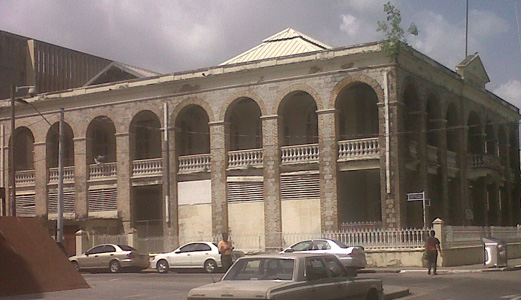
Trinidad Public Library
This historic building, at the corner of Knox and Pembroke Streets, is in a sad state of disrepair. It is in need of a serious program of repairs and renovation.
President’s House –
President's House
The western wing of the official residence of the Head of State of our Republic collapsed through lack of maintenance. President’s House is alongside the spanking-new, elaborate Prime Minister’s Residence and Diplomatic Centre, recently opened at a cost in the region of $200M. This building has not been properly maintained for a long time and it was shocking to hear Colm Imbert stating to the media that it had been declared unsafe about 10 years ago. Even the parts of the building which are still standing are now also condemned. There had actually been official functions taking place there up to the day before the collapse.
President’s House has to be a priority project for high-quality repair and renovation.
SIDEBAR:A legal and financial framework
We do not have a legal and financial framework which will preserve our architectural heritage. The Planning and Development of Land Bill (1997) piloted by the last UNC administration contained provisions which would have addressed many of the issues highlighted in this article.
We need to re-start our discussion on national development, including property and housing. That discussion must include a place for our built heritage.
 VIDEO: Morning Edition Interviews – March 2010
 Last week’s column delved into the vital issue of housing subsidy and its mis-allocation. This week, I will set out some suggestions as to how this wrong-headed allocation of public subsidy might be re-oriented to better serve our needy citizens.


 The
The 


 AfraRaymond.net