AUDIO: 95 Mandate interview on i95.5FM – 6 Feb 2015

Afra Raymond is interviewed on the ‘95 Mandate‘ show on i95.5FM with Ardene Sirjoo and Mariano Browne about the continuing impact of the CL Financial bailout on the economy and the pending Colman Commission report. 6 February 2015. Audio courtesy i95.5FM

  • Programme Date: Friday, 6 February 2015
  • Programme Length: 1:06:41

Integrity Strategy

ic-logoThe Integrity Commission is continuing its efforts to revise the Integrity in Public Life Act (IPLA) to give greater effect to its anti-corruption work. I fully support those efforts.

LifeSport-logoThe key challenge is to discern how Public Officials commit the corrupt acts the Commission is meant to reduce. It is therefore necessary to conduct a scrupulous examination of Commissions of Enquiry and other Inquiry (eg LifeSport) Reports & evidence; Auditor General’s Annual Reports; as well as the leading international learning on these questions.

Once the main methods of corrupt agents are discerned, it will then be necessary to consider how the existing powers of the Commission might be deployed in tackling those and if there are new powers needed.

  1. Public Money

    ‘Public Money’ is the term used to describe money due to or payable by the State, including those sums for which the State would be ultimately liable in the event of a default. Public Money is sometimes called Taxpayers’ Money. It is our Money. The leading learning from which we have drawn serious lessons in the campaign for Public Procurement reform is Lord Sharman’s 2001 Report to the British Parliament – Holding to Account – which was a thorough examination of the definition, role and need for control of ‘Public Money.’ We expanded on Sharman’s definition of ‘Public Money‘ so as to capture the full range of possibilities, but we have accepted his key finding as to the requirement that ‘Public Money‘ is to be managed to a higher standard of Accountability and Transparency than Private Money. The contemporary, best-practice position in respect of the management of and accountability for Public Money being that the private sector rules are the bare minimum. That position must be at the centre of any reform of the IPLA and should be enshrined in law.

  2. Code of Conduct

    The IPLA effectively contains two limbs – the first requires that Public Officials make declarations of their income, assets and liabilities and the second requires those officials to perform their duties in accordance with the ‘Code of Conduct’ as set out in Part IV. The majority of cases brought by or Notices from the IC are directed at Public Officials who fail to make proper declarations. Is there a single case in which breaches of the ‘Code of Conduct’ were cited in making a case or an adverse finding? It is in this failure or refusal to apply those IPLA provisions that much of the current mischief in our Public Affairs is left to flourish. Some of the largest State Enterprises are functioning in breach of the ‘Code of Conduct’ and as such the Public Officials running those bodies are liable to censure. The IPLA does not contain any penalties for breach of the ‘Code of Conduct’, so that needs to be rectified. I support the Commission’s proposals to make examination of declarations optional, as that shift would release resources for a greater focus on the ‘Code of Conduct’.

  3. Power to make recommendations

    S.36 (1) of the IPLA states –

    “36. (1) A person in public life or a person exercising a public function may, by application in writing, request the Commission to give an opinion and make recommendations on any matter respecting his own obligations under this Act.”

    The key flaw with this power is that it is limited to cases in which the Public Official first requests an investigation and what is more, the Commission can only release its findings/recommendations with the consent of that Official. That power must be extended to all cases, with the discretion as to publication of its findings/recommendations left to the Commission. The fundamental importance of the Public Interest should not be subordinated to the agenda of obstructive Public Officials. A good example of how those powers were used recently in a positive way was the Commission’s 12 September 2014 Report on the Ministry of the Environment & Water Resources with relation to issues of alleged improper conduct in relation to the grant of Saw-Millers Licences.

  4. Notification

    At present, the Commission notifies Public Officials who are being investigated. It seems counter-productive, to say the least, that the same Public Officials who are in charge of the papers which could prove their guilt are being notified by the Commission at the start of investigations. Little wonder that the Commission has had little impact on corruption. It is emblematic of the flagrant double-standards with respect to the detection and prosecution of ‘White Collar Crime’. One can hardly imagine the courtesy of ‘prior notice’ being extended to suspected rapists or murderers. The Commission needs to eliminate that practice of notifying persons to be investigated.

  5. Improving the impact of the Commission’s findings

    The Commission’s findings and recommendations must be effectively linked with other ‘gatekeeper’ regulators – eg ‘Fit & Proper’ regulations as controlled by the Central Bank, Professional bodies, T&T Securities and Exchange Commission and the Stock Exchange. The linkages need to be backward and forward, so that the Public Interest can be upheld by better-informed regulatory bodies. I have seen notices of penalties imposed by the TTSEC in relation to various Public Bodies which have issued bonds and failed to provide timely accounts. If the TTSEC fines were paid, it would have been out of Public Money, so there would be no personal cost to those Directors for their lawbreaking. Those findings would seem to constitute a breach of the ‘Code of Conduct’, but was the Commission formally notified? – examples are in the sidebar.

    SIDEBAR – Lawbreaking State Business

    The SEC has made Orders in respect of Contraventions of the Securities Industry Act 1995 and the Securities Industry Bye-Laws 1997. Those Orders are in relation to the failure of these huge State-owned Enterprises to publish their accounts –

    1. 19 March 2010 against HDC, with fines totalling $121,000 – see http://www.ttsec.org.tt/content/pub100326.pdf.
    2. 15 June 2011 against UDECOTT, with fines totalling $120,000 – see http://www.ttsec.org.tt/content/Order-for-settlement-re-UDECOTT.pdf.
    3. 25 July 2011 against HDC, with fines totalling $400,000 – see http://www.ttsec.org.tt/content/Order-for-settlement-re-Trinidad-and-Tobago-Housing-Development-Corporation.pdf.

    SIDEBAR – Public Companies, Private Business

    Some of the largest State Enterprises and Statutory Bodies are operating in breach of the ‘Code of Conduct’ in the IPLA, which requires at S.24 (3) that –

    “(3) No person to whom this Part applies shall be a party to or shall undertake any project or activity involving the use of public funds in disregard of the Financial Orders or other Regulations applicable to such funds.”

    At this time, there are no audited accounts for Caribbean Airlines Ltd (since 2008) or UDECOTT (since 2005) or Housing Development Corporation (since its inception in 2005). That is very serious since some of the largest State Enterprises and Statutory Bodies are refusing or failing to publish audited accounts as required by the published guidelines of the Ministry of Finance or their own statutes.

  6. Declarations also to be linked

    The declarations of Public Officials must also be linked to the Inland Revenue and Financial Intelligence Unit, so that they can be reconciled. With today’s information technology, that is no great task.

  7. The Judiciary

    The October 2007 High Court ruling that members of the Judiciary were exempt from the provisions of the IPLA needs to be urgently revisited. The fact is that the Judiciary has an immense amount of power and discretion which at present is being exercised outside of the framework which binds other Public Officials. It is true that judicial decisions are subject to review, but the appearance of a beneficial exemption from the Integrity Framework does not inspire confidence.

  8. Secret Shareholding

    The G20 countries recently agreed to start moves against secret shareholdings and nominee Directors. The effect of those proposed changes would be to effectively embargo Nominee Directors, Unissued shares and other ‘masking devices’ which are intended to conceal the ‘Ultimate Beneficial Owner’ of a company. Our Integrity laws need to reflect those practices.

  9. Public Private Partnerships

    The IPLA needs to restate the position that all Directors of State Enterprises and bodies under the control of the State are liable to its provisions. Of course, that would include the gigantic CL Financial.

It is critical that we get these issues right, there is no room for compromise here.

CL Financial – Bait & Switch

“They’ve got twelve Aces up their sleeve!
So who the Hell can we believe?”
—Rudder, David Michael. “Back to the Same Ole Same.” The Autobiography of The Now. Lypsoland, 2001. Used with permission

The CL Financial bailout seems to be entering its end-game, with repeated claims from the Minister of Finance that the recovery of the $25 Billion of Public Money spent is now on the cards. The consistent failure or refusal to publish any audited accounts and my ongoing research are telling. We are witness to yet another ‘Plot to Pervert Parliament’, this time it is the biggest project to ever hit this country. The CL Financial bailout.

Plots to Pervert Parliament

In January 2013, I identified the first of these, otherwise known as the ‘S.34 Fiasco’, which of course led me to the CLF Bailout Perversion, committed in January 2009 when our country was presented with its largest-ever public expenditure. The original bailout, presented to our Parliament, as a fait accompli, was the original Plot to Pervert Parliament.

I have come to the sobering conclusion, after much research and consideration, that the Colman Commission is not ever going to provide the details we were led to believe it would. I am now of the view that once again we have been misled and bamboozled by our Parliament. Yet another sick trick, a third ‘Plot to Pervert Parliament’.

The rationale stated for the Colman Commission of Enquiry is in serious conflict with the terms of reference for and consequently, the conduct of that Commission. This article will detail those assertions and show how the public interest is once again being subordinated to powerful private interests.

To understand this crime, one must take a stern view of dates and time.

  • 30 January 2009 – The bailout is announced at a Press Conference on Friday 30 January 2009 at the Central Bank. At that time, we were told that the estimated cost was about TT$5 Billion.
  • 12 June 2009 – Ministry of Finance signs the ‘CL Financial Shareholders’ Agreement’ which, for the first time, discloses that shareholders’ interests were to be specifically protected.
  • 8 September 2010Winston Dookeran’s first budget statement as Minister of Finance, following the Peoples Partnership electoral victory in May 2010, was notable since Dookeran announced a dramatic policy shift. The entire CL Financial bailout was declared to be the first of the ‘great uncertainties’ to be resolved. Dookeran outlined the problem before reducing the rate at which Public Money would be paid for this bailout. A huge storm of protest erupted, with several ‘Depositors and Shareholders groups’ emerging to represent those interests. With Dookeran isolated and the government under mounting pressure from these new protest groups, laws were swiftly drafted to stifle the protestors’ legal options.
  • 1st October 2010The PM’s historic address to Parliament on 1 October 2010  at which the Commission of Enquiry was announced. Most notable was the PM’s outrage at the mystery of the bailout – at pgs 25-26 –

    “…The $5 Billion has been spent—we are advised—to repay matured  EFPA policies in an ad hoc and unstructured manner where payment arrangements were entered into based on levels of funds invested. What criteria did you use to repay investors? Whom did you choose to pay? How were they chosen? These questions need to be answered. Because if it is today after the $7.3 Billion, all these EFPA people, the policy group and so on, they are out there, where is their money? Where is their money? Did you have a priority listing of who should be paid? Why did you go—and you are now crying crocodile tears about trade unions, credit unions, the poor man and the small man—why did you not pay them first? Why did you not pay them first? Where did that $7 Billion go? We need those answers, Mr. Speaker. We deserve those answers. The taxpayers need to know. Because when a parent  has to buy school books and bags to send his/her children to school but they have to pay tax out of the little money, they need to know where that money has gone…Where, how and why; we need to know…”

    The main argument made by the PM was that this was a case which needed serious investigation to establish what had caused this huge collapse and where had over TT$7 Billion of Public Money gone. I could not agree more.

  • 17 November 2010 – The Colman Commission with its Terms of Reference published in the Trinidad and Tobago Gazette. Those were divided into two limbs, causes and consequences. The first to examine the causes of the crisis and the second to make recommendations for prosecutions or other policy changes to prevent a repetition of the crisis.
  • In September 2011, the Parliament voted unanimously to pass two laws related to the CL Financial bailout. The first was to permit the Minister of Finance to borrow a further TT$10.7 Billion to fund the bailout and the second was to grant the Central Bank, which was administering the bailout on government’s behalf, immunity from any legal challenge. For those who consider these assertions of mine to be harsh, just look at Winston Dookeran’s closing words to the Senate on 16 September 2011 –

    “…I just want to give you the assurance which I gave to the Lower House when we debated this, that already the Ministry, along with the Central Bank and Clico, have begun the preparation of a public document—many questions that are still to be answered—to provide the necessary information. In addition to that, we did present to the hon. Senators, for those who afforded us the opportunity to accept our invitation, a document that is in the vicinity of 57 pages as of now, outlining all the necessary information that led to the story that assess what is the current challenges and why the proposals to go forward have been put forward. This document, I assure you, along with the questions and answers, will be converted into a simple, easy to read, hopefully, document for the sake of establishing that this Parliament has mandated us to put this as an anchor document for the purposes of evaluating our performance in the future…”.

    I requested that document via the Freedom of Information Act but it was not provided, which is why my litigation started.

In the course of recent research it became clear to me that the PM’s outraged demands for detailed information as to how the huge sums of Public Money spent in the bailout had been discarded, just like a flimsy Carnival Costume. At no point in its Terms of Reference was the Colman Commission required to examine the details of the actual Public Money spent on the bailout. A new species of lie is born here in T&T, once again…we used to have one called the ‘White Lie’ in those bad-old-days, now we have the ‘Bright Lie’. Right up in our face, as the Parliament is told one thing, with an entirely different thing being done. The Carnival was over, but the Ole Mas was now starting.

One can imagine the ebb and flow as these public promises were neutered in private discussions. Reasons are never given. I suspect that the influence of party financiers and voting blocks was a great element in this travesty. The public right to know how and why these vast sums of Public Money were spent is obviously of low priority for the highest public officials in this Republic.

Truth has a Power all of its own. At this point, in litigation against the Ministry of Finance for that information – the Ministry is represented by a five-member team headed by former AG, Russell Martineau SC and CL Financial is represented by three attorneys. Something resembling legal overkill to prevent publication of information which the PM told the Parliament it was her intention to unearth. Information which then Finance Minister Dookeran assured the Parliament he was compiling into a public document. Another writer has labelled the situation – ‘Afra, the Deviant‘. I tell you.

At every turn, the public interest has been subordinated to secretive private interests. The Courts are literally the last refuge to uphold the lawful rights of the public to obtain detailed information on these matters of the highest importance.

Accountability Calamity

Safeguard Status of query
Audited accounts for CL Financial? NONE
Details of Management accounts, Estimates, Drafts or any figures used by Ministry of Finance? NONE
Details of official briefing to Independent Senators in September 2011? CLAIMED TO BE EXEMPT
Details of Public Money paid out to people and institutions owed money by CL Financial? NONE
CL Financial is now under State control, so do its Directors comply with the Integrity in Public Life Act? NOT ACCORDING TO MY EXAMINATION OF INTEGRITY COMMISSION RECORDS.
Do we understand why the CL Financial group is enjoying this beneficial exemption from the lawful obligation to file declarations? NO WORD YET FROM THE INTEGRITY COMMISSION.

All of the usual integrity, accountability and transparency safeguards have been disconnected. All.

The Code of Silence rules.

Invader’s Bay – Suspicious Motives

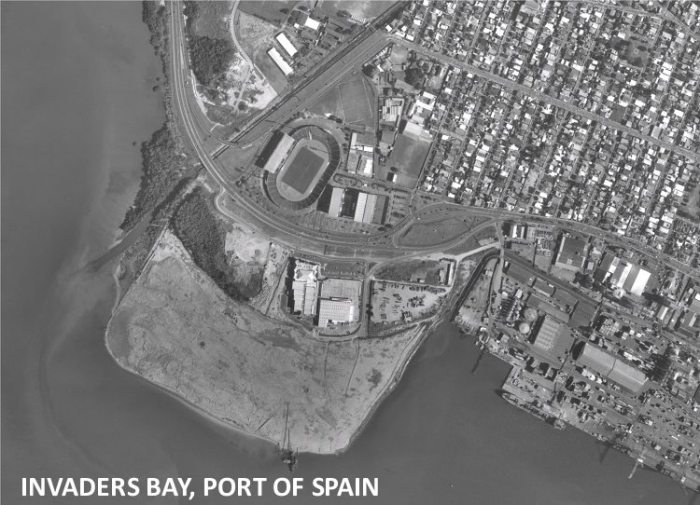
invadersbay-bwThe proposed development of Invader’s Bay will be the largest in our Capital City in living memory. The entire process is tainted by fundamental irregularities, any one of which ought to be enough to stop the development.

Some of those irregularities at Invader’s Bay include an improper and voidable tendering process; failure or refusal to hold Public Consultations; breach of the Central Tenders’ Board (CTB) Act and most recently, a wrong-sided policy on legal advice.

The State has appealed the High Court decision of Justice Frank Seepersad on 14 July 2014 to order publication of the legal opinions on which they had been relying thus far.  That hearing is now set for Wednesday 28 January 2015 at the Appeal Court in POS. At the preliminary hearing on Thursday 20 November, the State was represented by a seven-member team of attorneys, led by Russell Martineau SC.

Tender rules

Procurement_NoticMinister Tewarie has repeatedly told the public that the Appraisal rules for the Invader’s Bay development were first announced in his speech to the Annual Dinner of the T&T Contractors’ Association on Saturday 5 November 2011. That is true, I was there and heard the Minister do just as he said.  The issue here is that the closing-date stipulated in the Invader’s Bay Request for Proposals (RFP) was 4 October 2011, which was over one month before the rules were published.  Given that fact, the proposers would not have known the rules of the competition and it is fair to say there was no competition at all.  None.  Just imagine the rules for a Calypso competition being distributed the week after the singers had performed.  The RFP process for Invader’s Bay was therefore improper, voidable and illegal.

The most disturbing aspect of this nonsense, is that it raises disturbing questions as to what is fast becoming a new normal in our society.  To my mind, there are two possibilities.

The first is that the Minister was simply unaware that he was describing improper and unlawful acts.  If that is the case, one has to wonder at the quality of advice available to our Cabinet.  Are we now to accept that this is the proper way to proceed?

The second possibility is that the Minister was properly-briefed that the late publication of those rules was improper and that the entire RFP process was therefore voidable, but chose to act as if the whole process was ‘above-board’.  That Minister continues to insist that there is nothing improper taking place at Invader’s Bay and so on.  I tell you. Continue reading “Invader’s Bay – Suspicious Motives”

Re-Route Reboot

The continued dispute over the Debe-Mon Desir Link of the Point Fortin Highway and the growing public debate over this issue require further attention to certain critical aspects.

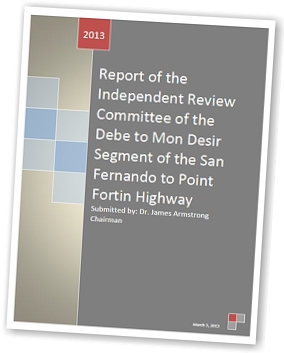
The Armstrong Reportcover-tilt was published in March 2013 after a process agreed between parties to the dispute over this highway link.  It is a significant achievement in the journey to a more considered and consultative approach to national development.  Given the shifting grounds of the dispute and the nature of the various statements, it is necessary to clarify some of the key issues.

The three main issues to be clarified are –

The Armstrong Report

The State’s position in relation to The Armstrong Report is a critical element of the dispute, so it is important to detail how this has morphed, like so much else in this matter.  The Ministry of Works & Infrastructure Press Statement of 3 December 2012welcomed the inputs…from the JCC, FITUN, T&T Transparency Institute and Working Women‘ and went on to note that ‘the discussions had been very fruitful‘.  That statement settled a basic framework for a Review of the elements of the link which were in dispute, with the preliminary Report to be provided within 60 days ‘to NIDCO for its consideration and publication thereafter’.  Some people have tried to restrict the meaning of NIDCO’s ‘consideration’ of The Armstrong Report to a merely editorial vetting which implied no commitment to any post-publication consideration.  The only conceivable reason for a party to this kind of process to have the right to review the preliminary Report would be to address factual errors in a situation in which the completed Report is of some significance.

At the post-Cabinet Press Briefing on Thursday 14 February 2013, the then ‘line Minister’ for NIDCO, Emmanuel George, said that the Report gave the State the ‘green light’, thanked the members of the Highway Review Committee and was reported to have agreed to ‘…as far as possible, accommodate their suggestions and recommendations…‘.

The only reasonable meaning to put to the State’s actions and agreements at the time was that there was a commitment to consider the recommendations of the Report.  Of course we are now hearing from officials that there was no commitment to adopt or consider any of the recommendations in The Armstrong Report.

As a reality check, just ask yourself what would have been the position if The Armstrong Report had fully vindicated the State’s actions.

You see?

The Highway Contract

The high cost of halting construction is the main argument being used by the State to criticise The Armstrong Report and in its litigation with the Highway Re-Route Movement (HRM).  On 25 February 2013, NIDCO wrote to JCC with its comments on the preliminary Report and the first page of that letter noted its concern that no consideration had been given to the fact that a $5.2Billion construction contract was in existence for this project. (Comment #2 on p. 30)  That complaint is fundamentally misplaced, to say the least, since technical and scientific reviews do not normally take financial or commercial elements into account as material considerations.

At the level of general principles, two examples can clarify the position. In the widely-used two-envelope tendering situations, the tenderers submit separate technical and financial proposals, which are examined independently, with points awarded for each.  The eventual selection is made after considering both those scores.

The most recent Commission of Enquiry was announced by the Prime Minister on 18 September 2014 into the HDC apartment blocks which had to be demolished in 2012 at Las Alturas in Morvant. (pp. 68-70) When HDC recognised that the stability of these newly-constructed hillside apartment blocks was in jeopardy, they obtained technical advice from professional engineers. It is doubtful whether those reports considered the financial and commercial fact that the building had already been erected or the losses that would accrue if they were to be demolished.  Very doubtful.  Indeed, one would rightly be suspicious of technical advice which was coloured by commercial considerations.

SIDEBAR: NIDCO’s reply to JCC

The JCC wrote to NIDCO on 10 October 2014 to request a detailed statement as to how the ten recommendations of The Armstrong Report had been treated and we met with NIDCO’s team on 17 October to discuss that request.  NIDCO agreed to provide the details to JCC by Friday 24 October, but that reply is still awaited at the time of this writing.

Now, to deal directly with NIDCO’s criticism of The Armstrong Report, we need to note two facts –

  1. Terms of Reference – If, despite the general principle, NIDCO had wished to have the construction contract for the highway considered alongside the other factors to be examined during the 60-day Review, it could have made that request.  The fact is that NIDCO never made that request, so the construction contract was not included in the terms of engagement for this review exercise.
  2. The Highway Review – If, having not requested that the construction contract be included in the review, NIDCO subsequently wanted it considered, there was an option to submit it. NIDCO never submitted the contract to the JCC or the Highway Review Committee.

Proceeding from the general principle to the particulars of this case, it is therefore clear why the Highway Review Committee did not consider the contract as part of the review process.

Note also that NIDCO has not submitted the contract to the Court during this extended litigation with the HRM.

Submitting the contract to either the Highway Review Committee or the Court would have exposed the underlying financial and commercial arrangements, as well as the repeated claims of adverse cost implications, to critical scrutiny.

Tender Truths

Lastly, there is now a series of new statements emerging from the HRM and its supporters which did not form part of the original concerns of that group. The most striking of these is that the highway contract was not tendered. That allegation can be found in the HRM’s International Media Release of 24th September 2014 on their Facebook page and on the AVAAZ campaign webpage, as well as in other media statements by various persons supporting the HRM.  That assertion is most alarming for two reasons.

Firstly, that is an entirely false assertion since the highway contract was tendered in 2010.  Consider this extract from the top of page 19 of The Armstrong Report

…On May 07, 2010, the closing date for this procurement, three proposals were submitted by 1.00 p.m. (from the 29 Request for Proposals issued)
The three entities submitting tenders were, in alphabetical order:

  1. China Railway Construction Corporation Limited;
  2. Construtora OAS Ltda (OAS); and
  3. GLF Construction Corporation…

On May 13, 2010 The NIDCO Evaluation Committee submitted its Final Report and recommended OAS as the Preferred Respondent, and so informed OAS by letter dated May 25, 2010…”

Secondly, those baseless assertions by the HRM show a lack of familiarity with the contents of The Armstrong Report.  The HRM has relied heavily upon The Armstrong Report in its recent campaigning, so one can only wonder at the implications of these repeated claims.
Given the public positions taken by the protagonists, it seems unlikely that mediation can be a real option.

The Armstrong Report is a serious advance in terms of our nation’s development, being to my knowledge the first Civil Society review of a State-sponsored project in the Caribbean region.  That Report would not have existed without Dr. Wayne Kublalsingh’s sacrifice, but the full benefits of the Report can only be realised by a proper and open consideration of its recommendations.  Only then can we gain from the increased public attention to the complex issues of national development and really start to learn the lessons.

National development is a real and inescapable challenge which will continue to evolve, whoever is in government.  That challenge can only be properly addressed by a fact-based approach adopted by all parties.

‘Unconquered’ discussion series

The ‘Unconquered‘ discussion series is hosted by Robert Young’s The Cloth at #24 Erthig Road, Belmont…Attilah Springer – aka Tillah Willah – is one of the livewires driving this initiative…

I was invited by Tillah to speak at the ‘Conscious Citizenship‘ meeting on Wednesday 13th August 2014, along with Dr. Kevin Adonis Browne, author of the searching new work ‘Tropic Tendencies’…the session was both heated and edifying…it was real, even when Browne ramoujayed on rhetoric!

For a Few Dollars More

Sen. Larry Howai, Minister of Finance

Next Monday, 8 September 2014, is carded for the Finance Minister to deliver his 2015 Budget Statement to the country and of course speculation is great as to whether this will be an ‘election budget‘ or if a more restrained approach might be taken.

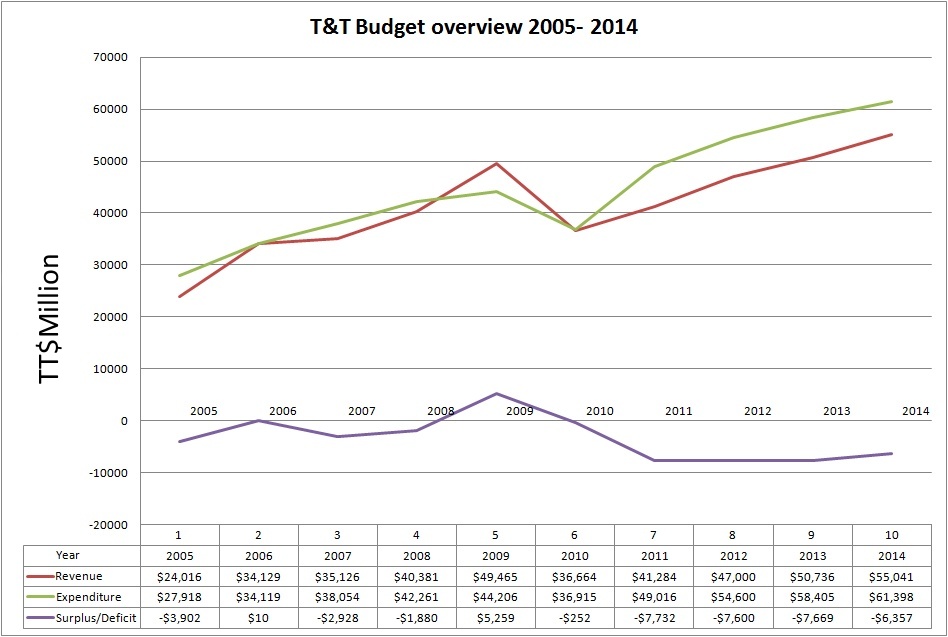
In preparing to write this column, I took a look at our budgets since 2005 and it was really striking that many of the key issues identified a full decade ago are still at the fore of the more recent budgets. Some of those issues were the imperative to reduce our dependence on the energy sector; the constant push to upgrade our infrastructure; the demand for more resources dedicated to national security and of course, the repeated statements about this or that program to reduce white-collar crime.

These expenditure and revenue figures were drawn from the Budget Statements, so no account has been taken of either actual outcomes or supplemental appropriations – this is the process used by the Government to obtain authorisation from the Parliament to exceed the approved spending limits in the national budget.


fistrful of dollars

Clearly, we are seeing a trend as to the constant increases in expenditure, with only one decline, in 2010. Given that background, it also appears that surpluses are rare, occurring only twice, in 2006 and 2009.

The reality that we are on the verge of a national election which is sure to be strongly-contested, leaves me in little doubt that the 2015 budget is also likely to be a deficit budget, with the State spending more than it earns.

The recent scandals at LifeSport, Eden Gardens, THA/BOLT, CAL, CL Financial and of course, the Beetham Water Recycling Project, all show the extent to which the Treasury is being targeted by well-connected parties.

There is a constant stream of allegations of ‘Grand Corruption’, which is little surprise in our society in which an unsupported allegation is so often used to discredit an opponent. There is no comfort to be had in that observation, since the other reality is that thorough investigations and prosecutions are only done against ones political enemies, inside or outside the ruling party. That is the sobering reality in our Republic, in which we should all enjoy equal rights and be held to common standards. Different strokes for different folks, just like back in the ‘bad-old-days‘.

It seems to me that the defining question, in terms of whether the various financial crimes are taken seriously, is whether the accused persons are ‘members in good standing‘, so to speak.

The extent to which our Treasury is protected from being plundered by criminal elements is a serious question which should concern every citizen, given that the Public Money in the Treasury belongs to us as citizens and taxpayers. The frequency with which these financial crimes are overlooked is nothing less than scandalous, as any of the Auditor General’s Reports in the previous decade would attest. Permanent Secretaries approving payments in breach of financial regulations; payments made with no documents (leases, contracts or agreements) on file; failure or refusal to produce documents as required by law upon the Auditor General’s request and so many other types of lawbreaking. The same types of conduct is also rife in State Enterprises, which is why so many of the larger ones are unable to produce accounts as required by the very Ministry of Finance which sets those rules and continues to fund them.

The wicked part is that these Public Officials are virtually never charged with breaking the law or made to face any other serious consequences for their misbehaviour in Public Office. We need a new beginning in terms of how we handle the reality of our country’s wealth and its intentionally-degraded laws for controlling how our Public Money is used. A big part of that would be a political dispensation in which full investigations and prosecutions were the norm, especially when key members of the ruling party are the target of allegations.

Our budgeting process now shows all the signs that our system of Public Financial Management is ineffective in dealing with the seasoned criminals who are hard at work helping themselves to our money, whatever the political party in power. At that level, at least, there is little evidence of discrimination.

The growing complexity of the budget is of no comfort. For example, the 2014 documents totalled some 2,997 pages, yet the Billion-Dollar-Plus Beetham Water Recycling Project (BWRP) was omitted. Despite questions as to what did he know and when did he know it, the Minister of Finance continues to ignore the fundamental requirement to provide for this huge project within our national accounts. There has been no attempt to give the public the necessary explanation as to how the BWRP is to be paid for, since the underlying commercial arrangements which are driving this project remain obscured. The BWRP also shows a strong theme as to the privatisation of our nation’s water supplies, which is a growing area of concern globally. Not the first one, it is true, since we had DESALCOTT before, but this second, huge project implies a trend, in my mind.

The inescapable question is ‘To what extent can we rely on our national accounts, if huge projects like BWRP are omitted?

All of which brings us to the continuing and unexplained delay in passing the Public Procurement & Disposal of Public Property Bill. That new law would play an important part in greatly reducing the scope for waste and theft of Public Money. The JCC and its Kindred Associations in the Private Sector Civil Society group continue to call for this law to be passed without any further delay.

Of course all of this is driven by the political parties’ imperative to raise money from various financiers to fund election campaigns, so Political Party Financing laws are essential to control those influences. The Parliament recently unanimously approved a Private Members’ Motion laid by Independent Senator, Helen Drayton, to appoint a Joint Select Committee (JSC) to start the long-overdue process of agreeing just what are the new laws we need to deal with this influence, described by President Carmona, in his inaugural address as a ‘veritable juggernaut‘. The JCC continues to call for the JSC to be appointed so that this critical work can be started to control Political Party Financing.

Having observed the two-week spectacle of prolonged debate in the Parliament on the recently-approved Constitutional Amendment Bill, one can only wonder as to the priorities which are being displayed.

Hence my title – ‘For a Few Dollars More‘.

Public Secrets?

It seems to me that we are entering a sustained and hard-fought Information War, global in extent, but with local flavour. The main features of this are the attempted redefinition of Privacy as a defunct notion, right alongside the State’s duty to know all about us, but tell us as little as possible of their own operations. That is the name of the game, so these issues are going to be challenged strongly as we go forward.

Dr. Bhoendradatt Tewarie
Sen. Dr. Bhoendradatt Tewarie, Minister of Planning & Sustainable Development

The High Court ruled on 14 July 2014 that the Minister of Planning & Sustainable Development must provide the legal advice which was said to have justified the development process at Invader’s Bay. This case was brought by the JCC after the Ministry refused to publish the legal advice obtained in response to our challenge that the Invader’s Bay development process was in breach of the Central Tenders’ Board Act. Given the repeated statements that the legal opinions supported the State’s actions in relation to the CTB Act, the obvious question is ‘Why the secrecy and refusal to publish those opinions?

The JCC requested the legal opinions and the letters of instructions under the Freedom of Information Act and the judge applied the ‘Public Interest Test’ in deciding that the public right to that information eclipsed the accepted point as to the existence of ‘legal professional privilege’. There have been many comments on what has been described as a landmark ruling and it appears that the question of just what is an official secret is once again up for discussion.

We are now being told that the right of the client to maintain the confidentiality of legal advice is now under threat, so the State is reportedly considering an appeal of that High Court ruling. Continue reading “Public Secrets?”

None So Blind

Property ownership is a critical ingredient of the society we are trying to build.  No one can deny that.   The wealthiest people and companies in this society have made a great part of their wealth through property dealings – buying, leasing, sub-dividing, selling, renovating and so on.  We all know that property is critical to amassing and holding wealth.

The single largest owner of all classes of property in the Republic is of course, the State.  Those properties are described as ‘Public Property‘ in the Public Procurement & Disposal of Public Property Bill 2014 which is now being debated in Parliament.  The penultimate paragraph of the Private Sector Civil Society group (PSCS) group statement of 13 June 2014, is clear –

“…Whilst very pleased with the progress to date and while not having sight of the amended bill we note two areas that remain of serious concern; the Role of civil society and the acquisition and disposal of public property…“.

At pg 7 of that Bill – “public property” means real or personal property owned by a public body;

‘Real Property’ usually means real estate (freehold or leasehold), while ‘Personal Property’ usually means all other types of property such as licenses, concessions and tangible items of worth.

‘Owned’ usually means literally owned, as in the case of a freehold or leasehold interest, but there are other important types of property which are not literally in the ownership of a public body.  Public Property is important because it is extremely valuable.  The power of the State or its agencies to allocate those Public Properties must therefore be exercised in an equitable and transparent fashion if we are to foster proper conduct of our country’s public affairs.

Crown Grants

In relation to real estate, it is important to note that the system of Crown Grants was used during the colonial period to encourage immigrants of a particular type.  Immigrants who were of acceptable race, religious belief or station in life were allocated public lands for the purpose of agriculture.  The actual documents are called ‘Crown Grants’ and they can be seen in our country’s records.  The allocation of those lands to those selected people established a pattern of substantial wealth which took generations to displace.  Of course such a system of property allocation, on the basis of ones’ external appearance and belief system, would be incompatible with our Republican status.

That history and the important role which property plays in today’s society are both reasons why the  ‘disposal of public property‘ is an inescapable part of the new law, so that we can ensure good governance in these matters.

The Maha Saba Episode

This is a good example of a type of Public Property not literally owned by a Public Body.  The dispute was over the decision of the previous administration to allocate radio licenses overnight to the Citadel Group, which was owned by a PNM member, at the same time as delaying the grant of broadcast licenses applied for by the Maha Saba.   The Maha Saba had to take legal action all the way to the Privy Council to obtain a favourable judgment as to the breaches of principles of good public administration by that PNM government. 

A new law intended to control dealings in Public Property as defined above would be one which extended beyond those literally owned by Public Bodies to include species of property in the ‘care, custody or control‘ of those bodies.  That would allow future occurrences of a ‘Maha Saba episode’ to be rapidly rectified, also at less expense, by the Procurement Regulator as that type of property transaction would be within oversight of the new law.

In point of fact, it was reported that the Citadel group which comprised three radio stations was sold in 2012 to the CCN group (owners of this newspaper) in 2012 for a sum reported to be over $50M.  So it is clear that these species of property have serious value, quite apart from any other aspects.

Caroni Lands

When Caroni Ltd. was closed in August 2004, about 76,000  acres came out of cultivation and become available for alternative uses.  The Caroni lands stretch from Orange Grove at Trincity (near the large new Blue Water facility) as far south as Princes Town.

Given the fact that Chaguanas has been our fastest-growing town for almost 20 years now and the ongoing growth of investment in San Fernando and its outlying districts, it is clear that the Caroni lands have a critical role to play in our medium to long-term prospects.  But those possible outcomes would be conditional on just how the Caroni lands are allocated in the short-term.  As far as I am aware, a decade after abandoning sugar cultivation, there is still no strategic plan for how these lands are to be utilised.  In the absence of a proper strategy for the management of those important State lands, there is scope for missed opportunity in terms of development and re-distribution.

The decisive land allocation issues would include –

  • How does the allocation policy work together with the State’s broader economic policies?
  • To whom are the lands allocated?
  • On what terms are the lands allocated – i.e. for how long are the lands to be leased and with what restrictions? Some of the ex-Caroni workers are demanding grants of freehold interests from the State, but no decision seems to have been made on that.
  • Does the State have the right to repossess the lands upon expiry of the lease?
  • Does the allocation strategy have dynamic measures to control speculation?  This is to prevent the growth of ‘flippers’ who just acquire property to hold and re-sell.  There is a serious view that ‘flippers’ are a part of the market, but there is also a way that their presence can retard development as they do not typically improve or maintain their properties.

All of those issues must be located within equitable and transparent arrangements as required by the new  law.

State Leases of offices

When the State leases offices or other property it is in fact procuring property via a transaction in Public Money.  Those transactions must take place within a modern system which ensures good governance by attaining accountability, transparency and value for money.

There is a huge oversupply of offices in greater POS as a result of the State’s overbuilding during the last regime and the current administration is now shifting significant public offices out of POS.  The combined impact of those ought to be a steady decline in both the gross amounts paid to landlords via State leases and the amounts paid per sq. ft..  That kind of change can only be obtained and monitored if the State’s leases of offices and other property are also part of the new Procurement system, so that the details are published as part of the database of State contracts.

Invader’s Bay

The State-owned reclaimed lands at Invader’s Bay in west POS are another pregnant example of how the use of improper land allocation processes can injure the public interest.  The JCC has mounted a legal challenge to seek publication of the legal advice obtained by the Ministry of Planning & Sustainable Development as to the legality of their activity ‘thus far’ in respect of that 70-acre parcel of prime land.

It is interesting to recall that one of the legal opinions on which the State seems to be relying, notes that this proposal was to grant long leases (about 99 years) to the successful bidders at Invader’s Bay.  That was not considered a disposal since the State would have retained the freehold interest.  Now that is probably the best example of why these types of transactions must be controlled by these modern and effective laws.  The attempt to conflate a residual freehold interest with ownership, while at the same time denying the tremendous commercial value of a 99-year lease over prime lands was scandalous.

The most valuable properties in the capital are the leaseholds in St. Clair and Woodbrook, that much is indisputable, which is why we have guard against this kind of evasive advice to facilitate arrangements to escape proper oversight.

The Landed Interests

The ill-fated 2009 proposals for a new Property Tax would have required an updated and open database of the entire country’s property holdings.  The campaign to ‘Axe the Tax’ was successful and that database never saw the light of day, which entirely suited the Landed Interests who are wary of any system which would expose their operations to easy scrutiny.

We need to be vigilant to ensure that the Public Procurement & Disposal of Public Property Bill 2014 does not leave a gaping, purposeful loophole thorough which our Public Money will continue to pour.

Given that our political parties receive financing from business-people, how will those party financiers be rewarded?  In a situation which properly controls the award of State contracts for goods, works and services, how can they be rewarded?

The answer is Public Property.

Money is the Problem

One of the big unanswered questions arising out of the recent ‘grand corruption’ cases in relation to the Public Sector remains – ‘How can we lawfully punish those wrongdoers who are looting our country?

Most discussions proceed along the lines of what I call the ‘bag of money‘ idea, in which we are looking for the actual stolen money.  The belief being that the stolen loot can actually be located and linked to the thieves, who will then face a harsh penalty.  My preferred solution is for full disgorgement of all the stolen monies as a starting-point, even if that is a remote goal.

In re-examining the issue practically, one has to ask “Why do we persist in these ‘pipe-dreams’, while ignoring the ‘low-hanging fruit’ all around us?”  So I am considering a new strategy for action on these critical issues.

‘Public Money’ is the term used to describe money due to or payable by the State, including those sums for which the State would be ultimately liable in the event of a default.  Public Money is sometimes called Taxpayers’ Money, it is our Money. Continue reading “Money is the Problem”