Afra Raymond’s submission seeking to be made a party to the Commission of Enquiry into the failure of
CL Financial Limited
Colonial Life Insurance Company (Trinidad) Limited
Clico Investment Bank Limited
Caribbean Money Market Brokers Limited and
The Hindu Credit Union Credit Union Co-operative Society Limited
My name is Afra Martin Raymond and I am a Chartered Surveyor, being a Fellow of the Royal Institution of Chartered Surveyors. I am Managing Director of Raymond & Pierre Limited – Chartered Valuation Surveyors, Real Estate Agents and Property Consultants. I am also the President of the Joint Consultative Council for the Construction Industry (JCC), an umbrella organisation which represents the interests of Engineers, Surveyors, Architects, Town Planners and Contractors in this Republic.
This submission is being made in my personal capacity and does not represent the position of either Raymond & Pierre Limited or the JCC.
My work on this vital issue has all been based on the public record and can be seen at www.afraraymond.com.
I am willing to give oral evidence before the Commission.
I have been conducting a campaign in the public interest on this important matter. My work is unfunded and I have no assistance. Indeed, I have no legal adviser at this Enquiry.
Having followed the issue so closely and attended the opening session on Friday 11th March, I am of the view that the parties thus far identified in this Enquiry are all seeking to advance their own interest.
I am here seeking to be made a party to this Enquiry, in seeking the interest of the silent majority, the taxpaying public, who have had to pay for this huge financial fiasco.
I am making this submission under rule 2. of the Commission’s Rules of Procedure, as a person whose “…participation in the Enquiry may be helpful to the Commission in fulfilling its mandate…”
I await your reply.
——————————-
Afra M. Raymond B.Sc. FRICS
Port-of-Spain
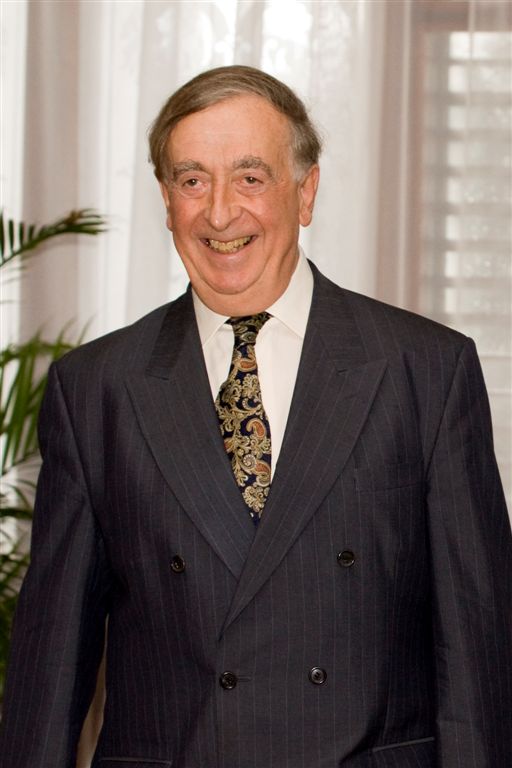
If you think this title is for the latest brand of household cleaner, you would be wrong. I drew that title from the famous statement by deceased US Supreme Court Justice Louis Brandeis, in reference to corruption and fraudulent dealings: ‘sunlight is said to be the best of disinfectants.‘
Of course, this is all about the impending Colman Commission of Enquiry into the failure of CL Financial and other companies (including CMMB) and the Hindu Credit Union.
We are attempting to understand our situation in this financial fiasco – how was the entire collapse caused? Who is responsible? What can we do to avoid a repetition?
Our House needs a serious cleaning and we need a new commitment to serious retrospection if we are to succeed in understanding this scandalous situation.
To set the stage, there are four principalities being represented in this Enquiry –
CL Financial Chiefs – The people who had Direction and Control of the entire failed group – that would include the shareholders.
The Regulators – The Supervisor of Insurance, Securities and Exchange Commission (SEC) and the Central Bank.
The Auditors – PriceWaterhouseCoopers and Ernst & Young – the former being auditors for the CL Financial group and the latter acting for the Central Bank.
The aggrieved Policy-Holders and Depositors – Several groups have been formed to seek the return of all the monies owed to these investors.
My first point about this Colman Commission is how welcome it is, as a tangible sign of a change in how our country is being run. No, I did not vote for either group in the last election, but it seems to me that neither of the last two regimes (Manning or Panday) would have initiated a public enquiry into this financial fiasco.
As much as I approve the decision to have this public enquiry, the purpose of this article is to warn against some of the forces now being assembled to erode the enquiry’s effectiveness. Even though, in this respect, political times have changed, we need to remain vigilant if the Colman Commission is to be effective.
To be sure, the four principalities I listed comprise very powerful players for whom this enquiry is a literal nightmare, since they will be obliged to explain some of their biggest decisions and actions, which they would never have had to explain to anyone outside of their own circle.
If the Enquiry takes place as intended, we are going to be afforded an unprecedented insight into the workings, dealings, arrangements and situations in our leadership class – all of it at a depth and range never before recorded. Matters that had been only the subject of picong, ole talk and so-called urban legends will all now become part of the official record. Yes, our Republic will be coming of age.
Our country is a Republic, which to me means that no class of citizen ought to enjoy rights which are superior. But there has been a pattern of behaviour in this fiasco which has been very disturbing because it violates those Republican expectations. Of course, I am referring to the fact that a three-tier system seems to have been in operation during the entire meltdown.
The lowest tier comprises those many persons who are now fretting over their investments with this failed group. Those people have to decide between continued protest action, legal action or just plain pleading to get some relief. A significant number of them would have placed undue reliance on the CLF products and would be suffering extra stress because they put too many, or all, of their eggs in one basket.
The middle tier is the lucky and/or well-connected people who were able to get back their money after the group collapsed. When the Prime Minister announced this Enquiry on 1st October 2010, she promised to release details of who received the monies disbursed in that period – i.e. after 30th January 2009. That list of names and who received what sums would be an absolutely explosive one.
Of course, the top tier and the absolute insiders would be those who had early warning of the oncoming collapse and took steps to preserve their wealth. That group would have to include the top CL Financial chiefs who left in the 12 months before the collapse – Monteil, Fifi and Mayers. Major depositors and investors would also have been part of this privileged group. The Governor of the Central Bank and the last Minister of Finance also withdrew monies just before the collapse.
Maybe I am entirely wrong and there was complete surprise when the CL Financial group collapsed. But if that is the case, one is really contemplating a slack system of management systems and an entire swath of our ruling elite who are not ‘fit and proper’. The question of who knew what and when, will be a main point of dispute, because either way you slice it, the picture is unappealing.
You can be sure that the people in the top layer will do anything in their power to protect themselves from the stern scrutiny of those in the lowest group, not to mention the public, who are paying for all this.
I wrote a previous column in this series, entitled ‘Taking in front‘ and on this occasion, in light of what is at stake, I, too, am taking in front. Having suffered a defeat in that the Colman Commission has now been established, the members of the Code of Silence can be expected to try halting, delaying or just diluting the Commission.
We have already had former Hindu Credit Union (HCU) chief, Harry Harnarine, defeated in the High Court in an attempt to stop the Colman Commission. I was not surprised to read reports that Harnarine is planning to appeal that decision. We can expect other strong challenges as this historic process unfolds.
If the members of the Code of Silence are unable to derail the Commission itself, we should not be surprised if they try to cloak the proceedings in some kind of blanket to prevent too much information escaping.
Readers, please note that the process of asking the Court to prevent publication of a particular piece of evidence is a very swift one, with the ruling expected in the very same sitting. That is because if those proceedings are too drawn-out, it can be actually self-defeating, since the matter which they are seeking to have concealed can be published and discussed while a decision is awaited.
That is the reason we need to beat this drum now. We cannot wait for the filing of injunctions and then seek to publish. By then, it would be too late.
The new algebra is simple and inescapable –
Expenditure of Public Money – Transparency = CORRUPTION
The preface of that Report contains an instructive paragraph, at page xii –
“…This report is not the sole repository of what the panel found. A website — www.fcic.gov — will host a wealth of information beyond what could be presented here. It will contain a stockpile of materials — including documents and emails, video of the Commission’s public hearings, testimony, and supporting research — that can be studied for years to come. Much of what is footnoted in this report can be found on the website. In addition, more materials that cannot be released yet for various reasons will eventually be made public through the National Archives and Records Administration…”
The US legislature is determined that the inner lessons and testimony on this important crisis are available to all interested parties for the years ahead. That represents a solid commitment to a learning society, which will at least attempt to draw lessons from the bitterest of experiences. In my opinion, that commitment is worthy of emulation.
Has our society reached the stage of maturation to commit to an entirely transparent process of retrospection? That is the question which will be tested in the weeks and months to follow.
The entire proceedings of the Colman Commission must be held in public. The proceedings must be on TV and available on the internet. The Colman Commission needs a strong internet presence, with its own website.
Austin 'Jack' Warner, MP and acting Prime MinisterOn 6th June, I wrote in this space about the challenge to the new government to bring about a real change, as opposed to mere exchange. I ended that column by highlighting the worrying case of Jack Warner, one of my former history teachers, making history by being the first Cabinet Minister to hold other appointments. My objection to Mr. Warner serving two masters was that it would be impossible for him to give the full energies we have every right to expect from our Cabinet members.
We need to be mindful of the relationship between morals, ethics, law and of course, that scarce commodity, good sense. Obviously, law is the paramount authority, because we live in a republic ruled by laws, not men. No one should break the law and there are penalties for doing that. But we also know that in life we make many important decisions without referring to any laws. Those are sound decisions, which form norms, eventually described as custom-and-practice or culture. There are many acts, which are at one and the same time both deeply offensive to right-thinking people (and I think that most people are right-thinking) and in breach of no particular law. Many acts, with no need for examples, since this is a newspaper any child could pick up and read. There might even be laws against me describing such acts in print. Who knows?
The reality being that, as important as law is, the proper development of our society depends on far more than just law. Law is a necessary, but not sufficient ingredient for proper development. So, what do I mean by proper development? One of the key signs that we are moving forward would be an increased sense of consequence and the capacity to learn from our errors. Some examples of our failures in those respects were set out in the prior article in this series.
Some of the main points here were –
Board resignations – Jack Warner’s opening statement, made on Indian Arrival Day, was his strong demand that all Board Directors of State Enterprises and Statutory Bodies coming under the control of his Ministry must submit immediate resignations. In making that call, Mr. Warner relied heavily on custom-and-practice, good practice and established norms. He was, quite properly, declaring that he expected those high-ranking public servants to behave properly. No reference to law was considered necessary to see what was the right thing to be done. Yet when queries arose on Jack Warner’s multiple appointments, we were rapidly boxed-into a strange place where only the law prevails. That is ‘chinksing’ with a vengeance.
Warner’s statement upon his return home on the 15th was most instructive. Consider please that this was no hasty response to an ambush question and that the entire Piarco reception had been arranged by Warner. His emphatic reply as to the weakness of Rowley’s case was telling, in as much as it relied on the various examples of PNM wrongdoing that Rowley was accused of having condoned.
…If Dr Rowley is so concerned about the Parliamentary Code of Ethics, I want to ask him some questions this afternoon. “Why was he so silent when Mr. Manning appointed his wife, not once, not twice, but three times as a minister? “I want to ask him why he was silent when a Minister of Health had his son open pharmacies all over the country to sell CDAP drugs? Wasn’t that code of ethics broken then? “I want to ask him also why he was silent when another Minister of Health had his wife take all the insurance of the Government of Trinidad and Tobago to a company she owned? Why was he silent then?
Strange as it might seem, a mere 3 weeks into the honeymoon, we were witnessing a premeditated statement by a senior Minister to the effect that ‘two wrongs make a right’. Mr. Warner was trying to silence Dr. Rowley, by reference to his condonation. That is a sad and rickety foundation from which to proceed, but even more telling is Warner’s implicit acceptance that his own position was wrong.
Warner’s attempt to diminish Rowley’s victory was also interesting –
Not contented that he removed Patrick Manning from office—he got the easiest political ride in history—he had the temerity to accuse me of breaking some law, or transgressing some code of ethics…
It has to make you wonder, if that is Jack Warner’s view of Rowley’s victory, what is his view of the PP’s triumph?
In the midst of all the lawyers’ opinions, we had an attempt, by Michael Beloff QC, to set these local events in international context –
…Beloff said he was unaware of any precedent in any common law jurisdiction for a person holding at one and the same time, ministerial office and another post outside of the Government. “I have little doubt that a main reason is that the demands of ministerial office would usually preclude such dual appointment and the minister could be exposed to criticism for not devoting himself full-time to his government duties…
The silence of the lions – Most notable, for me, in all this, was the lack of comment from outspoken people like – Errol McLeod, David Abdullah, Makandal Daaga and Anil Roberts.
We voted against the idiosyncratic and bizarre leadership style of Mr. Manning, in which important policies were perverted and new precedents set for a favoured operative. It seems that the grounds for the decision were limited and the well-established precedents set aside for Mr. Warner and effectively, a ‘special case’ was made for him.
I say again that the State has a duty to be exemplary in its conduct. We have a right to reasonable, consistent and transparent decision-making by government. Another aspect of this is that this lawyer-driven decision seems, to me at least, to limit the PM’s power in Cabinet to control her team.
Apart from law, most of the people who supported Jack Warner on this issue seemed to proceed from either the ‘two wrongs’ principle or from the notion that Mr. Warner is a superior performer. It seems that, in this case, Jack Warner will have to ‘take win’ and all we can do is measure his reputation against his actual performance.
One of the fascinating aspects of this affair is the way in which power has been defined, and re-defined, in the unfolding. My favourite definition of power was always ‘the ability to set the agenda’. It has always been the case that the setting of the public agenda was a prerogative of the PM, leaving Leaders of the Opposition lagging one beat behind. As a result of that pattern, a lot of sound and fury became the norm of Opposition. In his opening statement on 4th June, Dr. Keith Rowley, as the new Leader of the Opposition, set out his objections to Jack Warner’s multiple appointments. We had comments from every sector of the society on this issue and many group exchanges on radio call-ins and the social media. Whatever one thinks of the actual objections raised by Dr. Rowley, it is clear that those objections shaped the public agenda. That is no bad thing. In this rounds, it seems that the change we voted for could be coming from unexpected places and with odd timing.
Key points –
‘Cheaper Govt Houses’ in the Sunday Guardian of 27th June featured an interview with Dr. Roodal Moonilal, Minister of Housing and the Environment. The Minister touched on some of the key issues and confirmed that
…Some people simply cannot afford the market value of the homes. As a result, Government is looking to provide a further subsidy to assist with the purchasing of homes. I intend to take a proposal to Cabinet to consider the price reduction of the housing units…
There was no mention of rented housing in that article, so it seems that the new Minister has adopted the existing policy of preferring to sell the new homes built by the Housing Development Corporation (HDC). In addition, he is proposing to increase the housing subsidy. An important correction is that HDC houses are not sold at ‘market value‘ as the Minister implied. Market value is the amount the new home could sell for on the open market and the HDC offers the new homes to applicants at a lower price.
What is Housing Subsidy?
This is an important aspect of the housing policy discussion and these are the basic points –
Public funding – To create new homes, the HDC has to spend public money for land acquisition, professional fees and cost of construction – these are ‘first costs’ for new homes, but there are other significant costs of getting a needy family to move in.
Housing subsidy – For example, if the market value of a new HDC home is $900,000 and those homes are sold to applicants for $425,000, the housing subsidy in that case is $475,000. Please note that I am not relating the sale price to the cost of production of the new home – that is a mistaken approach, because it ignores the opportunity cost of the investment decision to sell at that reduced price. Effectively, this ignores the market to the detriment of the taxpayer. Even in the case of rented housing, the same basis would apply, with the difference between the market rent and the actual rent being the weekly housing subsidy.
The allocation of Housing Subsidy – Fidelis Heights at Bates Trace in St. Augustine is a new HDC development of townhouses near to UWI – in my view, the homes there are middle-income units which should not have been built by the HDC. In that case the housing subsidy per unit is in excess of $850,000. In view of the desperate national housing shortage and the scarcity of resources, it was a grievious mis-allocation of both public capital and housing subsidy to have embarked on this scheme. In the examples cited by the new Minister, the housing subsidy is far lower. The people who purchased units at Fidelis Heights got them at between $780,000 to $900,000. I am also aware that those homes were allocated without reference to housing need – i.e. some of them went to single people, without children. To put it plainly, there is no case for allocating $850,000 in housing subsidy to a single person, when there are entire families in greater need, who are not catered for by the system. There is a very poor quality of discussion on the issue of housing subsidy. That is because of the system of cost-based pricing, as mentioned above, which error is compounded by the sparse references in the official statistics. I have only been able to unearth a single official attempt to quantify housing subsidy in the ‘2010 Draft Estimates of Development Programme‘ http://www.finance.gov.tt/documents/publications/pub07D7E4.pdf ‘Provision of Housing Subsidies at Greenfield sites’ is stated, at line H 003 to be $3,058,863. I am not saying that there is a poor understanding of the role of housing subsidy. That would be untrue, since the people who are manipulating the system all understand the real value of housing subsidy very well.
[Minister of Science, Technology and Tertiary Education (MSTTE) Fazal] Karim said while the university has established mechanisms to register landlords “there exist no mechanisms to monitor prices, ensure quality accommodation, minimise security anxiety or seek the interests of the landlords and students.” In the near future, Karim said, the MSTTE and the Health Ministry will establish a committee that will make recommendations to establish mechanisms for the provision of subsidies “on rents to all students residing in the region and who are registered at tertiary institutions in the area.”
It seems from his statements that the MSTTE is proposing a rental subsidy to all tertiary students, whatever their means. In a situation of scarce resources, that type of policy can have inequitable consequences, since some of these students are not needy at all.
The Minister of Legal Affairs, Prakash Ramadhar, attending as MP for the area, said –
…what adds to the problem is the lapsing by the Rent Assessment Board. “We nationally had to debate the issue if this country would go into a free market in terms of rent or rent restriction.”
Ramadhar said he would like to see free market forces determine rents.
Legal Affairs Minister Prakash Ramadhar, left, Fazal Karim, Science, Technology and Tertiary Education Minister, right, listen attentively to the landlords during yesterday’s discussion. Photo: Jennifer Watson
So here we have the paradox deepening, with the Minister responsible for the rent control system seeming to say that he is against those controls.
The outlook for the state’s intervention into the housing arena is confusing, to say the least. Confusion is the ideal atmosphere to breed under-performance and corruption.
Our needy citizens deserve better. This entire debate should be to create reasonable, redistributive and sustainable housing policies for our nation.
The allocation of scarce housing subsidy must be reported and improved, so that the most needy receive the most subsidy.
Next week, we expand to include questions as to how many of the HDC houses are occupied by the legitimate tenants? Are steps being taken to deal with those who have broken the terms of their tenancy? Also, some discussion on the use of re-purchase schemes as another way to create extra units of housing.
SIDEBAR: The numbers’ game
Last week’s column asked Dr. Moonilal to specify how many new homes were empty at this time and it was very disappointing to read that “…approximately 10,000 homes, including defective units, are unoccupied…”. The new administration has to strive to do better than the one they just replaced and it is just not acceptable that the HDC cannot (or will not?) report on an elementary matter like this.
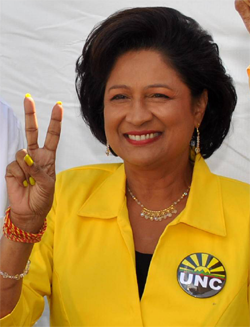
Kamla Persad-Bissessar, M.P., leader of the Peoples’ Partnership and newly elected Prime Minister
The CL Financial bailout has been a major public concern since it was announced on 30th January 2009 and I have been critical of the steps taken by the current administration to deal with the collapse of what was the Caribbean’s largest conglomerate. The leader of the Peoples’ Partnership (PP), Kamla Persad-Bissessar, has been noted for her strong criticism of the actions of the then Minister of Finance in making early withdrawals from the CL Financial group before the collapse. Her arguments in the Parliament are an important part of the story of this fiasco.
National elections are tomorrow, with the distinct probability of a victory by the united PP, so it is timely to consider the way in which that group might handle the bailout.
In addition to her major contribution to this debate, the opposition leader has recently promised to revisit the terms of the bailout and that is an intriguing development.
It is impossible at this stage to know what the PP will do on this important public matter, but I have been considering the role of certain major players.
The Insiders
For example, these are prominent people, formerly from the highest level of the CL Financial group –
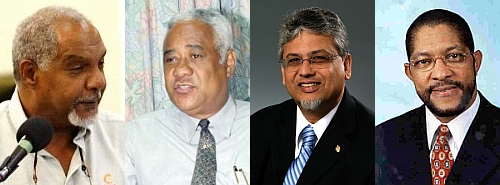
The Insiders: (l - r) Robert Mayers, Mervyn Assam, Dr. Bhoendradatt Tewarie, Carlos John
Robert Mayers – Deputy Leader of CoP and former Managing Director of CMMB – Mayers retired in November 2008 and was reportedly the financial adviser to Lawrence Duprey. Mr. Mayers is not listed in the CL Financial Annual Return of 17th February 2009 as a shareholder.
Mervyn Assam – Former Trade Minister with UNC in the 1995-2000 period and UNC Senator up until the dissolution of Parliament in April. Assam was a founder of CLICO Investment Bank (CIB) and its last Chairman before the collapse. Despite the heat and temper of the election campaign, we have heard nothing on the role of Assam in the collapse of CIB. Yet again, the ‘Code of Silence’ is suspected, by negative inference, as it were. There seems to be some tacit agreement between the contending parties on this controversial matter. Mr. Assam is listed in the CL Financial Annual Return of 17th February 2009 as #22 of the 325 shareholders, holding 7,500 shares.
Dr. Bhoendradatt Tewarie – Former Principal of UWI (St. Augustine), Director of CL Financial and Republic Bank Limited at the time of the collapse. The Foundation for Politics and Leadership, which was founded by some of the leading figures in the Congress of the People (CoP), headlined Dr. Tewarie to speak at their January 16th conference ‘Thinking Ahead – Governance in the 21st Century’. Tewarie is reported to have been one of the Directors who was present at the last Annual General Meeting of CL Financial on 23rd January 2009 at Trinidad Hilton. Yes, that is 7 days after they paid the final dividend; 10 days after they wrote the Central Bank and 7 days before announcing the bailout. Again, Tewarie is also silent on those events in the CL Financial Boardroom. Dr. Tewarie is listed in the CL Financial Annual Return of 17th February 2009 as #290 of the 325 shareholders, holding 1,171 shares.
Carlos John – Former close aide of Lawrence Duprey and Director of CL Financial. Now visible at political meetings and has reportedly been recently canvassing in support of the PP’s St. Joseph candidate, recently-retired High Court Judge, Herbert Volney. Mr. John is not listed in the CL Financial Annual Return of 17th February 2009 as a shareholder.
It is easy to imagine these men playing an important part in any future PP government.
The Outsiders
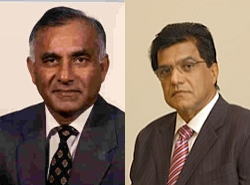
The Outsiders: (l - r) former MPs Trevor Sudama and Ramesh Lawrence Maharaj
In contrast, the two UNC MPs who, publicly and in advance, voiced serious concerns over the CL Financial group were economist, Trevor Sudama and former Attorney General, Ramesh Lawrence Maharaj. Both of those courageous individuals suffered the wrath of Mr. Panday and eventually found themselves sidelined. Ramesh was an MP in the last Parliament and ended up backing the very Basdeo Panday in the UNC’s recent leadership contest. A twisted road indeed, but ultimately, with Kamla’s victory, Ramesh has now been excluded from the ranks of PP candidates in tomorrow’s election. Only those two individuals in our public life had the foresight and fortitude to sound the alarm on CL Financial. For whatever reason, we have now come to an arrangement of forces which has no room for those two men.
What is at stake?
Apart from the crucial Special Purpose Entities (SPEs), the CL Financial bailout has placed the entire group under State control. There are therefore substantial Directorships and contracts, within the very CL Financial group, to be dispensed.
SIDEBAR: FIXING the bailout
Some of the main issues which must be dealt with if the bailout terms are to be normalised would be –
Audited Accounts – There is an immense variance between the asset value of the group as per their 2007 audited accounts ($100.7Bn as published on 18th November 2008) and as stated in their letter of 13th January 2009 requesting urgent financial assistance (a mere 56 days later, the asset value was stated to be $23.9BN). We need to have the audited accounts for 2008 and 2009 published without further delay. In any case, that publication is mandated by clause 4.4.5 of the Shareholders’ Agreement.
Payment of CL Financial dividend – CL Financial paid a dividend of $3.00 per share to its shareholders on 16th January 2009, 3 days after writing to seek the urgent financial assistance of the State. Steps need to be taken to recover those dividends from the shareholders.
Role of the Regulator – The Governor of the Central Bank has repeatedly told of the long-term concern over the risks inherent in CL Financial’s operations. We need to know if those regulators were at fault and to what extent could all of this have been avoided.
Fit and Proper conduct of the Directors – The ‘Fit and Proper’ criteria which are essential qualifications for Directors and Officers of Financial Institutions, were clearly not followed, if we are to believe the public statements of the Governor. What is to be done with the offenders? Will a PP administration be willing or able to dis-qualify those Directors?
Taxpayers’ protection for CL Financial shareholders – The Shareholders’ Agreement of 12th June 2009 extended the bailout protection to the shareholders of the collapsed group. For the interests of shareholders to be protected in this situation is contrary to good sense and violates elementary principles of good public policy. It is unprecedented anywhere else in the world, including Nigeria, as shown in ‘Finding the Assets‘, published in the Business Guardian on 19th November 2009. Literally, it is a case of ‘Only in Trinidad & Tobago’. Question is, will a PP administration be reversing that corrupt decision?
The strategy behind the bailout – Most importantly – ‘What is the strategy behind the bailout?‘ On 31st March, there was a major press conference of the CL Financial leadership to announce the resignation of Dr. Euric Bobb and the appointment of Marlon Holder as the group’s new CEO. The promise to provide accounts and a strategy was a key feature of that event and it is awaited.
SIDEBAR: The role of SPEs
There are about 65 SPEs and the terms of the CL Financial bailout bring another 65 companies in that group within the umbrella of State control. That is a total of 130 companies and this could be an opportunity to re-shape the corporate culture of the place.
The opposition leader has been noted for her sharp questioning of the real role of the SPEs, even going so far as to suggest that they are deliberately used to avoid the norms of proper accountability in the spending of public monies.
The PM, Mr. Manning, also told us in his interview last Sunday that in some cases, the SPEs may have ‘cut corners’.
Both those statements seem to signal an acceptance of the need to change, but we will have to wait to see what actually happens.
I have set out the key findings of the Uff Report, insofar as the elements of governance go. Those were combined with recently published news to offer a picture of the manner in which our leading Special Purpose Entities (SPEs) are being governed.
The picture is an unflattering one, which few could seriously seek to emulate. It brings to mind the question raised here some time ago – ‘What was it really all for?‘ I continue to believe that the State must behave in an exemplary fashion, but that is not all.
The concerns over governance being raised in this series ‘Learning the Lessons’ are part of an attempt to query the true purpose and effect of the SPEs. The point I am making in this final installment is that there are pre-conditions which ought to eclipse even important points like missing years of audited accounts, unsigned contracts, ‘back-fitted’ financial documents, publication of massively-inflated achievements, bogus feasibility studies and the like. Just listing the important principles which have been violated, the whole situation seems incredible.
Important as it is to eradicate those unprofessional and dishonest practices, there has to be more to the development process. Yes, even if the main ingredients of good corporate governance were practiced at our SPEs, it would all be for naught, unless those companies are operating in accordance with a sound strategy for national development. Good corporate governance is necessary, but not sufficient, if we are to achieve the sound development which every right-minded citizen would desire.
To illustrate this point as to the importance attached to strategy, I am going to shift focus from UDeCOTT and the HDC. I am going to consider the operations of NIDCO in terms of examining this issue.
In her maiden budget speech on 22nd September 2008, the Minister of Finance set out the main elements of this government’s ambitious transportation plans. These were in four parts – the rapid rail project, the coastal water taxi, the building of more highways and a significant expansion of PTSC’s fleet. The Rapid Rail, Coastal Water Taxi and Highway building program are all being handled by NIDCO.
“…another slew of ambitious, extremely expensive and long-range plans being carried out supposedly for our benefit, but once again, we are witness to fundamental dishonesty on a huge scale.”
“The National Infrastructure Development Company’s (Nidco’s) high-profile advertisements for rapid rail are now giving one pause. Hear this: “As part of a holistic plan to ease traffic congestion and create a more modern, efficient, transportation network, the Ministry of Works & Transport…signed a design-build-operate-maintain contract on April 11, 2008, for the implementation of the Trinidad Rapid Rail Transit System.
Where is this holistic plan?
Were public comments ever invited on that plan?
Where can the public see that plan?”
It was plainly the intention of NIDCO, in this series of advertisements, to promote the belief that these four huge, expensive initiatives are all part of a comprehensive strategy.
I was very sceptical and continued to call for the ‘Holistic Plan’ to be published. All to no avail.
On 27th November 2008, I submitted my application, under the provisions of the Freedom of Information Act (FoIA), for a copy of the said ‘Holistic Plan’. My application was sent to both the Ministry of Works and Transport (MoWT) and NIDCO, its implementing agency.
That FoIA application and NIDCO’s reply also dealt with the Rapid Rail contract, but that is for another time.
On 2nd January 2009, I was ‘phoned by a civil servant from MoWT, who advised that they were ‘working on my application’; she confirmed by email later that day that “…we are still gathering the information and working on your request…”.
Just imagine that. 9 months after signing a major contract, reportedly ‘…as part of a holistic plan…’ and three months after publishing advertisements to that effect, I get an email from MoWT to say they are putting the plan together.
On March 6th 2009, the Permanent Secretary of MoWT wrote me to apologise for the delay (these FoIA applications are supposed to be dealt with in a month) and direct me to pursue NIDCO for a reply.
On 4th August 2009, NIDCO’s Vice-President Legal, Nirad Samnadda-Ramrekersingh, wrote in reply to my application for the ‘holistic plan’ –
“…please note that same does not exist either as a formal document or series of documents and that the term as used in the newspaper advertisement to which you have referred is simply a descriptive reference to the Rapid Rail Transit System, the Water Taxi Service, the Interchange Project and the existing PTSC and Maxi Taxi networks also described in the said advertisement. We are satisfied that this is the case…”
“…simply a descriptive reference…” Take that.
So there we have it, another slew of ambitious, extremely expensive and long-range plans being carried out supposedly for our benefit, but once again, we are witness to fundamental dishonesty on a huge scale. Just like UDeCOTT, with its bogus feasibility studies, we can see that NIDCO’s claims are also highly questionable. In the absence of real development strategy, we can only hope for a lucky accident. That is no proper road to national development. Particularly in the arena of physical development, where decisions have long-term physical, environmental and financial consequences.
As our servant with special responsibilities, the State is responsible for carrying out those developments in accordance with some sound strategy. We must raise questions which are fundamental if we are to do better. If we are to do better, we have to think and act differently. Big changes are essential if the State is to deliver the future we need.
SIDEBAR: National Infrastructure Development Company (NIDCO)
NIDCO is a State-owned company, established in 2005 and under the control of the Ministry of Works and Transport.
According to its website – www.nidco.co.tt – its vision is –
Vision To be a key enabling vehicle for the development of infrastructure that enhances and sustains Trinidad and Tobago’s economic development and quality of life.
Its core values are –
Transparency.
Professionalism & Quality.
Integrity, Trust, & Honesty.
Meritocracy.
Teamwork.
Commitment.
Communication & Participation.
No reasonable person could object to those principles.
The Chairman of NIDCO is Professor Chandrabhan Sharma, of UWI’s Engineering Department; Professor Sharma is also a Director of Republic Bank Limited, TTEC and several other companies.
NIDCO’s President is Kaisha Ince, Attorney-at-Law.
Afra Raymond sits with Fitzgerald Hinds and Jessie May Ventour to discuss an updated in-depth look at UDeCOTT subsequent to the resignation of its Executive Chairman, Calder Hart. Video courtesy CNMG
VIDEO: Cock-a-Doodle-Doo Interview – 26 February 2010
Afra Raymond sits down with Magella Moreau at Gayelle TV to discuss and review the politics and the state of transparency in public affairs in the country.
I was perturbed to read in the press that our President had selected Mr. Michael Annisette to serve as an Independent Senator in our next Parliament.
Apart from his well-known role as head of the SWWTU, Mr. Annisette also sits on the Boards of the Urban Development Corporation of Trinidad and Tobago Limited (UDeCoTT), the Trinidad and Tobago Mortgage Finance Company Limited (TTMF) and the Vehicle Maintenance Corporation of Trinidad & Tobago Limited (VEMCOTT). These 3 Directorships are in significant State-owned enterprises and it is a widely-held view that such appointments, especially to those who are not experts in the relevant fields, are only offered to those in political favour. To put it plainly, one would hardly expect to see UNC or COP members, however expert, on State Boards under a PNM administration.
Whatever its latent defects, one would have to agree that an important part of our Parliamentary health is derived from our Independent Senators. At this time, with national concerns on constitutional reform looming large, it is vital that we have a vigorous, outspoken and articulate cadre of Independent Senators.
It raises serious questions as to process that our President was able to use his power to nominate Mr. Annisette. Of course one expected that Mr. Annisette would have resigned his Directorships of those State enterprises before his swearing-in as an Independent Senator, but that is the central issue. We were then being asked to accept that an individual who was loyal to the party in power, to the extent of gaining those sought-after appointments, would have, upon taking the oath of office, become an Independent Senator. Even a tolerant nation such as ours has its limits.
I recently read a story in the Express of 29th December headlined ‘Independent Senator resigns as EBC commissioner’ and the first paragraph deserves repetition – “After accepting the President’s request to serve on the Independent Bench in the Senate, Independent Senator Corinne Baptiste-McKnight has resigned as a Commissioner on the Elections and Boundaries Commission.” Imagine that. The Chairman of the EBC, Dr. Norbert Masson, was quoted as saying “She did the right thing”.
We are witnessing the slow erosion of unwritten standards of public life in so many worrisome ways and here is yet another such. We are now being asked to believe that it is possible for an individual to serve on the Board of 3 State-owned companies and also serve as an Independent Senator. The Express story mentioned above states that Mr. Annisette was still a Director of those State-owned companies. There has been no denial, retraction or correction to my knowledge. This is an utterly unacceptable state of affairs in my view.
Consider the nature of the Independent Senators in our Parliament. Andy Johnson wrote a column entitled ‘One of the President’s men’ in the Express of 20th December 2007 and it makes interesting reading since he mentions that a known CoP supporter is now amongst the ranks of our new Independent Senators. Johnson did not name the person but said that the other 2 parties in the Parliament knew of his affiliation and hinted that this could become controversial.
Given the way in which distractions are used in our country, we need to reflect with the necessary degree of seriousness on all this to properly distinguish these 2 cases. The lower House of our Parliament is made up of Members elected nationally. The upper House is comprised of the Senators selected by the PM, the Leader of the Opposition and the President. They are allowed to nominate sixteen, six and nine Senators, respectively. The party in power and the opposition are represented in both Houses of the Parliament. But our constitution implicitly recognizes that these 2 elements alone cannot be enough, hence the third group of Senators we have come to call Independents.
For our President to nominate a Senator who comes from within the ranks of PNM or UNC loyalists seems contrary to the spirit of the constitution. In contrast, the ranks of our Independent Senators is an appropriate place for supporters of ‘third parties’ together with other matured, expert and committed citizens. We expect our Parliament to be a place in which major policy issues are debated and settled, but the reality is much different. The decisive issue here is whether we have the vision and will to stop practices which further dilute the authority of our Parliament.
To challenge or remove the so-far-unnamed CoP supporter in the ranks of Independent Senators in this 9th Parliament will do violence to the spirit of the Constitution. To allow Mr. Annisette to continue as an Independent Senator while holding 3 Directorships in State-owned companies is to invite ridicule and disrespect. Even if he were to resign those Directorships now, one is bound to ask, ‘What next?’
It would be wicked to repeat here the scandalous suggestions I received in discussing this question with various people. Out of some latent regard for the little respectable that is left, I will just say that there are still ways to deal with this unpalatable situation.
The President’s selection of Mr. Annisette was questionable. For an Independent Senator to continue in his roles as Board Director of 3 State companies is completely unacceptable. Due to the constitutional immunity extended to that office, it is impossible to legally challenge any of the President’s decisions, so one is forced to take action in the Court of Public Opinion. Our President should himself take the necessary corrective action now. He has the power, under Section (43) (2) e of our constitution, to declare Mr. Annisette’s seat vacant.
The silence of the UNC-A and CoP on all this is damning. It would be interesting to see what views are expressed by other concerned citizens. The peril we face is Civil Obedience. Public apathy and cowardice are as corrosive to the health of our Republic as the menace of crime.
 If you think this title is for the latest brand of household cleaner, you would be wrong. I drew that title from the famous statement by deceased US Supreme Court Justice Louis Brandeis,


 To illustrate this point as to the importance attached to strategy, I am going to shift focus from UDeCOTT and the HDC. I am going to consider the operations of NIDCO in terms of examining this issue.
 VIDEO: First Up Interview – 09 March 2010
 AfraRaymond.net