The Uff Bluff

Jearlean John. Photo courtesy Trinidad Guardian
Jearlean John, Chairman UDeCOTT

On December 11, I wrote ‘Invader’s Bay Review‘ in this space, calling for an immediate public review of that improper large-scale development being proposed on reclaimed State lands in west POS.  I also took the opportunity to make the point that there had been no consultation on that proposed development and that UDECOTT’s repeated public statements that its operations are now compliant with the Uff Report recommendations are false.

UDECOTT’s response was to place full-page advertisements in the three daily newspapers, on Saturday 14 and Sunday 15 December, in an expensive attempt to refute my criticisms.  My letter to the editor, carried in this newspaper on the Sunday, put UDECOTT’s misleading advertisement in context and reaffirmed the continuing falsehood of their claimed compliance with the Uff Report.  The episode is recounted here.

There are several lessons one can draw from this exchange – the sheer hostility to the truth which is now becoming a disturbing ‘new normal‘ in our society; the invisible hand of the bureaucracy in devising large-scale developments, stated to be for the benefit of citizens, without citizen inputs; the inescapable reality that these obstructive forces operate across and within all our political administrations.

Sunity Maharaj wrote a fine overview of these burning issues in ‘Amandla!  Now listen to the people‘ in the 15 December Sunday Express.  In that article, Sunity detailed the development of a perverse consultation industry “Its specialty is in designing events that look like consultation, sound like consultation but do not actually involve consultation…”.

There is a serious challenge facing us here, since there is no will to implement the beneficial recommendations contained in the Uff Report, despite the repeated false promises.  The failure to implement those proposals is deeply detrimental to our society as it entrenches the colonial idea that development is not something which really concerns the people of this country.  Worse, the deceptive policy of politicians claiming to intend to do the right thing, while doing the underhanded thing, is imposing a neo-colonial reality.  The State has a duty to be exemplary in its conduct and for the State to fail to do so and to act deceptively in that failure, is to increase cynicism and instability in our society.

In addition to failing to implement the Uff Report recommendations, there was also another significant setback.   The Enquiry website – www.constructionenquiry.gov.tt – which held all of the proceedings and evidence, became inaccessible at the end of 2010, about 6 months after the Peoples Partnership electoral victory.

moore-volneyThe JCC has been pressing for the implementation of the Uff Report recommendations and the restoration of the Enquiry website.  Those efforts have ranged from the Attorney General, who directed us to the Minister of Justice, to the then Minister Volney who ignored our three letters on the matter – see http://www.jcc.org.tt/uff.htm.  When we pressed-on with Volney’s successor, Christlyn Moore, the exchanges were sobering.

The two previous Ministers of Justice – Volney and Moore – both claimed that the Uff Report recommendations were to be implemented by the impending Public Procurement legislation.  Quite apart from the inordinate delay in bringing these critical new laws into being, that claim is entirely false, since only one of the recommendations, the 56th, relates to new Public Procurement laws.  90 of the 91 recommendations could have been implemented by now with no need to get any new laws passed or any use of valuable Parliamentary time.  The JCC’s repeated offers to assist and advise in any working party for that purpose have also been ignored.  The implementation of those 90 recommendations would have greatly reduced the criminal theft and waste of Public Money with which we are now beset.  The failure to implement those recommendations is probably the largest single ingredient in the continuing decline in our ‘morality in public affairs‘.

Even worse is the steadfast refusal to reinstate the Uff Enquiry website.   There is no way to tell if the website was deliberately removed or if there was a mundane technical reason for its disappearance.  What we do know for sure is that there is solid official resistance to even offer a sensible explanation for the continuing refusal to reinstate.

It is critical for us to learn from our errors if we are to avoid a repetition and it is therefore important that we excavate those lessons so that they can be considered.  To fail to do that is to thwart the entire move to a ‘developed nation status’.  Our nation’s primary information needs to be properly documented and published so that anyone who wants to learn the lessons can do so.

The evidence in the Uff Enquiry offers a deep, unprecedented insight into the state of affairs in our country and the conduct of our substantial business dealings.  That information is first-class primary source material for research and teaching in critical fields such as Government, Finance, Engineering, Surveying, Planning, Economics, Sciences, Law and Management.  We cannot become a ‘learning society‘ if first-class primary information is suppressed.  It does not matter how many universities we build or how many pupils we certificate, the ignorance of our own primary information will frustrate the drive to a higher level of education.

On 26 March 2013, then Minister Moore replied to the JCC –

“…It is inappropriate to make available the evidence revealed in the Uff Enquiry at this time as they may ground future criminal enquiry…”

On 23 May, we invited the Minister to reconsider her position, pointing out that –

“…To quote from the final remarks of the Enquiry Chairman, Professor John Uff QC Ph.D. – “…Finally we would like to thank the Press for their continued and expert coverage of the Enquiry; and the public for their unflagging interest in the proceedings. There are few countries in the world where an Enquiry into the construction industry could fill a prime time television slot for over a year. For me it has been a unique experience and I am personally honoured to have had the opportunity, as I hope, to serve the interests of the construction industry and the people of Trinidad & Tobago…” There can therefore be no doubt that the entire proceedings of the Uff Enquiry were published widely…”

This is the Minister of Justice, claiming that our request to reinstate this invaluable website, would amount to ‘making the evidence available‘.  Evidence which had been widely televised, all day long and rebroadcast at night. I tell you.

The Minister promised to revert to us by the end of June 2013, but that reply never came.

So now UDECOTT’s stance is clearer, given the overarching policy of the State on these critical matters of public concern. I maintain that UDECOTT did not conform to the 17th Uff recommendation in its involvement in the Couva Children’s Hospital.  That recommendation is –

“User groups and other interest groups should be properly consulted on decisions regarding public building projects, to ensure that relevant views can be expressed at the appropriate time and taken into account before decisions are made.”  (emphasis mine)

Procurement_NoticBut the current concern goes beyond the ongoing Couva Children’s Hospital, since UDECOTT is playing a leading role in the Invader’s Bay development. In December 2013, UDECOTT published full-page Requests for Proposals in the newspapers for Designers for Infrastructure Development of Invader’s Bay.  UDECOTT is seeking to hire a designer for the infrastructure element of this large-scale development which means that the selected designers would have to conform to the client’s instructions in preparing their plans.  The client’s instructions would have to be based on some kind of concept, proposal or outline.  That raises the obvious questions of when were these concepts, proposals or outlines conceived and by whom?  Most importantly, who approved these?  We know for sure that there has been no consultation with the public, user groups or other interest groups.

So, we are witness to yet another episode of large-scale development being undertaken, in this case by UDECOTT, with none of the promised consultation.

Hence my title – The Uff Bluff.

Letter to the Editor – UDECOTT’s failure to consult response

udecott-complaintIn response to a full page UDECOTT advert (embedded below) in response to my article “Invader’s Bay Review” (excerpted above), also published in the Business Express.

From: Afra Raymond <afraraymond@gmail.com>
Date: Sat, Dec 14, 2013 at 9:30 AM
Subject: Letter to the Editor – UDECOTT’s failure to consult
To: Editors of daily newspapers. Email addresses withheld

The 17th recommendation of the Uff Report is –

User groups and other interest groups should be properly consulted on decisions regarding public building projects, to ensure that relevant views can be expressed at the appropriate time and taken into account before decisions are made.

The decisive part is ‘before decisions are made.

The Peoples Partnership has not implemented the Uff Report’s 90 recommendations as promised and there has never been an explanation of that failure or refusal to carry out those critical measures. The sod was turned for the Couva Children’s Hospital on 2nd March 2012, at which time the project type, location, size, budget and procurement arrangements were all announced for the first time. Plainly, no consultation took place before those decisions were made, which was the point made in my 11th December article ‘Invader’s Bay Review’.

UDECOTT has now issued full-page newspaper advertisements to attempt to label my irrefutable observation as ‘reckless and damaging’ and so on. Yet another waste of public money, given that UDECOTT provided no examples of consultation before the key decisions were made on this huge project.

That pattern of secret development is inimical to our country’s progress. We must be properly consulted before decisions are made. We strongly criticised the last administration for that pattern of development and we will continue to make the same point. We must become a learning society.

Afra Raymond
POS

Invaders’ Bay Review

There now needs to be a complete and open review of the Invaders’ Bay matter. That is imperative if the public interest is to be safeguarded.

The catalogue of irregular dealings and improper procurement practice at Invaders’ Bay has now grown so that we are facing an important moment of decision. At this point there has been no announcement as to an award of contract or grant of any lease, so the threshold of binding legal agreement has not been crossed. In investment language, we are at the ‘inflection point’, which is where the prudent investor has to make a decision to continue or abandon a course of action.

This is the exact moment we should be calling for an open review of this major public project, before any binding commitments are made.

The Commission of Enquiry is an often-used device to probe into matters of serious public concern. In relation to construction and property development, we have had recent CoEs into the Piarco Airport Project, UDECOTT, Land-Date and the Biche School Project, to name a few.

The public has a sceptical attitude to these Commissions, since they never seem to bring the desired results in terms of arrests of prominent public officials or disgorgement of stolen monies. Many people dismiss CoEs as ‘talk shops’ set up to enrich lawyers, but I do not dismiss them as effective ways to serve the public interest. Despite the imperfections of the Enquiry process, including the fact that key witnesses can refuse to appear without incurring any serious penalties, there are real benefits. The main one, in my view, is that a CoE allows us in the public to learn about major matters of public concern which would likely have remained hidden.

That is the reason we need to retain this process so that the wrongdoing of the past can be exposed, so that we can have the possibility of avoiding those in the future. The weak point of the process is that it always takes place after the crimes have been committed, so during the Bernard Enquiry we were learning about the already-constructed Piarco Airport Terminal. Too late to prevent the massive theft and waste of Public Money.

That is why we need to consider a shift in our approach to the question of enquiries into questionable public projects, since the process is a reactive one, completely unable to stem wrongdoing.

At the ‘inflection point’ now occupied by the Invaders’ Bay project, we have an opportunity to examine this large-scale development before any significant expenditure of Public Money so that we can detect and deter wrongdoing. I am not yet settled in my mind as to exactly what type of review is best here, but whatever happens, it must be independent and committed to publication of its findings.

Some of the main issues which such an Enquiry or Review should examine are –

  • Consultation – The complete lack of consultation in this large-scale development proposal for our capital city would be addressed by the process. The land is vested in UDECOTT via a lease and that organisation has repeatedly claimed to have implemented the recommendations of the Uff Report. The 17th of those recommendations states “User groups and other interest groups should be properly consulted on decisions regarding public building projects, to ensure that relevant views can be expressed at the appropriate time and taken into account before decisions are made”. Given the swiftness with which the Couva Children’s Hospital – which is being executed via UDECOTT – emerged in March 2012, we know for sure that those recommendations are not being observed by UDECOTT. Even looking beyond UDECOTT and its conflicting ‘versions’, we can see the contradictory actions of the Ministry of Planning & Sustainable Development supporting a public consultation process at King’s Wharf in San Fernando, yet refusing to hold public consultations on Invaders’ Bay in Port-of-Spain.
  • Environmental Concerns – The Invaders’ Bay lands are extensive waterfront holdings in State property. The proper development of those lands must take full account of drainage issues and the impact on the environment, including the marine-life issues arising in any waterfront project. I have before me the EMA’s letter of 14 November, which confirms that there have been no requests or Certificate of Environmental Clearance (CEC) applications for the Invader’s Bay lands. In addition, the EMA records provided to me show that the most recent application for a CEC at Invader’s Bay was in January 2007. It is not possible to obtain planning permission without EMA approval, so there are other implications of the lack of these approvals.;
  • There is no link between the RFP and the other three strategic plans for the POS area. That violates the fundamental notion of strategic planning in that existing plans are ignored for no given reason. Piecemeal planning and development is detrimental to the Public Interest. So, who was the author of that RFP and who in the Ministry of Planning approved such a document?;
  • The Request for Proposals (RFP) published by the Ministry of Planning in August 2011 seeking Design-Build proposals for the development of these lands specified an entirely inadequate 6 weeks for submissions. Whose recommendation was it to truncate the development process in this fashion?;
  • The evaluation rules were only published after the closing-date for the tenders, so how did the proposers know what criteria to meet? That late publication is in breach of proper tender procedure, so the entire process is voidable and therefore illegal.
  • Legal Instructions and advice – Also critical to any review process would be the details of the legal advice sought and obtained at various stages of this process. The Ministry is adopting a bizarre, secretive stance in which the advice is claimed to vindicate their actions ‘thus far’, yet that legal advice is being suppressed. The JCC has taken legal action to challenge that unacceptable secrecy in this most public matter.;
  • Infrastructure – The 2014 Budget discloses a $50M allocation for infrastructure at Invader’s Bay, which of course is only a small part of this substantial cost. In the absence of environmental or planning approvals, it is difficult to establish the cost for proposals of this nature, since a design cannot be completed.
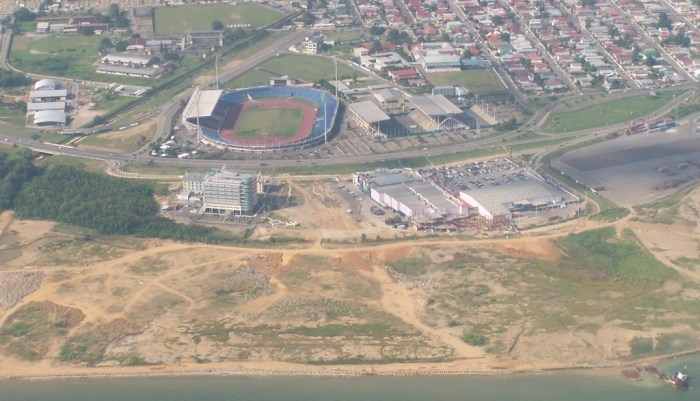
  • Allegations of squatting – Finally, we turn to one of the most vexed phrases in our lexicon where land is concerned. The issue of squatting, which is the unauthorised occupation of land not in your ownership. From the sequence of images shown below, we can trace some elementary conclusions:
    1. the first (left) is a map/plan, which uses a dotted line to illustrate the boundary between the Invaders’ Bay property and adjoining Port Authority lands to the north…the physical boundary is occupied by a watercourse/ravine and those ‘Port’ lands are occupied by MovieTowne/PriceSmart, a green play park and the Marriott/BHP-Billiton building
    2. the second (middle image) is an aerial photo which shows the Invader’s Bay land bare of vegetation
    3. the third (image at the base) is an aerial photo which shows the Invaders’ Bay land re-vegetated with mangrove and what appears to be a bare excision, immediately south of MovieTowne’s western carpark…that is a gravel-paved area, which is south of the watercourse I mentioned earlier…it is accessed via a basic bridge from the said MovieTowne carpark.

    (Click on images to expand)

    I am asking whether MovieTowne has a lease, licence or tenancy agreement to occupy those lands. Does MovieTowne pay any rent, licence fee or charge of any sort for the use and occupation of those lands? What action is UDECOTT taking on this? What action is the Commissioner of State Lands taking on this? It would be unacceptable for an entity in breach of State policy to benefit from the decisions of the State. I hope that is not what we are seeing here.

We need a full, independent and open review of this Invader’s Bay matter. Do you agree?

AUDIO: Heritage Radio Interview: Public Procurement, etc. – 04 December 2013

JCC President Afra Raymond interviewed on Heritage Radio 101.7FM by Hans Hanoomansingh to discuss JCC matters such as Public Procurement, Invader’s Bay and G2G Arrangements. 04 December 2013. Audio courtesy Heritage Radio 101.7 FM

  • Programme Date: Wednesday, 04 December 2013
  • Programme Length: 1:23:27

Secret Society

foiaThe State is the dominant agent in our national economy, which is the most vibrant in the Caribbean. It is therefore essential for us to understand how the State works so that we can better understand, or even plan, our interaction with that dominant party. Given the role T&T plays in the wider Caribbean, those concerns extend beyond our country to our region.
In order for us to understand how the State works, we must get quality information in the required quantities. We must also have the right to request further information from public bodies so that we can examine particular matters more closely – see Sidebar below.

This country’s Integrity Framework comprises elements such as –

  • The Integrity Commission (IC), which is responsible for monitoring the integrity of Public Officials;
  • The Freedom of Information Act (FoIA), which gives the right to ask for unpublished information;
  • The Auditor General, the Independent body monitoring the financial reporting of Public Bodies;
  • The Investments Division of the Ministry of Finance, monitoring the operations of State Enterprises;
  • The two Parliamentary Accounts Enterprises Committees, providing Parliamentary oversight of Public Bodies

This sustained examination of our country’s Integrity Framework is directed towards an enhanced level of information on how our nation’s Public Bodies are functioning. Continue reading “Secret Society”

Integrity Omission?

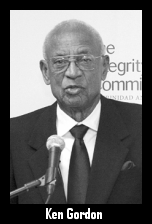
kengordonThe sheer pace of events surrounding the Integrity Commission and the startling series of revelations demand our attention, given the critical role of the Commission as the State’s principal anti-corruption agency.
The rising tide of corruption in our public affairs has been a constant, whichever political administration is in office, seemingly increasing since the IC was established in 1987.  Two general observations emerge from that – we certainly need a respected, effective agency to tackle corruption in our public affairs, so we therefore need to look soberly at how the IC can be improved.  I repeat that the Commission’s 2012 Annual Report contains serious proposals to improve its effectiveness.

My reading of these recent events is that there are two fundamental issues arising. Continue reading “Integrity Omission?”

CL Financial bailout – Really learning from the past

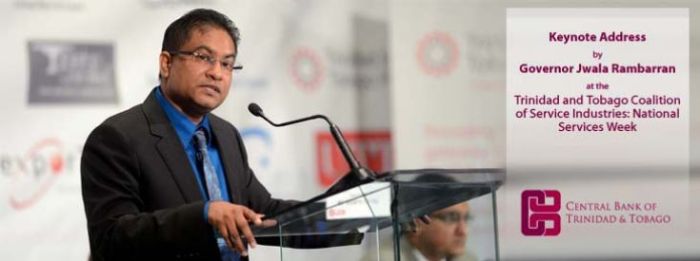
CB-gov - TTCSII am responding to the points made by Central Bank Governor, Jwala Rambarran, in his 6 November speech to the T&T Coalition of Service Industries.

This speech attempted to both re-affirm the Central Bank’s important role in our economy –

…as the country‟s prime financial regulator, the Central Bank has an almost fifty year record of maintaining the safety and soundness of the financial system…

and to distinguish Rambarran’s tenure as Governor since July 2012 –

…These are just a few of the initiatives the Central Bank has been working on over the last fifteen months to rebuild confidence, strengthen financial stability and to help create our future financial system…

Rambarran’s focus was “…First, “How did it all happen?” and, second…“What is being done to prevent a similar event from happening again?…” Continue reading “CL Financial bailout – Really learning from the past”

The Integrity Account

icttHaving completed my four-part series [1, 2 & 3, 4] on what I termed ‘The Integrity Threat‘, I was intrigued by two recent public notices on the meaning of the Appeal Court’s recent activity on these matters.

  1. 6 October  – The Integrity Commission issued a Public Notice which was a clear statement by the Commission that State Enterprises were within its lawful remit, according to the Appeal Court ruling on 27 June.  My reading of that ruling was that it effectively narrowed the 9th part of the Schedule to the Integrity in Public Life Act (IPLA) so that it only applies to Directors of Statutory Bodies performing public functions.  I maintain that view.  Even if one accepts the Commission’s reading of events, as set out in the exchange of emails in the sidebar, this ruling was a seriously retrograde step in the operation of our nation’s Integrity Framework, as I will illustrate;
  2. 5 November – the Judiciary issued a Media Release on the recent reports in other newspapers on a 28 October Appeal Court hearing on a 2006 Freedom of Information request made to TSTT.  I want to read the actual ruling/findings of the Appeal Court at that hearing before writing in detail on this.  Two things are clear – firstly, the Judiciary is able to set the record straight if there is a danger of the media misunderstanding important rulings.  That is the behaviour of a healthy Public Institution.  I am also noting here that the Judiciary has made no such efforts in respect of #30 of 2008, despite the several pointed criticisms in the media.  The second point is about the subject-matter of this lawsuit, which is the 2006 letter the Commission wrote to TSTT’s Directors confirming that they did not have to submit declarations.  That letter and the official efforts to conceal it, were the subject of this 7-year lawsuit.  I had raised this arrangement with senior officials of the Commission in earlier discussions, since it seemed incredible to me that TSTT could have gained such a concession.  I was told that the Commission had agreed to ‘hold its hand‘ since the issue was subject to the Court’s ruling – this is my paraphrasing of conversations, so of course I am subject to correction.  On the one hand I was recently told by the Commission that this arrangement was ‘in order‘ and on the other, it is now emerging that TSTT expended considerable time & money to conceal those details.  I am calling on the Commission to publish those details. Continue reading “The Integrity Account”

Invader’s Bay part 3: MORE Invaders Bay Ingredients

Invaders' Bay
Invaders’ Bay

I closed last week’s article by restating my view that all the ingredients for corruption were present at Invader’s Bay.

What are those ingredients?

Here is my list –

  • Extensive public assets coming onto the market, in turbid circumstances. Those assets can include property, concessions, contracts and jobs;
  • Questions of access to the gatekeepers – in these scenarios, some people will have unbelievable access to the decision-makers;
  • Conflicting and confusing versions of the project or proposal. The confusion is as persistent as it is deliberate, a part of the tangled web.
  • Blatant double-standards and lying is the norm in these situations;
  • Apart from ceremonial fluff, such as sod-turnings and ribbon-cuttings, there is no intention whatsoever to give any proper public account or statement of intentions. True transparency is evaded like taxes;
  • Professional Civil Servants who are unable or unwilling to insist on the maintenance of minimum standards;

Extensive Public Assets

These lands are estimated to be worth in excess of $1.2Bn at today’s priced, that means the unimproved value. Although the lands are reclaimed, a significant amount would have to be spent on infrastructure to make the property ‘shovel-ready’ for development.

As I noted in the first in this series, there were conflicting claims on this aspect, with the selected developers claiming extensive infrastructure expenses as a way to reduce what they would pay for the land. There were no estimates given for the developers’ cost of infrastructure, but I noted that the National Budget for 2014 had specified, at pg 89 of the Public Sector Investment Program, that there would be publicly-funded ‘Infrastructure Development’ at Invader’s Bay.

I have been assisted by some of the professionals in the very Ministry of Planning & Sustainable Development in identifying that item as being a $50M allocation for 2014. The actual works are unspecified, so it is difficult to be certain what is included. It certainly seems a modest sum given the size and peculiar challenges posed by the Invader’s Bay property.

In addition to the obvious public asset of the actual property, readers should note that assets in this context can include concessions. In this context that can mean maritime & docking concessions as well as tax concessions, so we will have to maintain full vigilance to safeguard the public interest.

As a first position, all the details of the overall agreements must be published for public consideration at the earliest opportunity. This is no minor point, since really huge sums of wealth can be transferred from public hands to private interests if proper transparency is not ensured. Just remember that in June this year while the President of the Peoples Republic of China was here there was the signing of a Government to Government Agreement. The JCC has lodged many strong objections to those agreements. How many readers will remember that there was an important agreement signed with respect to the Pitch Lake at that time?

To cite a press report

…According to a release from Lake Asphalt of Trinidad and Tobago (1978) Ltd, the signing ceremony of a Memorandum of Understanding and a Confidentiality Agreement with Beijing Oriental Yuhong Waterproofing Technology Co Ltd of the People’s Republic of China is scheduled to take place at the Hyatt Regency, Port of Spain…

So, faced with a Freedom of Information Act which ensures disclosure, the new trend is to wrap-up the details in yet another layer of secrecy. We need to be alert to that trend. After all, this is the same Ministry which claims to have legal advice confirming that its actions conform to the Central Tenders Board Act, yet steadfastly refuse to publish that advice.

Access to the gatekeepers

One of the two successful proposers has been the MovieTowne principal, Derek Chin, whose confidence has been striking.
According to Mr. Chin, in an extensive interview

…Chin has met with the Prime Minister and many government ministers seeking approval for this project.
Before Christmas 2010, he had a meeting with the Transport Minister Jack Warner, Foreign Affairs Minister Suruj Rambachan, and other ministers, at the Prime Minister’s Office. They all supported his plans. “I have been lobbying the Government for a year now, even before the elections. I sent in the preliminary sketches about the concept; I met 19 Cabinet ministers over the last six months. The next minister I am meeting is Bhoe Tewarie, Minister of Planning. He wants to see me. I also met with Jearlean John, Udecott chairman. She also loves it, but that was three to four months ago…

That interview was given in early July 2011, which is over one month before the Request for Proposals was published by the Ministry of Planning & Sustainable Development at the end of August. I tell you.

Conflicting and confusing versions

So, to return to the legal opinions, we have this swirling set of stories.

To date, Minister Tewarie has insisted that the project has been removed from UDeCoTT’s portfolio and placed within the Ministry of Planning. He claims that Cabinet approved this in 2011 and also insists that there is no tender process at Invader’s Bay. Of course it is impossible for the Ministry to proceed to invite tenders for anything without following the Central Tenders Board Act.

The first legal advice I saw was clear that there is indeed a tender process at work here and that the CTB Act ought to have been followed. Obviously, that conclusion did not ‘fit the script’, so an escape hatch had to be fashioned. Shortly thereafter another opinion was submitted by Sir Fenton Ramsahoye SC, on an entirely different set of assumptions which made UDeCoTT the central enabling agency in the entire scheme.

The approach endorsed by the Ramsahoye opinion flatly contradicts the version being advanced by Minister Tewarie.

That is the deep, intentional confusion being encouraged by public officials in this matter.

Blatant double-standards and lying

So, let us start with the role of the Ministry of Planning & Sustainable Development on the Invader’s Bay project. How does that Ministry reconcile its active role in seeking public views on the King’s Wharf project in San Fernando with its silence on Invader’s Bay in POS?

These are blatant double-standards of the worst kind. One can scarcely believe that there are professional civil servants who could condone this reckless and underhanded approach to national development. But there we have it.

When is the Ministry of Planning & Sustainable Development going to host a public consultation on Invader’s Bay? That is now an inescapable requirement. Sooner rather than later.

But that is not all. No, not at all.

This administration campaigned on the findings of the Uff Enquiry and made several public promises to implement the 91 recommendations of the Uff Report. Such was the importance of the matter in the political agenda that it formed the first item of the very first post-Cabinet Press Briefing of the Peoples Partnership administration on 1st July 2010. That is a broken promise, since those Uff recommendations have not been adopted and the JCC’s many attempts to offer our assistance to achieve that have all been rejected.

The 17th recommendation of the Uff Report is –

  1. User groups and other interest groups should be properly consulted on decisions regarding public building projects, to ensure that relevant views can be expressed at the appropriate time and taken into account before decisions are made…

There has been no consultation at all on the Invader’s Bay proposals. Quite frankly, apart from rumours and conflicting press reports, I do not really know exactly what is going to be built or where or even when.

According to the iconic American jurist Louis Brandeis, speaking on eradicating corruption –

‘Sunlight is the best Disinfectant’