On Wednesday 11 June 2014, the Senate unanimously approved the Public Procurement & Disposal of Public Property Bill 2014 and that Bill is soon to go to the House of Representatives for their deliberation. I was present to witness the collective efforts made by Senators on Tuesday 10 June and it was a really thought-provoking experience for me. I started to wonder just how much we could achieve if the banal point-scoring and ritual picong was to become a thing of the past. The basis of decision-making on public issues would have to shift to a fact-based one, which would be a huge, healthy step away from the sad formula of ‘might is right’.
What a day that would be for us all, just imagine.
But we have to exist in this place, as it is, with all its imperfections. Which leads me to discuss the constant questions put by people who want to know if ‘this law we are fighting for‘ could prevent this-or-that corrupt practice. So the two projects which I would use to give worked examples are –
- the THA/BOLT office project on which the High Court recently ruled;
- Calcutta Settlement/Eden Gardens land purchase by HDC.
THA/BOLT
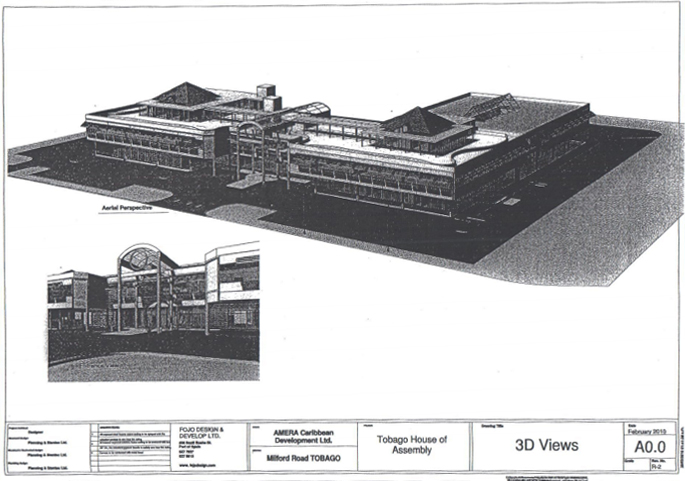 This project was analysed in a previous article, which set out certain questionable aspects of those arrangements. In my opinion, the greatest areas of concern were –
- Size – THA stated that the Divisions for which this building was being leased now occupy 28,500sf, yet the completed project is to comprise 83,000sf – almost three times more space.
- Quality – The new building is projected to cost $143M, which equates to $1,723 per sq ft and that is at the upper end of office costs, even when we consider that the contract was reported to be for a fully fitted building.
- Rent – The current rent paid by the THA for the Divisions to be located in the new facility is an average of $8.17 per sq ft. The rent for the new facility was agreed at $15.61 per sq ft, which is almost twice the rate now paid. It was telling that the THA relied on the statements of a Civil Engineer, Peter Forde, who sought to justify that rent by reference to the fact that $10 per sq ft was being paid for some offices in Scarborough. Mr. Forde is an esteemed engineer with whom I have worked well in the past, but that is like relying on my advice, as a Chartered Valuation Surveyor, as to the correct steel to use in some complex structure.
- Total Costs – The total monthly rent now paid by THA for those Divisions is $231,788, while the new project is set to cost a monthly rent of $1.295M – more than five times more.
All of these arrangements being made by a public authority which makes a compelling case that the Central Government has starved them of financial resources over a considerable period. The THA, starved of money, is justifying a deal which will hugely increase their monthly rent bill, for an office building three times larger than required at a higher quality than any other in Tobago. That is the sense of this deal.
The recent litigation over this project was altered after it started, to two questions of ‘construction’, being ruled by the Court to be issues of public interest –
- Finance Ministry approval – Is THA required to obtain approval from the Ministry of Finance before entering a BOLT arrangement?
- Tendering procedure – Is THA required to follow the procedures of the Central Tenders Board Act (CTB Act) in entering a BOLT arrangement?
The High Court ruling on 30 April 2014 was claimed by THA to be an endorsement of their course of action, but this is what it actually meant.
| ISSUES | High Court Ruling | Proposed Public Procurement Law |
| Preliminary considerations | No ruling by the Court. | A Needs Assessment would be required to take account of a life-cycle costing, which includes both initial and cost-in-use aspects. |
| Ministry of Finance approval | At para 33, the Court ruled that THA is not required to obtain approval of the Minister of Finance. In that respect, one can understand THA’s claim to have been vindicated.At para 29, the Court makes the inescapable point that since this is a 20-year recurrent commitment which would have to be paid for by financing from the Central Government, it would be prudent for the THA to consult with the Finance Ministry before entering such arrangements. | This is a transaction in ‘Public Money’ via a ‘Public Private Partnership’ which is included in the remit of the proposed law. |
| Tendering Procedure | At paras 48 through 51, the Court was emphatic that the THA was required to follow the provisions of the CTB Act. | The proposed law abolishes and replaces the CTB Act and would include this kind of project under the oversight of the Office of Procurement Regulation. |
In this case, the THA’s claims of victory appear unrealistic, but the good news is that the proposed arrangements will act to prevent a recurrence of this wasteful type of project.
EDEN GARDENS
 This 2012 purchase of 50.5 acres (comprising 264 residential lots with ancillary uses) by the Housing Development Corporation (HDC) was also the subject of a series of articles in this space, which highlighted these questionable aspects –
- Private sales as individual lots – Eden Gardens lots were being offered for sale in 2011 at $400,000.
- HDC Valuations or Offers? – HDC obtained a private valuation of the property at $52M in November 2011. In January 2012 Eden Gardens is offered to the HDC at $200M. So why did HDC order a valuation in November 2011? Was there an attempt to offer the site to HDC before November 2011 and at what price?
- The State valuer exceeds the opinion of a private valuer? – Of course that is virtually unknown, but the fact is that the Commissioner of Valuations issued an opinion of value in April 2012 placing the property at $180M.
- HDC Purchase – The HDC buys the property in November 2012 at $175M, which equates to $663,000 per lot. Given that those lots were available in 2011 at $400,000, that is a 66% increase in the value of those lands within one year, which can make no sense. It makes even less sense when one considers that HDC was buying the all that land at once, so a discount would be the rational and expected commercial practice. So what was the basis on which this price was settled?
- Plan ‘B’ – The State had the power to compulsorily acquire the land if it was required for a public purpose, which housing is. The point being that the State could have lawfully acquired Eden Gardens for no more than $35M, if they had chosen to use their powers of compulsory acquisition. So, why did they choose to go the Private Treaty route?
- The ‘Ultimate Beneficial Owner’ – The basic business practice required of bankers and other finance professionals is to ‘Know Your Customer’ as a fundamental part of ‘Anti Money Laundering’ (AML) laws now in force in this country. Those laws and professional practices have now extended to cover the activities of real estate agents, so anyone selling land would be required to conform. The vendor of Eden Gardens was Point Lisas Park Limited, but from my research at the Registrar General’s Dept, it seems that PLP Ltd. has never issued shares. Which means that we can only speculate as to who was the ‘Ultimate Beneficial Owner’ of Eden Gardens and indeed, who received $175M for that property.
The proposed new laws do not contain any provisions to govern the State in ‘acquiring public property’, which was the case in Eden Gardens, since the State was buying land.
This is one of the outstanding serious concerns as to the proposed new law, which would not act to prevent this type of corrupt practice. Our Parliamentarians need to consider these aspects in finalising this law.


 The recent statements of both the Minister of Finance, Larry Howai, and the Governor of the Central Bank, Jwala Rambarran, could give the public an impression that this financial disaster has now been mostly resolved and we are on some kind of smooth track to a complete solution.
 An additional enquiry has to be raised on the particular instances where the State is paying a rent for property which remains unoccupied. The same details listed above need to be sought in those cases, but in addition, we need to be told why those properties are still unused. A great concern was raised recently on #One Alexandra, which concern was mostly justified in my opinion, but the fact is that it is not the only one. The public needs to be told the full extent to which the State pays rent for unoccupied offices.

 The
The  Regional Strategy – As a leading nation within CARICOM, it is important for Trinidad & Tobago to give serious consideration to the role of the various bilateral G2G arrangements China is pursuing in our region and the implications of those arrangements on our aspirations for healthy regionalism. I have been reading the February 2013 Research Note by UWI’s Dr. Annita Montoute – ‘

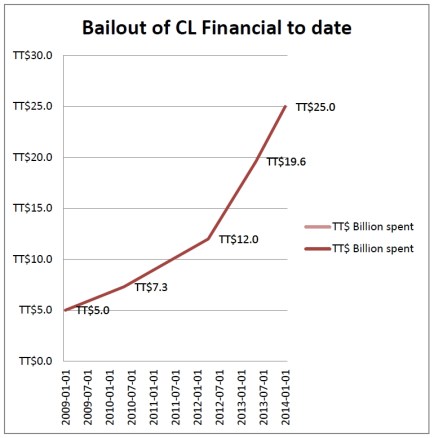 Today is the 30th of January 2014: five years since the State bailout of CL Financial was announced to a shocked nation and region. It is necessary to mark this moment in time with solid facts and stern meditation.
 AfraRaymond.net