CL Financial Bailout – Lessons from the Financial Crisis

This is an edited version of my address to the 4th Biennial Business Banking and Finance Conference (BBF4) held at the Trinidad Hilton from 22 to 24 June, 2011. The session I participated in was devoted to ‘Lessons from the Financial Crisis: The Resolution of Failed Entities.’ [See the acknowledgement letter from the conference convenor here.]

Thanks for the invitation to speak at this forum, it was last-minute, but welcome, since our local Institutions of Higher Learning have not spent the necessary time to explain and analyse this financial fiasco.  I have been very critical of the Institute of Business, the Institute of Social and Economic Research, the Faculties of Economics and Management and the Caribbean Centre for Money & Finance, so it is great to see you making a start on this overdue work.  It is my pleasure to participate in these proceedings.

I want to start by shifting focus to the arena of the mind and the existence of elements such as moral and ethical values, as well as social standards. In 1971 there was a famous series of psychological experiments in which selected students entered a two-week role-play as prison-guards in control of other people who were playing the role of prisoners.

That experiment was conducted at Stanford University in California and the results were that most of the prison guards adopted cruel behaviour with most of them being upset when the experiment was stopped after only six days. The entire experiment was filmed and the prisoners suffered from regular acts of wickedness, abuse and sheer perversity – one-third of the guards acted sadistically.

The Stanford Prison Experiment as it is now known, was heavily criticised as being unethical and unprofessional.  Of course the other aspect is that it re-opened the perennial discussion into the nature of things.  The nature of our nature, as it were – ‘Are we humans naturally evil and cruel?‘  The learning seems to be that well-adjusted and reasonable people can very quickly lose their moral compass in a situation with a lack of the conventional controls such as disapproval and laws.

No surprise to those familiar with history and politics, but the lesson for us in T&T is that if you let people get the idea that they can never be punished, there is virtually no limit to the rules they will break.  Asset-stripping, Bribery and Corruption can become the new norms of a governing class and that is what has happened in our country.

We have never had a strong tradition of detecting and punishing White-Collar Criminals, so if we are to make a start in terms of the resolution of failed entities, that has to be the starting-point.  We cannot reconstruct or resolve the failed entities if we do not change that aspect of our culture – the absence of consequence has to be abolished.

The absence of consequence is inimical to any development – personal, national or regional.  It is no point bringing new regulations or ‘approaches’ to this huge problem, until and unless the basic culture changes.

So that is the challenge for us – we have to change the way we think and behave around these issues of White-Collar Crime.  It is a very damaging type of crime which can affect the lives of many, many people – as we have seen in the CL Financial fiasco.  But we have to make that choice to change our culture around these issues.

The current financial disaster amounts to the greatest ever destruction of capital in peacetime – these are literally epochal events, but we do need to be careful as there is yet another big lie out there.  It suits the CL Financial chiefs to promote a version of events that has the blame attached to the Wall Street events of 2007/2008. The people promoting that version are buffoons, whose story is unable to withstand serious examination. I call it the Wall Street hoax and it is useful since it allows the CL Financial chiefs to escape the reality of their failure, to put it charitably, by blaming events way beyond their control.

Nothing could be further from the truth. We need to be very clear on the scale of this particular lie and the public mischief it represents. Even close examination of CL Financial’s 2007 audited accounts shows only tiny exposures to Wall Street  But what is worse is that the entire CL Financial pattern of behaviour and the burning question of the extent to which the CLF chiefs were ‘fit and proper’ are not new issues.  If we consider the 15 July 1996 ‘Circular Letter to Shareholders‘ issued by Republic Bank Limited under the hand of then Chairman, the late Frank Barsotti, it is all there. Fifteen years ago we knew the threat to which we were exposing this country by letting CLICO take over Republic Bank…it is 66-pages long, but very important to read – it is on my blog.

We don’t have a Wall Street problem, what we have here is a St. Vincent Street problem.  Yes, from the Central Bank (at the foot of the Street) to the Treasury (paying for the whole entire wretched bailout) to the Red House (where the real discussion has never taken place), right up to #29 – the CL Financial headquarters. Yes, is a real St. Vincent Street problem we suffering from. This is we own creation we fighting with.

The CL Financial fiasco is estimated to be costing at least ten times as much, as a proportion of GDP, as the Wall St. crisis.  Yet we still have mischief-makers who want to make misleading comparisons between the two, to justify the bailout.

A powerful parallel with the Wall Street crisis is the fact that the CL Financial fiasco was also characterized by ‘Shadow Banking’, meaning vast sums of money solicited from investors and being traded outside of the conventional regulatory umbrella.

Here are some extracts from the Financial Crisis Inquiry Commission’s Final Report (the FCIC is the US government’s official Commission of Inquiry into the Wall St crisis) –

From pg. XX (20) of the ‘Conclusions’ section –

…Within the financial system, the dangers of this debt were magnified because transparency was not required or desired. Massive, short-term borrowing, combined with obligations unseen by others in the market, heightened the chances the system could rapidly unravel. In the early part of the 20th century, we erected a series of protections—the Federal Reserve as a lender of last resort, federal deposit insurance, ample regulations—to provide a bulwark against the panics that had regularly plagued America’s banking system in the 19th century. Yet, over the past 30-plus years, we permitted the growth of a shadow banking system—opaque and laden with short-term debt—that rivaled the size of the traditional banking system. Key components of the market—for example, the multitrillion-dollar repo lending market, off-balance-sheet entities, and the use of over-the-counter derivatives—were hidden from view, without the protections we had constructed to prevent financial meltdowns. We had a 21st-century financial system with 19th-century safeguards…

Every line of that paragraph rings true to our local situation.  We are grappling with a shadow banking threat to the savings of the nation.  Our national wealth has been pledged to rescue adventurers at the very edge of the financial universe and that is what is wrong with the bailout.

I am no supporter of the Peoples’ Partnership, but what is right is right and the fact is that our Minister of Finance, Dookeran, is spot-on with this part of his analysis and action.  When Dookeran spoke in his inaugural budget speech on 8 September 2010, he took the approach of combining the assets and liabilities of both CLICO and British-American Insurance, which showed an insolvency in the order of $7.3Bn.

More to the point, the approach showed ‘traditional insurance‘ liabilities – i.e. Health, Pension and Life – of the order of $6Bn and ‘non-traditional/investment’ liabilities – i.e. EFPAs – of the order of $12Bn.

So what we are seeing is insurance companies whose non-insurance business is twice the size of their insurance portfolio and what is more, the supposedly guaranteed investment is nowhere to be found, hence the tremendous problem in repaying the EFPA holders.  That is the dilemma facing the country now and that is what Dookeran was explaining to us – a Shadow Banking arena that has grown to eclipse the core business and threaten the entire nation.

Another important part of the false discourse in all this is the promotion of the utter nonsense that there is any such thing as a ‘Guaranteed Investment’.  Absolute and complete lies.  There is no such thing and that is the fact.  Yet we have had CL Financial’s  Boards of Directors of the ‘Great & Good’ promoting that kind of deceptive dangerous nonsense.  You Investment Professionals need to find the courage of your convictions to speak-out on this smartman behaviour.

We had a product being promoted as offering twice the market rate of interest and also your entire investment is guaranteed and blah blah blah.  The Central Bank and the Supervisor of Insurance sat there and allowed that deceptive advertising to take place and it was a campaign, with thousands of letters.  A straightforward assault on good sense and the gatekeepers stood silent.

The final point we need to drive home is that, whatever the temptations, we must not lay the entire blame onto Lawrence Duprey & Andre Monteil.  It took plenty more than the main CL Financial chiefs to get us to this point.  There is a network of lawyers, accountants, agents who pretended to be financial advisers and of course, the many Board Directors.  That network is hundreds of people all of whom share a responsibility, quite probably culpability, for this crisis.

The Colman Commission has to work very hard to preserve its effectiveness.

Colman Commission considerations

This is a rapid look at some of the news coming out of the Colman Commission – the first live evidence was given on Monday 4th July.

That evidence has so far been into the Hindu Credit Union (HCU) and already some peculiar things are emerging.  I do not follow it on TV and just read the newspaper reports –

  • Breach of Trust – It seems clear to me that the depositors had a seriously misplaced faith in HCU and Harry Harnarine, which itself raises certain questions as to who was really fooling who.  It is basic and inescapable that a higher rate of return will mean a higher level of risk, which is why it is important to be more sceptical about high-return investments.  My point being that as a Credit Union, one has to become a member to participate and therefore one has a stake in the success of the organisation – with access to the accounts and attendance at the AGM, one can only wonder what kind of dance existed between the HCU chiefs and its ordinary members.  Yet, we are hearing from people who seem to have deposited their money at these  incredible rates of return and adopted attitudes of complete trust.  The witnesses need to be more seriously probed on what happened at those AGMs and so on – if they HCU conducted its AGMs anything like the CL Financial’s final AGM, it will be quite a story.   We need to get past the various heartbreaking stories, to the nexus of responsibility which is where this entire game is played.  I am sure there is plenty more to come out, plenty more.
  • farid scoon
    Farid Scoon

    Farid Scoon, Attorney-at-Law – Was expected to explain how he could be representing a group of HCU depositors and the former HCU chief, Harry Harnarine, at the same time.

There also seems to be a strange situation on CL Financial, since I am told that none of the affected people are willing to come forward to testify.  I am not very surprised at that and it is yet another indication of the extent of that toxic ‘Code of Silence‘.

What a shame!  25,000 policyholders said to be affected by the failure of CL Financial, yet only one is willing to testify.  Only One!   I wrote before in this space about the probability that a high proportion of those EFPA monies had never been screened by rigorous Anti Money Laundering (AML) procedures.  I suggested to the Minister of Finance that provisions be made in the payout agreements for the applicants for bailout monies to have the source of their funds vetted for compliance with VAT, PAYE, Income and Corporation taxes.  The Minister did not adopt those proposals.

So, what we now have is the spectacle of the Colman Commission set up by the government to examine the causes of the collapse and finding that few want to speak, very few.  I don’t know if it’s dirty money, or ‘keeping it in the family‘ or what…but I do hope that Colman takes a robust approach by using his powers to sub-poena people to appear and testify.

The Colman Commission needs to deploy more resources in getting info up onto its website in a timely fashion.  Just as a simple example, the opening arguments which were heard last week have been posted onto the website in very erratic, delayed fashion.   The session of Monday 27th June was posted on Tuesday 28th June, but the sessions of Wednesday 29th and Thursday 30th June were posted on Tuesday 5th July, no explanation given.  If more resources are required those need to be deployed.  The Colman Commission must not be allowed to become an orphan in our land of grandiose schemes and projects.

Of course we have seen the expected attempts by Lawrence Duprey to remove himself from being enquired into or even being required to answer questions.  At this time those attempts appear to have been thwarted, but we can surely expect more spoiling tactics and not just from Duprey, either.

The Duprey Letter

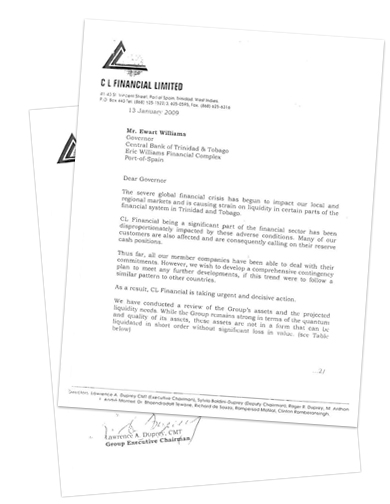
clf-cbtt letterThis is the CL Financial letter of 13th January 2009, signed by their ‘Trinity Chief’ Lawrence Duprey, for readers’ comments. I dub Lawrence Duprey the ‘Trinity Chief’ since he was the majority shareholder, Chairman of the Board and CEO of CL Financial.

I made three applications for this document under the Freedom of Information Act. The first was to the then Minister of Finance, who held over 10,000 shares in CL Financial, Karen Nunez-Tesheira. The reply to that application directed me to the Central Bank, to whom the letter was addressed, which was an obvious ploy to thwart my enquiry, since Central Bank is immune from the Freedom of Information Act. My two subsequent applications (2 & 3) to the current Minister of Finance, Winston Dookeran, have done little better – those were never even acknowledged.

It seems to contain the same text as the one Karen Nunez-Tesheira read into Hansard on 4th February 2009 – see ‘Finding the Assets‘ – except that the table in the copy is titled “CL Financial Group – Assets Available for Restructuring“.

CLF LETTER TO CENTRAL BANK

Setting the Standard

The PP government is establishing a ‘new normal’ insofar as ethics and acceptable standards of behaviour in public office are concerned.  As with any real-time and complex situation, the signals are mixed, but from my point of view, the direction is a welcome one.

To me, the main positive signs were –

  • Coup Enquiry – The July announcement of the Commission of Enquiry into the 1990 attempted Coup, now underway, was most welcome.  It seems certain that we would still be waiting in vain, if either Manning or Panday were still in power.
  • CL Financial bailout – Dookeran’s decision to review the payout to beneficiaries of the bailout was necessary and long-overdue.  Dookeran has done his cause no favours by with-holding the accounts and seeming to suppress vital information, but the decision to revise the bailout terms was a sound one.  On that occasion, he also took the steps of introducing relief for Hindu Credit Union depositors, which was a step in the direction of equity. Even those of us who did not support any bailout can concede that point.
  • On October 1, the Prime Minister resisted the temptation to use the PP’s Parliamentary majority to force through a new law to limit the legal rights of CLICO policyholders.  The PM chose to set aside that legislative proposal and embark on an act of persuasion.  That was a defining moment in our nation’s development of a democratic culture.  The announcement of a Commission of Enquiry into the entire financial collapse (CL Financial and HCU) was another high point.
  • Nizam Mohammed’s removal as Chairman of the Police Service Commission was overdue in my view, but not because of his ‘last-ditch/red-herring‘ attempts to martyr himself.  His primary and unpardonable offence, given his position, was his bold-faced abuse of power in that traffic police episode.
  • mary king
    Mary King

    Even Mary King’s removal from office earlier this week was a welcome sign despite the doubts over who knew what and when.  That was a good move because it is the first time a Minister has been fired for acting in a manner which causes reasonable suspicion.  Up until now in this country the rule followed by the various Ruling Parties has been the ‘wrong and strong‘ one, joined-up with the ‘do as I say and not as I do‘ one.  To have moved away from those immoral practices is a big step in the right direction, despite the ragged edges.

Even when I consider the disastrous Reshmi-gate episode, that list adds up to substantial progress in the right direction.  Democracy is a messy affair and coalition politics has particular challenges, so progress will be uneven, with some pauses along the way.  But progress we must.

The Prime Minister reportedly commented that there was no pressure from COP to replace Mary King with another of its members, so that the replacement would be chosen on merit.

I am very concerned at the fact that the CL Financial collapse has cast a literal shadow over our country.  Aside from the financial costs, there are significant areas of collateral damage which are now becoming visible.  I referred in an earlier article to one of the main externalities in this episode being the fact that many of the CL Financial chiefs are deeply embedded in our political parties.

Even now, with this new government – their honeymoon will end on the first anniversary, I think – we are witnessing acts which can make one wonder if the CL Financial disaster ever really happened.

The official Terms of Reference for the Colman Inquiry into this financial fiasco were published in the Trinidad and Tobago Gazette of 17th November 2010 – No. 144 in Volume 49.  Here is the first sentence in the second paragraph –

…And whereas the President on the advice of the Cabinet has deemed it advisable and for the public welfare that a Commissioner be appointed to enquire into the failure of CL Financial Limited, Colonial Life Insurance Company (Trinidad) Limited, CLICO Investment Bank Limited, British American Insurance Company (Trinidad) Limited, Caribbean Money Market Brokers Limited and the Hindu Credit Union Cooperative Society Limited with a  view to ascertaining why such events occurred…

robert mayers
Robert Mayers

Caribbean Money Market Brokers (CMMB)
The first example is Robert Mayers, former Managing Director of CMMB up until 7 December 2008 – see here.   Mayers is also a Deputy Political Leader of the Congress of the People (CoP), a leading element in the Peoples’ Partnership government.  CMMB collapsed along with some of the significant companies in the CL Financial group – the Terms of Reference for the Colman Commission refer.

On 20 November, there were reports that Robert Mayers had been offered a position as a Director of our Central Bank.  Mayers is reported to have declined that offer on the basis of a conflict of interest.  The burning question has to be ‘What kind of process could produce such a recommendation?

Consider this arresting headline ‘Investment pros set up new business‘ at page 10 of the Business Guardian of 9th December.  It was reported that a new investment house, KSBM, was launched and it seemed that they were profiling.

Given that all four of KSBM’s Executive Directors are ex-CMMB chiefs, Robert Mayers among them, there are inescapable questions –

How come the former chiefs of CMMB, a financial institution which is known to have failed on this scale, can be permitted to open another one?  We are acting as if we have no capacity to learn from our errors.  Just carrying on as though nothing happened.  What is the role of the SEC and the Central Bank in all this?  Have we learned nothing?

mervyn assam
Mervyn Assam

Clico Investment Bank (CIB)
Mervyn Assam was the Chairman of CIB at the time of the collapse.  Assam had been one of CIB’s founders in 1990 and was reportedly ‘cleaning house’ at the bank, which I do believe to be true.

But the picture is far from a simple one.  On 22 January 2009, CIB hosted its inaugural Investment Seminar at the CL Duprey box at the Queen’s Park Oval – I spoke at that event, together with Professor Patrick Watson.  Now, according to  para 5 of the April 2010 affidavit submitted to the High Court by the Inspector of Financial Institutions, Carl Hiralal, in the CIB winding-up petition, the CIB liquidity problem was disclosed to him in a meeting on the 15 January.  I have serious doubts as to the veracity of that statement, but yes, it is still a full week before the Investment Seminar.

Assam held 7,500 shares in CLF as at 7 February 2009.

Assam also launched a lawsuit to recover $1M he had deposited with CIB, that case went against him in January this year – see the judgment – and he is reported to have filed an appeal.

In October, Assam was appointed as Ambassador Extraordinaire and Plenipotentiary of Trade and Industry.  He has served in the NAR period as High Commissioner to London and as a UNC Senator, both in Cabinet and during their recent spell in opposition.

Dr. Bhoendradatt Tewarie

CL Financial (CLF)
Dr Tewarie was a Director on the Board of the parent company, CLF, which wrote to the Central Bank, seeking a bailout, on 13 January 2009.  On 16 January 2009, CLF paid dividends of $3.00 per share to its shareholders.  According to the CLF Annual Return of 7 February 2009, Dr Tewarie held 1,171 shares.

As I write this, we are informed that Dr Tewarie has been sworn in, to replace Mary King.

To be perfectly clear, I am making no allegation of theft against Mayers, Assam or Dr. Tewarie.

Does the ‘fit and proper’ criteria apply to these CLF chiefs?  Should those criteria apply to the holders of high office in our country?  What do you think?

We need new politics like no time before in our country, but that must involve new thinking.  The State must behave in an exemplary fashion if we are to uplift ourselves without civil disturbance and unnecessary confusion.  The State needs to set the standard.

I trust that the Colman Commission will give the proper attention to these episodes.

CL Financial Bailout – Retirement Planning

When you consider increasing lifespans, inflation and the greater likelihood of major medical expenses as one ages, it is clear that proper retirement planning should be a major factor for most people.

Some extracts from relevant advertisements to start off –

Company A

“Maintain your lifestyle – even after retirement…”

The time passed so fast and now you cannot imagine life without the luxuries you have come to know, the luxuries you deserve. The Company A annuities and pension plans allow you to live the lifestyle that you have become accustomed to – even after you’ve retired – without sacrifices that will affect your current quality of life.

Company B

“I WANT TO RETIRE COMFORTABLY”

It can be daunting to consider how much money it takes to retire in comfort. And government pensions do not provide the guarantees that they once did. But it’s never too late – or too early – to get started.

Company C

“At the rate things change today, long-term financial planning has become a concern for all of us.”

The responsibility for securing a comfortable retirement continues to shift from employers to the individual. Whether your goal is saving for retirement or you’ve already reached that goal and you want to be sure that you will never outlive your savings, an annuity may be just what you’re looking for. In Trinidad & Tobago as in the wider world, life expectancy has lengthened considerably with people living well past their retirement age. This introduces a new risk – outliving your savings.

Company C’s preferred plan features “…guaranteed income for the rest of your life…

Yes, Retirement Planning is an essential part of any good investment planning.

Central to the growth and long-term success of the CL Financial group was its ability to mobilise the retirement savings of the Caribbean people in pursuance of its wider commercial objectives.  I have been writing on how it all went wrong and who is to blame.

In preparing my submissions for the Colman Commission it occurred to me that the financial provisions made for the 3 CL Financial chiefs who departed in the last 12 months before the group collapsed is central to understanding the entire fiasco.  It is rich in irony.
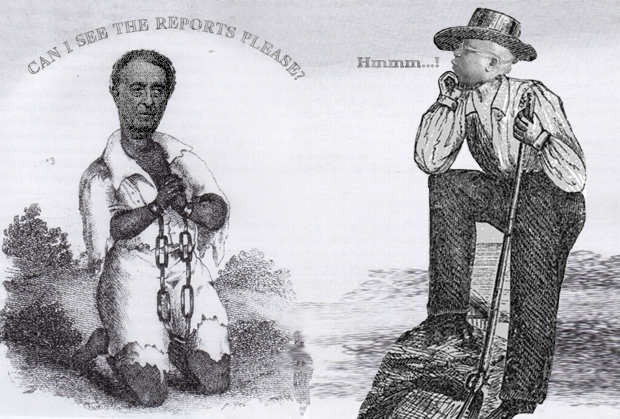
Fiduciary Duty of Directors and Officers

The burning questions are –

  1. When did the Directors and Officers of CL Financial (CLF) know that the group was heading to collapse?
  2. When did the Directors and Officers of the failed subsidiaries know?
  3. What did they know and when did they know it?
  4. How much warning did their management controls give them?

The questions are pertinent and the time-line is instructive –

Timeline to CLICO Bailout

  • 31 March 2008 – Andre Monteil retires as CLF’s Group Finance Director.
  • 6 August 2008 – Anthony Fifi retires as Managing Director of the Home Construction Limited (HCL) group, which is wholly-owned by CLF.  Fifi remained on the board of the parent company, CL Financial.
  • Mid-October 2008 – CLF purchases Jamaica Money Market Brokers’ 45% shareholding in CMMB.  Please note that CLF owns 40% of JMMB.
  • 7 November 2008 – Michael Carballo, CLF’s Group Finance Director gives an interview to the Business Guardian that the group had assets of $100Bn and could weather any storm.
  • 18th November 2008 – CLF 2007 Annual Report is published – its Consolidated Balance Sheet disclosed a Total Asset Value of $100.666Bn.
  • 8 December 2008 – Robert Mayers proceeds on pre-retirement leave from his position as Managing Director of CMMB, pending his scheduled retirement, on 28th February 2009, as Managing Director.
  • 13 January 2009 – Lawrence Duprey, CLF’s Executive Chairman, writes, detailing an asset value of $23.9Bn, to the Governor of the Central Bank to seek urgent financial assistance.  See ‘Finding the Assets‘ published on 23 August 2009 for the text of that letter.
  • 16 January 2009 – CLF pays a dividend of $3.00 per share.
  • 23 January 2009 – CLF has its final and fateful Annual General Meeting at Trinidad Hilton.
  • 30 January 2009 – The bailout is announced at a Press Conference at the Central Bank.

What benefits did the departing Directors and Officers enjoy?  Three of the most important and senior CLF chiefs departed in the 12 months prior to the collapse.  To be fair, Fifi was retiring from HCL, which has not been described as a failed company, despite its challenges.  To understand the picture properly it will be necessary for the Colman Commission to examine the terms of the retirement of these CL Financial chiefs.

Those departures must be examined from the documents if they were to be approached from the compensation aspect.  What I mean is that these chiefs would have been paid upon departure and that would likely have been documented.

The suggested line of enquiry is –

  • How much did Messrs. Monteil/Fifi/Mayers receive upon retirement?  Does anyone believe that these chiefs left without compensation after years of service, at the highest possible level?  The amounts actually received and the bases on which those sums were calculated promises to be very interesting.
  • How were those retirement payments calculated? – Were the amounts arrived at by a ‘set’ formula?  Was that formula specified in their employment contracts?
  • Were those sums reduced to reflect the impending crash? – That alternative is the crux of the issue, coming to the point of what did they know and when.   If the sums were reduced to reflect the poor performance of those failed companies, we need to question the misleading accounts given as to the group’s health right up to the very brink of the collapse.
  • Shifts in asset values – I am also wondering if the sudden drop in asset values from $100Bn + to just under $24Bn, in the space of less than 2 months is part of this aspect of the story.  Only when we have those employment contracts published will we be able to consider whether there was any connection between the chiefs’ compensation formula and the asset values or, to put it another way, their departures and the sudden drop in asset values.
  • Performance-related? – Ultimately, we have to wonder as to the implications of the other alternative.  If we learn that these CL Financial chiefs were able to depart the failing group with no reduction in their retirement payments, that would be very serious indeed.  If that were the case, we would be contemplating employment contracts which divorced pay from performance.  Given contemporary norms that link pay and performance, that would be an appalling vista.  We would be seeing that our region’s largest investment group was saddled with a leadership which had constructed for itself the ultimate high-return, no-risk employment and retirement benefits, all at the expense of everyone else.  The ultimate irony.

I am fully expecting that there will be further legal arguments to silence or shroud any efforts by the Colman Commission to delve into this aspect of things.  Colman must be robust in his probe – he must follow the money.

Colman Commission – A crucial choice

Image Illustration by NiCam GraphicsThere were several important developments in the Colman Commission last week, with the widely reported appeals of Sir Anthony Colman QC for the Central Bank to change its position with respect to the presentation of accounts to the Enquiry.

From my own attendance at the opening session of the Colman Commission on Friday 11th March and the various reports, it seems that there are various moves afoot to restrict or stop the enquiry.  I expected this sort of scenario in declaring the main players to be part of a ‘Code of Silence’ – it is no surprise to me.

There are three strands which are becoming evident as we move into the new phase, with the Colman Commission and several legal actions swinging into action.

  1. Firstly, we had former HCU boss Harry Harnarine challenging the Colman Commission in Court, claiming it to be illegal etc.  Obviously, Harnarine did not relish the thought of having to answer questions on TV.  The Appeal Court rejected those claims on Monday 4th April and the reports were contradictory, to say the least –

    Speaking with reporters following the ruling, Harnarine said he was not satisfied with the panel’s ruling.
    Harnarine said he welcomed the enquiry and would make objections “at the right time”.
    Harnarine wanted the court to declare the commission null and void, that it was an abuse of the court’s process and that it was unlawful and illegal, among other requests.”

  2. Secondly, the Central Bank’s action to wind-up Clico Investment Bank (CIB) was challenged by the National Gas Corporation (NGC) and the National Insurance Board (NIB).  On 27th January the judge in that case ruled that the petitioner must be questioned.  The Central Bank’s attorneys had fought very hard to resist that.  The petitioner was the Inspector of Financial Institutions, Carl Hiralal.  I have already questioned the apparent anomalies in his affidavits – in ‘The House on the Cornerparts 1 & 2 – so Hiralal’s cross-examination was one to be anticipated.  On 28th March, NGC withdrew from that lawsuit, which was to recover some $1.1Bn from CIB.  There has been no statement as to why that was done.  Given that the missing $1.1Bn is our taxpayers’ money, an urgent statement to clarify this decision is needed.
    WHERE IS THE NGC’s MISSING $1.1Bn?
    The NIB’s lawsuit is still ongoing and I await that cross-examination of Hiralal with great interest.
  3. Thirdly, we now have reports of various objections being raised by the attorneys in respect of the accounts for CL Financial.

Readers need to be clear that there are three types of accounts in this matter.  Given the room for error it is important to get this straight:

  1. Annual Audited Accounts – These are routine and ought to have been filed by now.  The last accounts for the CL Financial Group and its subsidiaries were by PriceWaterhouseCoopers (PWC) as at year-end 2007.  We therefore have a situation in this country with two insurance companies – CLICO and British-American – open for business with no accounts filed for 2008, 2009 or 2010.  That is unacceptable and further delaying will only bring discredit to the responsible parties.  The sidebar contains more on this.
  2. The Reviews of Accounts – Post-bailout, the Central Bank has hired Ernst & Young (E&Y) to review the accounts of the Clico Investment Bank and CLICO.  In addition, the Commissioner of Co-operatives had hired E&Y to do the same for Hindu Credit Union (HCU).  From what I have read, E&Y seem to be objecting to both the production of those reports to the Colman Commission and the subpoena to its Executive Chairman, Colin Soo Ping Chow – see Trinidad Express   of 6th April – see here.  I am not at all clear what is the objection to releasing those reports, after all, the E&Y report into CIB formed part of the Central Bank submissions to the High Court in the winding-up petition.
  3. Forensic Audits – These were reportedly done by Bob Lindquist and KPMG Canada for the Central Bank on CLICO, with the latter firm now claiming that their client is objecting to disclosure.  The grounds appear to be that if those reports were disclosed, it would undermine the intended prosecutions.  That seems to me to be a reasonable rationale to pause the publication of those reports until that impasse is resolved.

So, what is at stake here?

Sad to say, but this is reminding me of the actions of Calder Hart/UDeCOTT in trying to derail and frustrate the Uff Enquiry.  On that infamous occasion we had the spectacle of a State-owned company challenging the Uff Commission – which had been established by the State – in the High Court.  I hope that my view is incorrect.

This led to Colman’s appeal to the public as reported in the Trinidad and Tobago Guardian on 7th April and Trinidad Express of Friday 8th April.  The first of those reports contained an intriguing fragment in which former AG and Law Association President, Russell Martineau SC raised objections on behalf of his clients, PWC, on grounds of confidentiality. That mystified me, since PWC’s audits seem to be confined to the first, most innocuous group, as outlined above.

According to Colman, if the Commission has to get fresh reports into these matters it will mean more delays and more expense.  He said that would be a matter for the public to decide if that is in their interest, hence these efforts.

The Central Bank made a press release on 14th April which confirmed that they intend to take legal actions. Please note that the press release was silent as to the Annual Audited Accounts. For whatever reason, the Central Bank is continuing its silence as to the status of the most innocuous class of accounts.

It is unacceptable for these issues to be mixed in this misleading fashion. Simple and inescapable questions need to be answered now –

  • Are the CL Financial annual audited accounts for 2008, 2009 and 2010 ready?
  • If yes, why have they not been published?
  • If not, why not?
  • What is the objection to publishing the Reviews of Accounts?

It seems that we are being given a tough choice, between –

  1. a solid investigation, which preserves the secrecy of the forensic reports, with probable prosecutions, or
  2. a wide-open investigation, with a high level of information emerging about the entire fiasco, but little chance of successful prosecutions.

The Trinidad and Tobago Guardian editorial of Tuesday 12th opted for the former, while the Trinidad Express editorial of the same day took the opposite view, favouring the latter.

The decisive question, for me, is whether the Central Bank has a track record upon which we can rely. The basis of their objections is the notion that prosecutions are to be mounted against the offending parties. Can we really accept that?

The Central Bank’s track-record on these matters has been doubtful and people are right to be concerned.  From the CIB’s reported failure to file Corporation Tax returns for 2007, 2008 and 2009 to the continued inaction on the ‘Fit and Proper’ regulations, to the failure to recover the dividends CLF paid after the bailout was requested. A poor record of proper enforcement.

We are now being asked to believe that an organisation which is unable or unwilling to pick those ‘low-hanging fruit’, will be able and willing to prosecute ‘high-flying smartmen’.

I am being reminded of those childish spelling-games we all played –

A for Apple
B for Bat
C for yuhself!

Trinidad & Tobago Transparency Institute made a press release on the issue, which called on the Central Bank to act in an exemplary fashion. That is a welcome statement.

My vote, for what it is worth, is that we should preserve the secrecy of the forensic reports so as to remove any escape hatch for these fraudsters and their accomplices. Leave them no avenue to claim that if this or that had not happened they would have been able to prosecute. There is probably enough material in the other two classes of accounts to progress the Colman Commission.

SIDEBAR

Freedom of Information – Having had three applications under the FoI Act ignored, I have now given the Ministry of Finance ten (10) days to provide a copy of CL Financial’s letter of 13th January 2009 requesting the bailout and the 2008 Audited Accounts for the CLF group – see here .  If those documents are not supplied, it is off to Court we go.

Legal Opinions – At this point in the mix, we sorely need to hear from the legal columnists as to what is the position in this heated contest – Martin Daly, Dana Seetahal, Ken Lalla and Martin George, we await.

Freedom of Information in the CL Financial bailout

This – clfFoI-1 – is a copy of the letter sent today from my attorney to the Ministry of Finance, requesting that they provide –

  • ‘The Duprey letter’ – The fateful 13th January 2009 CL Financial letter, signed by Lawrence Duprey, seeking urgent and massive financial assistance from the Central Bank.
  • CL Financial’s 2008 audited accounts – These should have been prepared by PriceWaterhouseCoopers, as at 31st December 2008 and of course those are of great interest, since the 2007 audited accounts (published on 18th November 2008) disclosed assets of $100.6Bn, while ‘the Duprey letter’ showed assets of $23.9Bn.

The letter invites the Ministry of Finance to send the documents in 10 days or we go to the High Court.

Given the current state of play at the Colman Commission, there are no prizes for guessing which of those is going to happen.

CL Financial’s Annual Return as at 17th February 2009

CL Financial Annual Returns 17 February 2009

This is the official copy of CL Financial’s Annual Return from the Companies Registry, as at 17th February 2009 – it bears the official stamps and is signed by CLF’s then Corporate Secretary, Gita Sakal.

The company had a paid-up capital of $7.5M, with that number of $1.00 shares in issue.

The 325 shareholders are listed alphabetically, as at 7th September 2008, with details of their occupations and addresses also supplied.  Of course, that list shows, at #289, the then Minister of Finance – Karen Nunez-Tesheira – as Karen Tesheira, Attorney-at-Law – holding some 10,410 shares.

Another thing that is striking is that Lawrence Duprey would appear to have only three blocks of shares in his ownership –

  • #47 – CL Duprey Investment Trust – holding 1,634,335 shares, but we are unable to find the details on that company.
  • #78 – DALCO Capital Management Company Limited of #37 Frederick Street, POS – holding 1,947,833 shares.  I am assuming that DALCO is a play on his initials – Lawrence Andre Duprey LAD, reversed.
  • #302 – Trustees of CL Financial Limited – holds 119,145 shares.

I am taking that to mean that Lawrence Duprey had under his direct control a maximum of 3,701,313 shares – i.e. 49.35% of the group’s entire shareholding…slightly less than half.

I am leaving it to the better-informed readers to help fill in the gaps in this story.

As to Andre Monteil, the recently-retired Group Finance Director, his 337,269 shares were transferred from Stone Street Capital Limited to First Street Capital Limited on 31st March 2008, the date he retired from the CLF group.  Both companies’ registered address is the same – 33b Perseverance Road, Haleland Park, Maraval.

Afra Raymond’s submission to be made a party to the Colman Commission

16th March 2011

Afra Raymond’s submission seeking to be made a party to the Commission of Enquiry into the failure of

CL Financial Limited
Colonial Life Insurance Company (Trinidad) Limited
Clico Investment Bank Limited
Caribbean Money Market Brokers Limited and
The Hindu Credit Union Credit Union Co-operative Society Limited

My name is Afra Martin Raymond and I am a Chartered Surveyor, being a Fellow of the Royal Institution of Chartered Surveyors.  I am Managing Director of Raymond & Pierre Limited – Chartered Valuation Surveyors, Real Estate Agents and Property Consultants.  I am also the President of the Joint Consultative Council for the Construction Industry (JCC), an umbrella organisation which represents the interests of Engineers, Surveyors, Architects, Town Planners and Contractors in this Republic.

This submission is being made in my personal capacity and does not represent the position of either Raymond & Pierre Limited or the JCC.

My work on this vital issue has all been based on the public record and can be seen at www.afraraymond.com.

I am willing to give oral evidence before the Commission.

I have been conducting a campaign in the public interest on this important matter.  My work is unfunded and I have no assistance.  Indeed, I have no legal adviser at this Enquiry.

Having followed the issue so closely and attended the opening session on Friday 11th March, I am of the view that the parties thus far identified in this Enquiry are all seeking to advance their own interest.

I am here seeking to be made a party to this Enquiry, in seeking the interest of the silent majority, the taxpaying public, who have had to pay for this huge financial fiasco.

I am making this submission under rule 2. of the Commission’s Rules of Procedure, as a person whose “…participation in the Enquiry may be helpful to the Commission in fulfilling its mandate…

I await your reply.

——————————-
Afra M. Raymond B.Sc. FRICS
Port-of-Spain