On 17th June 2026, the Housing Development Corporation (HDC) reportedly issued its formal Notice to halt the intended award of 11 contracts totalling $3.4 Billion to build 3,700 new homes for sale, on public interest grounds.
That announcement has triggered official statements on the HDC’s intention to get the process right and to deliver these badly needed new homes for sale. All sides are going to great lengths to satisfy the Office of Procurement Regulation’s (OPR’s) requirements, so that aspect certainly represents real progress. But those statements can only offer comfort if one ignores the reality of the HDC’s extensive waiting-list, in which over 90% of the applicants can only afford to rent.
“…Whereas the People of Trinidad and Tobago—…(b) respect the principles of social justice and therefore believe that the operation of the economic system should result in the material resources of the community being so distributed as to subserve the common good…”
From the preamble of our Republic’s current Constitution (1976)
The simple truth is that the overwhelming majority of HDC’s applicants can only afford to rent, but nothing is being built for rent. That is the challenge we face in terms of realising the objectives of our Housing Policy.
I thought this would be a two-part analysis, but the final conclusions required a fuller treatment, hence this closing article to place those issues in a public policy context. My analysis led me to the conclusion that the HDC’s projects could not in any way have satisfied a proper needs assessment, as required by the Public Procurement and Disposal of Public Property Act (PPDPPA). As such, this is a call for the OPR to engage these public policy issues with the required seriousness.
The current state of play in this arena of Housing Policy and its originating Statute, operating within the PPDPPA, is plainly one in which the precept of ‘Value for Money’ is being routinely violated. HDC is a Statutory Agency, yet its vast capital spending is done in contradiction to its statutory obligations, which is the basis for my challenge as to its ability to support any value for money claims. Notwithstanding the claims of this economy or that new approach, if the HDC’s projects do not satisfy the required needs assessment, that serious failure must be the only reasonable conclusion.
These policies, laws and public agencies were intended to provide decent, affordable homes to the poor citizens in our country, in recognition of the ideal that social justice was an essential ingredient of a modern, progressive society. The historical context must first be established to understand what is at stake here.
The Housing Act, which was Act 3 of 1962, passed on August 3,1962, even before our formal Independence, which shows the importance placed on affordable housing, even in the ‘bad old days’. That Act established the National Housing Authority, which absorbed all the previous public housing agencies. Our legislators, in preparing that Act, took the care, in Section 2, to include proper definitions for –
“family of low income” means a family that receives a total family income that, in the opinion of the Authority, is insufficient to permit it to rent housing accommodation adequate for its needs at the current rental market in the area in which the family lives;
“low-rental housing project” means a housing project undertaken to provide decent, safe and sanitary housing accommodation complying with standards approved by the Authority, to be leased to families of low income or to such other persons as the Authority, under agreement with the owner designates, having regard to the existence of a condition of shortage, overcrowding or congestion of housing;
The 1992 Land Policy established strong guidelines on how our limited supply of land should be developed –
10.1 A small State such as Trinidad & Tobago must accord a very high priority to the judicious management and utilization of its land resources or perish. All elements of land policy must be designed to ensure that these finite resources are efficiently utilized and husbanded in such a manner as to serve the long term interests of the national community…
That chimes readily with the precepts of our Constitution, yet here we are, with sites being located and approved for large-scale development of new homes, all to be sold. One can scarcely recall any such official statement about sites for new homes for rent.
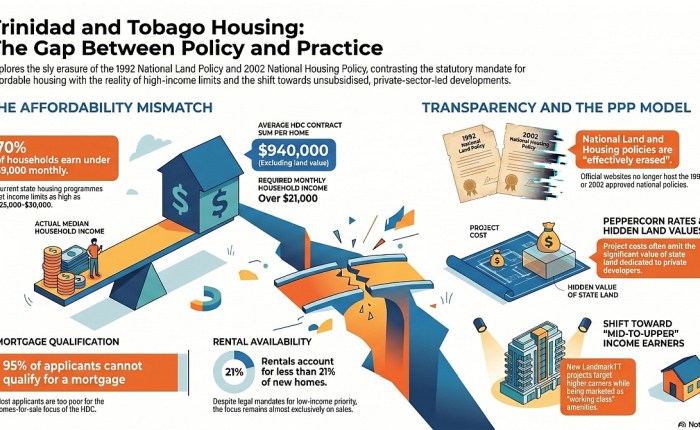
The 2002 Housing Policy set out the challenge of properly housing citizens who cannot afford to buy a home, and that Policy led directly to the HDC Act.
The HDC Act of 2005 – This Act established the Housing Development Corporation, which is mandated by Section 13 to create affordable homes for low and middle income applicants. The sequence intentionally sets a priority for low-income applicants, but here we are.
The CSO Statistics – 70% of our households have a monthly income of less than $9,000, according to the most recent CSO research (the 2011 census).
HDC Research – Many official statements confirm that over 95% of the applicants on the HDC’s waiting-list cannot qualify for a mortgage, simply because they are too poor. My research shows that only 21% of new HDC homes are available for rent. When one considers the Policy and Statutory requirements, we are witness to an unpardonable, ongoing misallocation of vast State resources of Land and Capital. This is a case of sly erasure, in which established public policy and statutory obligations were erased to facilitate routine violations by the responsible state agency.
Over 95% of applicants cannot qualify for mortgages, yet roughly four-fifths of new HDC construction is aimed at ownership rather than rental, so the State is structurally producing new homes beyond the reach of those applicants.
HDC’s decision to pursue this approach to the public housing program, in violation of its statutory obligations, has had the result of fortifying the position of the middle class, all at the expense of the lower-income citizens for whom these provisions were established. That is the class war at work in this large-scale program.
Having set the public housing background, the needs assessment issue must be engaged to understand how these projects, none of which could possibly have satisfied a proper needs assessment, could be compliant with OPR requirements. The only way that practice could prevail is if challenge proceedings issued to the OPR are limited to disgruntled competing contractors or party-political issues, which is exactly what is happening. Such challenges would never trigger a sober examination of the actual basis of these projects.
The OPR has an overarching responsibility to ensure value for money, but this analysis illustrates that, despite the encouraging engagement of challenge proceedings and the timely disposal of those, there is still a sobering gap in terms of achieving the established statutory targets. Even though no numbers are explicitly stated in the HDC Act, it is clear from this analysis that there is a major issue in terms of those statutory objectives being breached by these projects.
So what should be the OPR’s role in this matter? The clear objective of the policy is to provide affordable homes to lower and middle income applicants, yet that is not being achieved. The limited grounds upon which challenges are engaged is only a part of the issue here. More importantly, there is a way that a purely project-based approach to project review does not at all serve the wider public interest and in fact can permit this unacceptable situation to persist. If needs assessments are only being prepared with respect to particular projects, there is every danger that this quiet evasion of the HDC’s statutory obligations will continue, to the detriment of the lower-income citizens it was established to serve.
A legitimate housing needs assessment would necessarily compare applicant income distribution, mortgage qualification rates, rental demand, household size, geographic need, and long-term affordability before project typology is selected.
The OPR needs to engage this question since there is a clear prospect of Public Money being placed at peril since it is being spent in violation of the HDC’s statutory obligations. The stakes are high and we must be determined in developing a new understanding of the intersection between Housing Policy and the PPDPPA if we are to ensure ‘Value for Public Money’.
The calculated silence and erasure of our progressive public housing policy must be unmasked and resisted if we are to realise the ‘principles of social justice so that the operation of our economic system results in the material resources of the community being so distributed as to subserve the common good’, as cited in our Constitution. The HDC must serve our poorest citizens for whom these systems were created.
The second Procurement Compliance Plus (PC+) Lab on 10th September 2025 was focused on Procurement Governance, so it was a strong addition to this excellent training series for this important new legal arena. Although Procurement and Purchasing are long-established essential processes for any business, this is a novel field due to the significant changes arising from the Public Procurement & Disposal of Public Property Act (PPDPPA) 2015. The PPDPPA established effective new rules to oversee transactions in Public Money, with heavily punitive provisions, its most important feature being that oversight and penalties are now applicable to both named Public Sector Officials and Private Sector Suppliers and Contractors.
The interactive sessions were hosted by a cadre of outstanding professionals, led by the estimable Dr Margaret Rose, a long-time campaigner and educator in this field. I was a panellist, but it was also an opportunity for me to learn from and engage with a range of practitioners in this multi-faceted professional field.
The PPDPPA established the Office of Procurement Regulation (OPR) as the Statutory Oversight Agency with responsibility to ensure that these transactions are conducted in accordance with that law. Public Bodies and their Private Sector counterparts will continue to contract with each other, but in this new arrangement all of those decisions are under the oversight of the OPR.
Given the importance to our Public Interest of maximising the value obtained for every dollar of Public Money, the complexity of the PPDPPA with its various intersections with other laws, the heavy penalties and the high political stakes, there is every good reason for the professionals engaged in this arena to support this outstanding series of educational conferences.
I am also told that the OPR was invited to deliver the keynote speech at the inaugural PC+ event on 2nd May 2025, so I am very disappointed that the OPR has not attended either of these pivotal conferences. I am reliably informed that the OPR declined that invitation due to a stated fear of being accused of conflict of interest, given that it is that office which would have to rule on any complaints, challenges or other disputes. I will not stand aside while the OPR becomes yet another of our ineffective Oversight Bodies, like the Auditor General or the Integrity Commission. There is simply too much at stake here.
Apart from the over-arching point that the OPR could participate in such events without any loss of its neutrality, impartiality or fairness and more importantly, would certainly gain tremendous understanding of the challenges facing practitioners. All in all, the further bonus from OPR participation in these events would be a far greater general understanding of the issues and their context. The OPR must urgently reconsider its reluctance to attend these PC+ events, especially since its reasons appear quite rickety when one considers that the Chief Justice gave the keynote at the inaugural event and there were three Appeal Court judges in attendance at the entire second event.
Justice and its Officers should not be so cloistered and in this new dispensation that must now include Procurement Regulators.
The Office of Procurement Regulation (OPR) Chairman’s position has been vacant since 11th January 2023, with no official indication as to when that vacancy is to be filled. The OPR is an important institution which needs capable and experienced leadership, so we need to have that appointment made without any further delay.
I am reliably informed that this important appointment is being actively considered, but we need to ensure that a sound decision is made in the public interest. The inaugural Regulator, Moonilal Lalchan, was appointed in 2018 after the job was advertised by President Carmona in 2017, so the precedent has been set to publicly invite applications for this position. (See advertisement below)
Mr Lalchan performed well, without any complaints or concerns being expressed, so his reappointment ought to be a priority if we are to operationalise this important new Office to defend the Public Interest. In the alternative, the President should activate a transparent process to appoint a suitable candidate without further delay. The Regulator’s post has been vacant since January 2023 and President Kangaloo took office three months ago, so this vacancy now needs to be advertised.
PREVENTION OF CORRUPTION IN PUBLIC WORKS AND PUBLIC PROCUREMENT AND CONTRACTING
“…:29. Promoting the inclusion of anti-corruption clauses in all state and public-private-partnership contracts…”
— From the Lima Commitment ‘Democratic Governance against Corruption’ made at the Eighth Summit of the Americas in April 2018, to which Trinidad and Tobago is a signatory.
Finance Minister Imbert responded at the post-Cabinet briefing on Thursday, 16 January 2020 to the pointed questions raised by the media on the unexplained delays in implementing the new Public Procurement system. The Minister’s stated that he had only received a final position from the Office of Procurement Regulation (OPR) on 18 December 2019, which was too late to take action, given that Parliament had its last sitting for 2019 on 16 December. Continue reading “Public Procurement Delays, part three”→
This continues my series — Part 1 and Part 2 — on the unexplained and unacceptable delays in implementing the new Public Procurement system. Those delays arise from the failure or refusal of the Finance Minister to settle the Regulations which are essential for the Office of Procurement Regulation (OPR) to be fully operationalised.
“…I remain committed to attaining full implementation of the Act in the shortest possible time and the Ministry of Finance will continue to work assiduously towards that goal…”
As far as I know, there has been no response from Finance Minister Imbert to the points raised in the previous article. Of course, no response is required, but given the importance of the issue and the highly engaged communication style of that Minister, I certainly had cause for a pause.
This article will continue last week’s examination of the delays, but first, some background. The new Public Procurement system replaces the Central Tenders Board, so it is useful to note that although the CTB Act is a 1961 law, the first Board was not sworn-in until 1966 – a full five years after the law. Note well, too, that this was at a period when the CTB Act had the full support of the first PNM administration of Dr Eric Williams and the opposition forces were then a mere shadow of their current selves.
Given that background, what can we make of these delays in getting the Office of Procurement Regulation (OPR) up and running? Firstly, even though The Act is No. 1 of 2015, the first OPR Board was appointed two years ago, in January 2018, under the Chairmanship of Moonilal Lalchan.
Board of the Office of Procurement Regulation sits with former President of the Republic, Anthony Carmona (front row, centre). Board Chairman, Moonilal Lalchan seated, second from left, front row. Other members of the Board include: accountant David Charliere, supply-chain manager Frederick Bowen, civil engineer Dr Anthony Lamb, attorney Robin Otway, procurement manager Herdis Lee Chee, Human resource expert Lara Quentrall-Thomas, civil engineer Sandra Sammy, project manager Nadine Bushell, and youth advocate Nikoli Edwards.
Power 102.1 FM interview with Ms Sandrine Rattan on e-tendering within the new Public Procurement system with Afra Raymond, Moonilal Lalchan, Chairman of the Office of Procurement Regulation and Keino Cox, Chairman of TSTT’s Tenders Committee. Audio courtesy Power 102 FM