Our Land

landpolicy

10 CONCLUSION

10.1   A small State such as Trinidad & Tobago must accord a very high priority to the judicious management and utilization of its land resources or perish. All elements of land policy must be designed to ensure that these finite resources are efficiently utilized and husbanded in such a manner as to serve the long term interests of the national community.

—Conclusion of “A New Administration and Policy for Land” (19 November, 1992)

Click here to download the 1992 Land Policy

Long-standing public concerns over land allocation have been increased by a number of recent events. Most notably there have been reports of leases of waterfront land at ‘Chagville’ for a waterpark and the Chaguaramas Convention Centre for a hotel project. The other episode to have attracted interest is the alleged occupation of 35 acres of Caroni land by SIS in Couva in contested circumstances.

hdc-logoWhen one considers the recently-announced projections for distribution of 100 new homes per week by the Housing Development Corporation (HDC) and the huge ‘Land for the Landless‘ proposals, it is clear that land is a hot topic. It is tempting to dismiss these proposals as being mere electioneering, but that would be a grave error, in view of the importance of land in our society. Justifiably so.

This article will set out some of the inescapable facts about our country’s land and housing situation. It is not possible to cover these vast, complicated and interlocking issues in a single column, so this is the start of an important series. History demands nothing less.

Proceeding from the general to the particular will mean deferring discussion of the specific controversies arising at this time so that the fundamental and serious issues can be properly framed.

The main points are –

  1. The Land

    tt-land-map
    Landsat image map of Trinidad. Click image for linked article. See p 156 of linked article.

    The land area of Trinidad & Tobago is 5,128 sq. kilometres (1,980 sq miles), but apart from the raw quantity of land, we have to take proper account of the quality of our land. By which I mean to say that a majority of our land area is swamp, forest and mountainous terrain which is not suited for easy development – in my estimation, at least 60% of our land is in those zones.

    The existence of those development-free zones is essential for the sustainability of the other zones, the developed ones. Some of the elements in that sustainability equation would include green cover on high ground to reduce run-off from heavy rainfall; aquifers which can replenish with clean water; swamps/mangrove coastal areas to buffer high-tides and form a vital link in the food-chain; forests to act as living repositories of our bio-diversity and so on.

    The balance between the two types of zones is in constant tension, given the high level of national wealth; the tendency of wealthy persons to land-hoard; the tendency of poor people to take up unauthorised occupation of land and our growing environmental awareness. Those rising tensions as to land use can only be properly addressed by balancing of the needs of the human population against those of the other living elements; the present generation against those of the unborn and not least, the appetites of the wealthy against the needs of the poor.

    Idealists would suggest that those elements are not in actual conflict with each other, but realism and the facts before us speak of a grim kind of contest. The systems for environmental study, public consultation and urban & regional planning are all intended to set norms for the resolution of those conflicting demands.

  2. Population density

    popdensitymap-tt
    Population distribution map. Courtesy CSO. Click to enlarge.

    Since the land area of our country is static (at 5,128 sq kilometres) apart from marginal gains and losses due to reclamation and erosion, the actual population is an important measure of the pressure that our lands are under.

    The population density of T&T as at 2011 is 262 persons per sq kilometre, which places us 31st in terms of world population density, out of 194 countries measured at the Index Mundi website. Of course that figure is a serious underestimate, given the fact that our ‘official’ population has been recorded as virtually static at about 1.3M for quite some time now. The underestimate in terms of population is clear when one considers the electoral list of over-18s, which is just under 1,060,000 as at 2011. The situation is even starker when considered with the relevant figures for owner-occupation and the huge numbers shown in the HDC’s waiting-list.

    It seems clear that our actual population is significantly higher than the official figure, which means that the population density is much higher than stated by Index Mundi.

  3. Land Policy

    For the reasons outlined earlier, there has been a steady stream of criticism of the systems in place for environmental management, public consultation and planning in relation to our nation’s physical development.

    There is almost no discussion as to our land policy. The fact is that the national land policy was established in 1992 and has not been revised, superceded or withdrawn. As a practitioner in the field, I am aware of the policy and consider its contents to be substantially beneficial to our collective interests.

    The problem is that the official land policy is seldom observed, so much so that I often wonder how widely-known is its existence or contents.

    To test my suspicions, I decided to try an experiment by asking some surveyor colleagues at a recent conference and was astonished at the number of people who had no idea if there was a land policy. Some colleagues went beyond uncertainty to flatly deny its existence.

    But that is not all, not at all.

    I then caused queries to be raised with the relevant official bodies as to the existence of a national land policy. The replies need to be carefully noted, so that we can understand the turmoil and confusion which exists at the official level.

    Here is what we were told –

    • Ministry of Housing & Urban Development – Did not confirm or deny, but referred us to the Land Settlement Agency, which is a Division of that Ministry.

    • LSA_logonewLand Settlement Agency – Stated that they were unaware of any official land policy in existence and suggested that we contact the Ministry of Planning & Sustainable Development.
    • Ministry of Planning & Sustainable Development – Did not confirm or deny, but referred us to the Ministry of Land & Marine Resources. Another query to MPSD yielded the suggestion to contact the Town & Country Planning Division of that Ministry, but the TCPD then stated that “a policy was in process but nothing had been finalised.”
    • min-lmr-logoMinistry of Land & Marine Resources – Did not confirm or deny, but referred us to the Commissioner of State Lands, which office is yet to answer our repeated calls. Further queries to other departments within MLMR only yielded repeated statements that no such policy exists.

    This official level of confusion and ignorance is unacceptable, given the critical importance of land in “satisfying the long-term interests of the national community.”

    Quite frankly, the fact that only one of the many officials we spoke with was willing to give a name, which was actually someone else’s, speaks volumes to the pitiful position of official ignorance or obfuscation on this critical national resource. The responsible officials behaving irresponsibly in matters of the first importance. What is this?

We are either witness to woeful ignorance or a species of wilful blindness which can never serve our collective interests. The worst type of ignorance being displayed by those who do not know that they do not know. I tell you.

Given what is happening with State land in our country, this matter deserves our sternest scrutiny, so next week I will delve deeper.
Invader’s Bay – Suspicious Motives

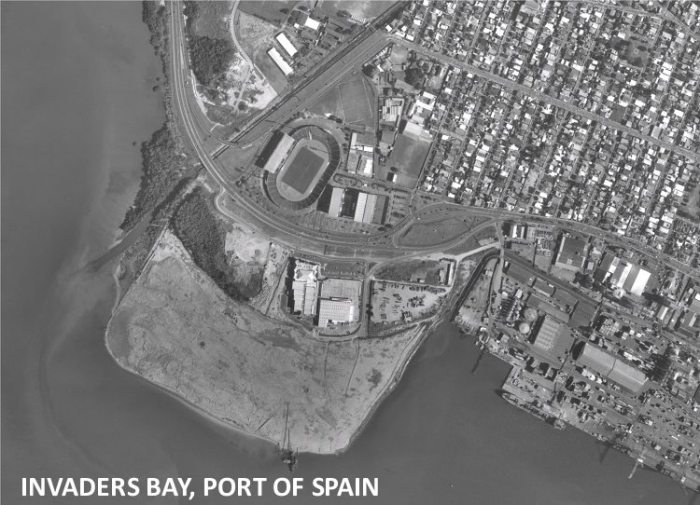
invadersbay-bwThe proposed development of Invader’s Bay will be the largest in our Capital City in living memory. The entire process is tainted by fundamental irregularities, any one of which ought to be enough to stop the development.

Some of those irregularities at Invader’s Bay include an improper and voidable tendering process; failure or refusal to hold Public Consultations; breach of the Central Tenders’ Board (CTB) Act and most recently, a wrong-sided policy on legal advice.

The State has appealed the High Court decision of Justice Frank Seepersad on 14 July 2014 to order publication of the legal opinions on which they had been relying thus far.  That hearing is now set for Wednesday 28 January 2015 at the Appeal Court in POS. At the preliminary hearing on Thursday 20 November, the State was represented by a seven-member team of attorneys, led by Russell Martineau SC.

Tender rules

Procurement_NoticMinister Tewarie has repeatedly told the public that the Appraisal rules for the Invader’s Bay development were first announced in his speech to the Annual Dinner of the T&T Contractors’ Association on Saturday 5 November 2011. That is true, I was there and heard the Minister do just as he said.  The issue here is that the closing-date stipulated in the Invader’s Bay Request for Proposals (RFP) was 4 October 2011, which was over one month before the rules were published.  Given that fact, the proposers would not have known the rules of the competition and it is fair to say there was no competition at all.  None.  Just imagine the rules for a Calypso competition being distributed the week after the singers had performed.  The RFP process for Invader’s Bay was therefore improper, voidable and illegal.

The most disturbing aspect of this nonsense, is that it raises disturbing questions as to what is fast becoming a new normal in our society.  To my mind, there are two possibilities.

The first is that the Minister was simply unaware that he was describing improper and unlawful acts.  If that is the case, one has to wonder at the quality of advice available to our Cabinet.  Are we now to accept that this is the proper way to proceed?

The second possibility is that the Minister was properly-briefed that the late publication of those rules was improper and that the entire RFP process was therefore voidable, but chose to act as if the whole process was ‘above-board’.  That Minister continues to insist that there is nothing improper taking place at Invader’s Bay and so on.  I tell you. Continue reading “Invader’s Bay – Suspicious Motives”

Reality Check

Dr. Bhoendradatt Tewarie

After a flurry of attempted explanations from the Minister of Planning & Sustainable Development, Dr. Bhoe Tewarie, as to the real meaning of the High Court’s 14 July ruling on the Invader’s Bay matter, the State has now appealed that ruling and applied for expedited hearing of the matter while having the judgment stayed.

What that means is that the State is asking the Court to agree an extension of the Stay of Execution until the appeal is decided, so that the requested information could be withheld while the case is being heard.  Presumably, the State has asked for a speedy hearing so as to avoid any impression of them encouraging needless delay in this matter of high public concern.

This article will focus on the three critical findings in the judgment.  I will be examining Dr. Tewarie’s statement to Parliament on Friday 18 July, alongside the facts and the actual High Court ruling.

  1. Legal Professional Privilege

    The very first point to be made in relation to this is that the reason given by the State for refusing the JCC’s request for this information was not originally ‘legal professional privilege’.

    That reason for refusal was only advanced after the litigation started, literally arising out of the very briefcase of the State’s attorney, on his feet before Justice Seepersad on 4 December 2012.

    We contested the State’s late introduction of these new reasons for refusal, but the Court ruled at para 37 –

    1. The Court…is of the view that the Defendant is entitled to rely upon additional reasons with respect to the refusal to disclose the said information…

    The question of whether the legal opinions are privileged was ruled-upon by Justice Seepersad –

    1. It cannot be disputed that the said information requested, is information that would ordinarily attract legal professional privilege…

    So that issue is not in dispute, in the Court’s mind at least.  I continue to hold the view that it is highly-questionable to easily accept this notion of client confidentiality, given that the State ought to be acting on our common behalf.

    In fact, no evidence was tendered nor was any real case made by the State as to the difficulties which would result from publishing the requested information.  None.  It is only now, with a ruling in the JCC’s favour, that we are getting these positions being advanced.

    For the record, the JCC’s original request under the Freedom of Information Act (FoIA) was for the legal advices and the letters of instruction.

    Consider this, from Dr. Tewarie’s opening statement –

    The very first point that I wish to make with regard to the high court ruling is that there is no issue of disclosure here. There is no issue of failing to disclose or of wanting to withhold disclosures. The Government is not seeking to prevent disclosure of any matter nor is the Government fearful of making any disclosure of fact.

    The only issue we are contesting is whether the advice of an Attorney to his/her client, which is generally regarded as privileged information, is subject to the jurisdiction of the Freedom of Information Act or whether, since it is a privileged exchange of information between Attorney and Client, it is exempt from the Act…”

    If that is truly the case, with the State’s only concern being the possible adverse impact of releasing the legal advices, the question has to be – ‘Why not publish the letters of instruction now?

  2. Waiver of Privilege

    A significant aspect of the case was as to the impact of Dr. Tewarie’s statement to the Senate on 28 February 2012, in reply to a question by then Independent Senator Dr. James Armstrong – see pg 716 of Hansard –

    The answer to (c); the publication of the request for proposals was not the subject of nor required to be in conformity with the Central Tenders Board Act. Advice to this effect was received from the Legal Unit of the Ministry of Planning and the Economy, and subsequently from the Ministry of the Attorney General…

    The point being advanced by the JCC was that a statement like that one, which purports to publicly disclose the very essence of the advice, has the effect of extinguishing the State’s right to suppress the document as being exempted.

    The Court ruled clearly on this –

    1. The gist and nature of the legal advice was in fact revealed when the Minister’s response was made and this amounted to conduct that is inconsistent with the stance that the said legal advice is exempt from being disclosed under the Act by virtue of section 29(1)…

    So, the High Court found that Dr. Tewarie’s statement to the Senate neutralized the State’s ‘legal professional privilege’. That is an important aspect of this ruling, given the frequency with which legal opinions and names are brandished by our leaders, always when convenient, of course.

  3. The Public Interest Test

    This ruling is significant in that Justice Seepersad weighed the existing ‘legal professional privilege’ – making a clear ruling on that at para 41 – against the ‘Public Interest Test’ set out in S.35 of the FoIA.

    At one point it was widely reported that Dr. Tewarie was insisting that the ruling had nothing to do with transparency, but was only on the narrow issue of legal professional privilege.

    The substance of Justice Seepersad’s ruling was at paras 85 & 86 –

    1. The nature of the project in this case and the process adopted by the Defendant to pursue the Request for Proposals process without regard to the provisions of the Central Tenders Board act, requires disclosure of all the relevant information that was considered before the said decision was taken and the refusal to provide the requested information can create a perception that there may have been misfeasance in the process and any such perception can result in the loss of public confidence. Every effort therefore ought to be made to avoid such a circumstance and if there is a valid and legally sound rationale for the adoption of the Request for Proposals process, then it must be in the public interest to disclose it and the rationale behind the process adopted ought not to be cloaked by a veil of secrecy.
    2. The public interest in having access to the requested information therefore is far more substantial than the Defendant’s interest in attempting to maintain any perceived confidentiality in relation to the said information…”

    The real point here is that Justice Seepersad has carried out the Public Interest Test, as mandated at S.35 of the FoIA and ignored by the State in this matter, to find that the ‘legal professional privilege’ is subordinate to the Public Interest in this case, given all the evidence submitted to the Court.

The entire process possesses all the ingredients for corruption, I maintain that view.

Dr. Tewarie has repeatedly claimed that the process was transparent because he disclosed the assessment rules for the Invader’s Bay development at the T&T Contractors’ Association Dinner on Saturday 5 November 2011.  That assertion is perfectly tautological, in that it is entirely true that the rules were revealed for the first time on that occasion, but it does not explain anything of substance.  The decisive fact is that the closing-date for the Invader’s Bay RFP process was 4 October 2011, a full month before the rules were disclosed.  That fact alone renders the entire process voidable and illegal.

What is more, we have to consider the widely-advertised public consultations on the redevelopment of King’s Wharf in San Fernando; the South-Western Peninsula development; the issue of ‘City-status’ for Chaguanas; Constitutional Reform and of course, the latest one, the Civil Society Board.  The glaring question has to be – ‘When is the State hosting the first in its series of Public Consultations on the Invader’s Bay development?

Finally, will this development process continue, while the legal arguments continue?

Public Secrets?

It seems to me that we are entering a sustained and hard-fought Information War, global in extent, but with local flavour. The main features of this are the attempted redefinition of Privacy as a defunct notion, right alongside the State’s duty to know all about us, but tell us as little as possible of their own operations. That is the name of the game, so these issues are going to be challenged strongly as we go forward.

Dr. Bhoendradatt Tewarie
Sen. Dr. Bhoendradatt Tewarie, Minister of Planning & Sustainable Development

The High Court ruled on 14 July 2014 that the Minister of Planning & Sustainable Development must provide the legal advice which was said to have justified the development process at Invader’s Bay. This case was brought by the JCC after the Ministry refused to publish the legal advice obtained in response to our challenge that the Invader’s Bay development process was in breach of the Central Tenders’ Board Act. Given the repeated statements that the legal opinions supported the State’s actions in relation to the CTB Act, the obvious question is ‘Why the secrecy and refusal to publish those opinions?

The JCC requested the legal opinions and the letters of instructions under the Freedom of Information Act and the judge applied the ‘Public Interest Test’ in deciding that the public right to that information eclipsed the accepted point as to the existence of ‘legal professional privilege’. There have been many comments on what has been described as a landmark ruling and it appears that the question of just what is an official secret is once again up for discussion.

We are now being told that the right of the client to maintain the confidentiality of legal advice is now under threat, so the State is reportedly considering an appeal of that High Court ruling. Continue reading “Public Secrets?”

The Elephant in the Room – part 2

Port of Spain
Port of Spain

The recent announcements as to the upcoming completion of the ‘Government Campus Plaza’ offices in POS and the relocation of significant State agencies to central Trinidad are charged with meaning for the office sector. The previous article on this topic examined the huge quantity of State-owned incomplete office buildings in greater Port-of-Spain, the impact of that on the incomplete private office projects and the role of the ongoing process of decentralisation.  For the purposes of this discussion, greater POS is the area bounded by the sea to the South, the WestShore Clinic to the West, the Queen’s Park Savannah to the North and the Lady Young Road to the East. This is going to be a closer look at those aspects, so that we might discern how this issue is going to be settled. There are interlocking issues which have created the Elephant in the Room –

  1. the incomplete State offices, which will impact on the private office rental market as they are completed;
  2. the existing offices leased by the State, which need to be re-examined;
  3. the trend towards decentralisation, with its own profound implications.

To understand the issue requires the reconciliation of these large, seemingly-conflicting, elements.  The first is of course, the ‘sunk capital’ in terms of the State-owned, incomplete office buildings in POS.  The second is the existing leases the State holds from landlords of office space in POS.  The third element is the ongoing programme to relocate significant Ministries and State Agencies out of POS, generally to Central Trinidad.   I am also of the view that we need to enquire into the progress of the ongoing decentralisation process.  The details we need are – Which Ministries/State Agencies are to be relocated from POS?  What are the preferred locations for these offices?  What progress has been made on those relocations?   Has land been purchased/leased?  Has State land been allocated? Has a building been identified?  If a new building is to be constructed, what progress has been made in terms of project scoping, design, tendering and construction?  When are these new non-POS State offices anticipated to be occupied? The key enquiries in this matter would be –

  • State Leases

    We need to know exactly what offices the State is leasing and that info would include – the Ministry or State Agency in occupation; the addresses of the buildings; the size of the office space and its facilities; the number of carparking spaces; the rent paid; the service charge paid; the parties; the extent of the lease/tenancy agreement (when did the lease start and for how long was it agreed).  Apart from the info being presented in that type of detail for each rental, the overall picture will be instructive, as it will show the amount of space occupied  and at what cost. That information will in turn disclose the average (mean) rent per square foot paid.  Without details on the present arrangements for State offices, we cannot properly judge the alternatives.

  • Empty Buildings

    Alexandra PlaceAn additional enquiry has to be raised on the particular instances where the State is paying a rent for property which remains unoccupied.  The same details listed above need to be sought in those cases, but in addition, we need to be told why those properties are still unused.  A great concern was raised recently on #One Alexandra, which concern was mostly justified in my opinion, but the fact is that it is not the only one.  The public needs to be told the full extent to which the State pays rent for unoccupied offices.

  • Re-location progress

    On 2 April 2014, Minister of Planning & Sustainable Development, Dr. Bhoe Tewarie, gave some details in the Senate on these relocations –

    • Ministry of Tertiary Education and Skills Training and some of its portfolio agencies are to be relocated to an ‘integrated administrative complex‘ 15-acre site north of the Divali Nagar on the eastern side of the Uriah Butler Highway. No size was given for the complex and construction was noted to have started in April 2014.
    • Ministry of Community Development is to be relocated to new offices at a 10-acre site near the Divali Nagar on the eastern side of the Uriah Butler Highway. No size or start-date was given for these offices.
    • Ministry of Food Production is considering relocating out of its long-established offices at St. Clair Circle, at the northern end of the Magnificent Seven strip, to either Chaguanas or Farm Road in Curepe.  That decision is pending.

    COSTATT2-595x340

    In the last week we have been told that the headquarters of COSTAATT, which is a part of UTT, is to be relocated from Melville Lane in POS to a location near the new Chaguanas Administrative Complex.   The main building occupied by COSTAATT is said to comprise 86,000sf, which is rented for $13.00psf – the total annual rent is $13.473M.  We were also told that COSTAATT’s POS operations require further rental space to the annual amount of $1.64M.  The new building is costing $168M inclusive of VAT, but no details were given as to its size or proposed completion date.  There are other relevant questions as to the convenience of the new location for students and faculty, but the fact that Chaguanas remains the fastest-expanding town in the country for the past 20 years is a part of that issue.

  • UDECOTT’s rollout

    governmentcampus
    Government Campus

    As per the previous article in this series, the State has built, but not completed, a total of 1,329,000sf of offices in POS.  According to Minister of Finance & the Economy, Larry Howai, on 5 May 2014 –  “Cabinet has approved a sum of approximately $1.5 billion to complete the Government Campus buildings in downtown Port-of-Spain,” said Howai. Once this is completed in the next 12 months I expect that the OSH problems being complained of at the BIR will be a thing of the past.”

    That Cabinet approval equates to $1,129 per sq ft, which seems high unless one considers that a significant part of that money is stated to be for remedial works and not strictly for fittings and finishes. The impending completion of those offices will be a sea-change in the fortunes of POS, since their occupation will force the landlords who were renting to the State to seek other tenants. In my estimation at least half the rented offices in the capital are occupied by the State, so that office market is largely driven by the public sector.

    I have heard many colleagues attempting to rationalise the coming change by reference to OSHA requirements which require more office space allocated to each worker and therefore those requirements would ease the impact of the impending new offices.  Another rationalisation I have heard is the one about how some landlords would be leaving their places locked-up so they will not actually be offering those on the market, so there will be no real effect and so on.

All of those are coping mechanisms for dealing with the reality of change on an epic scale.  This is the Manning Plan, in full effect.  To quote the CEO of leading private sector office developer, RGM, Gerard Darcy, in a May 2013 interview  – “…The Government Campus is still the 800-pound gorilla in the room because it is too large to ignore…”.  I expect a significant adjustment in office rent levels in POS in the medium term. The financial sector, especially those who have expanded their loan portfolios on the basis of the property boom, will need to take careful stock of the extent to which these rapidly-approaching changes imply severely impaired assets.

The Elephant in the Room

The huge potential supply of State-built, unfinished office buildings in our capital is the ‘Elephant in the Room‘. There are potent elements at play here in terms of the viability of the long-term and large-scale investments which have been made in Port-of-Spain by private and public capital.

At this point, taking account of offices over 25,000 sf in size, there are over 1,500,000 sf of incomplete offices in our capital. This article will examine the likely outcomes for our capital and those investors as the various projects are completed.

Incomplete Port of Spain offices at February 2014 (Over 25,000sf)

The State has 1,329,000 sf of incomplete offices in POS and the private sector has 224,800 sf. The State has virtually seven times more incomplete offices than the private sector and that is the ‘Elephant in the Room’. This chart portrays the reality – the details are set out in the table below.

The legacy of the POS offices built during the previous administration is a matter which deserves serious consideration. The sheer volume of offices built by the State during the previous administration is sobering – 2.3M sf. Given that Nicholas Tower – that elliptical, blue tower on Independence Square – contains 100,000 sf, it means that the State built the equivalent of ‘23 Nicholas Towers‘ in our capital in that period of rapid development.

We also know that there was no attempt at public consultation or feasibility studies by the State or its agent, UDECOTT. At the Uff Enquiry, the Executive Chairman of UDECOTT, Calder Hart, admitted that a feasibility study had been done for only one of those projects. That project is the International Waterfront Centre (IWC), which comprises the two office towers of 890,000 sf, the Hyatt Hotel, New Breakfast Shed and car-parking/outdoor facilities. Hart also admitted, under oath, that the value of the land had been omitted from the viability study for the IWC, so it was a bogus exercise. The break-even rent is the amount which must be earned by a project to repay the cost of land, construction, professional fees and finance. The IWC, repeatedly boasted-of as UDECOTT’s flagship project, is not a viable project, since its break-even rent exceeds the highest rents now earned by A-class offices in POS.

The Parliament has now relocated there during the Red House repairs and renovations. A number of other Ministries and Public Bodies have also started to occupy those offices.

The Office of the Prime Minister is now in the new 75,000 sf building on St. Clair Avenue, opposite to QRC grounds.

The rationale advanced by the Manning administration for that surge in office construction in our capital is that it would free the State from the payment of large monthly rents to private landlords. Although I made several requests, I was never able to get the actual figures for the rents paid by the State in POS. My own familiarity with that market allowed me to estimate the average rent at that time (2007-2009) at about $8-9 per sf. The break-even rents of those new buildings exceeded $25 per sf, so the costs of those office projects would never be recovered. I have read reports that the estimated cost of the Government Campus Plaza, which is the largest element in the POS offices, was recently stated by UDECOTT’s Chairman, Jearlean John, to be of the order of $3.2 Billion.

We can reasonably estimate that the rate of rents paid by the State for office buildings has now increased since 2007, in terms of dollars paid per sf.

The completion of those State-owned office buildings is therefore a matter of the first importance, given the high carrying-costs. There is also the significant issue of the high opportunity cost of the State continuing to occupy rented offices alongside virtually-completed offices.
elephant tablet

Against this background, we are now seeing an active policy of decentralisation of POS offices by the present administration, with several Ministries and Public Bodies being relocated to south and central Trinidad. The decentralisation discussion is one which has been going on since the 1970s and it is an important issue to be pursued, in my opinion. That said, one has to wonder how is the decentralisation to be rationalised, given the existence of this over-supply of State-owned offices in our capital. That is a serious question which needs to be discussed if we are to achieve any proper resolution.

The completion of the State-owned offices is under the management of UDECOTT, the original developers, with recent disclosures from the Finance Minister of plans to sell the buildings and lease them back as a means of financing their completion. The terms of any such proposals would have to be carefully considered to avoid the mistakes and fraudulent behaviour of the past.

The completion and occupation of the State-owned office buildings in POS will pose an existential challenge to those private investors who have built offices for rent. The rental levels for offices in POS are likely to decline significantly, which will impact on the revenues of those investors.

Invaders’ Bay Review

There now needs to be a complete and open review of the Invaders’ Bay matter. That is imperative if the public interest is to be safeguarded.

The catalogue of irregular dealings and improper procurement practice at Invaders’ Bay has now grown so that we are facing an important moment of decision. At this point there has been no announcement as to an award of contract or grant of any lease, so the threshold of binding legal agreement has not been crossed. In investment language, we are at the ‘inflection point’, which is where the prudent investor has to make a decision to continue or abandon a course of action.

This is the exact moment we should be calling for an open review of this major public project, before any binding commitments are made.

The Commission of Enquiry is an often-used device to probe into matters of serious public concern. In relation to construction and property development, we have had recent CoEs into the Piarco Airport Project, UDECOTT, Land-Date and the Biche School Project, to name a few.

The public has a sceptical attitude to these Commissions, since they never seem to bring the desired results in terms of arrests of prominent public officials or disgorgement of stolen monies. Many people dismiss CoEs as ‘talk shops’ set up to enrich lawyers, but I do not dismiss them as effective ways to serve the public interest. Despite the imperfections of the Enquiry process, including the fact that key witnesses can refuse to appear without incurring any serious penalties, there are real benefits. The main one, in my view, is that a CoE allows us in the public to learn about major matters of public concern which would likely have remained hidden.

That is the reason we need to retain this process so that the wrongdoing of the past can be exposed, so that we can have the possibility of avoiding those in the future. The weak point of the process is that it always takes place after the crimes have been committed, so during the Bernard Enquiry we were learning about the already-constructed Piarco Airport Terminal. Too late to prevent the massive theft and waste of Public Money.

That is why we need to consider a shift in our approach to the question of enquiries into questionable public projects, since the process is a reactive one, completely unable to stem wrongdoing.

At the ‘inflection point’ now occupied by the Invaders’ Bay project, we have an opportunity to examine this large-scale development before any significant expenditure of Public Money so that we can detect and deter wrongdoing. I am not yet settled in my mind as to exactly what type of review is best here, but whatever happens, it must be independent and committed to publication of its findings.

Some of the main issues which such an Enquiry or Review should examine are –

  • Consultation – The complete lack of consultation in this large-scale development proposal for our capital city would be addressed by the process. The land is vested in UDECOTT via a lease and that organisation has repeatedly claimed to have implemented the recommendations of the Uff Report. The 17th of those recommendations states “User groups and other interest groups should be properly consulted on decisions regarding public building projects, to ensure that relevant views can be expressed at the appropriate time and taken into account before decisions are made”. Given the swiftness with which the Couva Children’s Hospital – which is being executed via UDECOTT – emerged in March 2012, we know for sure that those recommendations are not being observed by UDECOTT. Even looking beyond UDECOTT and its conflicting ‘versions’, we can see the contradictory actions of the Ministry of Planning & Sustainable Development supporting a public consultation process at King’s Wharf in San Fernando, yet refusing to hold public consultations on Invaders’ Bay in Port-of-Spain.
  • Environmental Concerns – The Invaders’ Bay lands are extensive waterfront holdings in State property. The proper development of those lands must take full account of drainage issues and the impact on the environment, including the marine-life issues arising in any waterfront project. I have before me the EMA’s letter of 14 November, which confirms that there have been no requests or Certificate of Environmental Clearance (CEC) applications for the Invader’s Bay lands. In addition, the EMA records provided to me show that the most recent application for a CEC at Invader’s Bay was in January 2007. It is not possible to obtain planning permission without EMA approval, so there are other implications of the lack of these approvals.;
  • There is no link between the RFP and the other three strategic plans for the POS area. That violates the fundamental notion of strategic planning in that existing plans are ignored for no given reason. Piecemeal planning and development is detrimental to the Public Interest. So, who was the author of that RFP and who in the Ministry of Planning approved such a document?;
  • The Request for Proposals (RFP) published by the Ministry of Planning in August 2011 seeking Design-Build proposals for the development of these lands specified an entirely inadequate 6 weeks for submissions. Whose recommendation was it to truncate the development process in this fashion?;
  • The evaluation rules were only published after the closing-date for the tenders, so how did the proposers know what criteria to meet? That late publication is in breach of proper tender procedure, so the entire process is voidable and therefore illegal.
  • Legal Instructions and advice – Also critical to any review process would be the details of the legal advice sought and obtained at various stages of this process. The Ministry is adopting a bizarre, secretive stance in which the advice is claimed to vindicate their actions ‘thus far’, yet that legal advice is being suppressed. The JCC has taken legal action to challenge that unacceptable secrecy in this most public matter.;
  • Infrastructure – The 2014 Budget discloses a $50M allocation for infrastructure at Invader’s Bay, which of course is only a small part of this substantial cost. In the absence of environmental or planning approvals, it is difficult to establish the cost for proposals of this nature, since a design cannot be completed.
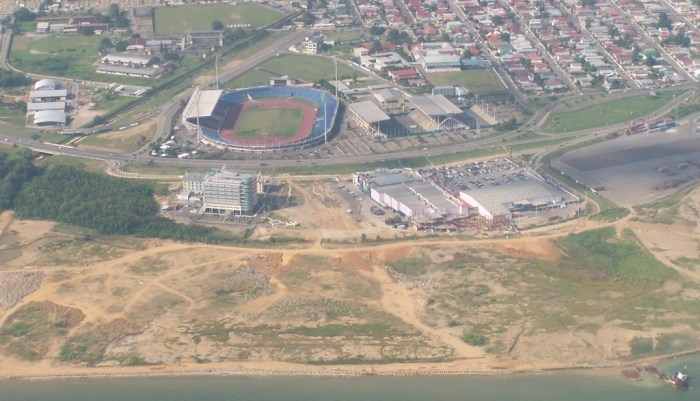
  • Allegations of squatting – Finally, we turn to one of the most vexed phrases in our lexicon where land is concerned. The issue of squatting, which is the unauthorised occupation of land not in your ownership. From the sequence of images shown below, we can trace some elementary conclusions:
    1. the first (left) is a map/plan, which uses a dotted line to illustrate the boundary between the Invaders’ Bay property and adjoining Port Authority lands to the north…the physical boundary is occupied by a watercourse/ravine and those ‘Port’ lands are occupied by MovieTowne/PriceSmart, a green play park and the Marriott/BHP-Billiton building
    2. the second (middle image) is an aerial photo which shows the Invader’s Bay land bare of vegetation
    3. the third (image at the base) is an aerial photo which shows the Invaders’ Bay land re-vegetated with mangrove and what appears to be a bare excision, immediately south of MovieTowne’s western carpark…that is a gravel-paved area, which is south of the watercourse I mentioned earlier…it is accessed via a basic bridge from the said MovieTowne carpark.

    (Click on images to expand)

    I am asking whether MovieTowne has a lease, licence or tenancy agreement to occupy those lands. Does MovieTowne pay any rent, licence fee or charge of any sort for the use and occupation of those lands? What action is UDECOTT taking on this? What action is the Commissioner of State Lands taking on this? It would be unacceptable for an entity in breach of State policy to benefit from the decisions of the State. I hope that is not what we are seeing here.

We need a full, independent and open review of this Invader’s Bay matter. Do you agree?

AUDIO: Heritage Radio Interview: Public Procurement, etc. – 04 December 2013

JCC President Afra Raymond interviewed on Heritage Radio 101.7FM by Hans Hanoomansingh to discuss JCC matters such as Public Procurement, Invader’s Bay and G2G Arrangements. 04 December 2013. Audio courtesy Heritage Radio 101.7 FM

  • Programme Date: Wednesday, 04 December 2013
  • Programme Length: 1:23:27

Invader’s Bay part 3: MORE Invaders Bay Ingredients

Invaders' Bay
Invaders’ Bay

I closed last week’s article by restating my view that all the ingredients for corruption were present at Invader’s Bay.

What are those ingredients?

Here is my list –

  • Extensive public assets coming onto the market, in turbid circumstances. Those assets can include property, concessions, contracts and jobs;
  • Questions of access to the gatekeepers – in these scenarios, some people will have unbelievable access to the decision-makers;
  • Conflicting and confusing versions of the project or proposal. The confusion is as persistent as it is deliberate, a part of the tangled web.
  • Blatant double-standards and lying is the norm in these situations;
  • Apart from ceremonial fluff, such as sod-turnings and ribbon-cuttings, there is no intention whatsoever to give any proper public account or statement of intentions. True transparency is evaded like taxes;
  • Professional Civil Servants who are unable or unwilling to insist on the maintenance of minimum standards;

Extensive Public Assets

These lands are estimated to be worth in excess of $1.2Bn at today’s priced, that means the unimproved value. Although the lands are reclaimed, a significant amount would have to be spent on infrastructure to make the property ‘shovel-ready’ for development.

As I noted in the first in this series, there were conflicting claims on this aspect, with the selected developers claiming extensive infrastructure expenses as a way to reduce what they would pay for the land. There were no estimates given for the developers’ cost of infrastructure, but I noted that the National Budget for 2014 had specified, at pg 89 of the Public Sector Investment Program, that there would be publicly-funded ‘Infrastructure Development’ at Invader’s Bay.

I have been assisted by some of the professionals in the very Ministry of Planning & Sustainable Development in identifying that item as being a $50M allocation for 2014. The actual works are unspecified, so it is difficult to be certain what is included. It certainly seems a modest sum given the size and peculiar challenges posed by the Invader’s Bay property.

In addition to the obvious public asset of the actual property, readers should note that assets in this context can include concessions. In this context that can mean maritime & docking concessions as well as tax concessions, so we will have to maintain full vigilance to safeguard the public interest.

As a first position, all the details of the overall agreements must be published for public consideration at the earliest opportunity. This is no minor point, since really huge sums of wealth can be transferred from public hands to private interests if proper transparency is not ensured. Just remember that in June this year while the President of the Peoples Republic of China was here there was the signing of a Government to Government Agreement. The JCC has lodged many strong objections to those agreements. How many readers will remember that there was an important agreement signed with respect to the Pitch Lake at that time?

To cite a press report

…According to a release from Lake Asphalt of Trinidad and Tobago (1978) Ltd, the signing ceremony of a Memorandum of Understanding and a Confidentiality Agreement with Beijing Oriental Yuhong Waterproofing Technology Co Ltd of the People’s Republic of China is scheduled to take place at the Hyatt Regency, Port of Spain…

So, faced with a Freedom of Information Act which ensures disclosure, the new trend is to wrap-up the details in yet another layer of secrecy. We need to be alert to that trend. After all, this is the same Ministry which claims to have legal advice confirming that its actions conform to the Central Tenders Board Act, yet steadfastly refuse to publish that advice.

Access to the gatekeepers

One of the two successful proposers has been the MovieTowne principal, Derek Chin, whose confidence has been striking.
According to Mr. Chin, in an extensive interview

…Chin has met with the Prime Minister and many government ministers seeking approval for this project.
Before Christmas 2010, he had a meeting with the Transport Minister Jack Warner, Foreign Affairs Minister Suruj Rambachan, and other ministers, at the Prime Minister’s Office. They all supported his plans. “I have been lobbying the Government for a year now, even before the elections. I sent in the preliminary sketches about the concept; I met 19 Cabinet ministers over the last six months. The next minister I am meeting is Bhoe Tewarie, Minister of Planning. He wants to see me. I also met with Jearlean John, Udecott chairman. She also loves it, but that was three to four months ago…

That interview was given in early July 2011, which is over one month before the Request for Proposals was published by the Ministry of Planning & Sustainable Development at the end of August. I tell you.

Conflicting and confusing versions

So, to return to the legal opinions, we have this swirling set of stories.

To date, Minister Tewarie has insisted that the project has been removed from UDeCoTT’s portfolio and placed within the Ministry of Planning. He claims that Cabinet approved this in 2011 and also insists that there is no tender process at Invader’s Bay. Of course it is impossible for the Ministry to proceed to invite tenders for anything without following the Central Tenders Board Act.

The first legal advice I saw was clear that there is indeed a tender process at work here and that the CTB Act ought to have been followed. Obviously, that conclusion did not ‘fit the script’, so an escape hatch had to be fashioned. Shortly thereafter another opinion was submitted by Sir Fenton Ramsahoye SC, on an entirely different set of assumptions which made UDeCoTT the central enabling agency in the entire scheme.

The approach endorsed by the Ramsahoye opinion flatly contradicts the version being advanced by Minister Tewarie.

That is the deep, intentional confusion being encouraged by public officials in this matter.

Blatant double-standards and lying

So, let us start with the role of the Ministry of Planning & Sustainable Development on the Invader’s Bay project. How does that Ministry reconcile its active role in seeking public views on the King’s Wharf project in San Fernando with its silence on Invader’s Bay in POS?

These are blatant double-standards of the worst kind. One can scarcely believe that there are professional civil servants who could condone this reckless and underhanded approach to national development. But there we have it.

When is the Ministry of Planning & Sustainable Development going to host a public consultation on Invader’s Bay? That is now an inescapable requirement. Sooner rather than later.

But that is not all. No, not at all.

This administration campaigned on the findings of the Uff Enquiry and made several public promises to implement the 91 recommendations of the Uff Report. Such was the importance of the matter in the political agenda that it formed the first item of the very first post-Cabinet Press Briefing of the Peoples Partnership administration on 1st July 2010. That is a broken promise, since those Uff recommendations have not been adopted and the JCC’s many attempts to offer our assistance to achieve that have all been rejected.

The 17th recommendation of the Uff Report is –

  1. User groups and other interest groups should be properly consulted on decisions regarding public building projects, to ensure that relevant views can be expressed at the appropriate time and taken into account before decisions are made…

There has been no consultation at all on the Invader’s Bay proposals. Quite frankly, apart from rumours and conflicting press reports, I do not really know exactly what is going to be built or where or even when.

According to the iconic American jurist Louis Brandeis, speaking on eradicating corruption –

‘Sunlight is the best Disinfectant’

Invader’s Bay part 2: All the Ingredients for Bobol…

Since my previous article on this controversial proposal, we have seen that certain legal advice reportedly considered by the government has been featured in another newspaper.  If that is the advice the State is relying upon in advancing their Invader’s Bay proposals, we are seeing a large-scale act of intentional illegality and a worrying return to the ‘bad-old-days.

My main concerns are –

CONSULTATION?

Compare the lack of consultation at Invader’s Bay with what happens elsewhere.  In particular, the large waterfront lands near the city centre of San Fernando at  King’s Wharf, which has been the subject of ongoing public consultations over the years.  The press reports that various design and redevelopment concepts were presented to and discussed with a widely-based audience.

Whatever the criticisms one might make of the King’s Wharf proposals, it is undeniable that views have been sought from the public/stakeholders and various proposals have been made for consideration.

The JCC and its Kindred Associations in Civil Society met with Ministers Tewarie and Cadiz on 26 September 2011 to express our serious concerns.  Yet, when Minister Tewarie was challenged by the JCC and others as to the complete failure to consult with the public, the only example of consultation he could cite was the very meeting we had insisted on, which took place after publication of the Ministry’s Request for Proposals (RFP) and just about one week before the closing-date for proposals.

This Minister obviously does not consider public consultation to be a serious element in real development, notwithstanding the lyrics about innovation, planning and, of course, Sustainability and the Cultural Sector.  Just consider the way in which East Port-of-Spain is being discussed within that same Ministry.  The prospects for sustainable economic development of East POS must be linked with the Invader’s Bay lands, there is no doubt about that.  What is more, to carry-on as though the two parts of the capital can enjoy prosperity in isolation from each other is to trade in dangerous nonsense.  When criticising the large-scale physical development plans of the last administration, ‘dangerous nonsense’ is exactly what I had accused them of dealing in.

Public Administration must be consistent, reasonable and transparent if the public is to be properly-served.  To do otherwise is to encourage disorder and a growing sense that merit is of little value.  The decisive thing has become ‘Who know you’. 

We need to be informed now what planning permissions or environmental approvals have been granted on Invader’s Bay and on what terms.

The Legal advice

I have seen the two legal documents reported on in another newspaper and have to say that those are remarkable documents.

A critical undisputed point, is that the evaluation rules – the “Invader’s Bay Development Matrix and Criteria Description” – were only published after the closing-date.  The JCC made that allegation in its letter of 14 December 2011 and that was confirmed by Minister Tewarie in his Senate contribution on 28 February 2012.  That is a fatal concession which makes the entire process voidable and therefore illegal, since the proposers would have been unfairly treated.

Note carefully that in writing to seek legal advice in response to that challenge of December 2011, the fact that the tender rules were published ex post facto does not seem to have been the subject of a query as to its legal effect.

In one of the legal documents I saw, the penultimate para is chilling in its directness –

…A simple answer to Dr Armstrong’s question on whether the RFP conforms to the (Central) Tenders Board Act is that it does. In reality, the entire tender process was not brought under the CTB Act and the matrix and criteria were forwarded to the tenderers AFTER they submitted their initial proposals to the MoPE…

The ‘simple answer‘, which is what Senator Armstrong got from Minister Tewarie, is that the Central Tenders’ Board Act had been conformed with.  The next sentence is where we enter the other place…let us deconstruct it –

Phrase

Meaning of the phrase

In reality The prior sentence is the official version we are going to tell Senator Armstrong, but here is what really happened.
“…the entire tender process…” Minister Tewarie has consistently held that there was no tender process, this is the State’s senior legal adviser calling that process by its correct title, two weeks before his statement in the Senate.
…“the entire tender process was not brought under the CTB Act…” The tender process was required to be brought under the CTB Act, since it was being done via a Ministry…but that did not happen.
“…the matrix and criteria were forwarded to the tenderers AFTER they submitted their initial proposals to the MoPE…” The State’s senior legal adviser is confirming here that the elementary good practice rules of tendering have been violated, rendering the entire process voidable.

There are two clear findings of illegality in that single paragraph by the State’s senior legal adviser.  Yet a ‘simple answer‘, which was ultimately deceptive, was suggested for Senator Armstrong.

The advice which featured in the press was from Sir Fenton Ramsahoye SC, seemingly obtained after the initial opinion just discussed.

The Ramsahoye opinion was reported to have ‘given Bhoe a green light‘ and so on, but I have serious doubts on that.

  1. Firstly, if there had been clear-cut, solid advice which would have exonerated its actions, the government would have published that so as to silence its critics.
  2. Secondly, having read it myself, their game is a lot clearer.

Ramsahoye’s mind seems to have been directed to the prospect of UDECOTT being granted a head-lease of the entire Invader’s Bay property and then granting sub-leases to the developers selected by the Ministry of Planning.  Those developers would then carry out the proposed development/s.

If that is the way this is proceeding, then there are two serious issues arising on UDeCoTT’s involvement –

  1. The Switch – While it is true that UDeCOTT can lawfully grant the subleases and operate outside the CTB Act, the burning question has to be when was this decision taken to give UDeCoTT that role?  Minister Tewarie has been adamant, since November 2011, that Cabinet took a decision that the Invader’s Bay project be removed from UDeCoTT’s portfolio to be placed within his Ministry.  When did that purported switch back to UDeCoTT take place?  Has Cabinet actually approved such a move?  The first advice looked at the development as it had proceeded and made the conclusions which I criticised above.  The second advice, contemplated a procedure which had been vigorously resisted by the responsible Minister.
  2.  The role of the Board – One of the most vexatious issues to be probed in the Uff Enquiry is the question of to what extent can Cabinet instruct a State Board.  That issue of undue Cabinet influence was also a large contention during the Bernard Enquiry into the Piarco Airport scandal.  Uff concluded, at para 8, that the scope of Ministers’ power to give instructions ought to be clarified.  There are several significant challenges if one accepts the formulation put onto the Invader’s Bay process in Ramsahoye’s opinion. Cabinet would have to instruct that UDeCoTT implement decisions taken by the Ministry of Planning etc.  As we have seen and as the legal advice has clarified, those decisions emerged from unlawful processes.  Is UDeCoTT obliged to follow unlawful instructions?  In the event of litigation, which is increasingly likely, will the members of UDeCoTT’s Board be indemnified by the State for their unlawful acts?   If that were the case, it would be repugnant, with deep echoes of the two earlier large-scale episodes of wrongdoing at Piarco Airport and UDeCoTT projects as cited above.

I stated earlier that this Invader’s Bay matter had all the ingredients for corruption.  I stand by those views.