AUDIO: The Breakfast Roundtable interview on Sky 99.5FM- 28 January 2016

sky995fmAfra Raymond is interviewed on the ‘The Breakfast Round Table‘ show on Sky 99.5 FM by Eddisson Carr and Jessie May Ventour in light of the fact that he spoke at “Corruption Perceptions Index 2015: Facts and Findings”, the seminar hosted by the Trinidad and Tobago Transparency Institute, in collaboration with the Trinidad and Tobago Chamber of Industry. He shares highlights of the discussion he led in that seminar. 28 January 2016. Audio courtesy Sky 99.5 FM

  • Programme Date: Thursday, 28 January 2016
  • Programme Length: 37:49

AUDIO: The Showdown Show Interview, i95.5FM – 7 June 2015

Afra Raymond is interviewed on the ‘Showdown‘ show on i95.5FM by Jennifer Baptiste-Primus and Ralph Maraj on the former PP government’s ‘Land for the Landless’ policy and bill. 7 June 2015. Audio courtesy i95.5FM

  • Programme Date: Sunday, 7 June 2015
  • Programme Length: 1:13:27

CL Financial bailout – Finding the Facts

Min of FInance, Colm Imbert, MP

On 10 August 2015, the then Minister of Finance and the Economy appealed the High Court’s 22 July 2015 judgment which ordered the release of the details on the CL Financial bailout. My protest at this action was published in this space as ‘Studied Disdain‘. Since then, the General Election of 7 September 2015 brought about a change of government – the People’s Partnership is now the official Opposition and the People’s National Movement is once again the government.

It is essential to now determine the areas in which we can expect changes in policy and the areas in which we can expect business as usual. Those perspectives informed my letter of 15 September 2015 to the new Minister of Finance & the Economy, Colm Imbert.

Imbert asked for more time to consider my request, so I consented to his application to the Appeal Court – the next hearing in this matter is therefore set for 25th January 2016.

My exchanges thus far with Imbert have been straightforward ones, but it is always important for us to be vigilant and aware.

15th September 2015
By email & hand
Mr Colm Imbert MP,
Minister of Finance & the Economy,
Ministry of Finance & the Economy,
8th Floor,
Eric Williams Financial Complex,
Brian Lara Promenade,
Port-of-Spain
Honourable Minister,
Request for Official Publication of Suppressed Details relevant to CL Financial bailout
The controversial CLF bailout is the largest payout of Public Money on a single project/issue in the history of our Republic. The entire operation has been conducted in conditions of complete secrecy with all the usual standards on transparency and accountability being ignored by the responsible public officials – a timeline showing the various official versions of the cost of this bailout is attached for ease of reference.
The PNM conducted its successful campaign for the recently-concluded 2015 General Elections on the commendable principles of Accountability, Transparency and Good Governance. I have been campaigning for the restoration of those standards to this CL Financial bailout and have gone so far as to sue the Ministry of Finance (CV 2013-00162) for the details of the bailout, at my own expense and in the Public Interest.

The High Court ruled in my favour on 22 July 2015 and ordered the publication of the requested details, but on 10th August 2015 the Ministry of Finance appealed that ruling (P201 – 2015). Our next hearing is set for Monday 19th October 2015, to argue the State’s application for extension of the stay of execution. It is my intention to strongly oppose that application for any extension of the stay of execution.I am formally requesting that you take the necessary actions to restore the Public Interest in the Accountability, Transparency and Good Governance in relation to this vast, opaque expenditure of Public Money.In specific terms, I am requesting three actions from you –

  1. Formal withdrawal of the State’s appeal in this matter;
  2. Urgent publication of the details of the CL Financial bailout to include the audited accounts for CL Financial 2008-2014 or any interim, preliminary, draft or unaudited statements of CL Financial Limited; the full details of the official briefing to Independent Senators in September 2011 preparatory to the debate on The Central Bank (Amendment) Bill and The Purchase of Rights and Validation Bill 2011 (to include copies of all slides. Power-Point slides, tables, charts, schedules, text or other information which comprised that presentation) and details of the funds paid in the bailout to include – a full list of creditors as at the commencement date of the bailout and at the date of my FoIA request (8th May 2012); the names of the EFPA holders; the dates of the repayments of the EFPA holders, together with details of the amounts received; the identities of all those who have received public money in the conduct of this exercise, together with details of the amounts received. These details are no doubt electronically stored, so I would request that the answers be provided in a searchable database;
  3. Refund of my reasonable legal fees in this matter – The High Court awarded 70% of my costs.

In anticipation of objections to disclosing these details on the grounds of the right of private investors to confidentiality, my response would be to point out that all other recipients of Public Funds are liable to having detailed information disclosed, upon request and without notice. A request for information on the details of a Public contract would include the identities of the parties; the contract itself; the dates and amounts of payments. Such requests are routinely handled without resort to attorneys or even the Courts, even if administrative delay is also a reality. That is the common and accepted practice in relation to all Public contracts and payments, which is fortified by the provisions of the Freedom of Information Act, under which my litigation was successful. There is no case made for any special status of financial investors to enjoy rights of confidentiality which are not available to other recipients of Public Funds.

The only way for the required level of transparency and accountability to be achieved is by the responsible officials publishing all the details of all the payments of Public Money.

The equation for the reality check is –

         Expenditure of Public Money
Minus    Transparency
Minus    Accountability
Equals   CORRUPTION    

I can appreciate that the impending 2016 budget would likely demand your attention for the next three weeks. I would like to know the State’s position in this matter before the next Appeal Court hearing on Monday 19th October 2015, so I would appreciate your reply by Friday 9th October 2015.

This request was made in the Public Interest, so I trust that it will receive your positive attention.

Yours sincerely,
……………………………………………….
Afra Raymond

c.c. – Dr. Keith Rowley MP, Prime Minister,
Mr. Faris Al Rawi MP, Attorney General

http://www.afraraymond.wordpress.com

How much has the CL Financial bailout cost?’
TIMELINE

DATE

EVENT

SOURCE

with live hyperlinks

30th January 2009

Bailout announced at an estimated cost of $5.0 Billion

CBTT Statement of 13th February 2009

12th June 2009

CL Financial Shareholders’ Agreement signed, which for the first time made it a priority to protect shareholders’ rights.

https://afraraymond.files.

– see Para ‘A’ of the Preamble at page two.

8th September 2010

Winston Dookeran’s first Budget Statement, in which he formally proposes to drastically reduce the rate of payout of Public Money in the bailout.

2011 Budget Statement 

pages eight through ten.

1st October 2010

Then PM confirms that $7.3 Bn had been spent and that a further $7.0 Bn needed to be spent (pg 31). The burning need for an explanation of where the $7.3 Bn went…(pgs 25-26)

Hansard for 1st October 2010 

pages 19 through 34.

3rd April 2012

Then Finance Minister Winston Dookeran confirms that $12 Bn had been spent.

Affidavit to High Court in Percy Farrell & Ors vs AG 

para 21.

1st October 2012

New Finance Minister Larry Howai confirms that $19.7 Bn had been spent, which is an additional $7.7 Bn in six months.

2013 Budget Statement 

page six.

17th May 2013

Formal confirmation of bailout cost “over $25 Bn

Formal Press Release from Office of the AG 

para eight.

2nd April 2014

Then Finance Minister Howai confirms bailout cost as – “… the cost to the country of the CL Financial bailout—the actual cash that has been put out—is approximately$20.8 billion...”

Hansard for Senate sitting of 2ndApril 2014 

page 35.

7th August 2015

Then Finance Minister Howai confirms bailout cost as ‘not quite $20 Bn‘.

CNMG interview

Our Land – The Review

“…A small State such as Trinidad & Tobago must accord a very high priority to the judicious management and utilization of its land resources or perish. All elements of land policy must be designed to ensure that these finite resources are efficiently utilized and husbanded in such a manner as to serve the long term interests of the national community…”
—Conclusion of “A New Administration and Policy for Land” (19 November, 1992)

The PNM won national elections on 7 September 2015 by 23-18.

Two key themes emerged during the PNM’s successful campaign –

  1. Firstly, there was a strong emphasis on the critical need to restore proper standards of Accountability, Transparency and Good Governance;
  2. Secondly, a commitment was given to ‘keep the various promises made by the PP government’.

When one considers the various promises, policy changes and actions of the PP in relation to land and property, it seems clear to me that those two campaign commitments made by the PNM are entirely incompatible.

Our country has a very high population density and the previous Minister of Land and Marine Resources estimated that some 63% of our country’s land belongs to the State. It is therefore a cardinal State responsibility to properly manage those critical resources so that short and long term interests can be reconciled in a sustainable manner. The present situation is so serious and damaging to our collective interests that I am calling for a halt to any attempt to keep promises with respect to land and property while a fact-finding and policy review is conducted.

landpolicyThe opening quotation is from the National Land Policy 1992, which is now a virtually unknown document since its very existence is denied by all the relevant agencies. This Policy provides critical guidance for how this scarce resource should be best managed in the Public Interest.

The severe crisis now evident in relation to our State Lands resembles a ‘Tragedy of the Commons‘ in which this crucial resource which should offer long-term collective benefits is effectively abused by self-seeking individuals. The pattern of abuse is facilitated by gross mismanagement, in profitable partnership with deliberate obscurity in how the State Land system actually operates.

Food Security

foodplan-2012-15This remains elusive since in March 2012 the Ministry of Agriculture, Land & Marine Resources published its Food Production Action Plan 2012-2015. The major goal of that Action Plan was to halve the country’s annual $4.0 Billion food import bill. Yet in March 2014, the Food Production Minister, Senator Devant Maharaj, stated that the food import bill had been reduced by only 2% since 2010.

The significant reduction of our food import bill will require a flexible plan, with dedicated implementation and continuous monitoring. The one inescapable requirement is for farmers to have access to land of suitable quantity, quality and location. Without a good supply of land, no food security plan can succeed.

Land for the Landless

The proposed revisions to the State Lands Act 1998 were approved by the Lower House of Parliament on 3 June 2015 and withdrawn after the JCC raised certain objections. The proposed change in the ‘Land for the Landless’ policy were approved by Cabinet on 19 March 2015 with these main elements –

  • Occupation Date – Was moved from January 1998 to June 2014, which means many more persons would qualify.
  • Income Limits – Previously the maximum monthly family income was $8,000, this was now revised to $30,000.
  • Definition – the 1998 Act defined a landless person as one who was ‘disadvantaged’ according to the Ministry of Social Development, that word was deleted from the revised proposals.
  • Designated Areas – these were specified in an extensive list of over 400 areas covering the entire country.
  • The Numbers – The total number of persons identified was 250,000 and a commitment was given to regularise some 60,000 of those.

A policy which was originally intended to alleviate the plight of our poorest citizens has now effectively been extended to offer ‘Land for Everybody’. The existing commitment in respect of 60,000 lots will consume about 8,000 acres of land.

EMBD

https://vimeo.com/7987617
embd logoThe EMBD website states that it is responsible for the development of the former Caroni lands – some 7,500 residential lots are being prepared for ex-Caroni workers as part of their retrenchment package, with a further 8,400 agricultural leases of 2-acre parcels reportedly being processed. That means about 940 acres are to be used for the residential lots, with at further 18,500 additional acres for the agricultural plots. The total land area to be used would be about 19,420 acres, which is about a quarter (26%) of the estimated area of the Caroni lands.

Caroni Lands

caroni1975_logo_smallCaroni Lands were leased to ex–Caroni workers as part of their retrenchment compensation – they were entitled to one residential lot and a two-acre parcel for food-crop farming. The use of those lands for those purposes was intended to be controlled by the restrictive covenants in those leases. For instance, the residential lots were to be developed by a residential building within three years and the agricultural lots were to be held by the ex-workers for food-crop farming. In the 2015 budget, the restriction on sale of those agricultural lands was removed (pg 14). In addition, Cabinet Minute 3093 of 6 November 2014 approved the removal of the restrictive covenants in the leases to ex-Caroni workers – both agricultural and residential. No restriction on sale and no requirement to build on the lots.

This is tantamount to the State entirely gifting the development and transactional rights to these lessees, with no effective means of ensuring the originally desired results.

Housing Development Corporation (HDC)

hdc-logoThe HDC sells new homes at heavily-subsided rates to middle-income families, subject to restrictive covenants which prohibit open-market sale within the first ten years. Under the terms of that clause, the owner of one of these homes is required to offer the property to the HDC at the original price. It now seems that the HDC has relinquished those restrictive covenants. I have seen several letters signed by the HDC which authorise the open-market sale of those homes within the ten-year embargo period. I am not aware of any policy decision which supports that pattern of approvals and none of the vendors I have spoken with have paid any penalties of profit-share to the HDC.

This is yet another example of the State or its agents abandoning its fundamental duty to properly manage the public property rights within its remit.

Property Tax

The proposed Property Tax would require a live, open-access database which would allow anyone to examine the details of any property in the country. Those details would include land area, building area, number of bedrooms/bathrooms and other facilities, transaction history, ownership and assessed taxes. One of the strongest sources of opposition to the Property Tax is persons who would wish to keep the details of their property holdings and dealings as secret as possible.

The new Property Tax system and the modern database is in fact a key element in unearthing the facts of our country’s property ownership and occupation.

Property Tax must therefore be a priority in this arena.

The unrealistic policy of homes with gardens consumes too much land and will jeopardise our country’s sustainable future.

CL Financial Bailout – The Hidden Truth

We are now in what I call the Season of Reflection, which for me covers the period from Emancipation Day on 1 August to Independence Day on 31 August, right up to Republic Day on 24 September. Those celebrations appear in proper historical sequence in our calendar and every year I find this two-month ‘season’ to be a sobering period for deep reflection. This year, with this CL Financial judgment and the impending election seeming to converge, the reflections are piercing ones.

Sad to say, this CL Financial bailout is resembling a situation in which well-connected persons are getting what they can, anyway they can, but making sure not to get caught. Who were the beneficiaries of this lavish payout? What is this reluctance to release details?

That is the Code of Silence in effect.

Sen. Larry Howai, Min of Finance

I was not at all surprised at the reported statements of the Minister of Finance, Larry Howai, on the 22 July 2015 High Court judgment ordering him to provide the detailed information I had requested on the CL Financial bailout. The High Court granted a 28-day stay of execution and the Ministry is reportedly in consultation with its lawyers, claiming that “A decision will be made within the period of time allowed by the court,”. The article closed with this quote –

“…Finance Minister Larry Howai said in the statement it should be noted, none of the requests refer to “how over $25b was spent in the Clico bailout”…”

Given that the very request was for the detailed financial information which has been deliberately suppressed since 2009, it is of course impossible to say with any certainty just how much Public Money was actually spent on this CL Financial bailout. That is the inescapable fact at the centre of this scandal. The Minister’s tautology is really a powerful explanation of this point.
Continue reading “CL Financial Bailout – The Hidden Truth”

CL Financial Bailout – The Real Case

Sen. Larry Howai, Min of Finance
Sen. Larry Howai, Min of Finance & the Economy

In 2013 I sued the Minister of Finance & the Economy for his continuing failure or refusal to provide the details relating to the huge $25 Billion bailout of the failed CL Financial group.

On Wednesday 22 July 2015, the High court ruled in my favour by ordering the release of all the requested information.

The basic principle behind the Freedom of Information Act is that the information held by Public Authorities belongs to the public, unless one of the valid exemptions is applicable.

The Court also granted the State a 28-day stay of execution which seems intended to allow them the time to decide whether to appeal before they have to provide the requested information. Given the ongoing Information War and the high stakes to maintain the ‘Code of Silence’ in relation to this bailout, I would not be at all surprised if the State were to appeal against this ruling.

The unexplained gap

On 1 October 2010, the Prime Minister addressed Parliament to explain that $7.3 Billion had been spent on the bailout and that a further estimated $7.0 Billion was required to settle all debts. That is a 2010 estimate of $14.3 Billion to settle the CL Financial bailout, but the current estimated cost of the bailout is in excess of $25 Billion. That means that over $10.5 Billion more than the 2010 estimate has been spent, so where did all that extra money go? That information and the defined official policy of secrecy are at the heart of this scandal. Continue reading “CL Financial Bailout – The Real Case”

CL Financial Bailout – Steal of a Deal

The CL Financial bailout was a steal of a deal for the owners of that troubled company. After all, the wealthiest man in the Caribbean was able to obtain an interest-free loan exceeding $25 Billion in Public Money at a time when no one else would lend him. Our Treasury was effectively the ‘lender of last resort’, so those terms were hugely in favour of CL Financial and its controlling shareholder, Lawrence Duprey. What is more, the shareholders kept all their shares.

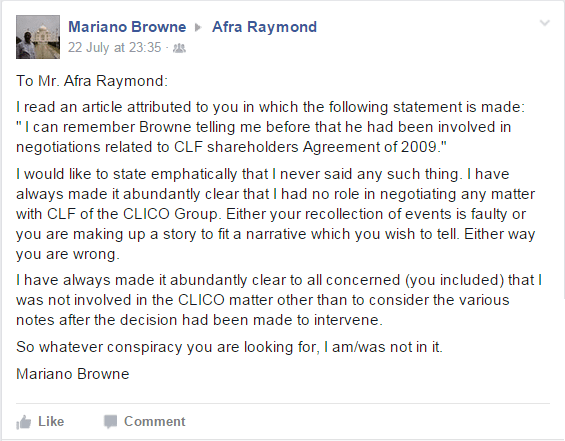
In the previous column, I stated my view that Mariano Browne had taken what seemed to be a position supportive of Lawrence Duprey’s attempt to regain control of CLICO. I also pointed out that Browne was a member of the Cabinet when that fateful and detrimental deal was made to bail out CL Financial in 2009 and called on the significant members of that Cabinet to explain their rationale. I went further to say that Browne was one of the five significant persons who had been requested to testify and refused to do so.
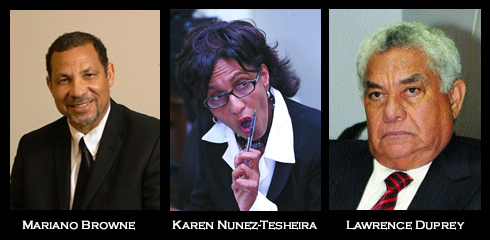
browne-karen-dupreyI am pleased that Mariano Browne has replied on the record, so this column will deal with those valuable points. For starters, it is even clearer than before that former Minister of Finance, Karen Nunez-Tesheira, has serious questions to answer in relation to her central role in this bailout. Given that financial training and experience formed a weak part of her profile, one can only wonder at what prompted Manning to appoint Nunez-Tesheira to that position. We will see. In addition, the terms which were negotiated between the State and CLF are essential to understand today’s dilemma with respect to Duprey’s ambitions. A related issue which needs clarity is the role of the powerful, unelected ‘bigger heads’ who are seemingly in control of our country.

mariano-to-afra1mariano-to-afra2mariano-to-afra3

mariano-to-afra4

Duprey and his cohorts benefitted from an unprecedented degree of access to key decision-makers in the Cabinet and the Central Bank.

One of the enduring paradoxes in how our society is governed is the lopsided distribution of information. There is an abundance of relatively unimportant information, alongside a severe scarcity of critical facts on the big issues of the day. It seems that we are now ‘Amusing ourselves to Death‘, to borrow an insightful phrase from Neil Postman.

There is a world seen and a world unseen. The challenge is to discern the scope and influence of the unseen world. The current lexicon describes the unseen world as the ‘Deep State‘. I have no doubt that such a state of affairs exists in our country. So what do we know about the huge decisions in our society’s governance and how do we come to know those things?

For instance, the most serious decisions are taken by the Cabinet, which consists only of members of Parliament – some directly-elected as MPs and others appointed as Senators. Some of those decisions are announced at the Thursday afternoon post-Cabinet Press Conference. But the coverage is always partial with my suspicion being that stories are often presented so as to conceal their less-favourable aspects.

Cabinet seems to operate according to two conventions – the first being ‘Collective Cabinet Responsibility’ and the second being that the discussions of Cabinet are secret. The Freedom of Information Act gives Cabinet documents a 10-year embargo against publication. So, the first problem is that the highest decision-making Chamber in our Republic is essentially a secret one. I have always felt that the veil of secrecy which covers Cabinet’s deliberations is most times severely detrimental to our collective interests. This sordid CLF bailout fiasco fortifies that view.

Another critical aspect of the current arrangements is the role of the powerful Party Political Financiers, which is rarely revealed, but often suspected. In the case of the CL Financial group, we know that CLICO was a major funder of both major parties, which gives this bailout fiasco its lingering, bitter, flavour. There are few opportunities for us to get a real insight, beyond rumours, as to the true role of the party financier. Apart from the role of CL Financial as financiers, we also learned in the Colman Commission that Nunez-Tesheira’s 2007 campaign benefitted from Hindu Credit Union (HCU) financing.

The 2009 negotiations

One question I always ask is whether Karen Nunez-Tesheira told her colleagues that CLF had paid a dividend three days after it requested a bailout? As a shareholder, she would have been in receipt of dividends. If the Cabinet was told, they should have insisted on immediate repayment of any dividend since an insolvent company cannot pay a dividend. If the Cabinet was not told, we are dealing with a most deceptive course of action. Which was it?

So, what did Browne say about those negotiations?

…I have said that Duprey’s (and other shareholders) legal position is strong as the government depended on a MOA (memorandum of Agreement) the time frame of which has long since passed. On that basis, the shareholders have rights. Even if the state has expended money, the State and or its agents (the Central Bank) must do so in way that protects both the policy holders and the shareholders.

That was my advice in cabinet and at the Finance Policy Committee. The view of the Minister of Finance prevailed. I am of the opinion that Karen Nunez Tesheira was wrong then and is wrong now…

Browne is concurring with my view that the State’s position is weak in this bailout endgame, the key point being “…the shareholders have rights…”. Being bound by the first convention of ‘Collective Cabinet Responsibility’, Browne kept his silence during the raging controversy of the past 6 years, but he has now chosen to break the secrecy convention. I am grateful to him and it is telling that the most expert Cabinet member in that critical arena of finance and economics is now revealing his recollections of these critical events.

karenandlawrence

Nunez-Tesheira needs to share the rationale for the bailout formula which let Duprey and the other shareholders keep their shares and loaned those huge sums of Public Money to the wealthiest man in Caribbean on an interest-free basis. What were the public policy considerations which could possibly have supported such a course of action?

Browne goes further to outline a situation in which he seems to have been excluded from the negotiations –

…And for the record I have not been part of any negotiations with Clico or CLF as part of the bailout action. Neither was I a part of the cabinet which took the decision to support the CLF/ CLICO Group. Those decisions were taken at a Cabinet meeting of which I was not a part on 29th January 2009 as I was in Barbados representing the Minister of Finance at a COFAP meeting. This bailout was always the province of the Minister of Finance and the Governor of the Central Bank and (sic) had no part in those decisions.

Further, Clico/CLF/Duprey made no contributions to the PNM during my tenure as Treasurer…

I can remember Browne telling me before that he had been involved in negotiations related to the CLF Shareholders Agreement of June 2009. That Agreement, at para A of its preamble, undertakes to protect the interest of shareholders. Note – Browne has since denied this claim of mine, so that has to be noted.

Of course, we know that Browne was part of the Cabinet which made those decisions, even if he was not in attendance at those particular meetings (I have no reason to doubt him), it is immaterial. As a member of that Cabinet he bears collective responsibility.

Duprey’s intended re-entry

Browne contested my statement that he seemed to be supporting Duprey’s attempt to regain control of CLICO –

…With regard to your opinion, I am am (sic) supporting nothing…The state only owns 49% of the company. If the shareholders act in concert there is nothing to prevent them from having an extra ordinary shareholders (EGM) Meeting and replacing the state appointed Directors. It is unlikely that Lawrence Duprey can pass the fit and proper rule and therefore cannot be appointed to CLICO’s Board, but he can be appointed to the CLF Board…

Browne listed the reasons which seemed to favour Duprey’s position, which position is fortified by his interpretation of the fit & proper rules. In his view, those rules would have prevented Duprey’s appointment to CLICO’s Board, but he would have still been eligible to sit on CL Financial’s Board. If we are considering a situation in which CLICO would still have CLF as its majority shareholder, that is an entirely misplaced view.

In the Central Bank’s ‘Fit and Proper Guideline‘, the question of ‘Who should be Fit and Proper?’ is addressed at page 2 –

“…4.1 According to governing legislation the following persons referred to in this Guideline as holding “key positions” are required to be fit and proper: -…
…4.1.4 Controlling Shareholder – may be an individual or a corporate entity

  1. Under the IA, any person who is entitled to control at least one-third of the voting power at any general meeting of the company.
  2. Under the FIA, any person who controls twenty five per cent or more of the voting power at any general meeting…

Before the bailout about 89% of CLICO’s shares were owned by CLF, so Duprey cannot regain control of CLICO, either directly or via a holding company, if the fit and proper regulations are enforced. As I said previously, the acid question is whether the Central Bank will summon the will to apply those rules without fear or favour.

This is no academic dispute, since Duprey has made it clear that he is seeking to regain control of CLICO, so that financial company and the rules which govern it, must be central concerns in this matter.

Sunlight is the best disinfectant. Come clean.

AUDIO: Election Hardtalk interview on Power 102FM – 16 Jul 2015

Power 102 FMAfra Raymond and Peter Permell are interviewed on the ‘Election Hardtalk‘ show on Power 102FMFM by Tony Fraser about the continuing impact of the CL Financial bailout on the economy and the request to get back the company by Lawrence Duprey. 16 July 2015. Audio courtesy Power 102FM

  • Programme Date: Thurday, 16 July 2015
  • Programme Length: 1:19:47