The UDeCOTT finale

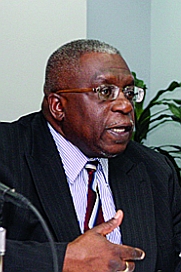
Calder Hart. Photo courtesy Trinidad Guardian
Calder Hart

The resignation of Calder Hart as Executive Chairman of UDeCOTT and all four other major Boards he chaired is no surprise to me. None whatsoever. I had already noted in this space the consistent false claims and bogus rationales emerging from that individual.

One of the main ones is the ‘Anancy-story’ that all these new buildings would reduce the rents paid by government for offices. Those false claims of savings to the public purse were often repeated by the PM and his then Minister of Planning and Development, Camille Robinson-Regis, but they were withdrawn when challenged to let us have some figures. By my calculations, the UdeCOTT offices will cost this country about 3 times MORE per square foot than the space now occupied. Hart has consistently declined/refused or ignored my several requests for information on the touted savings.

We need to locate this moment firmly in context, so that we are not fooled, again, into seeing these issues too narrowly. Some main issues are –

  • Rationale – If we are to do better with our limited resources, we need to behave differently. Before we can behave differently, we need to think differently. This entire UDeCOTT/Calder Hart/JCC/Imbert/Rowley/Uff scene has been useful in that huge areas, previously hidden, have now been revealed. It is an opportunity for us to learn from our mistakes. In my view, the weak spot in the link is that we have no proper system for project origination, selection and ranking. We need to start asking the essential questions – ‘What are we proposing?’ and ‘Why are we proposing that?’
  • Cabinet-Approved? – We need to be mindful of the PM’s address to the Senate on 13th May 2008 – see http://www.ttembassy.org/051308.htm – in which he emphasised that all UDeCOTT’s projects were carried out with proper Cabinet approval – after a thorough process – and that that organisation enjoyed his full confidence. One is now bound to reflect on the implications of the doctrine of Cabinet solidarity – one for all and all for one. Does the Cabinet as a whole share in the political cost of Mr. Manning’s vote of confidence? If Mr. Hart’s actions were indeed Cabinet-approved, why the need for him to resign? If he is guilty of ‘going too far’, does the doctrine of collective responsibility apply here? Do his fellow Board Directors share in that responsibility? How far does the stain spread? Are the other companies Hart chaired OK?
  • UDeCOTT’s procedures – For example, UDeCOTT was shown at the Uff Commission to have separate tendering rules from those applicable to other State Enterprises. Even with that special approval in hand, UDeCOTT found it necessary to breach its own tender procedure. Other shocking evidence of improper practices emerged at the Uff Commission, so one can understand their strong attempts to derail that enquiry. The public should brace for a critical report with many unpleasant revelations. The report of the Uff Commission must be published without delay or dilution.
  • UDeCOTT’s board – On Monday morning, I was disgusted, but not surprised, to read about the flat refusal of the other UDeCOTT directors to step down. Some real predictable alibis there – ‘Innocent until proven guilty’, ‘needing more information before a statement could be made’ and, of course, the classic one, ‘squeaky-clean’. The most worrying aspect of UDeCOTT’s shambles is the steadfast silence on its audited accounts. I published End-notes on the Uff Commission in this space on 17th December 2009 – that article highlighted Hart’s opaque explanation for the lack of accounts for UDeCOTT. UDeCOTT is the largest State Enterprise and, at the Uff commission, its attorneys stated it to be a $20Bn + company. We have all heard over and over from the PM that it is the best-performing State Enterprise. The lack of audited accounts since 2006 is shocking. No accounts for 2007, 2008 or 2009 and that could never be exemplary or squeaky-clean. It is obvious, to anyone with a shred of sense, that a company which was unable or unwilling to publish audited accounts for three years has serious issues, none of them likely to be positive. I doubt that the Unit Trust would buy, or continue to hold, shares in a company which had failed to publish accounts for three years. I doubt that any prudent or proper investment house would do so. What is worse, UDeCOTT has offered no cogent explanation for its failure to publish accounts. The difference with UDeCOTT is that we are constitutionally unable to divest ourselves of those shares. It seems to me that the contemptuous attitude of those at the top is informed by this reality.
  • Hart’s testimony – Calder Hart, under oath, denied the allegations made by Carl Khan as to the link between the owners of CH Limited and himself. Given what has transpired here, is Hart guilty of lying to the Commission? Is that a criminal offence? Readers need to note that the instant Calder Hart’s and UDeCOTT’s attorneys refused to question testimony of Carl Khan, it was tantamount to an admission of the truth. That refusal to cross-examine Carl Khan was almost 6 months ago, so this trusted civil servant was given time to prepare before his resignation. Not everyone is offered that sort of courtesy and consideration, as Dr. Rowley’s case shows. It is a clear case of double-standards. Calder Hart appears to have enjoyed a most favoured status, for whatever reason.
  • Manning’s judgement – This entire sorry episode casts a shadow of doubt over the quality of judgement exercised by our Prime Minister. Consider that since Carl Khan filed his evidence in May, Calder Hart must have known that his days were numbered. Did Hart tell Manning that there was truth to the accusations? Yes or no? Did Manning ask him? Did they just keep on with the relationship long after a wise person would have broken it off?

Finally, we need to deal with the widespread belief that after all is said and done, the country is better off as we have gotten many new buildings for our money, even if a few things went wrong, or too far. I do not support those views, for three reasons –

  1. Firstly, none of the UDecott projects make any commercial sense. Even NAPA, which is supposedly of some cultural or artistic importance is now being seriously questioned by many responsible groups.
  2. Secondly, what we are hearing is a version of ‘the ends justify the means’ and that is not an acceptable path to developing any modern country. Every time we have tried that, the costs far outweigh the benefits. That is the strategic and moral bankruptcy which took us to this sorry place.
  3. Lastly, we need to remember that most of UDeCOTT’s projects were paid for with borrowed monies, which we are only now starting to repay.

VIDEO: First Up Simulcast Interview – 21 January 2010

VIDEO: First Up Simulcast Interview – 21 January 2010
Fazeer Mohammed and Jessie May Ventour interview Afra Raymond on the simulcast of First Up on Talk City 91.9 FM radio and C Television on the topic, “What’s the Deal with CL Financial” touching on the continued silence of the professional class, politicians and labour unions on the ongoing debacle of the CL Financial bailout. Video courtesy Caribbean New Media Group Limited.

  • Programme Date: Thursday, 21 January 2010
  • Programme Length: 0:37:53

CL Financial bailout – The Governor speaks

Ewart Williams, Governor of the Central Bank TT. Photo courtesy Trinidad Guardian.
Ewart Williams, Governor of the Central Bank TT

My last column on this important matter was published on 31st December, almost a month ago, with several major developments since then.  The main development in my view is that we had some truly remarkable statements from the Governor of the Central Bank.

The messages on the CL Financial group are now so confused that the most charitable phrase possible, is that the public is getting ‘mixed messages’.

  • The Top-level resignations – The group CEO, Steve Bideshi – a former senior manager at Citigroup – was reported on 12th January to have tendered his resignation, effective 31st January.  See – http://guardian.co.tt/news/general/2010/01/13/bideshi-quits-cl-after-6-months or http://www.trinidadexpress.com/index.pl/article?id=161581443.  We are told that his reason for resigning is the breakdown of negotiations for his compensation package.  Our governments have a serious track-record of agreeing and then secreting the terms of compensation for its high-fliers. Just think of Caribbean Airlines, PetroTrin and UdeCOTT. It is unbelievable that government was unable to agree terms with this one CEO. Arguably, Mr. Bideshi was heading the largest and most complex group within the State’s control.

    On 19th January, we were told that Michael Carballo, the group Finance Director, was resigning, also effective 31st January.  See – http://guardian.co.tt/business/business/2010/01/20/another-exec-leaves-cl-financial or http://www.trinidadexpress.com/index.pl/article?id=161584620. Carballo had the unique position of being the only senior executive to survive the crisis at the group and keep his position.  We were not given any reason for his departure, but we were told that Carballo is to continue acting as a Director on CL Financial’s Board.

    Bideshi and Carballo were the two top executives at CL Financial.  What is going on?

    To date there has been no proper explanation as to the causes of these major resignations or clear statement on the way forward. To have both the group CEO and Finance Director resign within a week of each other, effective within less than a month, speaks of turmoil and jostling. That kind of thing would not happen if the situation was stable. The purpose of this bailout was said to be the avoidance of systemic risk and the maintenance of confidence in our financial system. The official silence on this startling development only adds to the impression of ‘more in the mortar than just the pestle’.

    An absolutely fundamental clash of ideas seems to be emerging, but that is beyond the scope of this week’s column.  One week ago, I appeared for the first time on the electronic media (CNMG/91.1FM) to discuss these issues.  It seems that there is a ‘Code of Silence’ on this issue with the political parties all having agreed to not discuss it in any sustained or meaningful way.  Our civic bodies are little better, with a remarkable silence from our professional bodies (most notably, the Institute of Chartered Accountants of T&T), trade unions and institutes of higher learning.

    Early on in the bailout process, on 13th February 2009, the Governor of the Central Bank had promised regular updates to the media – see http://www.central-bank.org.tt/news/speeches/2009/sp090213.pdf.  For whatever reason, those have not been as regular as hoped for or as informative as the first.  Given that various teams of accountants have been working on the group’s books since the first MoU was signed, that is disappointing in terms of quality and quantity of information.  I was therefore very pleased to note that the Governor made certain statements on CL Financial later that same morning, Thursday 21st January.  See http://guardian.co.tt/business/business/2010/01/22/governor-promises-action-cl-financial-audit or http://www.trinidadexpress.com/index.pl/article?id=161585448.

  • The question of wrong-doing – The Governor is reported to have expressed his frustration at the slow pace of the ongoing forensic audits into the group’s financial affairs.  He went so far as to promise to act if wrongdoing is revealed.  The first point to be made is that we need the audited accounts as at 31st December 2008 and that will light up many of the darker areas of this series of issues.  The second point is that wrong-doing has already been exposed in two substantive respects –
    1. CL Financial dividends – The group paid dividends to its shareholders three days after writing the same Governor for urgent financial assistance.  Is it the Governor’s view that it was legal and prudent to pay dividends in that situation of virtual insolvency?
    2. Directors’ legal responsibility – Under the Companies Act, Directors can be held liable for mismanagement.  They have a legal liability to properly manage the affairs of the companies under their direction.  Speaking on 10th November 2009 at a conference on “The Global Financial Crisis: Institutional Management and Regional Opportunities” – see http://www.central-bank.org.tt/news/speeches/2009/sp091110.pdf – the Governor, in his closing remarks, said –

      “I prefer, however, to focus on the governance issues because, without doubt, the failure of Clico was a failure of Governance … it was absence of controls from the Board of Directors.  Clico shows what damage could occur when prudence is clouded by unbridled ambition.   Clico shows what can happen in the virtual absence of a risk management framework and the absence of internal controls.  Clico shows that we need to rethink corporate governance … not only in Trinidad and Tobago but in the region as a whole.”  (Please note that the emphasis is the Governor’s.)

      If one is unable or unwilling to pick the ‘low-hanging fruit‘, which are well within grasp, why should we believe you will take action in more complicated and contested cases?

  • The financing mechanism…Are assets being sold, or not? – The other aspect the Governor spoke on was the difficulty in getting payouts for a significant number of depositors and policyholders.  That has been widely reported in the press according to this newspaper’s reports on the Governor’s statement – “He said some of the payouts to CL Financial stakeholders were taking longer than the authorities had anticipated because the company was facing a liquidity problem and the pace of disposing of the assets to cover the payouts was going very slowly.”Up until now, I had assumed that the payouts were being funded by the Treasury via the Central Bank and that those monies would be recovered by sale of CL Financial assets – all in accordance with the MoU.  We are now getting a top-level statement that if assets are not sold, the payouts cannot proceed.  Is this another way of saying that the Treasury support has reached its limits or is it a sign of deeper conflict?

    On Thursday 15th October 2009, Mariano Browne, Minister in the Ministry of Finance, spoke at the post-Cabinet press briefing – see http://guardian.co.tt/business/business/2009/10/16/browne-no-plans-govt-increase-shares-rbl – and his reported statement was very clear – ‘Browne also said government had no intention of selling any of the assets of Clico, one of the three CL Financial-owned companies that was being bailed out. “One needs to be judicious in terms of the managing of the assets at CL Financial Group, given the depressed state of the market both here and internationally. There is certainly no intentions (sic) of selling the assets. The position is to manage them and manage them well,” he said.

    It is either that there has been an unannounced, significant shift in policy on this important matter or there really is a scene with ‘turmoil and jostling’.  Both statements cannot be true.

    We were told in the 2010 Budget that the monies allocated to the CL Financial bailout were some $5.1Bn, which is a huge amount of money.  I am beginning to wonder what is the total amount of money really allocated to this bailout and if we are ever going to recover it.  Just to make 2 examples, we have had the British-American Insurance Company’s insolvency, announced in November 2009, and the government’s subsequent commitment to put $50M USD towards that regional effort to construct a new company.  Also, on Christmas Eve we heard of the $400M commitment to pay CLICO pensions due to ex-Caroni workers.  What are the real totals?

CL Financial – The bailout timeline

This is to be published on the last day of 2009 and it is intended to do two things – firstly, to provide an overview of the CL Financial bailout and secondly, to start a critical conversation on our work as writers and analysts.

The timeline of the events over the last year or so on the CL financial bailout is set out for ease of reference. The detailed material can be found in the earlier part of this series at www.afraraymond.com. In doing some other reading, I came across a valuable part of the story and that is the first item in the timeline.

TIMELINE – November 2008 to December 2009

  • Michael Carballo. Photo courtesy Trinidad Guardian
    Michael Carballo
    6th November 2008 – The Guardian publishes ‘Surviving the Storm’, an extensive review by Sandra Chouthi on the prospects for our local businesses on surviving whatever the global situation throws at them – see http://legacy.guardian.co.tt/archives/2008-11-07/bussguardian1.html. The first person interviewed for that article was Michael Carballo, Group Finance Director of the CL Financial group. Some of his quotes are remarkable, given the imminent collapse –
    • “Luckily, the group has not been impacted in any way via securities in any banks we have had to write down.”
    • Carballo said CL Financial, with $100 billion in assets, could weather any storm.
    • “We are not exposed in any one particular industry. That is our business model,” Carballo said.
  • 18th November 2008 – Publication of CL Financial’s 2007 Annual Report ‘The Next Wave of Growth’, which includes audited accounts showing profits after tax of $1.74Bn, with ‘cash and cash at bank’ of $9.486Bn.

2009


The ‘Express element’

It is common to criticise governments on the basis that they are out of touch and seem to operate in silos. Meaning that various departments of our governments often operate without taking account of each others’ plans and actions. That is indeed so, but we also have to be willing to change if we are to have a chance of changing our world.

In saying so, we in the media have been existing in a similar place where cross-linking and critical discourse is almost extinct. If we are not able or willing to start a critical, public conversation amongst ourselves, there would also be severe limits on our own growth and effectiveness. The times are very challenging and they pose a caution for us all in the media. Our country needs a quality media of integrity.

Of course, I am speaking of the work of Camini Marajh, the respected investigative reporter from the Express. This year we have been treated to 3 high-profile exposes on CL Financial by Ms. Marajh – on Gita Sakal, Patrick Patel and most recently, the Home Mortgage Bank/Angostura deal (those 3 articles are at http://www.trinidadexpress.com/index.pl/article?id=161566763, http://www.trinidadexpress.com/index.pl/article?id=161566759, http://www.trinidadexpress.com/index.pl/article?id=161569418), with heavy focus on the role of the CL Financial group’s former Finance Director, Andre Monteil.

It is clear from that series of articles that Ms. Marajh has access to private documents and Michael Carballo. Is it that readers will have to remain in suspense as to the key mysteries of the CL Financial fiasco? In my view, those would have to be –

Of course, one could maintain that the focus on the other aspects of the story are of greater importance and public interest. I am just wondering, in public, whether those questions have ever been put to Carballo and if so, what did he reply. It would be a real piece of investigative tonic if Ms. Marajh were to use her access to ask these burning questions.

It also needs to be said that Ms. Marajh’s last set on the Angostura purchase of the Lascelles Mercado group in Jamaica opened two aspects for further investigation.

I do not have the kind of space the Express affords my colleague, so this will be brief.
The first of these was the fact that Home Mortgage Bank seems to have guaranteed a transaction in which Angostura took over Jamaican rum manufacturer, Lascelles Mercado at a cost exceeding $600M USD. It seems that the HMB guarantee was set out in a December 2007 document. That sum was also said to be in excess of the financing headroom available to HMB, but that is not something I am going to pursue here. My concern is that the Home Mortgage Bank was established by an Act of Parliament to provide liquidity to the secondary mortgage market. How come a mortgage company, established to provide finance for the benefit of homeowners, could issue a guarantee to a conglomerate to buy a liquor company? How come? To my mind, that seems to be well outside the intended scope of the HMB as per its own company information – http://www.homemortgagett.com/loadpage.cgi?company_info. There is also the interesting point that this huge deal, with all its possible implications for the stability of the HMB, was not disclosed in the audited accounts (where it ought to have appeared as a Contingent Liability) or Chairman’s Review of their 2007 Annual Report – see http://www.homemortgagett.com/AnnualReport2007/HMBAnnualReport2007.pdf.

The second point is that the expose mentioned that the Angostura purchase was made at twice the listed price of the Lascelles Mercado shares. It is one thing for a company to take strategic decisions, using its own shareholders’ funds and paying ‘over the odds’ for assets, if that acquisition satisfies its objectives. That is one thing, but what we seem to have here is a mortgage bank guaranteeing a massive purchase of shares at twice the value. Was a due-diligence of the transaction done? If there was none, this would be a case in which shareholders’ and depositors’ monies were put needlessly at risk.

As far as I can tell, this is the kind of behaviour which led to the collapse of the entire CL Financial group. We in the media have a responsibility to do better.

End-notes on the Uff Commission

The Uff Commission ended its hearings last week, amidst even more ‘amazing scenes’.

There are so many examples to draw on, but here are a few choices –

  • Dr. Keith Rowley, MP. Photo courtesy the Trinidad Guardian
    Dr. Keith Rowley, MP

    Cleaver Heights missing money – The entire reason this HDC project was included on the Uff Commission’s agenda is PM Manning’s $10M question to his former Housing Minister, Dr. Keith Rowley ‘Where the money gone?’ After months of evasion, the purging of an HDC Board, the resignation of the HDC’s CEO and the rustication of the UK-based expert, Gerry McCaffrey, the truth is out.  No money missing. Simple so. Given the denials by Noel Garcia, the then-CEO of the HDC, and his principal assistants, the question remains who informed the PM of that missing money. I do not expect our PM to either apologise to or re-appoint Dr. Rowley.

  • Cleaver Heights contract type – Another point which emerged recently is that Cleaver Heights started off as a Design, Finance and Construct and became a modified Design/Build contract without a financing component, seemingly without a corresponding adjustment in the contract sum.  If that is the case, it would be grounds for serious concern.
  • Carl Khan – The ‘surprise witness’, Carl Khan was unchallenged by either Calder Hart’s or UDeCOTT’s attorneys.  They adopted the ambiguous course of trying to cast doubt on that testimony, but yet declining to cross-examine Mr. Khan.  It seems that these attorneys are so ‘bright’, they want to have their dinner ‘both boiled and fried’.  We not so easy to destabilise.  We too have eyes.
  • The new creature – Lastly, it is interesting to consider the new creature all of this has laid bare.  There is now a species of Super State Enterprise, who seem to enjoy an exemption from the rules, norms and guidelines which would apply.  A State Enterprise which can mount a legal challenge to a Cabinet decision and the President of the Republic.  Imagine that.

More questions than answers – The open process adopted by this Enquiry was refreshing, so much so that it has yielded a real ‘windfall’ in terms of public awareness.  Even the least-interested or most-loyal citizens are now aware that something huge is wrong here.  We now see that our PM dismissed a Cabinet Minister on grounds which have all proven baseless, yet continues to publicly defend one of his key lieutenants, whose behaviour is now revealed to be questionable.  That outcome would have been entirely unthinkable to the government at the outset of this bizarre year.  It is a prime example of the Law of Unintended Consequences.

‘Who is Calder Hart?’

Calder Hart. Photo courtesy Trinidad Guardian
Calder Hart

Calder Hart is Executive Chairman of UDeCOTT, Chairman of the Home Mortgage Bank, Trinidad & Tobago Mortgage Finance, the National Insurance Board (NIB) and the National Insurance Property Development Company (NIPDEC).  He obviously enjoys the highest level of trust from the government.  So consider this extract from Calder Hart’s cross-examination, under oath, at the Enquiry on Wednesday 28th January 2009.  Hart is being questioned by Gilbert Peterson SC, attorney for Dr. Keith Rowley –

Continued Cross-Examination By Mr. Peterson:
Q.      Mr. Hart, I am examining your CV.  I see that you attended St. Francis Xavier University.  What degree did you obtain from that University?
A.       Bachelor of Arts in Economics.
Q.      Bachelor of Arts in Economics.  And I also see that you attended a course at MIT?
A.       That’s correct.
Q.      What was the scope of that course?
A.       Well, I think it’s down there as Urban Economics and Public Policy.
Q.      What was the duration of that course?
A.       I think it was either two or three weeks.
Q.      And the one at Alberta?
A.       The University of Alberta I gained managing human resources; the same amount of time, two or three weeks.
Q.      You would not describe yourself as a financial expert, would you?
A.       No, I would not describe myself as a financial expert.  But I would describe myself as a person with a body of experience.
Q.      Yes.  But your lawyers misdescribed you in these proceedings as a financial expert.  You would not agree with that description?
A.       I would not describe myself as an expert of anything.

That cross-examination can be found at page 53 of that day’s transcript – http://www.constructionenquiry.gov.tt/getattachment/6f957486-f0f4-4aad-b585-d644f3212806/COE-Construction-Industry-20090128-Merged-doc.aspx.

‘UDeCOTT’s accounts’

We have repeatedly been told that UDeCOTT is an exemplary and highly-efficient State Enterprise.  In light of those assertions, coming from the PM and his colleagues, we are entitled to be concerned as to their lack of financial transparency.  On 28th January 2009, Calder Hart was cross-examined, also under oath, by Alvin Fitzpatrick SC, attorney for the JCC.  Consider his testimony on the specific issue of UDeCOTT’s audited accounts –

Continued Cross-Examination By Mr. Fitzpatrick

Q.      Now, rather than go through all of them, would you accept that in respect of the audited accounts for the periods which are due at 31st December of each year and the all the accounts from 2003 to 2006 were signed off by your external auditors prior to the end of March of the following year?
A.       That’s correct.
Q.      That’s correct.  And your external auditors are Price Waterhouse?
A.       Yes.
Q.      Now, I notice that there are no audited accounts for the period ending December 2007?
A.       That’s correct.
Q.      Now, that is close to two years ago they are overdue.  Is that so?
A.       Just one year.
Q.      Just one year.
A.       Not quite a year.  Normally they would have been due in March.
Q.      They would have been due in March and they are now overdue?
A.       Yes.
Q.      Now, the period 2007 would have included a number of costs related to the Brian Lara Cricket Academy?
A.       Yes.
Q.      Would you agree that external auditors will not sign off on statements where they are not satisfied with the records or they have some concerns about the records?
A.       No, that’s not my understanding at all.  My understanding is that there were issues surrounding the notes to the accounts in terms of some of the areas where they wanted to change some of the interpretation of what we had been doing.  So there was a long discussion.  I think some of the problems had to do with getting all of the information reconfigured.  So my understanding is that probably before the end of next week we shall have our 2007 accounts.
Q.      I will be very glad to hear that.  So what you are saying is that the accounts have not been signed off by your external auditors, because they did not agree with the existing configuration of some of the figures?
A        Well no, I mean, you have to understand that PWC have been doing our accounts from day one.  But I think that what they wanted to do was to deal with some of the notes as well as the manner in which the structure of our operations—I think what has happened is that as we have moved to expand our financing in the international markets.  My understanding is that they are obviously ensuring that international standards are followed and in looking at them they want to restate some of the elements in it.
And my understanding is that has all been agreed between the accountants.  There were some issues surrounding some of the information and that sort of thing which they have now been satisfied with.  And we are expecting it obviously within the next couple weeks.
Q.      Let me see if I can summarize that.  It was quite a mouthful.  PWC have not signed off because there were some unresolved issues which have now been resolved?
A.       As I understand it, yes.
Q.      And, of course, PWC will not sign off on any financial statements unless they are satisfied that all the issues remain unresolved (sic)?
A.       Mr. Fitzpatrick, let me assure you, there is no flight of fantasy eh.
Q.      Thank you.  Well, I assume before we resume on the next occasion we will have those audited accounts?
A.       Yes.

This part can be found at pages 37 to 39 of the same day’s transcript.

No accounts yet for 2007, none for 2008 and we are near to the end of 2009.  If this is exemplary performance, what next?

Afra Raymond is Managing Director of Raymond & Pierre Limited and President of the Institute of Surveyors of Trinidad & Tobago.  Comments can be sent to afra@raymondandpierre.com.

Freedom of Information request for MOU between CLF and the State

FOI ApplicationThis is my application, under the provisions of the Freedom of Information Act, for publication of the second MoU between CL Financial and the State.  At CMMB’s Budget Breakfast on 10th September, I asked the Minister of Finance when this would be published and she replied that there was no intention to publish it.  I followed up with an email to her on 19th September.  That email was the subject of a telephone call from one of the Minister’s staff to advise that a written reply was being finalised for me in the next few days.  Having had no reply, or any explanation of the delay, I published the Open letter to the Minister of Finance on 5th October in the Trinidad & Tobago Review.  This application is made in the belief that the public deserve to know the details of this arrangement.  The bailout is supposedly being conducted for our benefit and indisputably at our expense, yet there is now an open position that its details are to deemed ‘confidential’.  We, the taxpaying public, need to know who exactly are the beneficiaries of the bailout and what are the terms on which those benefits are being obtained.  Anything less than full and immediate publication is a recipe for utter confusion and corruption.

Finding the Assets

This week, I am at last able to answer two queries which have bedeviled this series for some time.

Firstly, several readers have pointed out that there was  significant repetition of details in this series.  While it is true that that repetition was deliberate on my part, it is also true that there was a growing question…”When are you going to give us some fresh information?

Secondly, my repeated requests for publication of the initial letter from CL Financial seeking the state’s financial support.  It seemed that those calls were being ignored and I did wonder why.  On June 11th, in ‘Do what is Right’, I wrote – “Could it be that that letter contains information which reveals too much about the true background to this tangled affair?  Madam Minister, what is your interest in further secrecy on this aspect?”.

In the course of researching another aspect of the bailout, I came across the letter about a week ago, so that is the fresh information for presentation this week.  Given that the Minister of Finance revealed that information in the first week after signing the Memorandum of Understanding, I was clearly wrong to suggest that she had any intention to conceal the letter.

The Minister of Finance was speaking in Parliament and seeking to rebut the allegations by opposition politicians that she had benefited from insider information.  This extract of her statement is taken from page 628 of Hansard of Wednesday 4th February 2009 – this can be found at http://www.ttparliament.org/hansards/hh20090204.pdf

With your leave also, I would like to read into the record of Hansard, a letter from Clico Investment Bank addressed to the Central Bank. That letter is dated January 13, 2009. It is on the letterhead of CL Financial, addressed to Mr. Ewart Williams, the Governor and signed by Lawrence A. Duprey, Group Executive Chairman.

“Dear Governor,

The severe global financial crisis has begun to impact our local and regional markets and is causing strain on liquidity in certain parts of the financial system in Trinidad and Tobago.

CL Financial being a significant part of the financial sector has been disproportionately impacted by these adverse conditions. Many of our customers are also affected and are consequently calling on their reserve cash positions.

Thus far, all our member companies have been able to deal with their commitments.  However, we wish to develop a comprehensive contingency plan to meet any further developments, if this trend were to follow a similar pattern to other countries.

As a result, CL Financial is taking urgent and decisive action.

We have conducted a review of the Group’s assets and the projected liquidity needs. While the Group remains strong in terms of the quantum and quality of its assets, these assets are not in a form that can be liquidated in short order without significant loss in value.”

And they gave a table setting out the estimated value, just by sector:

Real estate –          $2,505,000,000
Manufacturing Sector –          $6,300,000,000
Energy –          $7,048,993,014
Financial Services –          $8,060,000,000
Total:             $23,913,993,014

We are in the process of realigning the asset-liability structure of the Group to better match the current liquidity situation. This is a complex action plan that we are embarking on immediately, including initiatives such as merger of certain entities within the Group with strategic partners and/our sale of certain assets in order to raise liquidity.

As you would appreciate, these initiatives would need some time before they yield the desired results. In the event that the financial crisis deepens in the local market we may need urgent liquidity support to be made available to the group.

In this regard, we would like to discuss the approach of the Central Bank toward supporting the financial sector and by extension the CL Financial Group, if conditions were to deteriorate.

I thank you for your understanding in this matter and look forward to your continued support.”

That letter, as I said, was dated January 13, 2009

CL Financial Consolidated Balance Sheet is at page 23 of their Annual Report 2007 ‘The Next Wave of Growth’ –

http://www.clico.com/pdf/AR07/CL%20Financial%20Annual%20Report%202009.pdf

That Consolidated balance Sheet discloses Total Assets, as at 31st December 2007, as being $100.666 Bn – those financial statements were published on 18th November 2008.

Given accounting conventions as to intervening events and their reporting, it is startling, to say the least, that this balance sheet should have declined to $24Bn just 12 months and 13 days after their reporting date. Only 56 days after publication.  This is an aspect of the fiasco which has not been discussed in public, so far.

We need to hear some accounting of this extraordinary situation.  Just to select one item of interest, Loans and Advances are shown as $21.975Bn in the CLF 2007 accounts and yet only $8.0Bn is there at 13th January 2009.

My reading of this is that CL Financial’s assets declined in value from $100.7Bn at the end of 2007 to $23.9Bn at the beginning of 2009.  We have now agreed to restore asset value to the shareholders of CL Financial on terms which are as yet unpublished.

SIDEBAR: Out of Africa

The dominant media coverage of the wealthier countries can sometimes mask interesting developments.  I had been wondering how other developing countries were handling their own financial crises.

I was struck last week by extensive reporting of the action of the newly-appointed Governor of the Central Bank of Nigeria (CBN) in bailing-out 5 large, publicly-listed banks.  There is a widely-held view that Nigeria is one of the most corrupt countries.  CBN Governor Lamido Sanusi has taken several bold actions to restore confidence in the banking sector.  The main ones were –

  • Dismissal of 19 of the top executives of the rescued institutions, deploying seldom-used powers.
  • Publishing lists of defaulting borrowers, many of whom are prominent citizens and leading companies, along with a strong warning that all these loans must be repaid now.  Those who do not comply will face the Courts.
  • Making it clear to shareholders that the bailout funds are not for dividends at all, but to restore banking confidence.
  • A special police unit, to deal with Economic and Financial Crimes, is questioning the dismissed executives.  Those who are not being questioned are forbidden to leave the country.

This story is in the Wall Street Journal, The Financial Times and Reuters.

Moral Hazard, Part I

The key issue being exposed in the entire CL Financial bailout is that of Moral Hazard.  What is moral hazard and how does it have a bearing on this bailout?

A society in which people operate without standing the consequences of their actions is on a downward spiral to social breakdown or worse.  We have all discussed the social breakdown of our country with our friends and families.  Ours is a nation which has not suffered natural disaster, epidemics or invasion from our enemies, so the source of the breakdown is the absence of consequence.  The concept and reality of consequence is the essence of responsible, mature behaviour.

Moral hazard describes a situation in which, as a matter of policy, people escape the adverse consequences of their actions.  The idea that responsible people can, as a matter of custom and practice, escape the consequences of their actions is of course immoral to most right-minded people.  If there are no consequences, there is no motivation to do the right thing, other than an individual’s own private morals.  We all know how weak a safeguard those can be.  The hazard comes from the fact that the absence of consequence can encourage irresponsible and anti-social behaviour.  Hence the term moral hazard.

A society’s morality is the foundation upon which its legal system is built.  Morals come first and legalities are secondary.  An important point to note, for those who seem fixed upon which laws may, or may not, have been broken in this episode.  The point here is that it is possible to cause a great deal of harm by irresponsible behaviour, without necessarily breaking the law.

The Central Bank’s Governor has spoken directly on these points –

  • 30th January, in describing the causes of the CLF problems – “excessive related-party transactions which carry significant contagion risks. I should note that the high level of concentration is not specifically prohibited by the present legislation. An aggressive high interest rate resource mobilization strategy to finance equally high risk investments, much of which are in illiquid assets (including real estate both in Trinidad and Tobago and abroad).”
  • 13th February – “Clico/CIB were isolated cases of an overly-aggressive and risky business model.”
  • 11th March, speaking on that occasion on the limits of our financial regulations – “Even with all these pieces in place, any licensee who is committed to exploiting loopholes, to taking excessive risks with policyholders’ and depositors’ funds, and to bending the system could go undetected for a while and in so doing could do a lot of damage.”

The State is funding the bailout of the CL Financial Group and CLF’s operating methods were extremely risky ones.

There is no doubt in my mind that the bailout was necessary to prevent a huge financial disaster.  It was a necessary evil that we use taxpayers’ funds to preserve investor confidence.  The question is whether we are capable of learning from these experiences.  The litmus test is to ask – ‘What is to be the fate of those directors, officers, auditors, actuaries and attorneys who presided over the entire house of cards?’

We the taxpayers are now committed to finding the money to fix this colossal fiasco, and that is despite the fact that we did not cause it.  That is moral hazard for you.  This fiasco is due to CLF’s adventurous directors and officers.  What is to be their contribution to cleaning up this disaster?  Are these directors and officers going to be allowed to continue as if nothing happened?   I am asking whether CLF’s directors and officers are going to be let off the hook completely.

We continue to hold aspirations for Caribbean leadership and our response at this time of crisis is instructive as to challenges facing our region.

SIDEBAR: The CL Financial dividend

I have not spent any time on the many calls for the Minister of Finance to resign, be prosecuted, be fired and so on.  To me, the issue is simply too obvious for words and that is all.  I agree with Minister Enill that our time is better spent on the ‘bigger picture’.

The timeline set out in last week’s column allows an insight into the conduct of CL Financial over the last few crucial months.

CL Financial was unable to pay the interest or capital due to its depositors.  CL Financial was also unable to pay the benefits to which its policyholders were entitled.  We are told that that was the background to their letter of 13th January requesting urgent financial assistance.  We have no reason to doubt that account of events.

We have also read that dividends were paid to CL Financial shareholders on 16th January.  As a shareholder, the Minister of Finance knew that those dividends were paid after CLF requested State assistance.  The MoU, which is the ‘rescue plan’ for this fiasco, was signed on 30th January.  Why was that document silent on the refund of those dividends?

This cannot be allowed to stand.  It goes to the heart of the major issue of the negative long-term impact of a lack of consequence.  This is really the bigger picture.

Did the Central Bank know that a dividend had been paid to CL Financial shareholders after the written request for assistance and before the signing of the MoU?  If the Central Bank knew, why were CLF shareholders allowed to keep hold of those dividends?  If the Central Bank did not know, why not?  Was the Central Bank operating with an incomplete and misleading set of instructions?  Or are we contemplating something far, far, worse?


Methanol Holdings Trinidad Limited

Last weeks’ column sought to say that 2 statements on this aspect of the bailout – one from the Governor of the Central Bank and the other from MHTL – were contradictory.  It has been pointed out to me that those statements are not necessarily contradictory and I now accept that as being correct.


Equity in the Bailout process

Apart from the directors and officers of CL Financial and members of the government, there are other aspects of moral hazard at the level of the private citizen.

It is already a matter of concern that profits and benefits have been privatized, while the costs and losses have been nationalised.  That is a shame.  But there is more, since CLICO and CIB always offered the best interest rates and everyone knows what that means.

More reward is only available to those who have an appetite for more risk.  Those people who invested in CLICO knew that a greater rate of return was being offered.  Why then are we bailing out adventurous investors on these terms?

There is an apparent discrepancy in the terms of the bailout and that variance is interesting, to say the least.  CLICO Investment Bank has been absorbed by FCB and depositors there have been offered a choice of reduced interest at FCB rates, or the $75,000 entitlement under the Deposit Insurance scheme.  In contrast, CLICO’s depositors and policyholders have had their position fully guaranteed.  CIB, being a bank, was better capitalised, better regulated and its depositors were insured.  In terms of those benchmarks, CLICO was an inferior investment vehicle, yet the State has offered full protection to CLICO investors and only partial satisfaction to those who invested in CIB, the stronger company.  In my view the playing field should be leveled so that both sets of investors are offered the more modest package of benefits.

To continue with this lop-sided bailout only adds to the moral hazard of this messy situation.

Who is Who and What is What?

The more one considers the CL Financial bailout, the less comfortable one feels.  It was no surprise to see the main points of last week’s column publicly confirmed by the key participants.

What can one possibly say to the confirmation that the assets pledged in the MoU were pledged elsewhere? That was confirmed by both the Governor of the Central Bank and Michael Carballo, CL Financial’s Group Financial Director.

These are some of the puzzling aspects of this complex situation-

  • Methanol Holdings Trinidad Limited (MHTL) – There appear to be stark contradictions between the 6th April statements of the Governor of the Central Bank and the recent MHTL press release (available at http://www.ttmethanol.com/web/assure.html).  The signatory on the MHTL press release is their CEO, Rampersad Motilal, who is also listed as a CLF Director in their 2007 Annual Report.  There have been recent press reports that Mr. Motilal recently resigned as a Director of CL Financial.  The Governor stated that methanol prices are so low that to try to sell those shares now would be to limit the returns on the sales.  MHTL states that  its operations continued to be strong with all their plants having excellent first quarter performance, with its low cost profile allowing it to maintain overall profitable operations for 2009 even if the softened methanol prices continue.  The press release went on to state that the company’s financial position, especially its liquidity position is very strong.  Which one of these accounts should we trust?  What are the MHTL shares worth?
  • Republic Bank Limited (RBL) – These shares were pledged as part of CLF’s collateral in the 30th January MoU, but we have only silence on the agreed disposal.  Indeed, the RBL share price is stable at $86 per share since November 2008 and one has to wonder why the delay in the agreed disposal.
  • CLICO – As stated in last week’s column, the newly-appointed CEO of CLICO, Claude Musaib-Ali, revealed on Ash Wednesday that over $5.0Bn is missing from CLICO’s Statutory Fund and that those monies cannot be located.  A week ago, the Governor stated that the size of the CLICO bailout is now estimated to be $5.0Bn.  I am assuming that these taxpayers’ funds are being used to fill the gap left by the missing Statutory Fund monies.
  • CL Financial’s stance – At the beginning of this process we were led to believe that CL Financial was being pro-active and cooperative in their dealings with the State.  Indeed the Governor even made this point directly in his prepared remarks at the 30th January press conference “…I would like to acknowledge the high level of cooperation that we have received from Mr. Duprey…”  Since then CLF has now been exposed as paying dividends after requesting the State bailout, challenging the injunction obtained by the State over their assets with a powerful legal team and, to top it all, pledging the same assets twice.  The Governor spoke on 23rd April – “If you ask me whether CL Financial did everything that was honourable and beyond reproach, the answer is no! The answer is no!”  [See – http://guardian.co.tt/business/business/2009/04/24/cl-financial-bailout-cost-5-billion-over-two-years ]My word.  But there is yet another account coming from Michael Carballo, expressing surprise at the Governor’s statements – “We have a good relationship…and we have always sought to operate in good faith.  All information presented has been authentic and above board…”  In that case we may not need a Bob Lindquist to find out ’Where is the missing $5.0Bn the Treasury is now replacing?’  One can only wonder – What next?
  • A matter of interest – It seems clear that some consensus has now been formed to defer the sale of CLF assets so as to transfer the burden to the Treasury.  The MoU, which we were led to believe is the main document, now appears to have become secondary, despite the existence of no new facts.  What could possibly be the rationale for such an iniquitous decision?  If we proceed from where we are, it is clear that CL Financial has negotiated for itself an unsecured, massive line of credit from our Treasury.  Any one who has had to borrow money without security knows how difficult it is to get such a loan.  Even if you are lucky and someone big in the bank favours you, the interest rate is going to be extremely high.  Given the background to this fiasco, the lack of security and the reported conduct of the chiefs at CLF, what is the rate of interest being paid by this high-risk borrower?  We need to know that interest rate and now, please.

The weakening of moral authority

Finally, we come to an inevitability we all have to face, even if there is seldom any appetite to discuss it.  Yes, I am talking about the future and our aspirations.  There is a real danger that we – and I am deliberately using the collective ‘we’ – could allow our ‘Fit and Proper’ guidelines to remain yet another law which is ‘on the books’ but ‘nobody ever get charge’.  Here we have Directors and Officers of a finance company who –

  • have paid dividends after appealing for a massive State bailout;
  • pledged assets twice, which is something no ordinary person would ever be allowed to get away with;
  • claim to be cooperating with the State yet there is still $5.0Bn missing and silence on the refund of those odious dividends.

This country has intentions or stated ambitions to become an International Financial Centre.  This sorry episode is a litmus test as to our seriousness.

SIDEBAR: 22 Days of Decision

  • Tuesday 13th January 2009 – CLF writes to Central Bank requesting urgent financial assistance.
  • Friday 16th January 2009 – CLF issues dividend cheques to its shareholders.
  • Friday 23rd January 2009 – CLF holds its AGM at Trinidad Hilton.
  • Friday 30th January 2009 – MoU announced at Central Bank.  This is available at http://www.finance.gov.tt/documents/news/mr03183E.pdf
  • Sunday 1st February 2009 – Press reports that an agreement has been made to allow CLF to re-purchase MHTL shares at an agreed price in 2 years’ time.
  • Thursday 5th February 2009 – Press reports that an agreement has been made to allow Lawrence Duprey to remain as CLF Executive Chairman.  Further press reports that CLF has been advised by its British legal advisers that they must abide by the terms of the MoU.

If it was not so serious, this would be real jokey.

Rapid De-Rail

The Governor of the Central Bank is reported to have advised, at his address to the South Trinidad Chamber of Industry & Commerce on 7th April, that the assets of CL Financial (CLF) were fully pledged. <http://guardian.co.tt/business/business/2009/04/08/govt-left-empty-handed-cl-financial-bailout>. This is an outrageous development.

We are told that CLICO, CMMB, CIB and British-American Insurance Company Limited are the 4 CLF companies which were in financial trouble.  Those troubles prompted the request for urgent financial assistance made on 13th January.

That letter remains hidden from our view.  What sound reasons could possibly exist for its concealment?  Lawrence Duprey was interviewed on 12th March by this newspaper and it was reported that “…Speaking about the bailout, Duprey said he could not discuss the proposals that the CL Financial group made to the Government in January…”  Why the secrecy?  http://guardian.co.tt/news/general/2009/03/12/conflict-interest-no-way-says-duprey

This is not, repeat not, private business.  This is an enormous claim, estimated to exceed $10Bn, on our Treasury at a time of ‘belt-tightening’.  The continued secrecy on this matter is inimical to the very investment trust which the bailout is meant to preserve.  The CLF letter of 13th January must be published without further delay.

We are witnessing one of the greatest outrages in the history of our young Republic.  You see, the CLF officials who negotiated with the State must have known that the assets being pledged under the terms of the Memorandum of Understanding (MoU) were already pledged elsewhere.  You cannot sell something twice.  Everybody knows that.  Unless, that is, you trade in lies and fraud.

One of the basic principles of the insurance contract is Uberrima Fides – meaning that the person seeking the cover of an insurance policy must act with utmost good faith.  Failure to disclose important facts to your insurer could have the effect of making your policy in-valid.  It seems that CLF has acted with utmost bad faith in this matter.

CLF does not have, or cannot borrow, enough money to meet its financial obligations.  The plain meaning of the Governor’s statement is that CLF’s liabilities exceed its assets, which means that CLF is insolvent.

On Ash Wednesday, 25th February, the newly-appointed CEO/Managing Director of CLICO, Claude Musaib-Ali, reportedly told employees that the sum of $5.0Bn was missing from the company’s Statutory Fund.  “The people who were here before took the money and put it somewhere. We don’t know where. “We are perplexed…” he told workers, “we don’t know where it has gone.”<http://guardian.co.tt/news/general/2009/03/01/where-money-gone>

I could scarcely believe what I was reading.  If ever there were a case for the expensive expertise of the renowned forensic accountant, Bob Lindquist, this is it.  Mr. Lindquist is now investigating an alleged discrepancy of $20M at the Housing Development Corporation.

The Liquidation process

We also need to consider the liquidation process – what gets sold; to whom; when and at which price.  According to the 30th January MoU, CLF agreed to sell its shareholdings in Republic Bank, Methanol Holdings and CMMB to meet the cost of the bailout.  If the money raised from the sale of those shares was insufficient, CLF also agreed to the sale of “…all or any of their other assets as may be required to achieve the said correction…”.  Yet the Governor was reported to have also said on 7th April – “…because of a slump in real estate and methanol prices the Government would not be able to sell the conglomerate’s vast real estate holdings at present to recover the funds provided to CL Financial to relieve a liquidity problem.

It seems that the decision has been taken to defer the sale of these assets because of the poor returns which would be made at this time.  Why the shift in strategy since 30th January?  The plain meaning of the Governor’s words is that to sell the CLF assets as agreed in the MoU would not yield the required monies.  That, in turn, would lead to a call on ‘all or any’ of the other CLF assets until the State injection of funds were matched.  The likely effect would be to close down CLF.  We are now being given a stupefying rationale for the fact that the implementation of the MoU is being delayed.  I say stupefying because the slump in real estate and methanol prices were already realities on 30th January.  The deferral of the liquidation of these CLF assets has two important consequences –

Firstly, taxpayers would be funding the bailout while waiting for asset prices to recover.

Secondly, CLF, having negotiated in bad faith, are being given a second lease on life, since, when asset prices recover they would be able to settle their indebtedness to the State and continue trading.  The obvious CLF insolvency issue is being forgotten.  Is any interest being charged on the huge sums of money being advanced to fund this business rescue?  Is it proper use of taxpayers’ money to rescue a privately-owned conglomerate?

In my view, the main effect of deferring the liquidation of CLF’s assets would be to transfer the growing costs of the bailout from the CLF balance sheet to the Treasury.  Thus allowing CLF’s shareholders to retain value.

The Minister of Finance and her defenders would have us believe that the MoU does not benefit CLF shareholders.  That would be so if it were being faithfully implemented.  But, as is so often the case, the devil is in the details.

Finally, we come to the burning issue which has occupied so much of the debate taking place overseas.  CLF paid a dividend to its shareholders on 16th January, 3 days after writing to the Central Bank for urgent financial assistance.  What moves are being made to recover those dividends?

SIDEBAR: CLF’s Directors and their responsibility

CLF’s Directors, as listed in their 2007 annual report, were –

Lawrence A. Duprey, CMT (Group Executive Chairman / Executive Director)

Sylvia Baldini-Duprey (Deputy Chairman)

Michael E. Carballo (Group Financial Director)

Roger R. Duprey (Executive Director)

M. Anthony Fifi (Director)

Dr. Bhoendradatt Tewarie (Director)

Dr. Rampersad Motilal (Director)

Clinton Ramberansingh (Director)

Leroy Parris (Director)

Bosworth Monck (Director)

Evan McCordick (Alternate Director)

Director’s liability – In May 2005, the Central Bank published its ‘Fit and Proper’ Guideline (sic) and that document can be found at http://www.central-bank.org.tt/news/releases/2005/mr050510.pdf.  It is a critical part of this discourse since it sets out the official position as to the type of person held to be ‘fit and proper’ to be a Director or Officer of a Financial Institution.

It states –

3.1 In accordance with governing legislation a person is considered to be fit and proper if the person essentially is of good character, competent, honest, financially sound, reputable, reliable and discharges and is likely to discharge his/her responsibilities fairly.

In light of the startling information disclosed in the Governor’s recent speech, how can we regard the CLF officers who conducted the MoU negotiations as ‘fit and proper’?  What action is being proposed to deal with them?


On 12th March Mr. Duprey was interviewed on the conflict of interest issue – here are some interesting quotes from that interview –

  • What conflict of interest? Let’s grow up.
  • …Government came to protect the policyholders. They are not protecting us because I could walk away from Trinidad tomorrow and make a better living…
  • …It does not matter what I am left with. That is irrelevant. What is most important is that the policyholders are protected. I’m not important because I could pick up tomorrow and make a living in Greenland or Alaska or Saudi Arabia…