Afra Raymond sits with host, Fazeer Mohammed on the Morning Edition television show to discuss the Colman Commission into the CLICO/HCU collapse. Video courtesy TV6
- Programme Air Date: 24 March 2011
- Programme Length: 0:28:13
Afra Raymond sits with host, Fazeer Mohammed on the Morning Edition television show to discuss the Colman Commission into the CLICO/HCU collapse. Video courtesy TV6
This – clfFoI-1 – is a copy of the letter sent today from my attorney to the Ministry of Finance, requesting that they provide –
The letter invites the Ministry of Finance to send the documents in 10 days or we go to the High Court.
Given the current state of play at the Colman Commission, there are no prizes for guessing which of those is going to happen.
16th March 2011
Afra Raymond’s submission seeking to be made a party to the Commission of Enquiry into the failure of
CL Financial Limited
Colonial Life Insurance Company (Trinidad) Limited
Clico Investment Bank Limited
Caribbean Money Market Brokers Limited and
The Hindu Credit Union Credit Union Co-operative Society Limited
My name is Afra Martin Raymond and I am a Chartered Surveyor, being a Fellow of the Royal Institution of Chartered Surveyors. I am Managing Director of Raymond & Pierre Limited – Chartered Valuation Surveyors, Real Estate Agents and Property Consultants. I am also the President of the Joint Consultative Council for the Construction Industry (JCC), an umbrella organisation which represents the interests of Engineers, Surveyors, Architects, Town Planners and Contractors in this Republic.
This submission is being made in my personal capacity and does not represent the position of either Raymond & Pierre Limited or the JCC.
My work on this vital issue has all been based on the public record and can be seen at www.afraraymond.com.
I am willing to give oral evidence before the Commission.
I have been conducting a campaign in the public interest on this important matter. My work is unfunded and I have no assistance. Indeed, I have no legal adviser at this Enquiry.
Having followed the issue so closely and attended the opening session on Friday 11th March, I am of the view that the parties thus far identified in this Enquiry are all seeking to advance their own interest.
I am here seeking to be made a party to this Enquiry, in seeking the interest of the silent majority, the taxpaying public, who have had to pay for this huge financial fiasco.
I am making this submission under rule 2. of the Commission’s Rules of Procedure, as a person whose “…participation in the Enquiry may be helpful to the Commission in fulfilling its mandate…”
I await your reply.
——————————-
Afra M. Raymond B.Sc. FRICS
Port-of-Spain
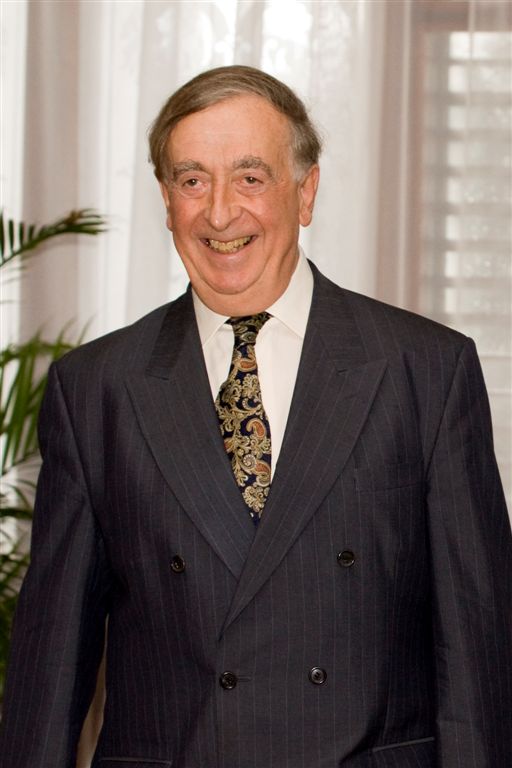
This is the opening statement given by Sir Anthony Colman QC at the first sitting of the Colman Commission on Friday 11th March 2011.
https://afraraymond.net/wp-content/uploads/2011/03/commission-of-enquiry-clico-sir-a-colman.pdf
 If you think this title is for the latest brand of household cleaner, you would be wrong. I drew that title from the famous statement by deceased US Supreme Court Justice Louis Brandeis, in reference to corruption and fraudulent dealings: ‘sunlight is said to be the best of disinfectants.‘
Of course, this is all about the impending Colman Commission of Enquiry into the failure of CL Financial and other companies (including CMMB) and the Hindu Credit Union.
We are attempting to understand our situation in this financial fiasco – how was the entire collapse caused? Who is responsible? What can we do to avoid a repetition?
Our House needs a serious cleaning and we need a new commitment to serious retrospection if we are to succeed in understanding this scandalous situation.
To set the stage, there are four principalities being represented in this Enquiry –
My first point about this Colman Commission is how welcome it is, as a tangible sign of a change in how our country is being run. No, I did not vote for either group in the last election, but it seems to me that neither of the last two regimes (Manning or Panday) would have initiated a public enquiry into this financial fiasco.
As much as I approve the decision to have this public enquiry, the purpose of this article is to warn against some of the forces now being assembled to erode the enquiry’s effectiveness. Even though, in this respect, political times have changed, we need to remain vigilant if the Colman Commission is to be effective.
To be sure, the four principalities I listed comprise very powerful players for whom this enquiry is a literal nightmare, since they will be obliged to explain some of their biggest decisions and actions, which they would never have had to explain to anyone outside of their own circle.
If the Enquiry takes place as intended, we are going to be afforded an unprecedented insight into the workings, dealings, arrangements and situations in our leadership class – all of it at a depth and range never before recorded. Matters that had been only the subject of picong, ole talk and so-called urban legends will all now become part of the official record. Yes, our Republic will be coming of age.
Our country is a Republic, which to me means that no class of citizen ought to enjoy rights which are superior. But there has been a pattern of behaviour in this fiasco which has been very disturbing because it violates those Republican expectations. Of course, I am referring to the fact that a three-tier system seems to have been in operation during the entire meltdown.
Maybe I am entirely wrong and there was complete surprise when the CL Financial group collapsed. But if that is the case, one is really contemplating a slack system of management systems and an entire swath of our ruling elite who are not ‘fit and proper’. The question of who knew what and when, will be a main point of dispute, because either way you slice it, the picture is unappealing.
You can be sure that the people in the top layer will do anything in their power to protect themselves from the stern scrutiny of those in the lowest group, not to mention the public, who are paying for all this.
I wrote a previous column in this series, entitled ‘Taking in front‘ and on this occasion, in light of what is at stake, I, too, am taking in front. Having suffered a defeat in that the Colman Commission has now been established, the members of the Code of Silence can be expected to try halting, delaying or just diluting the Commission.

We have already had former Hindu Credit Union (HCU) chief, Harry Harnarine, defeated in the High Court in an attempt to stop the Colman Commission. I was not surprised to read reports that Harnarine is planning to appeal that decision. We can expect other strong challenges as this historic process unfolds.
If the members of the Code of Silence are unable to derail the Commission itself, we should not be surprised if they try to cloak the proceedings in some kind of blanket to prevent too much information escaping.
Readers, please note that the process of asking the Court to prevent publication of a particular piece of evidence is a very swift one, with the ruling expected in the very same sitting. That is because if those proceedings are too drawn-out, it can be actually self-defeating, since the matter which they are seeking to have concealed can be published and discussed while a decision is awaited.
That is the reason we need to beat this drum now. We cannot wait for the filing of injunctions and then seek to publish. By then, it would be too late.
The new algebra is simple and inescapable –
Expenditure of Public Money – Transparency = CORRUPTION
Whatever the negatives of the American Imperium, there are still aspects of that society which are worthy of emulation. The example which comes to mind is the recently-published report of the Financial Crisis Inquiry Commission.
The preface of that Report contains an instructive paragraph, at page xii –
“…This report is not the sole repository of what the panel found. A website — www.fcic.gov — will host a wealth of information beyond what could be presented here. It will contain a stockpile of materials — including documents and emails, video of the Commission’s public hearings, testimony, and supporting research — that can be studied for years to come. Much of what is footnoted in this report can be found on the website. In addition, more materials that cannot be released yet for various reasons will eventually be made public through the National Archives and Records Administration…”
The US legislature is determined that the inner lessons and testimony on this important crisis are available to all interested parties for the years ahead. That represents a solid commitment to a learning society, which will at least attempt to draw lessons from the bitterest of experiences. In my opinion, that commitment is worthy of emulation.
Has our society reached the stage of maturation to commit to an entirely transparent process of retrospection? That is the question which will be tested in the weeks and months to follow.
The entire proceedings of the Colman Commission must be held in public. The proceedings must be on TV and available on the internet. The Colman Commission needs a strong internet presence, with its own website.
Sunlight Disinfectant cleans brighter, you see?
We are now entering a bizarre endgame in this rounds of musical chairs. The children’s game has returned for us adults, but with a vengeance.
As I wrote on 10th September in this space, the real question is ‘When exactly did the CL Financial group collapse?’.
To understand this huge matter we need to put things in the correct order –
What did they know and when did they know it?
There now appear to be at least four groups representing these investors –
Some of the positions being taken by the various groups are indicative of the degree of desperation of the parties, hence the title of this article. The general view emerging from these groups seems to be that the CL Financial group is basically healthy and profitable, so there should be no issue about returning their investment.
I do not know what those views are based on and it is impractical to continue basing our discussions on the series of rumours and draft reports and suchlike. We need good quality information to make a quality decision and that is not negotiable. We need to insist on that as a minimum.
After the first round of organizing and attorneys’ letters, followed by the Prime Minister’s important address on 1st October, we are now into what appears to be an even stranger place.
Two of the stranger proposals emerging from the CPG’s Port-of-Spain meeting on 24th October were –
It may all just be a series of negotiating positions, but it seems pretty clear that no one from these various investors’ groups intends to take a discount or ‘haircut’ on the monies owed to them. The unstated assumption is that if someone has to stand the bounce or take a haircut, that someone must be the taxpayer. That could never be the correct position. So, we need the facts.
The most startling development is the Central Bank’s full page adverts on Thursday 28th October, repudiating the claims that it had offered any guarantees in this situation. The reaction was immediate, with the CPPA publishing large adverts in opposition the next day and a new anti-bailout group emerging for the first time – at last! The CPG’s response was a nadir in their campaign, with the Trinidad Guardian reporting that – “…Permell went on to say that they do not care where the Central Bank gets the money from once they guarantee the policyholders’ contracts…” – I could scarcely believe what was on the page before me. Even the most militant Trade Unionists use more reasonable language.
Which brings us right to the meat of the matter, the order of things. What is the reason that the investors’ groups are now at the front of the line for assistance from this government? I could be wrong, but it is easy to get that impression when one hears of Cabinet discussing the matter twice in one week, certain groups giving threatening timetables and so on. I do not know if our Cabinet – PNM, UNC or PP – has ever given such a total priority to any matter in the past.
There are other claims on the limited monies available to the State. All of those claims existed before these investors groups. All.
Many people have poor water supply. Outstanding payments to contractors and suppliers are in excess of $7.0Bn, according to Central Bank estimates. Insufficient money for OPVs – the estimated cost of $3.0Bn is too much for the country to bear, so national security is falling behind. More guns and drugs entering our homeland. Public Servants claims are about $3Bn and that is also a strain on the Treasury. Not enough police cars. Sad situation in the public hospitals.
The CPG issued a 2 page advert in the Guardian on Thursday 4th November and it deserves careful reading. It was good to see their call for the publication of the correct financial information before making a decision. They set out their proposals for the relief of CPG members – those are the latter of the two above, with the added condition that they be given two seats on the boards of CL Financial and Clico.
The CPG claims that its proposals place no additional burden on the taxpayers, which is a good thing, if that is truly so. The CPG’s proposals are silent as to how the monies already spent are to be recovered.
The real test will be if the accounts and asset valuations reveal the group to be insolvent. Will the various investors’ groups accept that or are we in for a long, bitter fight?
The Attorney General recently announced that he had withdrawn Sir Gavin Lightman QC as the sole Commissioner, due to an apparent conflict of interest. Lightman had appeared for Clico in a 1991 court case and the PNM did well to have stopped this before it went too far.
Two important further points, though –
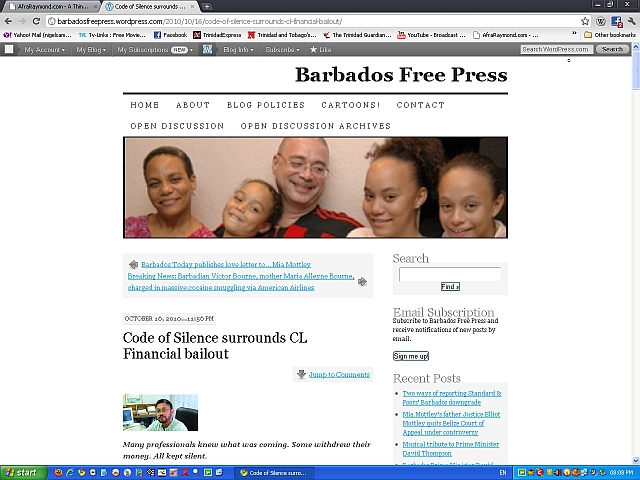
Code of Silence was an article in two parts – the first dealing with the agents and effects of that Code and the second dealing with the unfolding case of AIC.
As usual, I sent the article to my main blogging-collaborator Barbados Free Press (BFP)  who split it apart into those halves. Maybe they felt that the bond default by AIC Barbados in the second half deserved a separate focus for their readers – who knows?
So, BFP published Code of Silence surrounds CL Financial bailout on Saturday 16th and Michael Lee-Chin’s AIC Finance – Another CL Financial CLICO situation in progress? on Monday 18th.
Later that day, the AIC story was picked-up by Forbes.com and that story is here, Forbes picks up Barbados Free Press news feed!

We have all looked on in horror at the scenes of destruction and human suffering, experienced by our Caribbean neighbours in Haiti as a result of the strong earthquake on 12th January. Coming after the horror and attempts to assist, my mind shifted to the possibility of such a disaster in our country. That prompted me to attend the seminar organized by the Association of Professional Engineers of T&T (APETT) and the T&T Contractors’ Association (TTCA) at Crowne Plaza on Wednesday 3rd February. The seminar was excellent and such was the content that this week I am setting aside the other important matters with which I have been dealing.
The Structural situation
We heard several presentations from engineers and the President of the TTCA which set out the structural situation. Some of the main points emerging there were that we are at significant risk because –
These quotes were drawn from the Trinidad Express story on Friday 5th February – http://www.trinidadexpress.com/index.pl/article_news?id=161591595 .
The Seismic situation
The speaker on this aspect was Dr. Walter Salazar, Senior Research Fellow at the Seismic Research unit at UWI. The three main points from his presentation were firstly, that our country is indeed at similar risk as Haiti in terms of a strong earthquake. Secondly, the most likely areas for the strongest earthquakes are Tobago and the north-west peninsula of Trinidad, particularly Chaguaramus. Thirdly, we are now overdue for that strong earthquake.
The disaster-preparedness situation
The head of our Office of Disaster Preparedness and Management (ODPM), Col. George Robinson has confirmed, in light of natural public concerns, that our systems are in place to deal with such an earthquake. Knowing the individual, there is little doubt in my mind that the necessary diligence has been applied to developing solid systems.
What is the likely financial impact?
My concerns as to our level of earthquake-preparedness are rooted elsewhere and that is at the level of the ‘financial safety-net’ upon which we would rely in the event of such a disaster. Our low national savings rates have long been a concern of economists/financial experts. We do not save enough money, in the view of these experts, to propel our country’s journey to the next level of national development. My concern is the implied question of how we would cope with a destructive earthquake.
Add to that the fact that only a small fraction of our buildings are properly insured and a worrying element to the disaster-preparedness picture starts to emerge.
Aside from the structural concerns and seismic risks as outlined above, there is a question as to the nature and extent of our financial safety-net. Where will we find the money to rebuild? Our lending institutions need effective systems to ensure that the properties they hold as security are properly insured.
Such an earthquake would also damage our infrastructure – roads, water and electrical distribution systems, drains and so on.
As a consequence, even if your own property is undamaged or properly-insured, you could also suffer from the wider damage. If your entire neighbourhood is severely-damaged, apart from the issue of loss of life and physical injury, there would be a negative effect on the value of your property.
This issue affects everyone.
Some suggestions
I am suggesting that this is an issue which needs our urgent attention and that the private sector can take the lead. The Association of Trinidad & Tobago Insurance Companies (ATTIC) and the Bankers’ Association of Trinidad & Tobago (BATT) can take a leadership position here. One way forward could be for the insurance and banking sectors to agree, in their self-interest, a minimum code for design and construction with APETT and the TTCA. That would be one way to set a benchmark in terms of proper standards for all financed or insured construction going forward.
In terms of existing privately-owned building owners, the Central Bank should consider adding a component on the importance of proper insurance to their National Financial Literacy Programme.
The other urgent requirement is the retro-fitting of our major public buildings to meet the challenge of these overdue earthquakes.
Thank you to APETT and the TTCA for organising this important intervention.
 AfraRaymond.net