This – clfFoI-1 – is a copy of the letter sent today from my attorney to the Ministry of Finance, requesting that they provide –
‘The Duprey letter’ – The fateful 13th January 2009 CL Financial letter, signed by Lawrence Duprey, seeking urgent and massive financial assistance from the Central Bank.
CL Financial’s 2008 audited accounts – These should have been prepared by PriceWaterhouseCoopers, as at 31st December 2008 and of course those are of great interest, since the 2007 audited accounts (published on 18th November 2008) disclosed assets of $100.6Bn, while ‘the Duprey letter’ showed assets of $23.9Bn.
The letter invites the Ministry of Finance to send the documents in 10 days or we go to the High Court.
Given the current state of play at the Colman Commission, there are no prizes for guessing which of those is going to happen.
Afra Raymond’s submission seeking to be made a party to the Commission of Enquiry into the failure of
CL Financial Limited
Colonial Life Insurance Company (Trinidad) Limited
Clico Investment Bank Limited
Caribbean Money Market Brokers Limited and
The Hindu Credit Union Credit Union Co-operative Society Limited
My name is Afra Martin Raymond and I am a Chartered Surveyor, being a Fellow of the Royal Institution of Chartered Surveyors. I am Managing Director of Raymond & Pierre Limited – Chartered Valuation Surveyors, Real Estate Agents and Property Consultants. I am also the President of the Joint Consultative Council for the Construction Industry (JCC), an umbrella organisation which represents the interests of Engineers, Surveyors, Architects, Town Planners and Contractors in this Republic.
This submission is being made in my personal capacity and does not represent the position of either Raymond & Pierre Limited or the JCC.
My work on this vital issue has all been based on the public record and can be seen at www.afraraymond.com.
I am willing to give oral evidence before the Commission.
I have been conducting a campaign in the public interest on this important matter. My work is unfunded and I have no assistance. Indeed, I have no legal adviser at this Enquiry.
Having followed the issue so closely and attended the opening session on Friday 11th March, I am of the view that the parties thus far identified in this Enquiry are all seeking to advance their own interest.
I am here seeking to be made a party to this Enquiry, in seeking the interest of the silent majority, the taxpaying public, who have had to pay for this huge financial fiasco.
I am making this submission under rule 2. of the Commission’s Rules of Procedure, as a person whose “…participation in the Enquiry may be helpful to the Commission in fulfilling its mandate…”
I await your reply.
——————————-
Afra M. Raymond B.Sc. FRICS
Port-of-Spain
The new situation is charged with peril and one is reminded of Naipaul’s father, the intrepid journalist from A House for Mr. Biswas whose favourite tagline was “…amazing scenes were witnessed…”
Finance Minister, Winston Dookeran, addressed Parliament on the Finance Bill (No. 2) 2010 on Wednesday 24th November. It was a lengthy and detailed statement, which put things into a necessary perspective. For me, it was important that Dookeran gave priority to the claims of the contractors and of course, the last item being the claims being made by the various groups representing Clico policyholders.
The Finance Minister held his position as set out in the 2011 budget, which was no surprise when one considers his statement that the various submissions received from the policyholders’ groups did not withstand scrutiny. I only had two significant concerns in terms of outstanding items which require proper attention.
The first of those was the continuing failure to produce the audited accounts for the CL Financial group – by now the 2008 and 2009 accounts are long overdue. The absence of those important figures means that the many heated discussions taking place, in the media and privately, are all uninformed. The questions are simple – Are the 2008 and 2009 audits for the CL Financial group completed or not? Yes or no? If they are, when are they to be published? If not, what is the problem with completing these?After all, as I wrote about the 12th June 2009 CL Financial Shareholders’ Agreement in this space on 1st April 2010 –
…Clauses 2.3.3 and 2.3.4. of the SA, require the outgoing CL Financial chiefs to render all assistance to the incoming Board and Management in terms of all records and accounts etc. The question here is ‘Have the new Board and management been receiving the full assistance of the previous CLF chiefs?’ If not, what is being done about it?…
The second concern I had was with the special window being opened to assist the Credit Unions, some of whom had invested in excess of 10% of their funds in the EFPA, an annuity approved for individual investors. We need to know just which Credit Unions took those imprudent investment decisions. There is no way we can merely legislate or pay our way out of this crisis, the problem runs deeper, into fundamental matters such as the attitudes of the leadership group in the society. Some of those details might emerge during the upcoming Commission of Enquiry, but it would be to Dookeran’s credit if he released the names of those Credit Unions and the amounts to be refunded.
The immediate statements of the Clico Policyholders’ Group (CPG), which targeted Dookeran, are a perturbing sign. For whatever reason, the CPG is ignoring the settled principle of Cabinet’s collective responsibility. That stance seems to be detrimental to effective negotiation and I am beginning to wonder if some person or persons in the Cabinet is ‘giving them basket’.
The threatening statements from the CPG as to the damage their proposed lawsuit can do to our country’s economy are nothing less than scandalous. We are now witness to a grim game of brinksmanship.
We have all heard the arguments and rumours surrounding this bailout, so no point repeating those. It certainly seems that those are going to be ventilated in a high-profile series of lawsuits. I only hope that the hearings remain open and do not take place in a sealed Court. That is what happened in the very first lawsuit after the bailout, in which the Central Bank was attempting to get CL Financial to comply with the terms of the bailout. The stakes are too high now for any concept of privacy to prevail in this matter.
The Minister of Finance also announced that the conditions under which the financial relief would be offered were being considered and it is good to know that there is to be no unconditional relief at our collective expense.
My thoughts on that aspect are that the State must conduct itself in an exemplary fashion and not be placed at any further disadvantage, having already shouldered this enormous, exceptional payout.
There are now anti money-laundering (AML) laws which require depositors to make declarations as to the Source of Funds, all in an effort to prevent the proceeds of crime from entering the legitimate economy. In my view it is necessary for the government to be satisfied that the various sums being claimed by these policyholders were properly declared under the AML laws. We have had shocking reports about the elementary management controls which were either absent or awry in the CL Financial group, so it would not surprise me if their AML-compliance was lax. That needs to be thoroughly checked. It would not be acceptable for our taxpayers’ monies to be used to rinse ‘dirty money’.
Also, the claimants who owe on their taxes – VAT, PAYE, Corporation Tax, Income Tax and so on – should not be refunded. As Dookeran said in that address, if everyone paid the taxes due, our budget would not be in deficit. We cannot go deeper into deficit without these elementary precautions being taken.
Finally, there is the issue of the many borrowers from Clico, British-American, Clico Investment Bank (CIB). In the case of CIB alone, we are told that about $1.0Bn of those loans are ‘non-performing’ – which means that the borrowers are not repaying their loans. It would be perverse for some of those non-performing borrowers to receive refunds from the State. This is a live part of this situation, since in the case of CIB itself, the very Inspector of Financial Institutions swore in his affidavit filed in the winding-up action for that failed bank –
…With respect to the Creditors of the Petitioner, the Petitioner has met the statutory obligations for the Board of Inland Revenue (except for Corporation Tax Returns for 2007, 2008 and 2009 which are being prepared and remain outstanding)…
That is a glaring example of the kind of wanton wrongdoing at the heart of this mess. CIB fails to file its Corporation Tax returns for three years, yet keep their banking licence and arrange for the taxpayer to bail them out when it all goes sour.
Some claimants may try to invoke the ‘corporate veil’ to shield themselves from various breaches committed by their companies, but this is an exceptional situation in which the State is making an offer. In my view, the corporate veil ought properly to be ignored, so that the long-standing commercial principle of ‘set-off’ can be applied to the claimants.
The Colman Commission of Enquiry and its effects on the Code of Silence will be my next topic.
Winston Dookeran’s budget proposals to re-order the ongoing CL Financial bailout have sparked considerable controversy. Dookeran stated his first priority to be “…Stop the drift and indecision…” – ironically enough, it appears that the sentiments of the public are moving in another direction entirely. A new mood of protest and threats of impending lawsuits have emerged. This is a live example of the law of unintended consequences.
The budget’s revised proposals are –
Immediate stop on all interest payments;
$75,000 claims from depositors to be settled immediately;
Balances exceeding that threshold to be repaid over 20 years, with no interest payable. For an example, click here;
The group to be re-structured, with CLICO and British-American Insurance Company (BAICO) to be merged and prepared for divestment;
“…Those responsible for this crisis must be held accountable.…”
Clearly, Dookeran took the decision to review the MoU of 30th January and the Shareholders’ Agreement of 12th June 2009. He reduced the burden on the State by increasing the sacrifice of those who were anticipating the return of all their funds under the terms of the original agreements. The latter aspect is arousing serious protest, but there are other areas which also deserve attention.
The entire picture is very confused, which seems to be deliberate. There were two main types of investments made in this situation – firstly, the basic and traditional insurance products such as pensions; life, health and general insurance and secondly, the depositor who was seeking high returns. It is true that the pension products offered an optimistic 12% rate of return, but the short-term depositors were different.
Much of the current discussion and argument is actually about the repayment of the depositors, not the traditional insurance policyholders. The fate of the policyholders is often invoked by people who are actually arguing for the return of their own deposits and that is why the separation between the two, which Dookeran makes, is so important.
To quote – “…The number of traditional, long term policyholders affected by this crisis, covering pensions, life and health insurance, is around 225,000 persons and accounts for $6 billion in liabilities…” That is an average of $26,666 per policyholder.
Again – “…There are approximately 25,000 customers holding these short term contracts, and the liability to this group is in the region of $12 billion…” That is an average of $480,000 per depositor.
Ironically enough, the voice of the traditional policyholders, who outnumber the depositors nine-to-one, is virtually silent in all this. But then again, it is clear that by far the greater liability lies with the depositors and further, that they appear, on average at least, to be owed about 18 times more than the typical policyholder. Yes, I am aware that there are depositors who are also policyholders and so on.
For those of us who did not invest with CLICO, the mere idea of our taxpayers’ funds being used to rescue those who placed high-return deposits is deeply offensive. Both the CL Financial chiefs and the depositors who took the chance at investing at those incredible rates of return are being spared the consequences of their decisions by the bailout process. But those groups are being differently treated from each other and that is the point in this commentary.
On the principle, the absence of consequence is inimical to any development, personal or national.
When I consider the appeals from Credit Union and Trade Union leaders, as well as individual investors, it makes me wonder if there is a live concept of responsibility in this place. All those people withdrew money from the slow-but-steady accounts of the traditional banks and put it into the high-interest accounts at CL Financial and HCU were indulging in riskier choices. How can they be so bold-faced as to tax the rest of us for their adventure?
CLICO EFPA Policyholders group at press conference on Sept. 21
There are now two groups organized to lobby for the interest of the disappointed depositors – the ‘CLICO EFPA Policyholders’ and the ‘CLICO Depositors Interest Group.’ Some of the leading members are themselves leading CLICO sales agents, so the decline continues. They are asking for an urgent meeting with the Minister of Finance and litigation is threatened, so this will form part of this ongoing series.
‘Credit Unions fear collapse’ was the headline of a story in this newspaper on 17th September – at http://guardian.co.tt/news/general/2010/09/17/credit-unions-fear-collapse – reporting on the concerns of the Credit Union League (CUL), given the scale of their investments in the CL Financial group. Figures were presented for four large credit Unions and those have an average of less than 4% of their assets in CLICO. See the table here:
CREDIT UNIONS’ reported CLICO Holdings
Credit Union
CLICO Deposits
Total Assets
Proportion
Eastern CU
$17,000,000
$1,234,000,000
1.37%
Teachers’ CU
$24,000,000
$503,000,000
4.77%
Rhand CU
$28,100,000
$395,000,000
7.11%
Venture CU
$21,000,000
$333,000,000
6.29%
Summary
$90,100,000
$2,474,700,000
3.64%
Note – The data in this table is taken from the Guardian article cited, except for the Eastern Credit Union Asset Value which is from its 2009 Annual Report.
The CUL has not made any convincing case for a possible collapse and it seems reckless to even suggest further collapses on the basis of these figures.
But the confusion is continuing, with contradictory positions being taken on this issue. The idea that the Credit Union movement is under threat is a very serious one, which would be of great public concern, so we need to examine these statements carefully.
At page 10 of the Express of 22nd September ‘Credit Unions seek help from Rowley’ – see http://www.trinidadexpress.com/business/Credit_unions_seek_help_from_Rowley-103498744.html?corder=reverse – the Credit Union League met with the Opposition Leader, Dr. Keith Rowley. Once again, the idea that Credit Unions are in serious trouble was advanced – “…They said they would not be able to sustain daily operations. …” That is a very startling statement, this time given without any attempt to provide evidence.
To add to the confusion, the Guardian of that same day (22nd September) reported, at page 13 “CFF welcomes move to meet with CU on Clico” – see http://guardian.co.tt/news/general/2010/09/22/cff-welcomes-move-meet-cu-clico – on statements by Esme Raphael, President of the credit union’s Central Finance Facility (CFF) on this situation – “…Raphael said while the credit union movement was under no threat of collapse, the 20-year repayment plan would make it less competitive in delivering credit union services…”.
These contradictory messages will detract from the credibility of the Credit Union movement and must be clarified.
The idea that there is any such thing as a ‘guaranteed investment’ is preposterous. An absolute oxymoron is generating all this argument.
Yes, the last government made certain pledges and I have been critical of those, but here we are entering an even more turbid situation.
As outlined above, the PP government has decided to alter the terms of the existing bailout agreement as to refunds to depositors, so it is clear that it regards the terms of those agreements to be negotiable.
In my view, the most odious aspect of the entire bailout is that the wealthiest individual in the Caribbean was able to negotiate the largest-ever loan from our Treasury at zero interest on the basis of a letter. If the terms of the bailout agreement are negotiable, why are we not insisting on charging a proper rate of interest to compensate the State for these massive loans? Who is protecting our country’s wealth? In view of the fact that they are essentially unsecured loans, the only proper interest rate would be a punitive one.
There are live, cogent notions of financial equity and economic justice which are being abused in this entire scenario, but that is for a separate series.
The amounts involved are massive – “…The total funding provided as at May 2010 by the Government and the Central Bank, excluding indemnities and guarantees to First Citizens Bank amounted to approximately $7.3 billion…” Emphasis in the original. That equates to over $456M a month to rescue Mr. Duprey. I wonder how much is the total of the indemnities and guarantees?
The bailout terms were revised to reduce the amount of the State payout to the depositors, but no additional pressure is being put on the CL Financial group in terms of interest payments. It is resembling a comfortable arrangement for Duprey.
Another aspect of the budget which was difficult to follow was the shifting focus between CLICO and CL Financial.
We need a better quality of information to move ahead with this, so it was encouraging to hear Dookeran’s clear post-budget statement “…No more shall we have secret government,…” – see http://www.newsday.co.tt/news/0,127330.html.
Minister, these facts need to be made public if we are to eliminate secret government :
The original Duprey letter of 13th January 2009 – I have applied twice under the Freedom of Information Act for this and the second application has been in your Ministry since 28th June, unacknowledged.
The audited accounts of the CL Financial group for the year ending 31st December 2008 – Have PwC completed that? When are they to be published?
The Lindquist Report – Bob Lindquist was reportedly appointed to examine CLICO. Has he submitted a report? Are we to be told of any of his findings?
The Mottley Report – There was a team of three advisers – Wendell Mottley, Colin Soo Ping Chow and Steve Bideshi – appointed to examine the CL Financial group and we need to know what were the findings of this group.
Given that we are being asked to bailout and clean-up Mr. Duprey’s crisis, I feel we need to be told who are the borrowers of the $1.0Bn of ‘non-performing loans’ in CIB’s portfolio. The fact is that these are some of the delinquents we are being asked to bailout and the names would surprise the public. Local banks customarily publish the names etc of people who have non-performing loans, so why can you not do the same thing in this case?
To quote the budget statement – “…This crisis was caused by…wrong financial reporting…” False Accounting is a criminal offence under our laws – When are criminal charges to be laid? Those people – the accountants who were accused of that grave offence – belong to professional bodies, both here and overseas. Is there any intention to make formal reports to these professional bodies?
Quoting again – “…This fiasco was caused by reckless corporate governance and the glaring failure of our financial regulatory institutions…” What action is to be taken against these slack regulators?
Is there any intention to invoke the ‘Fit and Proper’ provisions against any of the CL Financial Directors or Officers?
Finally, do you intend to insert an interest clause into the ‘sweetheart bailout agreement’?
Mr. Dookeran, you have the opportunity to inject notions of solid responsibility and proper conduct into this sorry situation.
Next, I am going to delve into the promise to ensure accountability of the responsible persons.
SIDEBAR: The Hindu Credit Union peril
Amidst all this and completely to be expected, the PP government is bailing-out HCU depositors on identical terms to those now being offered to CL Financial depositors. For the record, the Finance Minister’s statement was as plain as it was unsettling –
“…Although the failure of HCU did not carry a systemic risk to the financial system since it represents less than one percent of the total assets of the financial sector, this Government is of the view that these funds of these small investors must be protected…”
We were told directly that this HCU collapse is not a risk at all to the system, but these disappointed savers are still to be rescued by the Treasury.
This is a poor precedent, since when the next Financial Institution collapses, the then Minister of Finance would have to deal with those unrealistic expectations.
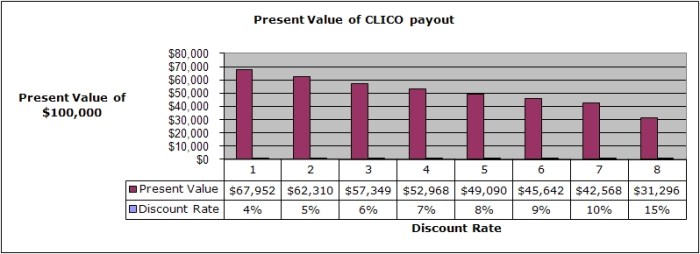
The new proposals for refunds of amounts over $75,000 are that those will be repaid in equal annual payments over a 20-year period, via zero-interest bonds.
Claimants can either wait 20 years or, if they need money right now, sell their right to receive these future sums of money at a discount. The future value of money is lower than its present value a long-time truth made powerful by the force of inflation and the threat of devaluation – the effect being that this lower value of future sums of money is shown in the discount rate applied to the right to receive these sums.
There is no way to know for sure exactly what/how the various negotiations will play out between the claimants and the people they are seeking to sell their bonds to. There is a widespread belief that the discount rates will match the rates at which bonds are floated and that view has merit.
These are some specimen calculations for the benefit of our readers:
Notional Sum is $100,000 payable over 20 years at zero interest
This was the inaugural budget for both the newly-elected People’s Partnership and its Finance Minister, Winston Dookeran.
The burning question for me in preparing these comments was the big one – “Is the Honeymoon over?”
In my view, the honeymoon for this new government will last about 6 months, given the sheer scale of the mess they have inherited.
There were real expectations aroused in the recent election campaign and the reduced revenues available to the State would have made the budget into a balancing-act, particularly when one considers the repeated promises of ‘No New Taxes’.
The main items on the property and construction aspects were –
PROPERTY TAX
The Property Tax was ‘Axed’ as promised – “…The Property Tax will be replaced by the old Lands and Building Taxes regime at the old rates and old values. There will be a waiver of lands and buildings tax for the year 2010…”There has been a misleading rebuttal on this from the Opposition Leader, Dr. Keith Rowley, in that the 2011 Estimates of Revenue tell us that the Land & Building Taxes are expected to increase from $71.4M to $173.8M. Rowley’s statement would lead one to think that the property tax take would be of the order of $300M, due to the omission of the municipalities. In fact, that is not the case, since the revenue of the five municipalities (POS, San Fernando, Arima, Chaguanas and Point Fortin) are found in the Estimates of Revenue for Statutory Boards and Similar Bodies etc. Due to the fact that one of the effects of the controversial property tax was to relieve these municipalities of their powers to tax property, the 2011 estimates of revenue need to be properly interpreted. The municipalities are estimated to raise revenue of nil in 2011, since all their revenue – as well as that of the regional corporations – is collected by the Counties and transmitted to the Central Government.The true picture is that $142.52M was the estimate of revenue from property taxes in 2009 – that is the combined figure for House Rates, paid in municipalities, and Land & Building taxes paid elsewhere. We are therefore anticipating an increase in revenue from this source of the order of 18%.
No rationale was given for the waiver of property taxes for 2010, which was an astonishing decision, given the background against which the budget was drawn up.
Before I leave the property tax topic, it is interesting to consider that rental income is also subject to income tax. Not many people who own rental property actually pay income tax on that rental income – if you don’t believe me, just ask a few friends or relatives who own rental property. This seems to me to be an area in which the Finance Minister can easily collect the data and increase the State’s revenue by staying within the ‘No New Taxes’ promise and implementing the laws which are already on the books. But more on that in a later article.
HOUSING
The Minister of Finance made strong statements in support of home ownership, he also outlined what appears to be a merger between several State-controlled mortgage companies. No target numbers of new homes to be built were given. The Housing and Environment Minister, Dr. Roodal Moonilal, recently announced that the Housing Development Corporation’s (HDC) new output target is 6,000 new homes in 2011. The Housing and Environment Ministry have zero allocation of capital funding according to the 2011 Estimates of Expenditure. There is an allocation of $845M to the Hosuing and Settlements programme shown in the Public Sector Investment Program (PSIP). Those estimates should cross-reference with each other and the fact that they do not is cause for concern, to say the least. This is the pattern of State spending on new homes, derived from the capital allocations only –
Year
Housing Ministry Capital Allocation ($M)
2008
$718.70
2009
$1,342.40
2010
$860.40
2011
$845.00
There was also the revival of an annual tax credit of $18,000 per household for first-time owners for the first five years. That measure is expected to cost $20M, which implies that just over 1,100 households will benefit from this provision. To quote – “…This measure will generate significant investment in the private sector housing industry….” Given the quantity of unsold, privately-built homes and the volume of HDC units soon to be released onto the market, it seems quite unrealistic to expect that this measure could yield ‘significant investment‘.
What is of greater concern to me is the question of whether we are at the limits of possibility as to home-ownership levels. 76% of our households now own their homes, the comparative figure for the USA is 69% and for the UK it is 68%. How realisitic is it to keep pushing for increasing home-ownership?
The HDC’s low-cost ‘Accelerated Housing Program’ stalled, with over 10,000 empty homes as proof, due to a shortage of applicants who could qualify for a mortgage.
The Minister of Finance spoke of the neglect with which our organisational and institutional infrastructure had been treated and I could not agree more. On this count, there needs to be proper consideration given to the resucitation of the Rent Control Boards. Also, the HDC needs to start giving some of those empty homes to people who just want to rent.
Special Purpose Entities (SPEs) – What is their future in this new dispensation
Mr. Speaker, no coherent, co-ordinated planning or strategy for state enterprises exists. As a result we have begun to rationalize the state enterprises, including the special purpose companies, which will incorporate a new accountability system that goes beyond the presently operating company ordinances. It is these loopholes in public accountability that resulted in the UDeCOTT scandal. This must never again happen in Trinidad and Tobago.
This issue, as always in our country, is one of implementation. The provisions of that guide are not being followed and the wrongdoers are not being called to order.
The issue for us is to prevent the recurrence of that pattern of mismanagement and disorder in public affairs. That can only happen if we enforce the present guidelines and systems.
In the next column, I will discuss the attempt to map out a new philosophy in this budget and the CL Financial/HCU bailout.

 The new situation is charged with peril and one is reminded of Naipaul’s father, the intrepid journalist from A House for Mr. Biswas whose favourite tagline was “…amazing scenes were witnessed…”
 Winston Dookeran’s budget proposals to re-order the ongoing CL Financial bailout have sparked considerable controversy. Dookeran stated his first priority to be “…Stop the drift and indecision…” – ironically enough, it appears that the sentiments of the public are moving in another direction entirely. A new mood of protest and threats of impending lawsuits have emerged. This is a live example of the law of unintended consequences.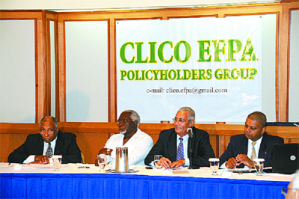
 This was the inaugural budget for both the newly-elected People’s Partnership and its Finance Minister, Winston Dookeran.
 AfraRaymond.net