VIDEO: First Up Simulcast Interview – 21 January 2010

VIDEO: First Up Simulcast Interview – 21 January 2010

Fazeer Mohammed and Jessie May Ventour interview Afra Raymond on the simulcast of First Up on Talk City 91.9 FM radio and C Television on the topic, “What’s the Deal with CL Financial” touching on the continued silence of the professional class, politicians and labour unions on the ongoing debacle of the CL Financial bailout. Video courtesy Caribbean New Media Group Limited.

  • Programme Date: Thursday, 21 January 2010
  • Programme Length: 0:37:53

CL Financial bailout – The Governor speaks

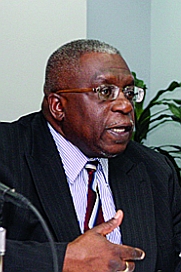
Ewart Williams, Governor of the Central Bank TT. Photo courtesy Trinidad Guardian.
Ewart Williams, Governor of the Central Bank TT

My last column on this important matter was published on 31st December, almost a month ago, with several major developments since then.  The main development in my view is that we had some truly remarkable statements from the Governor of the Central Bank.

The messages on the CL Financial group are now so confused that the most charitable phrase possible, is that the public is getting ‘mixed messages’.

  • The Top-level resignations – The group CEO, Steve Bideshi – a former senior manager at Citigroup – was reported on 12th January to have tendered his resignation, effective 31st January.  See – http://guardian.co.tt/news/general/2010/01/13/bideshi-quits-cl-after-6-months or http://www.trinidadexpress.com/index.pl/article?id=161581443.  We are told that his reason for resigning is the breakdown of negotiations for his compensation package.  Our governments have a serious track-record of agreeing and then secreting the terms of compensation for its high-fliers. Just think of Caribbean Airlines, PetroTrin and UdeCOTT. It is unbelievable that government was unable to agree terms with this one CEO. Arguably, Mr. Bideshi was heading the largest and most complex group within the State’s control.

    On 19th January, we were told that Michael Carballo, the group Finance Director, was resigning, also effective 31st January.  See – http://guardian.co.tt/business/business/2010/01/20/another-exec-leaves-cl-financial or http://www.trinidadexpress.com/index.pl/article?id=161584620. Carballo had the unique position of being the only senior executive to survive the crisis at the group and keep his position.  We were not given any reason for his departure, but we were told that Carballo is to continue acting as a Director on CL Financial’s Board.

    Bideshi and Carballo were the two top executives at CL Financial.  What is going on?

    To date there has been no proper explanation as to the causes of these major resignations or clear statement on the way forward. To have both the group CEO and Finance Director resign within a week of each other, effective within less than a month, speaks of turmoil and jostling. That kind of thing would not happen if the situation was stable. The purpose of this bailout was said to be the avoidance of systemic risk and the maintenance of confidence in our financial system. The official silence on this startling development only adds to the impression of ‘more in the mortar than just the pestle’.

    An absolutely fundamental clash of ideas seems to be emerging, but that is beyond the scope of this week’s column.  One week ago, I appeared for the first time on the electronic media (CNMG/91.1FM) to discuss these issues.  It seems that there is a ‘Code of Silence’ on this issue with the political parties all having agreed to not discuss it in any sustained or meaningful way.  Our civic bodies are little better, with a remarkable silence from our professional bodies (most notably, the Institute of Chartered Accountants of T&T), trade unions and institutes of higher learning.

    Early on in the bailout process, on 13th February 2009, the Governor of the Central Bank had promised regular updates to the media – see http://www.central-bank.org.tt/news/speeches/2009/sp090213.pdf.  For whatever reason, those have not been as regular as hoped for or as informative as the first.  Given that various teams of accountants have been working on the group’s books since the first MoU was signed, that is disappointing in terms of quality and quantity of information.  I was therefore very pleased to note that the Governor made certain statements on CL Financial later that same morning, Thursday 21st January.  See http://guardian.co.tt/business/business/2010/01/22/governor-promises-action-cl-financial-audit or http://www.trinidadexpress.com/index.pl/article?id=161585448.

  • The question of wrong-doing – The Governor is reported to have expressed his frustration at the slow pace of the ongoing forensic audits into the group’s financial affairs.  He went so far as to promise to act if wrongdoing is revealed.  The first point to be made is that we need the audited accounts as at 31st December 2008 and that will light up many of the darker areas of this series of issues.  The second point is that wrong-doing has already been exposed in two substantive respects –
    1. CL Financial dividends – The group paid dividends to its shareholders three days after writing the same Governor for urgent financial assistance.  Is it the Governor’s view that it was legal and prudent to pay dividends in that situation of virtual insolvency?
    2. Directors’ legal responsibility – Under the Companies Act, Directors can be held liable for mismanagement.  They have a legal liability to properly manage the affairs of the companies under their direction.  Speaking on 10th November 2009 at a conference on “The Global Financial Crisis: Institutional Management and Regional Opportunities” – see http://www.central-bank.org.tt/news/speeches/2009/sp091110.pdf – the Governor, in his closing remarks, said –

      “I prefer, however, to focus on the governance issues because, without doubt, the failure of Clico was a failure of Governance … it was absence of controls from the Board of Directors.  Clico shows what damage could occur when prudence is clouded by unbridled ambition.   Clico shows what can happen in the virtual absence of a risk management framework and the absence of internal controls.  Clico shows that we need to rethink corporate governance … not only in Trinidad and Tobago but in the region as a whole.”  (Please note that the emphasis is the Governor’s.)

      If one is unable or unwilling to pick the ‘low-hanging fruit‘, which are well within grasp, why should we believe you will take action in more complicated and contested cases?

  • The financing mechanism…Are assets being sold, or not? – The other aspect the Governor spoke on was the difficulty in getting payouts for a significant number of depositors and policyholders.  That has been widely reported in the press according to this newspaper’s reports on the Governor’s statement – “He said some of the payouts to CL Financial stakeholders were taking longer than the authorities had anticipated because the company was facing a liquidity problem and the pace of disposing of the assets to cover the payouts was going very slowly.”Up until now, I had assumed that the payouts were being funded by the Treasury via the Central Bank and that those monies would be recovered by sale of CL Financial assets – all in accordance with the MoU.  We are now getting a top-level statement that if assets are not sold, the payouts cannot proceed.  Is this another way of saying that the Treasury support has reached its limits or is it a sign of deeper conflict?

    On Thursday 15th October 2009, Mariano Browne, Minister in the Ministry of Finance, spoke at the post-Cabinet press briefing – see http://guardian.co.tt/business/business/2009/10/16/browne-no-plans-govt-increase-shares-rbl – and his reported statement was very clear – ‘Browne also said government had no intention of selling any of the assets of Clico, one of the three CL Financial-owned companies that was being bailed out. “One needs to be judicious in terms of the managing of the assets at CL Financial Group, given the depressed state of the market both here and internationally. There is certainly no intentions (sic) of selling the assets. The position is to manage them and manage them well,” he said.

    It is either that there has been an unannounced, significant shift in policy on this important matter or there really is a scene with ‘turmoil and jostling’.  Both statements cannot be true.

    We were told in the 2010 Budget that the monies allocated to the CL Financial bailout were some $5.1Bn, which is a huge amount of money.  I am beginning to wonder what is the total amount of money really allocated to this bailout and if we are ever going to recover it.  Just to make 2 examples, we have had the British-American Insurance Company’s insolvency, announced in November 2009, and the government’s subsequent commitment to put $50M USD towards that regional effort to construct a new company.  Also, on Christmas Eve we heard of the $400M commitment to pay CLICO pensions due to ex-Caroni workers.  What are the real totals?

End-notes on the Uff Commission

The Uff Commission ended its hearings last week, amidst even more ‘amazing scenes’.

There are so many examples to draw on, but here are a few choices –

  • Dr. Keith Rowley, MP. Photo courtesy the Trinidad Guardian
    Dr. Keith Rowley, MP

    Cleaver Heights missing money – The entire reason this HDC project was included on the Uff Commission’s agenda is PM Manning’s $10M question to his former Housing Minister, Dr. Keith Rowley ‘Where the money gone?’ After months of evasion, the purging of an HDC Board, the resignation of the HDC’s CEO and the rustication of the UK-based expert, Gerry McCaffrey, the truth is out.  No money missing. Simple so. Given the denials by Noel Garcia, the then-CEO of the HDC, and his principal assistants, the question remains who informed the PM of that missing money. I do not expect our PM to either apologise to or re-appoint Dr. Rowley.

  • Cleaver Heights contract type – Another point which emerged recently is that Cleaver Heights started off as a Design, Finance and Construct and became a modified Design/Build contract without a financing component, seemingly without a corresponding adjustment in the contract sum.  If that is the case, it would be grounds for serious concern.
  • Carl Khan – The ‘surprise witness’, Carl Khan was unchallenged by either Calder Hart’s or UDeCOTT’s attorneys.  They adopted the ambiguous course of trying to cast doubt on that testimony, but yet declining to cross-examine Mr. Khan.  It seems that these attorneys are so ‘bright’, they want to have their dinner ‘both boiled and fried’.  We not so easy to destabilise.  We too have eyes.
  • The new creature – Lastly, it is interesting to consider the new creature all of this has laid bare.  There is now a species of Super State Enterprise, who seem to enjoy an exemption from the rules, norms and guidelines which would apply.  A State Enterprise which can mount a legal challenge to a Cabinet decision and the President of the Republic.  Imagine that.

More questions than answers – The open process adopted by this Enquiry was refreshing, so much so that it has yielded a real ‘windfall’ in terms of public awareness.  Even the least-interested or most-loyal citizens are now aware that something huge is wrong here.  We now see that our PM dismissed a Cabinet Minister on grounds which have all proven baseless, yet continues to publicly defend one of his key lieutenants, whose behaviour is now revealed to be questionable.  That outcome would have been entirely unthinkable to the government at the outset of this bizarre year.  It is a prime example of the Law of Unintended Consequences.

‘Who is Calder Hart?’

Calder Hart. Photo courtesy Trinidad Guardian
Calder Hart

Calder Hart is Executive Chairman of UDeCOTT, Chairman of the Home Mortgage Bank, Trinidad & Tobago Mortgage Finance, the National Insurance Board (NIB) and the National Insurance Property Development Company (NIPDEC).  He obviously enjoys the highest level of trust from the government.  So consider this extract from Calder Hart’s cross-examination, under oath, at the Enquiry on Wednesday 28th January 2009.  Hart is being questioned by Gilbert Peterson SC, attorney for Dr. Keith Rowley –

Continued Cross-Examination By Mr. Peterson:
Q.      Mr. Hart, I am examining your CV.  I see that you attended St. Francis Xavier University.  What degree did you obtain from that University?
A.       Bachelor of Arts in Economics.
Q.      Bachelor of Arts in Economics.  And I also see that you attended a course at MIT?
A.       That’s correct.
Q.      What was the scope of that course?
A.       Well, I think it’s down there as Urban Economics and Public Policy.
Q.      What was the duration of that course?
A.       I think it was either two or three weeks.
Q.      And the one at Alberta?
A.       The University of Alberta I gained managing human resources; the same amount of time, two or three weeks.
Q.      You would not describe yourself as a financial expert, would you?
A.       No, I would not describe myself as a financial expert.  But I would describe myself as a person with a body of experience.
Q.      Yes.  But your lawyers misdescribed you in these proceedings as a financial expert.  You would not agree with that description?
A.       I would not describe myself as an expert of anything.

That cross-examination can be found at page 53 of that day’s transcript – http://www.constructionenquiry.gov.tt/getattachment/6f957486-f0f4-4aad-b585-d644f3212806/COE-Construction-Industry-20090128-Merged-doc.aspx.

‘UDeCOTT’s accounts’

We have repeatedly been told that UDeCOTT is an exemplary and highly-efficient State Enterprise.  In light of those assertions, coming from the PM and his colleagues, we are entitled to be concerned as to their lack of financial transparency.  On 28th January 2009, Calder Hart was cross-examined, also under oath, by Alvin Fitzpatrick SC, attorney for the JCC.  Consider his testimony on the specific issue of UDeCOTT’s audited accounts –

Continued Cross-Examination By Mr. Fitzpatrick

Q.      Now, rather than go through all of them, would you accept that in respect of the audited accounts for the periods which are due at 31st December of each year and the all the accounts from 2003 to 2006 were signed off by your external auditors prior to the end of March of the following year?
A.       That’s correct.
Q.      That’s correct.  And your external auditors are Price Waterhouse?
A.       Yes.
Q.      Now, I notice that there are no audited accounts for the period ending December 2007?
A.       That’s correct.
Q.      Now, that is close to two years ago they are overdue.  Is that so?
A.       Just one year.
Q.      Just one year.
A.       Not quite a year.  Normally they would have been due in March.
Q.      They would have been due in March and they are now overdue?
A.       Yes.
Q.      Now, the period 2007 would have included a number of costs related to the Brian Lara Cricket Academy?
A.       Yes.
Q.      Would you agree that external auditors will not sign off on statements where they are not satisfied with the records or they have some concerns about the records?
A.       No, that’s not my understanding at all.  My understanding is that there were issues surrounding the notes to the accounts in terms of some of the areas where they wanted to change some of the interpretation of what we had been doing.  So there was a long discussion.  I think some of the problems had to do with getting all of the information reconfigured.  So my understanding is that probably before the end of next week we shall have our 2007 accounts.
Q.      I will be very glad to hear that.  So what you are saying is that the accounts have not been signed off by your external auditors, because they did not agree with the existing configuration of some of the figures?
A        Well no, I mean, you have to understand that PWC have been doing our accounts from day one.  But I think that what they wanted to do was to deal with some of the notes as well as the manner in which the structure of our operations—I think what has happened is that as we have moved to expand our financing in the international markets.  My understanding is that they are obviously ensuring that international standards are followed and in looking at them they want to restate some of the elements in it.
And my understanding is that has all been agreed between the accountants.  There were some issues surrounding some of the information and that sort of thing which they have now been satisfied with.  And we are expecting it obviously within the next couple weeks.
Q.      Let me see if I can summarize that.  It was quite a mouthful.  PWC have not signed off because there were some unresolved issues which have now been resolved?
A.       As I understand it, yes.
Q.      And, of course, PWC will not sign off on any financial statements unless they are satisfied that all the issues remain unresolved (sic)?
A.       Mr. Fitzpatrick, let me assure you, there is no flight of fantasy eh.
Q.      Thank you.  Well, I assume before we resume on the next occasion we will have those audited accounts?
A.       Yes.

This part can be found at pages 37 to 39 of the same day’s transcript.

No accounts yet for 2007, none for 2008 and we are near to the end of 2009.  If this is exemplary performance, what next?

Afra Raymond is Managing Director of Raymond & Pierre Limited and President of the Institute of Surveyors of Trinidad & Tobago.  Comments can be sent to afra@raymondandpierre.com.

Freedom of Information request for MOU between CLF and the State

FOI ApplicationThis is my application, under the provisions of the Freedom of Information Act, for publication of the second MoU between CL Financial and the State.  At CMMB’s Budget Breakfast on 10th September, I asked the Minister of Finance when this would be published and she replied that there was no intention to publish it.  I followed up with an email to her on 19th September.  That email was the subject of a telephone call from one of the Minister’s staff to advise that a written reply was being finalised for me in the next few days.  Having had no reply, or any explanation of the delay, I published the Open letter to the Minister of Finance on 5th October in the Trinidad & Tobago Review.  This application is made in the belief that the public deserve to know the details of this arrangement.  The bailout is supposedly being conducted for our benefit and indisputably at our expense, yet there is now an open position that its details are to deemed ‘confidential’.  We, the taxpaying public, need to know who exactly are the beneficiaries of the bailout and what are the terms on which those benefits are being obtained.  Anything less than full and immediate publication is a recipe for utter confusion and corruption.

Open letter to the Institute of Chartered Accountants of Trinidad & Tobago

Anthony Pierre
Anthony Pierre, president of ICATT

From: Afra Raymond <afra@tstt.net.tt>
Date: Sun, Oct 18, 2009 at 4:19 PM
Subject: ICATT and the CL Financial bailout
To:  Anthony Pierre, President

Dear Mr. President,

I am writing to you, as President of the Institute of Chartered Accountants of Trinidad & Tobago, to urge your involvement in the calls for greater transparency and accountability in the bailout process involving the CL Financial group.

Anthony, on the many occasions on which we have interfaced, I developed considerable respect for your integrity and sense of purpose.  Most recently, I took note of your critical intervention on the proposed new regulatory regime for the credit union movement.

I am of the view that we citizens and civil society organisations, such as ICATT, need to be active in promoting higher standards of professional and public conduct.  I know that those are values within which we can find common ground, because in so many respects we can do better.  Yes, we can.

As you know, I have been publishing a critical review of the CL Financial bailout in the pages of the Business Guardian and that now forms the core of my blog at www.afraraymond.com.  The collapse of the CL Financial group is certainly the largest financial crisis to beset our nation and the first MoU of 30th January 2009 was widely welcomed as offering relief to depositors and policyholders.  I expressed doubts on the grounds that we seemed to be ignoring moral hazard.

The second MoU, signed on 12th June 2009, has now apparently been deemed ‘confidential’.  That designation is inimical to vital concepts such as transparency and good governance, both of which form important themes of ICATT’s work generally and in this Accountants’ Week in particular.

I appreciate that your time is very limited, so there are only two articles to which I would invite your attention, both available on my website – ‘Finding the Assets‘ (published on 23rd August) and ‘Open letter to the Minister of Finance‘ (published on 5th October and also in that issue of the Trinidad & Tobago Review).  For ease of reference, I have attached copies of these articles.

My specific questions to the Minister of Finance, on which I am here lobbying for ICATT’s support and involvement are:

  1. CL Financial 2008 Audited Accounts – When are these to be published? What is the reason for the delay in doing so?
  2. The second MoU with CL Financial – The first MoU was published on the Ministry of Finance website on 9th April, 9 weeks after it was signed.  Using even that slow timetable, the new MoU is overdue for publication.  Some 18 weeks have now elapsed.  What is the reason for its omission from the Ministry’s website?  The second MoU creates new and onerous commitments for the country and its publication must no longer be delayed.  I emailed the Minister of Finance on 19th September to request clarification on this, but there has been no reply.
  3. Forensic Audits – We have seen various official reports of forensic audits being carried out at CL Financial and some of its subsidiaries.  Have these been completed?
  4. The interest rate – What is the interest rate being charged to CL Financial for this open-ended financial assistance?
  5. Status Reports – We have had no interim reports as to the disbursement of State funds or the disposal of CL Financial Assets.  When does the Ministry of Finance intend to start providing regular reports on the progress of the bailout to the public?
  6. The equity position – How is the equity position of the shareholders being adjusted in this deal?  Has their shareholding been diluted to reflect the position?  Has the State now taken an equity position in the group?  If not, what is the upside for the State in all this?

For the avoidance of doubt, given the recent confusion amongst our learned friends, please note that this is being published to my website.

Afra Raymond

Figuring it out

“We are not serious,

Very few conscious,

So I cannot agree wid mih own chorus!”

from ‘Trinidad is Nice, Trinidad is a Paradise’ by Brother Valentino (Emerol Philips)

The 12th June agreement is to be voted on by CL Financial’s shareholders on Wednesday 15th July.  By the time this is published, there ought to have been a decisive vote on the matter.

I maintain my position that the 12th June agreement is taking us in a completely different direction to that outlined in the original MoU of 30th January.  I am also saying that the new direction is a detrimental one for this country with not even an attempt being made to explain the underlying rationale.

The flagship of the CL Financial group was CLICO, according to the Central Bank Governor, on 13th February – “In the CL Financial business model, Clico was a major source of cash much of which was used to finance investments held in the name of other entities in the Group.  In this model, Clico has ended up as guarantor for many of the Group’s assets most of which are heavily pledged.”  CLICO’s most successful product in this model was a high-interest one which promised more than any other investment available in the market.  Even at those high rates of interest promised to their investors, it was cheaper for CL Financial to raise funds in this way than to borrow.

CL Financial is no longer able to rely on CLICO for a source of cheap funds, so we are all thrust into a new, perilous position.

CLICO is now unable to offer the highest rates of return which once distinguished its products and is suffering an unwelcome migration of its better sales agents.  What future for CLICO?

We were often regaled with stories of Lawrence Duprey’s prowess, as a commercial negotiator, in securing the best terms.  It seems to me that CL Financial has arranged a new line of finance from the Treasury to go forward.  We are not told what, if any, interest rate is being charged by our Treasury for this massive line of unsecured borrowing.  Overdue Tax payable to the BIR attracts a punitive interest rate of 20% per annum, being rightly regarded as the taxpayers’ unsecured borrowings from the Treasury.  Are we seeing a plain case of double-standards?

As part of the new agreement, Lawrence Duprey has resigned from his Directorships of the companies in the CL Financial group.  He has retained his significant shareholding and it is clear that Michael Carballo, the group’s finance director, continues as his representative.

Some of you may think this is all OK, since the public funds being advanced to clean up this fiasco are ultimately protected by CL Financial’s agreement to sell assets so as repay.  Time to think again.  The assets which were pledged in the original MoU, were already pledged elsewhere.

Yes, the CL Financial chiefs tried to sell the same thing twice.

But what about the assets which were not pledged?  Oh, those were treated differently.  For example, CL Financial agreed to sell its majority shareholding in CLICO Energy Company less than a week after agreeing to seek the State’s prior written approval to any asset sales.  That action triggered the Central Bank’s legal action to both halt all further assets sales and demand a declaration of all assets.

Yes, CL Financial chiefs tried to sell off one of the remaining assets, contrary to the terms of the MoU.

So we have Republic Bank and Methanol Holdings shares being effectively unsaleable, since they are reliably reported as having been fully pledged before the original MoU.  Next we have the aborted attempt to sell other assets, not yet pledged.

So what is left?  Wait, what about the Liquor and spirits brands, the Angostura and Jamaican rum companies and such?  Well, according to its most recent Notice to Shareholders, Angostura is itself owed some $633M by CL Financial.  Given that its 2007 accounts disclose sales of $818M, that is a colossal amount of money for Angostura to be owed.  So much for that.

As for those Jamaican Rum assets, Lascelles de Mercado is Jamaica’s leading spirits company, controlling the top rum brands of Wray & Nephew and Appleton.  CL Financial owns about 87% of Lascelles de Mercado, which still has some 1,500 minority shareholders.  The Jamaica Gleaner of 17th June (at http://www.jamaica-gleaner.com/gleaner/20090617/business/business1.html and http://www.jamaica-gleaner.com/gleaner/20090617/business/business4.html) contained two instructive reports on that CL Financial subsidiary.  The first one highlights the payment of dividends to holders of ordinary shares for the first time in 2 years – Lascelles de Mercado said Monday it would pay dividend amounting to $14 per share, ending a drought for ordinary shareholders who have received no returns for at least two years. That subsidiary appears to be doing well.  The second report tells us  –

  • Duprey…has bowed out as chairman of CLF, but remains chairman of Lascelles.
  • Referring to the 12th June agreement – “Carballo said the government was in control of the management and running of the Caribbean conglomerate, but what has not changed is the ownership.

“The shareholding hasn’t changed. There is no intention to change the shareholding. It’s an agreement for about three years whereby the assets are managed and restructured and then the company will be returned to the shareholders,” he said.

  • There is more – “”So the question of selling does not arise,” he (Carballo) added, referring in this instance to Lascelles.”

So there you have it.  If we are to believe Michael Carballo – and I see no reason to doubt him – the good assets which are not pledged are to be retained by CL Financial.

Having lost grip of CLICO and its positive cash-flows, the CL Financial chiefs have now negotiated a new survival strategy.  On the other hand, we have now agreed to finance the recovery of the CL Financial group on terms which are unknown, to restore the value of its assets and return it to its shareholders.

The rueful regulator

The Governor’s statements on 13th February are really perturbing. On 13th February, at his first (and only) CL Financial briefing, the Governor of the Central Bank said – “Meanwhile, with the assistance of the Manager appointed to Clico by the Central Bank, we have made much progress in clarifying the present financial position of CLICO, which unfortunately, appears to be much worse than we had envisaged.”  How could it be much worse?  Are we being told, in not so many words, that CLICO’s filings and accounts were misleading?  Or did the regulator make a poor reading of the information?

Payback Time – Moral Hazard, Part II

There is a powerful and circular irony in the entire CL Financial fiasco.  That irony is in the manner in which risk and its twin brother, reward, were dealt with.  CLICO and British-American built an impressive reputation as safe companies with which one could invest for an uncertain future.  That reputation was such that many people in our region held the greater part of their investments with those companies.  The irony, which is now clear for us to see, is that those companies did not do an effective job of managing their risks.  Hence the disaster we are facing.

According to CL Financial’s 2007 annual report, the group held cash or cash equivalents in excess of $8.7Bn at the end of 2007.  That huge sum of money was depleted to the extent that the CLF Group had to write on 13th January 2009 seeking a massive bailout.

The same annual report also gives cause to question the manner in which the global meltdown has been blamed for the fiasco.  With the audited accounts only being completed in late November 2008, the annual report must have been finalised after that date.  The preface to the CLF 2007 annual report, at page 1 and entitled ‘The Next Wave of Growth’, refers to the meltdown like this –

  • “These are foreboding financial times – for Trinidad and Tobago, for the world. At C L Financial we are cautious but unafraid. Leaders in government and business sectors throughout the globe are taking joint action to mitigate this economic crisis, and so are we.”
  • “No organisation will be immune from the turbulence but our widespread assets and market penetration are the best shield against these uncertain conditions.”
  • “We have confidence in our ability to not only navigate this financial storm but to find fresh and profitable opportunities within it.”

Contrast those statements, finalized in the last six weeks of 2008, with the written appeal to the State for urgent help in the first fortnight of 2009.  Maybe truth really is stranger than fiction after all.

We are now getting reports that some CLF directors have resigned in the last month or so.  In addition, there was a story in another newspaper which detailed the high salary and bonuses (exceeding $2.5M US annually) paid to the CLF General Counsel/Corporate Secretary.  That story also stated that she retired on 21st April and was making claims for terminal payments of some $5.0M US.  According to the annual report, that person was the third highest officer in CLF.  I have not seen any published correction to or denial of that story.  She is also the officer who signed the Director’s (sic) Report in the CLF 2007 annual report, which declared a dividend of $3.00 per share.  Do these post-fiasco resignations and retirements exonerate directors and officers from their liabilities in this matter?

The MoU of 30th January specifies, at clause 20, that there are to be no increases in salary, payment of bonuses or share options without the government’s prior approval.  That is good, but it would be interesting to know what salaries and bonuses were paid to the CLF chiefs since the beginning of 2008.  That is a most important question, since it is the period in which the group went from a position of reported strength to one of virtual insolvency.  These directors and officers were in charge of the group’s strategy and operations in that period.  How were they rewarded?  How much of those people’s wealth is actually invested in the CLF group?

The issue is one of transparency, but that is a plastic concept here.  It is interesting to note that Royal Bank of Canada, which purchased RBTT last year, has a totally transparent policy on compensation.  I am right now looking at RBC’s website (http://www.rbc.com/investorrelations/pdf/2009englishproxy.pdf) on which they have displayed the detailed salaries of its directors and principal officers, with the rationale.  If we are going to bailout this fiasco, we need to know what were the rewards earned by the CLF chiefs.

We have seen bold moves being made in the USA to recover bonuses from executives of failed financial giants which are now seeking federal bailout.  Does our government intend to take firm and fair actions to recover those monies?

We also need to consider the role of professional standards in all this, since those exist to provide assurance to stakeholders that they are looked after in a complex world.  Not every question is for the court, since all the responsible professionals – accountants, attorneys and actuaries – belong to organizations with disciplinary codes.  Those codes can be severe in dealing with those who bring their profession into disrepute.  It is absolutely no defense for a professional to say that they were just following client’s instructions, if those instructions are in contravention of one’s professional codes of practice.  None.  Is the State intent on making the necessary reports?

This episode has important lessons for our country at a most delicate time of economic downturn and growing social unrest.  What lesson is this sending to our less-well-off citizens and our young people?  Is it going to be a straight case of business as usual or do we have the belly to make a fresh start?

SIDEBAR

The Governor of the Central Bank gave a press update on the CL Financial bailout on 13th February at which he told us that the financial position of CLICO was much worse than had been originally envisaged.  At that time, the Governor promised that that update was the first of a series.  There have been several incidental releases of information on the issue, most recently at the Monetary Policy Review press conference.  Since then it is fair to say that the entire position seems much worse than we had thought and another specific CL Financial update is now overdue, Governor.

Some of the matters I would like to propose for explanation at the next press briefing are –

  1. CLF’s letter – The CLF letter of 13th January has not been published.  Why not?
  2. CLF Dividends – Did the State negotiators know that CLF paid a dividend after writing to seek financial assistance?  If no, why not?  If yes, why not seek recovery of those dividends as a condition of the MoU?
  3. At what point did the State learn that the CLF assets pledged in the MoU had already been pledged elsewhere?
  4. When is the disposal of CLF assets, agreed in the MoU, to start?
  5. In light of the Governor’s own comments, when can we expect him to make a finding as to the CLF directors’ and officers’ being ‘fit and proper’ under Central Bank guidelines?
  6. What progress is being made in finding the $5.0Bn missing from CLICO’s statutory fund, as stated by their newly-appointed CEO?  Are the CLF chiefs, with whom you are in negotiation, being co-operative in this regard?
  7. The Court proceedings in relation to the Carnival Sunday injunction obtained by the Central Bank against CL Financial are being held in closed session.  Why is there the need for secrecy/privacy on these issues?  Who applied to the Court for the hearings to be closed to the public?

Moral Hazard, Part I

The key issue being exposed in the entire CL Financial bailout is that of Moral Hazard.  What is moral hazard and how does it have a bearing on this bailout?

A society in which people operate without standing the consequences of their actions is on a downward spiral to social breakdown or worse.  We have all discussed the social breakdown of our country with our friends and families.  Ours is a nation which has not suffered natural disaster, epidemics or invasion from our enemies, so the source of the breakdown is the absence of consequence.  The concept and reality of consequence is the essence of responsible, mature behaviour.

Moral hazard describes a situation in which, as a matter of policy, people escape the adverse consequences of their actions.  The idea that responsible people can, as a matter of custom and practice, escape the consequences of their actions is of course immoral to most right-minded people.  If there are no consequences, there is no motivation to do the right thing, other than an individual’s own private morals.  We all know how weak a safeguard those can be.  The hazard comes from the fact that the absence of consequence can encourage irresponsible and anti-social behaviour.  Hence the term moral hazard.

A society’s morality is the foundation upon which its legal system is built.  Morals come first and legalities are secondary.  An important point to note, for those who seem fixed upon which laws may, or may not, have been broken in this episode.  The point here is that it is possible to cause a great deal of harm by irresponsible behaviour, without necessarily breaking the law.

The Central Bank’s Governor has spoken directly on these points –

  • 30th January, in describing the causes of the CLF problems – “excessive related-party transactions which carry significant contagion risks. I should note that the high level of concentration is not specifically prohibited by the present legislation. An aggressive high interest rate resource mobilization strategy to finance equally high risk investments, much of which are in illiquid assets (including real estate both in Trinidad and Tobago and abroad).”
  • 13th February – “Clico/CIB were isolated cases of an overly-aggressive and risky business model.”
  • 11th March, speaking on that occasion on the limits of our financial regulations – “Even with all these pieces in place, any licensee who is committed to exploiting loopholes, to taking excessive risks with policyholders’ and depositors’ funds, and to bending the system could go undetected for a while and in so doing could do a lot of damage.”

The State is funding the bailout of the CL Financial Group and CLF’s operating methods were extremely risky ones.

There is no doubt in my mind that the bailout was necessary to prevent a huge financial disaster.  It was a necessary evil that we use taxpayers’ funds to preserve investor confidence.  The question is whether we are capable of learning from these experiences.  The litmus test is to ask – ‘What is to be the fate of those directors, officers, auditors, actuaries and attorneys who presided over the entire house of cards?’

We the taxpayers are now committed to finding the money to fix this colossal fiasco, and that is despite the fact that we did not cause it.  That is moral hazard for you.  This fiasco is due to CLF’s adventurous directors and officers.  What is to be their contribution to cleaning up this disaster?  Are these directors and officers going to be allowed to continue as if nothing happened?   I am asking whether CLF’s directors and officers are going to be let off the hook completely.

We continue to hold aspirations for Caribbean leadership and our response at this time of crisis is instructive as to challenges facing our region.

SIDEBAR: The CL Financial dividend

I have not spent any time on the many calls for the Minister of Finance to resign, be prosecuted, be fired and so on.  To me, the issue is simply too obvious for words and that is all.  I agree with Minister Enill that our time is better spent on the ‘bigger picture’.

The timeline set out in last week’s column allows an insight into the conduct of CL Financial over the last few crucial months.

CL Financial was unable to pay the interest or capital due to its depositors.  CL Financial was also unable to pay the benefits to which its policyholders were entitled.  We are told that that was the background to their letter of 13th January requesting urgent financial assistance.  We have no reason to doubt that account of events.

We have also read that dividends were paid to CL Financial shareholders on 16th January.  As a shareholder, the Minister of Finance knew that those dividends were paid after CLF requested State assistance.  The MoU, which is the ‘rescue plan’ for this fiasco, was signed on 30th January.  Why was that document silent on the refund of those dividends?

This cannot be allowed to stand.  It goes to the heart of the major issue of the negative long-term impact of a lack of consequence.  This is really the bigger picture.

Did the Central Bank know that a dividend had been paid to CL Financial shareholders after the written request for assistance and before the signing of the MoU?  If the Central Bank knew, why were CLF shareholders allowed to keep hold of those dividends?  If the Central Bank did not know, why not?  Was the Central Bank operating with an incomplete and misleading set of instructions?  Or are we contemplating something far, far, worse?


Methanol Holdings Trinidad Limited

Last weeks’ column sought to say that 2 statements on this aspect of the bailout – one from the Governor of the Central Bank and the other from MHTL – were contradictory.  It has been pointed out to me that those statements are not necessarily contradictory and I now accept that as being correct.


Equity in the Bailout process

Apart from the directors and officers of CL Financial and members of the government, there are other aspects of moral hazard at the level of the private citizen.

It is already a matter of concern that profits and benefits have been privatized, while the costs and losses have been nationalised.  That is a shame.  But there is more, since CLICO and CIB always offered the best interest rates and everyone knows what that means.

More reward is only available to those who have an appetite for more risk.  Those people who invested in CLICO knew that a greater rate of return was being offered.  Why then are we bailing out adventurous investors on these terms?

There is an apparent discrepancy in the terms of the bailout and that variance is interesting, to say the least.  CLICO Investment Bank has been absorbed by FCB and depositors there have been offered a choice of reduced interest at FCB rates, or the $75,000 entitlement under the Deposit Insurance scheme.  In contrast, CLICO’s depositors and policyholders have had their position fully guaranteed.  CIB, being a bank, was better capitalised, better regulated and its depositors were insured.  In terms of those benchmarks, CLICO was an inferior investment vehicle, yet the State has offered full protection to CLICO investors and only partial satisfaction to those who invested in CIB, the stronger company.  In my view the playing field should be leveled so that both sets of investors are offered the more modest package of benefits.

To continue with this lop-sided bailout only adds to the moral hazard of this messy situation.

Who is Who and What is What?

The more one considers the CL Financial bailout, the less comfortable one feels.  It was no surprise to see the main points of last week’s column publicly confirmed by the key participants.

What can one possibly say to the confirmation that the assets pledged in the MoU were pledged elsewhere? That was confirmed by both the Governor of the Central Bank and Michael Carballo, CL Financial’s Group Financial Director.

These are some of the puzzling aspects of this complex situation-

  • Methanol Holdings Trinidad Limited (MHTL) – There appear to be stark contradictions between the 6th April statements of the Governor of the Central Bank and the recent MHTL press release (available at http://www.ttmethanol.com/web/assure.html).  The signatory on the MHTL press release is their CEO, Rampersad Motilal, who is also listed as a CLF Director in their 2007 Annual Report.  There have been recent press reports that Mr. Motilal recently resigned as a Director of CL Financial.  The Governor stated that methanol prices are so low that to try to sell those shares now would be to limit the returns on the sales.  MHTL states that  its operations continued to be strong with all their plants having excellent first quarter performance, with its low cost profile allowing it to maintain overall profitable operations for 2009 even if the softened methanol prices continue.  The press release went on to state that the company’s financial position, especially its liquidity position is very strong.  Which one of these accounts should we trust?  What are the MHTL shares worth?
  • Republic Bank Limited (RBL) – These shares were pledged as part of CLF’s collateral in the 30th January MoU, but we have only silence on the agreed disposal.  Indeed, the RBL share price is stable at $86 per share since November 2008 and one has to wonder why the delay in the agreed disposal.
  • CLICO – As stated in last week’s column, the newly-appointed CEO of CLICO, Claude Musaib-Ali, revealed on Ash Wednesday that over $5.0Bn is missing from CLICO’s Statutory Fund and that those monies cannot be located.  A week ago, the Governor stated that the size of the CLICO bailout is now estimated to be $5.0Bn.  I am assuming that these taxpayers’ funds are being used to fill the gap left by the missing Statutory Fund monies.
  • CL Financial’s stance – At the beginning of this process we were led to believe that CL Financial was being pro-active and cooperative in their dealings with the State.  Indeed the Governor even made this point directly in his prepared remarks at the 30th January press conference “…I would like to acknowledge the high level of cooperation that we have received from Mr. Duprey…”  Since then CLF has now been exposed as paying dividends after requesting the State bailout, challenging the injunction obtained by the State over their assets with a powerful legal team and, to top it all, pledging the same assets twice.  The Governor spoke on 23rd April – “If you ask me whether CL Financial did everything that was honourable and beyond reproach, the answer is no! The answer is no!”  [See – http://guardian.co.tt/business/business/2009/04/24/cl-financial-bailout-cost-5-billion-over-two-years ]My word.  But there is yet another account coming from Michael Carballo, expressing surprise at the Governor’s statements – “We have a good relationship…and we have always sought to operate in good faith.  All information presented has been authentic and above board…”  In that case we may not need a Bob Lindquist to find out ’Where is the missing $5.0Bn the Treasury is now replacing?’  One can only wonder – What next?
  • A matter of interest – It seems clear that some consensus has now been formed to defer the sale of CLF assets so as to transfer the burden to the Treasury.  The MoU, which we were led to believe is the main document, now appears to have become secondary, despite the existence of no new facts.  What could possibly be the rationale for such an iniquitous decision?  If we proceed from where we are, it is clear that CL Financial has negotiated for itself an unsecured, massive line of credit from our Treasury.  Any one who has had to borrow money without security knows how difficult it is to get such a loan.  Even if you are lucky and someone big in the bank favours you, the interest rate is going to be extremely high.  Given the background to this fiasco, the lack of security and the reported conduct of the chiefs at CLF, what is the rate of interest being paid by this high-risk borrower?  We need to know that interest rate and now, please.

The weakening of moral authority

Finally, we come to an inevitability we all have to face, even if there is seldom any appetite to discuss it.  Yes, I am talking about the future and our aspirations.  There is a real danger that we – and I am deliberately using the collective ‘we’ – could allow our ‘Fit and Proper’ guidelines to remain yet another law which is ‘on the books’ but ‘nobody ever get charge’.  Here we have Directors and Officers of a finance company who –

  • have paid dividends after appealing for a massive State bailout;
  • pledged assets twice, which is something no ordinary person would ever be allowed to get away with;
  • claim to be cooperating with the State yet there is still $5.0Bn missing and silence on the refund of those odious dividends.

This country has intentions or stated ambitions to become an International Financial Centre.  This sorry episode is a litmus test as to our seriousness.

SIDEBAR: 22 Days of Decision

  • Tuesday 13th January 2009 – CLF writes to Central Bank requesting urgent financial assistance.
  • Friday 16th January 2009 – CLF issues dividend cheques to its shareholders.
  • Friday 23rd January 2009 – CLF holds its AGM at Trinidad Hilton.
  • Friday 30th January 2009 – MoU announced at Central Bank.  This is available at http://www.finance.gov.tt/documents/news/mr03183E.pdf
  • Sunday 1st February 2009 – Press reports that an agreement has been made to allow CLF to re-purchase MHTL shares at an agreed price in 2 years’ time.
  • Thursday 5th February 2009 – Press reports that an agreement has been made to allow Lawrence Duprey to remain as CLF Executive Chairman.  Further press reports that CLF has been advised by its British legal advisers that they must abide by the terms of the MoU.

If it was not so serious, this would be real jokey.

Sagacity and Veracity

The sheer rash of recent events, many of them contradictory, make it necessary to draw the connections between the emerging fiascos at both CL Financial and UDeCOTT.

The CL Financial crisis concerns every citizen, whether or not you had any funds invested there.  Indeed, given the scale of the fall-out, it seems that every Caribbean citizen ought to be concerned as well.  CL Financial was a trail-blazer in too many ways for this column to encompass and their problems are, in every way, also ours.  Just to show two ways, think firstly of the thousands of employees and other stakeholders who are affected by the unfolding crisis, then think of the way this episode is affecting the already poor levels of investor confidence.

The challenge at these times is to see what lessons we can usefully draw from the revelations thus far.  Yes, I am going to make a link between CL Financial and UDeCOTT and no, I am not going to make any comment on HCU.

About half of the nation’s insurances reside with the CLICO group.  CLICO’s agents were all trained to speak about the range of impressive assets which were owned by the CL Financial group – the Methanol plant, US and local real estate, Republic Bank Limited, the Home Mortgage Bank, lucrative Liquor brands and so on.  We all knew CLICO agents and have heard the lyrics.  But, as we have now found out, the decisive thing was the extent to which those various impressive assets were used for collateral and the way in which the parts worked together.  It seems that the actual returns on these investments were less than those originally anticipated.  So much so, that the liabilities eventually eclipsed the assets.

Point being that ownership of assets is necessary, but not sufficient, to add value to a portfolio.  The decisive aspect is the way in which those assets and liabilities are matched.  The related question being how much latitude to manoeuvre would the group have if times changed.

It seems to me that there are 3 aspects of the CL Financial fiasco to be highlighted in order to see the picture.

  1. The large-scale ‘Act of God’ events such as the fall in methanol prices, the stock/finance collapse and the declines in the real estate markets which no one corporate group could avoid.
  2. The viability of the business model and the emerging issues on the Statutory Fund.
  3. The struggle to retain selected assets for the CL Financial group by the corporate leadership.

UDeCOTT is the subject of the Uff Commission and we have learned that they have carried out a feasibility study on only one of the many office buildings they are responsible for erecting.  That feasibility study is itself discredited by the fact that the land was omitted.  It is true that our capital city is being greatly altered by the many commercial projects done by UDeCOTT, but the fact is that none of the projects are feasible and all of them are financed by US$ borrowings.  There is no doubt that this represents a great tranche of investment, but what is the rate of return?  Can anyone say?  Is the interest rate greater than the rate of return?

These are object lessons in hubris and the social costs of empire-building.  There are benefits to be sure, but we are witness in both cases to agendas to privatize the benefits and nationalize the losses.  It is particularly important at this point to guard against attempts to confuse us by blaming the respective fiascos on the large-scale events mentioned above.  In both cases we need to separate the ‘Acts of God’ from the imprudent and improper acts for which the public now has to pay.  Those events did indeed take place but it does seem that their impact would have been reduced, had proper prudent procedure been followed.

Commission of Enquiry

There have been calls for a Commission of Enquiry from Mary King, Dennis Pantin and Ramesh Lawrence Maharaj.  I support those calls.

It is not ‘every Monday morning’ that one can have a Commission of Enquiry, but we need to know what happened if we are to prevent a repetition of this fiasco.  This is a ‘bail-out’ in excess of $10Bn, which is a colossal sum at any time.  This is historic and we need to enquire vigorously into the causes of the collapse.  We constantly hear of our aspirations towards regional leadership, particularly in the finance arena.  We cannot learn from this fiasco unless we know what went wrong.

Just two questions could illustrate the issues –

  1. In light of the obvious insolvency, when exactly did CIB and CLICO stop soliciting investments?  This one is almost personal because I spoke, along with two other panelists, at CIB’s inaugural Investment Seminar at the CL Duprey Box at the Oval on Thursday January 22nd.  Yes, that’s right, the official version is that  “…on January 13 2009, Clico’s Chairman formally raised the issue of possible financial assistance from the Central Bank…
  2. Did CL Financial pay dividends to its shareholders in January 2009?  CIB is wholly-owned by CL Financial (CLF) and CLICO is about 98% owned by CLF.  If CLF had to write on 13th January seeking urgent assistance from the State it is obvious that the parent company was unable to meet the looming obligations.  That is a situation tantamount to insolvency and one can only wonder if it is true that a dividend was paid in these circumstances.  As is my practice, I am sticking to the facts and not indulging in innuendo or ole talk.  I have myself seen the Minister of Finance’s name on the register of shareholders for CL Financial Limited as filed on 17th February 2009.  What a thing.

The CL Financial Fiasco contains lessons at all levels and these would include –

  • the type of regulatory framework
  • the independence, degree of discretion and diligence of the regulators
  • the culpability of Directors and Executives.

There are many solid and troubling accounts of the last days which would emerge during a Commission of Enquiry.

SIDEBAR: An easy guide to the CL Financial and UDeCOTT Fiascos

Six quick pointers for our readers –

  1. Ambitious Empire-building – Huge and dazzling development is envisaged and implemented.
  2. Other peoples’ money – Use of either taxpayers’ or investors’ monies as ‘seed capital’.
  3. Excessive borrowings – Make sure to borrow for the majority of the costs.  As we are discovering in the CL Financial case, assets have been heavily pledged – i.e. borrowed against.  In the case of UDeCOTT, most of the massive borrowings are in $USD with the situation tantamount to the taxpayer having given a blanket guarantee.
  4. No cogent planning or feasibility checks – Independent professionals of integrity are marginalized or erased from the script.  Witness the long-overdue audits of both CLICO and UDeCOTT, usually a sign of some adverse news.  CLICO’s 2007 audited accounts were only issued in November 2008.  On 28th January 2009, UDeCOTT’s Executive Chairman told the Uff Commission under oath that “my understanding is that probably before the end of next week we shall have our 2007 accounts…”.  The plain meaning of that statement is that those accounts would have been ready a month ago.  No accounts yet.  The silence and its implications are equally concerning.
  5. Real Profits? – Is it possible for CL Financial to pay dividends at the same time as writing to seek the State’s urgent financial assistance?  How could UDeCOTT be employing commercial strategies and declaring improving profits as a property-development company, if every one of their projects is not feasible?  As usual, the figures will reveal a lot to careful readers.
  6. Strategic Agenda – The common agenda is to privatize the benefits and profits while being careful to nationalize the losses.  We reject that agenda.  Moral hazard has to be upheld as a reality if we are to develop a progressive nation.