Raymond: Housing strategy requires ‘disciplined effort’

logo-guardian

HDC housing in central Trinidad. Chaguanas is the fastest growing town in T&T.

The Trinidad and Tobago Guardian published part 2 of its interview with Afra Raymond in the 1 September 2014 edition of the newspaper.

Recent reports that the HDC housing waiting list has reached 200,000 have thrown up questions about strategies for land usage, housing design and urban planning in T&T. In our series on housing, JOSHUA SURTEES speaks to architects, planners and surveyors to find out if there is enough land available, whether everybody on the list can get a place to live and what kind of accommodation makes best use of space while providing comfortable, functional living that complements people’s lifestyles. Part four features AFRA RAYMOND, president of the Joint Consultative Council, MD of Raymond & Pierre Ltd chartered surveyors and an expert on land usage issues, procurement and housing.

How many ultra-rich, multiple homeowners are there?

How many, I don’t know. But as a practitioner I can tell you it’s a significant part of what takes place. It informs how, when parcels of land become available, what are the forces that compete for it, and this is where the boundaries between public and private become very elastic. If the forces on one side have the capacity to go after that piece of land and get it before the government, that has an effect on what options are available to the government to build affordable housing…

For More, click here.

Raymond: T&T in danger of repeating housing mistakes

logo-guardian

© Guardian Media Ltd. Photo by Shirley Bahadur
© 2014, Guardian Media Ltd. Photo by Shirley Bahadur

The Trinidad and Tobago Guardian published an interview with Afra Raymond in the 25 August 2014 edition of the newspaper.

Recent reports that the HDC housing waiting list has reached 200,000 have thrown up questions about strategies for land usage, housing design and urban planning in T&T. In our series on housing, JOSHUA SURTEES speaks to architects, planners and surveyors to find out if there is enough land available, whether everybody on the list can get a place to live and what kind of accommodation makes best use of space while providing comfortable, functional living that complements people’s lifestyles. Part four features AFRA RAYMOND, president of the Joint Consultative Council, MD of Raymond & Pierre Ltd chartered surveyors and an expert on land usage issues, procurement and housing.

Regarding the state of houses that people are currently living in, what is the extent to which there are people who should be rehoused immediately because their dwellings are unfit to inhabit? 

That sort of housing-condition survey is not something on which we have very accurate or timely information. We ought to have that information and the lack of it, on a national basis, gives rise to sober questions about the 200,000 waiting list…

For More, click here.

People Say

The Port of Spain International Waterfront Centre

I call this the Season of Reflection, being the two-month period starting with Emancipation Day on 1 August, centred by our nation’s Independence on 31 August and closing with Republic Day on 24 September.  To me that is a compelling sequence in which those days of national importance are celebrated.  It is a good time for reconsidering the role Conscious Citizens should play in the process of National Development.

Our country is relatively tiny, at 5,128 square kilometres, and its population density is relatively high, at an estimated 239 persons per square kilometre.  I say estimated, since those figures effectively yield a population of 1.225 million and it seems to me that our population is far higher, but that aspect is for another column.  What concerns me here are the implications of our high population density in terms of our physical development.

Given that over 60% of our land is effectively alienated by physical factors such as its being swampy or heavily forested, there are in fact only very limited areas readily available for development.  Place that fact alongside the concentrations of economic activity/population and the growing environmental awareness and there is cause for a pause.

The recent past has been a series of large-scale, impactful developments carried out in our small country with little or no regard for citizens’ input or review.  The established pattern is the creation of big development plans, behind closed doors and in secret, to be announced at the most opportune moment for publicity purposes.  The Citizen, who ought to be at the centre of our Republic’s development, would seem to have been ‘re-purposed’ into a mere audience.  The factors I have outlined above mean that the present  way of proceeding is no longer going to be acceptable.

The most glaring example of this obstinate and wasteful impulse to develop, at literally any cost, is the large-scale redevelopment of POS by the previous administration.  The Patrick Manning/UDECOTT/Calder Hart axis was responsible for rebuilding a huge proportion of our capital with no consultation whatsoever.  What is worse and as confirmed at Calder Hart’s cross-examination at the Uff Enquiry, every single project was commercially unfeasible.  According to Hart, only UDECOTT’s so-called flagship project, the International Waterfront Project, was subject to a feasibility test, which was revealed, under oath, to have been entirely rigged.  Bogus.

The 17th recommendation of the Uff Enquiry was –

  1. User groups and other interest groups should be properly consulted on decisions regarding public building projects, to ensure that relevant views can be expressed at the appropriate time and taken into account before decisions are made. (Emphasis mine.)

I maintain my view that UDECOTT has not been adhering to that standard,  and despite its many statements to the contrary.  That failure or refusal by UDECOTT was the issue settled in ‘The Uff Bluff’, published in this space on 8 January 2014, so that Uff recommendation is an important standard to which we should aspire in these areas.

In relation to the controversial Invader’s Bay project, a serious aspect of improper official conduct has been the failure or refusal of the Ministry of Planning & Sustainable Development to host even one Public Consultation.  This is unacceptable since there are Public Consultations on King’s Wharf redevelopment proposals in San Fernando; the South-West Peninsula Growth Pole; the proposals for City status for Chaguanas and so many other issues.  There is no justification for this blatant attempt to develop Invader’s Bay without public input.

Next we come to the sharpest example of them all, the actions of the Highway Reroute Movement (HRM) on the controversial Debe-Mon Desir segment of the Point Fortin Highway.  That issue came to the fore during the November 2012 hunger strike by the HRM’s leader, Dr. Wayne Kublalsingh, intended to force a State review of the implications of that segment of highway.  That hunger strike was only broken by both sides’ acceptance of the Civil Society proposal for an independent review of the issues in contention.  That proposal was made by the JCC, the T&T Transparency Institute, Working Women for Social Progress and the Federation of Independent Trades Unions and NGOs (FITUN).  The review was conducted over a 60-day period by a 19-member team under the Chairmanship of then Independent Senator Dr. James Armstrong and it is all here.

cover-tiltAfter a prolonged series of legal battles on the point, the Armstrong Report was finally accepted into evidence in the High Court case between the HRM and National Infrastructure Development Company Ltd. (NIDCO) on 10 July 2014.  The HRM has now lost in the Appeal Court in its attempt to have the Court order a stop to work on the disputed segment and it is not clear whether or not the Appeal Court decision will be appealed via the Privy Council.

The reality is that the Armstrong Report is the first time a major State-sponsored development has been the subject of an independent review at the instigation of private citizens, with the State making a substantial financial contribution to the costs.  The entire HRM episode represents a notable high-water-mark in this struggle for proper citizens’ participation in national development.

As in so many other episodes, the entire HRM issue has become pointedly political, with pronounced positions being taken.  Some people have taken the position that the HRM’s concerns were definitely out-of-place, given the traffic woes suffered by people living in that South-Western part of Trinidad.  Those people were anxious to have the political administration and the Courts dismiss the Armstrong Report.

Just consider the position of Dr. Keith Rowley, who stated in March 2014 his intention to implement the ‘Rapid Rail Project’ if he is elected Prime Minister.  Rapid Rail was one of the heavily-criticised projects which had been proposed by the previous administration and to his credit, Rowley has said that proper feasibility tests would be carried out before proceeding with this, the largest single project ever proposed in our nation, at an estimated cost in the region of $20 Billion.

The important point here is that we need to keep sight of the important lesson of the HRM episode, that an independent, State-funded review of large-scale development projects is in our collective best interest. The HRM episode is still ‘in play’, but a critical aspect of that main lesson is that the review must be carried out before decisions are taken, as recommended by Uff.

The people must have their say, decisions must be fact-based and the public servants must do just that, serve the public.  That has to be our goal.

SIDEBAR: PUBLIC CONSULTATION

Excerpted from  the 19 May 2014 High Court decision in the Charlotteville Beachfront Movement case on the issue of Public Consultation –

At para 66-

  1. R  v  Secretary of State for Social Services, ex parte Association of Metropolitan Authorities [1986] 1 All ER 164, where Webster J stated-
    “…in any context the essence of consultation is the communication of a genuine invitation to give advice and a genuine consideration of that advice…it must go without saying that to achieve consultation sufficient information must be supplied by the consulting to the consulted party to enable it to tender helpful advice. Sufficient time must be given by the consulting to the consulted party to enable it to do that, and sufficient time must be available for such advice to be considered by the consulting party…”
  2. Also, the case of R  v  North and East Devon Health Authority, ex parte Coughlan [2000] 3 All ER 850, where Lord Woolf stated:
    “It is common ground that, whether or not consultation of interested parties and the public is a legal requirement, if it is embarked upon it must be carried out properly. To be proper, consultation must be undertaken at a time when proposals are still at a formative stage; it must include sufficient reasons for particular proposals to allow those consulted to give intelligent consideration and an intelligent response; adequate time must be given for this purpose; and the product of consultation must be conscientiously taken into account when the ultimate decision is taken…”

At para 71-

  1. In Fishermen and Friends of the Sea v The Environment Management Authority and Another [2006] 2 LRC 384, Lord Walker at para 28, emphasizing the need for public consultations, indicated that –

    “Public consultation and involvement in decisions on environmental issues are matters of high importance in a democracy.”

Reality Check

Dr. Bhoendradatt Tewarie

After a flurry of attempted explanations from the Minister of Planning & Sustainable Development, Dr. Bhoe Tewarie, as to the real meaning of the High Court’s 14 July ruling on the Invader’s Bay matter, the State has now appealed that ruling and applied for expedited hearing of the matter while having the judgment stayed.

What that means is that the State is asking the Court to agree an extension of the Stay of Execution until the appeal is decided, so that the requested information could be withheld while the case is being heard.  Presumably, the State has asked for a speedy hearing so as to avoid any impression of them encouraging needless delay in this matter of high public concern.

This article will focus on the three critical findings in the judgment.  I will be examining Dr. Tewarie’s statement to Parliament on Friday 18 July, alongside the facts and the actual High Court ruling.

  1. Legal Professional Privilege

    The very first point to be made in relation to this is that the reason given by the State for refusing the JCC’s request for this information was not originally ‘legal professional privilege’.

    That reason for refusal was only advanced after the litigation started, literally arising out of the very briefcase of the State’s attorney, on his feet before Justice Seepersad on 4 December 2012.

    We contested the State’s late introduction of these new reasons for refusal, but the Court ruled at para 37 –

    1. The Court…is of the view that the Defendant is entitled to rely upon additional reasons with respect to the refusal to disclose the said information…

    The question of whether the legal opinions are privileged was ruled-upon by Justice Seepersad –

    1. It cannot be disputed that the said information requested, is information that would ordinarily attract legal professional privilege…

    So that issue is not in dispute, in the Court’s mind at least.  I continue to hold the view that it is highly-questionable to easily accept this notion of client confidentiality, given that the State ought to be acting on our common behalf.

    In fact, no evidence was tendered nor was any real case made by the State as to the difficulties which would result from publishing the requested information.  None.  It is only now, with a ruling in the JCC’s favour, that we are getting these positions being advanced.

    For the record, the JCC’s original request under the Freedom of Information Act (FoIA) was for the legal advices and the letters of instruction.

    Consider this, from Dr. Tewarie’s opening statement –

    The very first point that I wish to make with regard to the high court ruling is that there is no issue of disclosure here. There is no issue of failing to disclose or of wanting to withhold disclosures. The Government is not seeking to prevent disclosure of any matter nor is the Government fearful of making any disclosure of fact.

    The only issue we are contesting is whether the advice of an Attorney to his/her client, which is generally regarded as privileged information, is subject to the jurisdiction of the Freedom of Information Act or whether, since it is a privileged exchange of information between Attorney and Client, it is exempt from the Act…”

    If that is truly the case, with the State’s only concern being the possible adverse impact of releasing the legal advices, the question has to be – ‘Why not publish the letters of instruction now?

  2. Waiver of Privilege

    A significant aspect of the case was as to the impact of Dr. Tewarie’s statement to the Senate on 28 February 2012, in reply to a question by then Independent Senator Dr. James Armstrong – see pg 716 of Hansard –

    The answer to (c); the publication of the request for proposals was not the subject of nor required to be in conformity with the Central Tenders Board Act. Advice to this effect was received from the Legal Unit of the Ministry of Planning and the Economy, and subsequently from the Ministry of the Attorney General…

    The point being advanced by the JCC was that a statement like that one, which purports to publicly disclose the very essence of the advice, has the effect of extinguishing the State’s right to suppress the document as being exempted.

    The Court ruled clearly on this –

    1. The gist and nature of the legal advice was in fact revealed when the Minister’s response was made and this amounted to conduct that is inconsistent with the stance that the said legal advice is exempt from being disclosed under the Act by virtue of section 29(1)…

    So, the High Court found that Dr. Tewarie’s statement to the Senate neutralized the State’s ‘legal professional privilege’. That is an important aspect of this ruling, given the frequency with which legal opinions and names are brandished by our leaders, always when convenient, of course.

  3. The Public Interest Test

    This ruling is significant in that Justice Seepersad weighed the existing ‘legal professional privilege’ – making a clear ruling on that at para 41 – against the ‘Public Interest Test’ set out in S.35 of the FoIA.

    At one point it was widely reported that Dr. Tewarie was insisting that the ruling had nothing to do with transparency, but was only on the narrow issue of legal professional privilege.

    The substance of Justice Seepersad’s ruling was at paras 85 & 86 –

    1. The nature of the project in this case and the process adopted by the Defendant to pursue the Request for Proposals process without regard to the provisions of the Central Tenders Board act, requires disclosure of all the relevant information that was considered before the said decision was taken and the refusal to provide the requested information can create a perception that there may have been misfeasance in the process and any such perception can result in the loss of public confidence. Every effort therefore ought to be made to avoid such a circumstance and if there is a valid and legally sound rationale for the adoption of the Request for Proposals process, then it must be in the public interest to disclose it and the rationale behind the process adopted ought not to be cloaked by a veil of secrecy.
    2. The public interest in having access to the requested information therefore is far more substantial than the Defendant’s interest in attempting to maintain any perceived confidentiality in relation to the said information…”

    The real point here is that Justice Seepersad has carried out the Public Interest Test, as mandated at S.35 of the FoIA and ignored by the State in this matter, to find that the ‘legal professional privilege’ is subordinate to the Public Interest in this case, given all the evidence submitted to the Court.

The entire process possesses all the ingredients for corruption, I maintain that view.

Dr. Tewarie has repeatedly claimed that the process was transparent because he disclosed the assessment rules for the Invader’s Bay development at the T&T Contractors’ Association Dinner on Saturday 5 November 2011.  That assertion is perfectly tautological, in that it is entirely true that the rules were revealed for the first time on that occasion, but it does not explain anything of substance.  The decisive fact is that the closing-date for the Invader’s Bay RFP process was 4 October 2011, a full month before the rules were disclosed.  That fact alone renders the entire process voidable and illegal.

What is more, we have to consider the widely-advertised public consultations on the redevelopment of King’s Wharf in San Fernando; the South-Western Peninsula development; the issue of ‘City-status’ for Chaguanas; Constitutional Reform and of course, the latest one, the Civil Society Board.  The glaring question has to be – ‘When is the State hosting the first in its series of Public Consultations on the Invader’s Bay development?

Finally, will this development process continue, while the legal arguments continue?

Public Secrets?

It seems to me that we are entering a sustained and hard-fought Information War, global in extent, but with local flavour. The main features of this are the attempted redefinition of Privacy as a defunct notion, right alongside the State’s duty to know all about us, but tell us as little as possible of their own operations. That is the name of the game, so these issues are going to be challenged strongly as we go forward.

Dr. Bhoendradatt Tewarie
Sen. Dr. Bhoendradatt Tewarie, Minister of Planning & Sustainable Development

The High Court ruled on 14 July 2014 that the Minister of Planning & Sustainable Development must provide the legal advice which was said to have justified the development process at Invader’s Bay. This case was brought by the JCC after the Ministry refused to publish the legal advice obtained in response to our challenge that the Invader’s Bay development process was in breach of the Central Tenders’ Board Act. Given the repeated statements that the legal opinions supported the State’s actions in relation to the CTB Act, the obvious question is ‘Why the secrecy and refusal to publish those opinions?

The JCC requested the legal opinions and the letters of instructions under the Freedom of Information Act and the judge applied the ‘Public Interest Test’ in deciding that the public right to that information eclipsed the accepted point as to the existence of ‘legal professional privilege’. There have been many comments on what has been described as a landmark ruling and it appears that the question of just what is an official secret is once again up for discussion.

We are now being told that the right of the client to maintain the confidentiality of legal advice is now under threat, so the State is reportedly considering an appeal of that High Court ruling. Continue reading “Public Secrets?”

None So Blind

Property ownership is a critical ingredient of the society we are trying to build.  No one can deny that.   The wealthiest people and companies in this society have made a great part of their wealth through property dealings – buying, leasing, sub-dividing, selling, renovating and so on.  We all know that property is critical to amassing and holding wealth.

The single largest owner of all classes of property in the Republic is of course, the State.  Those properties are described as ‘Public Property‘ in the Public Procurement & Disposal of Public Property Bill 2014 which is now being debated in Parliament.  The penultimate paragraph of the Private Sector Civil Society group (PSCS) group statement of 13 June 2014, is clear –

“…Whilst very pleased with the progress to date and while not having sight of the amended bill we note two areas that remain of serious concern; the Role of civil society and the acquisition and disposal of public property…“.

At pg 7 of that Bill – “public property” means real or personal property owned by a public body;

‘Real Property’ usually means real estate (freehold or leasehold), while ‘Personal Property’ usually means all other types of property such as licenses, concessions and tangible items of worth.

‘Owned’ usually means literally owned, as in the case of a freehold or leasehold interest, but there are other important types of property which are not literally in the ownership of a public body.  Public Property is important because it is extremely valuable.  The power of the State or its agencies to allocate those Public Properties must therefore be exercised in an equitable and transparent fashion if we are to foster proper conduct of our country’s public affairs.

Crown Grants

In relation to real estate, it is important to note that the system of Crown Grants was used during the colonial period to encourage immigrants of a particular type.  Immigrants who were of acceptable race, religious belief or station in life were allocated public lands for the purpose of agriculture.  The actual documents are called ‘Crown Grants’ and they can be seen in our country’s records.  The allocation of those lands to those selected people established a pattern of substantial wealth which took generations to displace.  Of course such a system of property allocation, on the basis of ones’ external appearance and belief system, would be incompatible with our Republican status.

That history and the important role which property plays in today’s society are both reasons why the  ‘disposal of public property‘ is an inescapable part of the new law, so that we can ensure good governance in these matters.

The Maha Saba Episode

This is a good example of a type of Public Property not literally owned by a Public Body.  The dispute was over the decision of the previous administration to allocate radio licenses overnight to the Citadel Group, which was owned by a PNM member, at the same time as delaying the grant of broadcast licenses applied for by the Maha Saba.   The Maha Saba had to take legal action all the way to the Privy Council to obtain a favourable judgment as to the breaches of principles of good public administration by that PNM government. 

A new law intended to control dealings in Public Property as defined above would be one which extended beyond those literally owned by Public Bodies to include species of property in the ‘care, custody or control‘ of those bodies.  That would allow future occurrences of a ‘Maha Saba episode’ to be rapidly rectified, also at less expense, by the Procurement Regulator as that type of property transaction would be within oversight of the new law.

In point of fact, it was reported that the Citadel group which comprised three radio stations was sold in 2012 to the CCN group (owners of this newspaper) in 2012 for a sum reported to be over $50M.  So it is clear that these species of property have serious value, quite apart from any other aspects.

Caroni Lands

When Caroni Ltd. was closed in August 2004, about 76,000  acres came out of cultivation and become available for alternative uses.  The Caroni lands stretch from Orange Grove at Trincity (near the large new Blue Water facility) as far south as Princes Town.

Given the fact that Chaguanas has been our fastest-growing town for almost 20 years now and the ongoing growth of investment in San Fernando and its outlying districts, it is clear that the Caroni lands have a critical role to play in our medium to long-term prospects.  But those possible outcomes would be conditional on just how the Caroni lands are allocated in the short-term.  As far as I am aware, a decade after abandoning sugar cultivation, there is still no strategic plan for how these lands are to be utilised.  In the absence of a proper strategy for the management of those important State lands, there is scope for missed opportunity in terms of development and re-distribution.

The decisive land allocation issues would include –

  • How does the allocation policy work together with the State’s broader economic policies?
  • To whom are the lands allocated?
  • On what terms are the lands allocated – i.e. for how long are the lands to be leased and with what restrictions? Some of the ex-Caroni workers are demanding grants of freehold interests from the State, but no decision seems to have been made on that.
  • Does the State have the right to repossess the lands upon expiry of the lease?
  • Does the allocation strategy have dynamic measures to control speculation?  This is to prevent the growth of ‘flippers’ who just acquire property to hold and re-sell.  There is a serious view that ‘flippers’ are a part of the market, but there is also a way that their presence can retard development as they do not typically improve or maintain their properties.

All of those issues must be located within equitable and transparent arrangements as required by the new  law.

State Leases of offices

When the State leases offices or other property it is in fact procuring property via a transaction in Public Money.  Those transactions must take place within a modern system which ensures good governance by attaining accountability, transparency and value for money.

There is a huge oversupply of offices in greater POS as a result of the State’s overbuilding during the last regime and the current administration is now shifting significant public offices out of POS.  The combined impact of those ought to be a steady decline in both the gross amounts paid to landlords via State leases and the amounts paid per sq. ft..  That kind of change can only be obtained and monitored if the State’s leases of offices and other property are also part of the new Procurement system, so that the details are published as part of the database of State contracts.

Invader’s Bay

The State-owned reclaimed lands at Invader’s Bay in west POS are another pregnant example of how the use of improper land allocation processes can injure the public interest.  The JCC has mounted a legal challenge to seek publication of the legal advice obtained by the Ministry of Planning & Sustainable Development as to the legality of their activity ‘thus far’ in respect of that 70-acre parcel of prime land.

It is interesting to recall that one of the legal opinions on which the State seems to be relying, notes that this proposal was to grant long leases (about 99 years) to the successful bidders at Invader’s Bay.  That was not considered a disposal since the State would have retained the freehold interest.  Now that is probably the best example of why these types of transactions must be controlled by these modern and effective laws.  The attempt to conflate a residual freehold interest with ownership, while at the same time denying the tremendous commercial value of a 99-year lease over prime lands was scandalous.

The most valuable properties in the capital are the leaseholds in St. Clair and Woodbrook, that much is indisputable, which is why we have guard against this kind of evasive advice to facilitate arrangements to escape proper oversight.

The Landed Interests

The ill-fated 2009 proposals for a new Property Tax would have required an updated and open database of the entire country’s property holdings.  The campaign to ‘Axe the Tax’ was successful and that database never saw the light of day, which entirely suited the Landed Interests who are wary of any system which would expose their operations to easy scrutiny.

We need to be vigilant to ensure that the Public Procurement & Disposal of Public Property Bill 2014 does not leave a gaping, purposeful loophole thorough which our Public Money will continue to pour.

Given that our political parties receive financing from business-people, how will those party financiers be rewarded?  In a situation which properly controls the award of State contracts for goods, works and services, how can they be rewarded?

The answer is Public Property.

Money is the Problem

One of the big unanswered questions arising out of the recent ‘grand corruption’ cases in relation to the Public Sector remains – ‘How can we lawfully punish those wrongdoers who are looting our country?

Most discussions proceed along the lines of what I call the ‘bag of money‘ idea, in which we are looking for the actual stolen money.  The belief being that the stolen loot can actually be located and linked to the thieves, who will then face a harsh penalty.  My preferred solution is for full disgorgement of all the stolen monies as a starting-point, even if that is a remote goal.

In re-examining the issue practically, one has to ask “Why do we persist in these ‘pipe-dreams’, while ignoring the ‘low-hanging fruit’ all around us?”  So I am considering a new strategy for action on these critical issues.

‘Public Money’ is the term used to describe money due to or payable by the State, including those sums for which the State would be ultimately liable in the event of a default.  Public Money is sometimes called Taxpayers’ Money, it is our Money. Continue reading “Money is the Problem”

Paying the Price

On Wednesday 11 June 2014, the Senate unanimously approved the Public Procurement & Disposal of Public Property Bill 2014 and that Bill is soon to go to the House of Representatives for their deliberation. I was present to witness the collective efforts made by Senators on Tuesday 10 June and it was a really thought-provoking experience for me.  I started to wonder just how much we could achieve if the banal point-scoring and ritual picong was to become a thing of the past.  The basis of decision-making on public issues would have to shift to a fact-based one, which would be a huge, healthy step away from the sad formula of ‘might is right’.

What a day that would be for us all, just imagine.

But we have to exist in this place, as it is, with all its imperfections.  Which leads me to discuss the constant questions put by people who want to know if ‘this law we are fighting for‘ could prevent this-or-that corrupt practice.  So the two projects which I would use to give worked examples are –

  1. the THA/BOLT office project on which the High Court recently ruled;
  2. Calcutta Settlement/Eden Gardens land purchase by HDC.

THA/BOLT

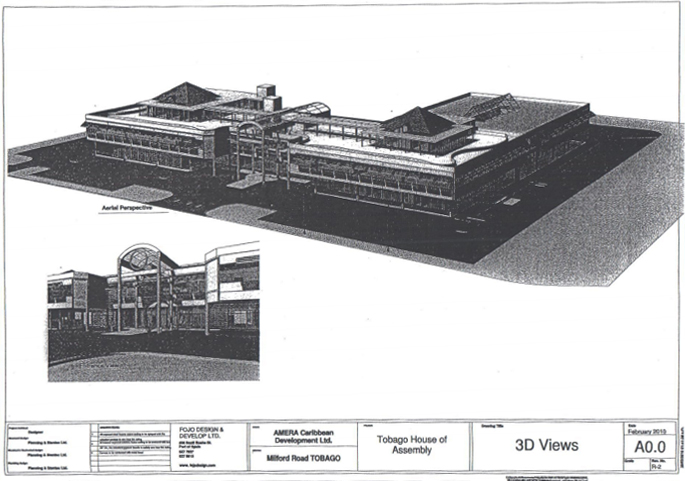
tha-bolt1This project was analysed in a previous article, which set out certain questionable aspects of those arrangements.  In my opinion, the greatest areas of concern were  –

  • Size – THA stated that the Divisions for which this building was being leased now occupy 28,500sf, yet the completed project is to comprise 83,000sf – almost three times more space.
  • Quality – The new building is projected to cost $143M, which equates to $1,723 per sq ft and that is at the upper end of office costs, even when we consider that the contract was reported to be for a fully fitted building.
  • Rent – The current rent paid by the THA for the Divisions to be located in the new facility is an average of $8.17 per sq ft.  The rent for the new facility was agreed at $15.61 per sq ft, which is almost twice the rate now paid.  It was telling that the THA relied on the statements of a Civil Engineer, Peter Forde, who sought to justify that rent by reference to the fact that $10 per sq ft was being paid for some offices in Scarborough.  Mr. Forde is an esteemed engineer with whom I have worked well in the past, but that is like relying on my advice, as a Chartered Valuation Surveyor, as to the correct steel to use in some complex structure.
  • Total Costs – The total monthly rent now paid by THA for those Divisions is $231,788, while the new project is set to cost a monthly rent of $1.295M – more than five times more.

All of these arrangements being made by a public authority which makes a compelling case that the Central Government has starved them of financial resources over a considerable period.  The THA, starved of money, is justifying a deal which will hugely increase their monthly rent bill, for an office building three times larger than required at a higher quality than any other in Tobago.  That is the sense of this deal.

The recent litigation over this project was altered after it started, to two questions of ‘construction’, being ruled by the Court to be issues of public interest –

  • Finance Ministry approval – Is THA required to obtain approval from the Ministry of Finance before entering a BOLT arrangement?
  • Tendering procedure – Is THA required to follow the procedures of the Central Tenders Board Act (CTB Act) in entering a BOLT arrangement?

The High Court ruling on 30 April 2014 was claimed by THA to be an endorsement of their course of action, but this is what it actually meant.

ISSUES High Court Ruling Proposed Public Procurement Law
Preliminary considerations No ruling by the Court. A Needs Assessment would be required to take account of a life-cycle costing, which includes both initial and cost-in-use aspects.
Ministry of Finance approval At para 33, the Court ruled that THA is not required to obtain approval of the Minister of Finance.  In that respect, one can understand THA’s claim to have been vindicated.At para 29, the Court makes the inescapable point that since this is a 20-year recurrent commitment which would have to be paid for by financing from the Central Government, it would be prudent for the THA to consult with the Finance Ministry before entering such arrangements. This is a transaction in ‘Public Money’ via a ‘Public Private Partnership’ which is included in the remit of the proposed law.
Tendering Procedure At paras 48 through 51, the Court was emphatic that the THA was required to follow the provisions of the CTB Act. The proposed law abolishes and replaces the CTB Act and would include this kind of project under the oversight of the Office of Procurement Regulation.

In this case, the THA’s claims of victory appear unrealistic, but the good news is that the proposed arrangements will act to prevent a recurrence of this wasteful type of project.

EDEN GARDENS

163940This 2012 purchase of 50.5 acres (comprising 264 residential lots with ancillary uses) by the Housing Development Corporation (HDC) was also the subject of a series of articles in this space, which highlighted these questionable aspects –

  • Private sales as individual lots – Eden Gardens lots were being offered for sale in 2011 at $400,000.
  • HDC Valuations or Offers? – HDC obtained a private valuation of the property at $52M in November 2011.  In January 2012 Eden Gardens is offered to the HDC at $200M.  So why did HDC order a valuation in November 2011?  Was there an attempt to offer the site to HDC before November 2011 and at what price?
  • The State valuer exceeds the opinion of a private valuer? – Of course that is virtually unknown, but the fact is that the Commissioner of Valuations issued an opinion of value in April 2012 placing the property at $180M.
  • HDC Purchase – The HDC buys the property in November 2012 at $175M, which equates to $663,000 per lot.   Given that those lots were available in 2011 at $400,000, that is a 66% increase in the value of those lands within one year, which can make no sense.  It makes even less sense when one considers that HDC was buying the all that land at once, so a discount would be the rational and expected commercial practice.  So what was the basis on which this price was settled?
  • Plan ‘B’ – The State had the power to compulsorily acquire the land if it was required for a public purpose, which housing is.  The point being that the State could have lawfully acquired Eden Gardens for no more than $35M, if they had chosen to use their powers of compulsory acquisition.  So, why did they choose to go the Private Treaty route?
  • The ‘Ultimate Beneficial Owner’ – The basic business practice required of bankers and other finance professionals is to ‘Know Your Customer’ as a fundamental part of ‘Anti Money Laundering’ (AML) laws now in force in this country.  Those laws and professional practices have now extended to cover the activities of real estate agents, so anyone selling land would be required to conform.  The vendor of Eden Gardens was Point Lisas Park Limited, but from my research at the Registrar General’s Dept, it seems that PLP Ltd. has never issued shares.  Which means that we can only speculate as to who was the ‘Ultimate Beneficial Owner’ of Eden Gardens and indeed, who received $175M for that property.

The proposed new laws do not contain any provisions to govern the State in ‘acquiring public property’, which was the case in Eden Gardens, since the State was buying land.

This is one of the outstanding serious concerns as to the proposed new law, which would not act to prevent this type of corrupt practice.  Our Parliamentarians need to consider these aspects in finalising this law.

The Elephant in the Room – part 2

Port of Spain
Port of Spain

The recent announcements as to the upcoming completion of the ‘Government Campus Plaza’ offices in POS and the relocation of significant State agencies to central Trinidad are charged with meaning for the office sector. The previous article on this topic examined the huge quantity of State-owned incomplete office buildings in greater Port-of-Spain, the impact of that on the incomplete private office projects and the role of the ongoing process of decentralisation.  For the purposes of this discussion, greater POS is the area bounded by the sea to the South, the WestShore Clinic to the West, the Queen’s Park Savannah to the North and the Lady Young Road to the East. This is going to be a closer look at those aspects, so that we might discern how this issue is going to be settled. There are interlocking issues which have created the Elephant in the Room –

  1. the incomplete State offices, which will impact on the private office rental market as they are completed;
  2. the existing offices leased by the State, which need to be re-examined;
  3. the trend towards decentralisation, with its own profound implications.

To understand the issue requires the reconciliation of these large, seemingly-conflicting, elements.  The first is of course, the ‘sunk capital’ in terms of the State-owned, incomplete office buildings in POS.  The second is the existing leases the State holds from landlords of office space in POS.  The third element is the ongoing programme to relocate significant Ministries and State Agencies out of POS, generally to Central Trinidad.   I am also of the view that we need to enquire into the progress of the ongoing decentralisation process.  The details we need are – Which Ministries/State Agencies are to be relocated from POS?  What are the preferred locations for these offices?  What progress has been made on those relocations?   Has land been purchased/leased?  Has State land been allocated? Has a building been identified?  If a new building is to be constructed, what progress has been made in terms of project scoping, design, tendering and construction?  When are these new non-POS State offices anticipated to be occupied? The key enquiries in this matter would be –

  • State Leases

    We need to know exactly what offices the State is leasing and that info would include – the Ministry or State Agency in occupation; the addresses of the buildings; the size of the office space and its facilities; the number of carparking spaces; the rent paid; the service charge paid; the parties; the extent of the lease/tenancy agreement (when did the lease start and for how long was it agreed).  Apart from the info being presented in that type of detail for each rental, the overall picture will be instructive, as it will show the amount of space occupied  and at what cost. That information will in turn disclose the average (mean) rent per square foot paid.  Without details on the present arrangements for State offices, we cannot properly judge the alternatives.

  • Empty Buildings

    Alexandra PlaceAn additional enquiry has to be raised on the particular instances where the State is paying a rent for property which remains unoccupied.  The same details listed above need to be sought in those cases, but in addition, we need to be told why those properties are still unused.  A great concern was raised recently on #One Alexandra, which concern was mostly justified in my opinion, but the fact is that it is not the only one.  The public needs to be told the full extent to which the State pays rent for unoccupied offices.

  • Re-location progress

    On 2 April 2014, Minister of Planning & Sustainable Development, Dr. Bhoe Tewarie, gave some details in the Senate on these relocations –

    • Ministry of Tertiary Education and Skills Training and some of its portfolio agencies are to be relocated to an ‘integrated administrative complex‘ 15-acre site north of the Divali Nagar on the eastern side of the Uriah Butler Highway. No size was given for the complex and construction was noted to have started in April 2014.
    • Ministry of Community Development is to be relocated to new offices at a 10-acre site near the Divali Nagar on the eastern side of the Uriah Butler Highway. No size or start-date was given for these offices.
    • Ministry of Food Production is considering relocating out of its long-established offices at St. Clair Circle, at the northern end of the Magnificent Seven strip, to either Chaguanas or Farm Road in Curepe.  That decision is pending.

    COSTATT2-595x340

    In the last week we have been told that the headquarters of COSTAATT, which is a part of UTT, is to be relocated from Melville Lane in POS to a location near the new Chaguanas Administrative Complex.   The main building occupied by COSTAATT is said to comprise 86,000sf, which is rented for $13.00psf – the total annual rent is $13.473M.  We were also told that COSTAATT’s POS operations require further rental space to the annual amount of $1.64M.  The new building is costing $168M inclusive of VAT, but no details were given as to its size or proposed completion date.  There are other relevant questions as to the convenience of the new location for students and faculty, but the fact that Chaguanas remains the fastest-expanding town in the country for the past 20 years is a part of that issue.

  • UDECOTT’s rollout

    governmentcampus
    Government Campus

    As per the previous article in this series, the State has built, but not completed, a total of 1,329,000sf of offices in POS.  According to Minister of Finance & the Economy, Larry Howai, on 5 May 2014 –  “Cabinet has approved a sum of approximately $1.5 billion to complete the Government Campus buildings in downtown Port-of-Spain,” said Howai. Once this is completed in the next 12 months I expect that the OSH problems being complained of at the BIR will be a thing of the past.”

    That Cabinet approval equates to $1,129 per sq ft, which seems high unless one considers that a significant part of that money is stated to be for remedial works and not strictly for fittings and finishes. The impending completion of those offices will be a sea-change in the fortunes of POS, since their occupation will force the landlords who were renting to the State to seek other tenants. In my estimation at least half the rented offices in the capital are occupied by the State, so that office market is largely driven by the public sector.

    I have heard many colleagues attempting to rationalise the coming change by reference to OSHA requirements which require more office space allocated to each worker and therefore those requirements would ease the impact of the impending new offices.  Another rationalisation I have heard is the one about how some landlords would be leaving their places locked-up so they will not actually be offering those on the market, so there will be no real effect and so on.

All of those are coping mechanisms for dealing with the reality of change on an epic scale.  This is the Manning Plan, in full effect.  To quote the CEO of leading private sector office developer, RGM, Gerard Darcy, in a May 2013 interview  – “…The Government Campus is still the 800-pound gorilla in the room because it is too large to ignore…”.  I expect a significant adjustment in office rent levels in POS in the medium term. The financial sector, especially those who have expanded their loan portfolios on the basis of the property boom, will need to take careful stock of the extent to which these rapidly-approaching changes imply severely impaired assets.

G2G Policy

The current Government to Government (G2G) arrangements are a direct threat to our country’s fundamental interests.

The key element of the G2G arrangement is that a larger, more advanced, country will assist a smaller, less-advanced country by building or operating complex facilities which are beyond the reach of the smaller state.

One of the features the G2G arrangements have in common with the other large-scale projects is the high degree of secrecy with which the proposals are developed.  That secrecy raises doubts as to whether proper Needs Assessments are undertaken and as to the degree to which the views of citizens and stakeholders are sought, far less considered.  The fundamental issue as to the necessity for these projects is thus routinely sidelined, which is inimical to the public interest.

The main criticisms of the G2G arrangements are –

  • Sidelining of the elementary Tendering Process – the procurement process is effectively outsourced, since the more powerful country has the right to select the contractor;
  • Limited, if any, role for Local Participation in terms of labour, professionals, suppliers, or contractors;
  • Weak or nonexistent contract controls, due to the disparity in power between the parties;
  • Serious drain on Foreign Exchange;
  • Lack of the promised Transfer of Technology.

These arrangements have been heavily criticised in our country for almost 35 years, starting with Winston Riley’s October 1979 paper which identified many of the emerging problems.  As a result of that rising tide of criticism, an official enquiry was established by then PM, George Chambers.  In March 1982, the Ballah Report was published and the G2G programme was brought to a halt as a result of its dire findings.

Despite the learning, successive political administrations seem unable to resist the appeal of these G2G arrangements, so we have today’s situation as shown in the table.

Physical Development Projects via G2G – April 2014

Readers who access this article online can view the background info via the hyperlinks

COUNTRY PROJECT/S DATE AMOUNT COMMENTS
CHINA NAPA – North & South 2008
  • TT$818M as’final cost’
  • TT$207M for ‘remedial works’
NAPA (POS) completed in 2009, NAPA (San Fernando) completed in 2012stated final cost of both projects was $130M USD ($818M TTD). A further $207M was borrowed from EXIM Bank of China in 2011 for ‘remedial works‘ on NAPA (POS). Design & Build contractor was Shanghai Construction Group.
AUSTRIA San Fernando Teaching Hospital 2011 TT$739M Opened in January 2014
CANADA Penal Hospital 2012 Undisclosed Involvement with Canada’s nominated designer SNC-Lavalin was discontinued after serious concerns over that firm’s international banning for corrupt business practices.
CHINA
  1. Couva Children’s Hospital,
  2. three national sports facilities in Couva,
  3. three multi-sports facilities in other parts of the country.
2012 TT$1.8 Billion Loan Agreement signed in March 2013 with EXIM Bank of China, with Shanghai Construction Group selected as the contractor for all the projects.These projects include the swimming & cycling complex at Balmain and the sporting complex at Tacarigua Savannah in Orange Grove.
CHINA Lake Asphalt 2013 Undisclosed MoU, with a Confidentiality Agreement, signed on 30 May 2013 between Lake Asphalt T&T Ltd and a Chinese contractor. One of the official objectives of the February 2014 State visit to China, according to the Office of the PM, was “…Removal of asphalt from the Pitch Lake in greater capacities…”.
CHINA La Brea Port and seven industrial parks. 2014 US$750M (TT$4.83 Billion) Agreement signed in February 2014 to have these facilities built by China Harbour and China Construction.

The total cost of these projects is just under $8.4 Billion TTD.
That is the background, against which we must consider these further elements –

  • china-caricomRegional Strategy – As a leading nation within CARICOM, it is important for Trinidad & Tobago to give serious consideration to the role of the various bilateral G2G arrangements China is pursuing in our region and the implications of those arrangements on our aspirations for healthy regionalism.  I have been reading the February 2013 Research Note by UWI’s Dr. Annita Montoute – ‘Caribbean-China Economic Relations: what are the Implications?‘  The scope of Dr. Montoute’s research and her findings are sobering – at pg 115  “…CARICOM Trade with China is on the increase; however it is overwhelmingly in China’s favour…”.  The regional issue is a serious one to which we must address our energies.
  • Trinidad & Tobago’s Strategy – Now consider these statements by then Finance Minister, Winston Dookeran, at the September 2011 ceremony to sign the $207M TTD loan for NAPA (POS) ‘remedial works’ –

    “…Dookeran said it was now imperative that TT deepens its ties with China…’In the first instance China has now emerged as a very significant player, especially in light of the recent tremors and uncertainties in the world economy,’ he said. ‘China…is now an economy that we will have to rely upon. It is in that context that it is very appropriate and timely for Trinidad and Tobago to start to intensify its relationship with China.’..”

    Winston Dookeran is now Trinidad & Tobago’s Minister of Foreign Affairs.

  • The Uff Report – The 42nd and 43rd recommendations of the 2010 Uff Report deal directly with this  issue –
    1. The Government’s policy on the use of foreign contractors and consultants for public construction projects should be transparent and open to review.
    2. Local contractors and consultants who compete with foreign companies should be provided with the same or equivalent benefits as enjoyed by those foreign companies and should be protected from unfair competition through matters such as soft loans…

    Uff was calling for the establishment of a national policy on this series of issues and the JCC has been requesting a consultation between government and stakeholders, so that a proper strategy can be developed in open collaboration. That would include labour, professionals, the State, the contracting sector and all the associated elements such as suppliers of building materials, financiers, skills training and so on.  The JCC wrote to the PM on this in April 2012, but to date there has been no response to our calls for those consultations in the national interest.

  • NAPA, again – The Minister of Culture, Dr. Lincoln Douglas, told the Senate on 8 April 2014 of the serious issues arising at NAPA (POS), with an estimated further $100M being required for more repairs.  It is not certain if the issues of disrepair are all due to inadequate maintenance, but it is unacceptable for such issues to have emerged for a structure less than 5 years old.
  • Shanghai Construction Group – Despite the bad record at NAPA, the selected contractor for the $1.8 Billion Couva Children’s Hospital and the other sporting facilities is the said Shanghai Construction Group.
  • Proposed Public Procurement Law – most alarmingly, Clause 7 of the proposed Public Procurement & Disposal of Public Property Bill 2014 specifically excludes Government to Government Arrangements and projects funded by International Financial Institutions from oversight.  That proposed exclusion is entirely unacceptable as it further jeopardises our national interest.

The PM has made a call for a National Conversation and this is one topic which needs addressing. Our country cannot continue exporting our jobs, capital and skilled people in favour of unexamined and undisclosed foreign policies.