 The PNM’s successful election campaign placed strong emphasis on the critical need to restore proper standards of Accountability, Transparency and Good Governance. That was a commendable and necessary stance in the face of widespread public disgust at the falling standards of morality in public affairs as experienced with successive political administrations.
The new PNM government was installed about a fortnight ago and we expect the 2016 budget to be delivered in about another fortnight, so this is a good time to set out our position. This column will be a simple list, with notes of what are the main priorities to be pursued with the new government in relation to our industry –
-
Public Procurement & Disposal of Public Property Act 2015
This law was partially-proclaimed, but the government has proposed amendments, so we would be available for discussions if those are needed. The public interest requires that this new law be swiftly implemented so as to properly control transactions in Public Money. We have to bring the era of epic waste and theft of Public Money to a close.
-
Planning & Facilitation of Development Act 2014
This law is intended to control physical development in our country. It was partially-proclaimed at the end of July 2015, so there is some work to be done to have that important law implemented. Its companion law, the Urban & Regional Planning Profession Bill (2014), also needs to complete its passage through Parliament so that there would be proper regulation to control the professionals in that field.
-
Building Codes
Our country has never had a legally-enforceable building code to govern the standard of construction. That is a serious gap in terms of our physical development, given that we live in an earthquake-prone island, together with the risk of flooding due to occasional tropical storms and ineffective drainage systems. The PP administration established a multidisciplinary National Building Code Committee which the JCC participated in. That Committee completed its preliminary work about two years ago but was unable to secure the required money to prepare a draft building code and do the necessary consultations. This is an important item to be completed.
-
Registration Acts
We are seeking updates to the laws controlling professional practice of Engineers and Architects (planners are mentioned above) as well as our long-term efforts to secure an effective Licencing system for Building Contractors.
-
Bernard Report
This is the Report of the Commission of Enquiry into the Piarco Airport project which was completed at the end of August 2003. Of course that project and the allegations of grand corruption within it actually triggered the collapse of the UNC government in its previous incarnation. US-based persons who were involved in this international criminal gang which successfully targeted our Treasury have been arrested, tried, convicted and have completed their terms of imprisonment. Here in T&T we suffered the ‘Plot to Pervert Parliament’, which is what I call the entire S.34 fiasco, intended to engineer a loophole through which the Piarco Airport Accused could lawfully evade the Courts. That is bad enough, but despite the fact that the legal right to suppress the Bernard Report has expired, the previous administration refused to publish it. Apart from the Bernard Report, I would really like to know the exact time at which S.34 was taken to then President Max Richards and at what time it was signed on Friday 31st August 2012, the 50th Anniversary of our country’s Independence. That kind of detail will bring real clarity to this sordid chapter. We will soon see the position of the new government on this matter.
-
Uff Proceedings
These comprise the witness statements and transcripts of the hearings which were available on the Enquiry’s website, together with TV footage of the hearings which was stored by GISL. The Enquiry website disappeared at the end of 2010 and our constant efforts to have that information re-published were all effectively ignored. That is fundamental primary information on how our society handles its large-scale affairs and it must be republished.
-
Beetham Water Recycling Project (BWRP)
This project is an unconventional Public Private Partnership to process wastewater for subsequent sale for industrial cooling. BWRP is stated to cost in excess of $1.0 Billion yet it has never been properly shown in any budget. BWRP represents just the kind of ‘off-balance-sheet’ project of which we need to be cautious, especially at this time of budget constraints with the consequent temptation of our public officials. Quite apart from our stated concerns on the tendering and evaluation process, the JCC has made the point that no business case has ever been made for this huge PPP. Does the BWRP improve WASA’s financial position? Does it improve or diminish the financial position of NGC? The ultimate destination of these 10 million daily gallons of water is Point Lisas industrial users – are they prepared, in terms of their own plant, to receive that supply? Have they agreed to pay the necessary charges? In terms of opportunity cost, what are the other uses to which those funds could have been put? If one includes finance, maintenance and other charges, what is the total cost of the BWRP? Given our country’s high level of annual rainfall and the degree to which our pipe-borne water is wasted via leaks, is this the most cost-effective way for WASA to have ‘harvested’ an additional 10M gallons (daily) of potable water? I am sure the answers to those questions will be of great public interest.
-
State Land
The Minister of Agriculture, Lands & Fisheries, Senator Clarence Rambharat, has already announced his intention to do an audit of State Lands. We support that initiative as an essential step in establishing the true position with our State Lands. It would be a very important strategic step if that audit were followed by a thorough review of National Land Policy, which dates from 1992, and the UWI’s 2003 study of the role of Caroni Lands in National Transformation. It would also be critical for that review process to be broad-based and consultative.
-
Invader’s Bay
This huge, ambitious project to develop 70 acres of State-owned reclaimed waterside land in west POS was mired in serious controversy from the very beginning due to the improper RFP process adopted by the State. The JCC went to Court and won an order forcing the State to publish the fundamental legal advice supporting the RFP process. The State has appealed, but it is time for a new start at Invader’s Bay.
These are the main areas of concern which we would want properly addressed.

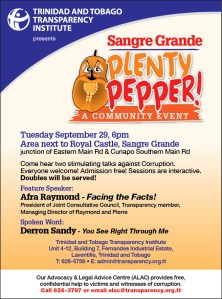 T&T Transparency Institute presented “Sangre Grande Plenty Pepper! A Community Event” on Tuesday, September 29, 2015 at which Afra Raymond, in his capacity as president of the JCC, was the feature speaker. His topic was “Facing the Facts!”
 Afra Raymond, as JCC president, is interviewed on the ‘The Breakfast Round Table‘ show on Sky 99.5 FM by Eddisson Carr and Jessie May Ventour giving a post-budget analysis from his perspective. 7 October 2015. Audio courtesy Sky 99.5 FM
 Noel Garcia served as General Manager of the Housing Development Corporation during the period in which critical decisions were made on the Las Alturas housing project. That project, in which two apartment buildings failed, is now the subject of a
 Afra Raymond is interviewed by a group of young people on Synergy TV’s pre-election discussion series, “In The Chair”.
 The opening quotation is from the
 This remains elusive since in March 2012 the Ministry of Agriculture, Land & Marine Resources published its
 The EMBD website states that it is responsible for the development of the former Caroni lands –
 Caroni Lands were leased to ex–Caroni workers as part of their
 The HDC sells new homes at heavily-subsided rates to middle-income families, subject to restrictive covenants which prohibit open-market sale within the first ten years. Under the terms of that clause, the owner of one of these homes is required to offer the property to the HDC at the original price. It now seems that the HDC has relinquished those restrictive covenants. I have seen several letters signed by the HDC which authorise the open-market sale of those homes within the ten-year embargo period. I am not aware of any policy decision which supports that pattern of approvals and none of the vendors I have spoken with have paid any penalties of profit-share to the HDC.

 Afra Raymond sits with host, Larry Lumsden on the Good Morning T&T television show to discuss his recent High Court victory over the Minister of Finance to get accounting details on the CL Financial bailout. Video courtesy CNMG

