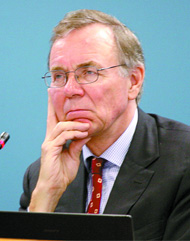
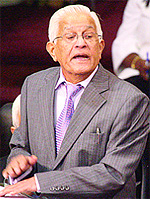
Managing Director, Raymond & Pierre Ltd.
Past-President, Joint Consultative Council for the Construction Industry, Trinidad and Tobago- December 2010 to November 2015.
Past President Institute of Surveyors of Trinidad & Tobago 2009-2010.
VIDEO: First Up Simulcast Interview – 21 January 2010
Fazeer Mohammed and Jessie May Ventour interview Afra Raymond on the simulcast of First Up on Talk City 91.9 FM radio and C Television on the topic, “What’s the Deal with CL Financial” touching on the continued silence of the professional class, politicians and labour unions on the ongoing debacle of the CL Financial bailout. Video courtesy Caribbean New Media Group Limited.
PODCAST: RICS Americas Interview – 14 January 2010
This is a podcast Afra Raymond did while in New York on Thursday 14th January at the offices of RICS Americas, the regional HQ of the international professional body, the Royal Institution of Chartered Surveyors.
As you will hear, Afra Raymond was speaking from his positions as a Chartered Surveyor, Managing Director of Raymond & Pierre Limited and of course, President of the Institute of Surveyors of Trinidad & Tobago. He focused on 2 matters
the new Property Tax recently passed by our Parliament and,
the Uff Commission of Enquiry into the Public Sector Construction Industry.
He concluded by reminding listeners that the RICS’ principal cause was that of “serving the public interest” and that that was one of the main engines for him as a campaigning surveyor.
My last column on this important matter was published on 31st December, almost a month ago, with several major developments since then. The main development in my view is that we had some truly remarkable statements from the Governor of the Central Bank.
The messages on the CL Financial group are now so confused that the most charitable phrase possible, is that the public is getting ‘mixed messages’.
The Top-level resignations – The group CEO, Steve Bideshi – a former senior manager at Citigroup – was reported on 12th January to have tendered his resignation, effective 31st January. See – http://guardian.co.tt/news/general/2010/01/13/bideshi-quits-cl-after-6-months or http://www.trinidadexpress.com/index.pl/article?id=161581443. We are told that his reason for resigning is the breakdown of negotiations for his compensation package. Our governments have a serious track-record of agreeing and then secreting the terms of compensation for its high-fliers. Just think of Caribbean Airlines, PetroTrin and UdeCOTT. It is unbelievable that government was unable to agree terms with this one CEO. Arguably, Mr. Bideshi was heading the largest and most complex group within the State’s control.
Bideshi and Carballo were the two top executives at CL Financial. What is going on?
To date there has been no proper explanation as to the causes of these major resignations or clear statement on the way forward. To have both the group CEO and Finance Director resign within a week of each other, effective within less than a month, speaks of turmoil and jostling. That kind of thing would not happen if the situation was stable. The purpose of this bailout was said to be the avoidance of systemic risk and the maintenance of confidence in our financial system. The official silence on this startling development only adds to the impression of ‘more in the mortar than just the pestle’.
An absolutely fundamental clash of ideas seems to be emerging, but that is beyond the scope of this week’s column. One week ago, I appeared for the first time on the electronic media (CNMG/91.1FM) to discuss these issues. It seems that there is a ‘Code of Silence’ on this issue with the political parties all having agreed to not discuss it in any sustained or meaningful way. Our civic bodies are little better, with a remarkable silence from our professional bodies (most notably, the Institute of Chartered Accountants of T&T), trade unions and institutes of higher learning.
The question of wrong-doing – The Governor is reported to have expressed his frustration at the slow pace of the ongoing forensic audits into the group’s financial affairs. He went so far as to promise to act if wrongdoing is revealed. The first point to be made is that we need the audited accounts as at 31st December 2008 and that will light up many of the darker areas of this series of issues. The second point is that wrong-doing has already been exposed in two substantive respects –
CL Financial dividends – The group paid dividends to its shareholders three days after writing the same Governor for urgent financial assistance. Is it the Governor’s view that it was legal and prudent to pay dividends in that situation of virtual insolvency?
Directors’ legal responsibility – Under the Companies Act, Directors can be held liable for mismanagement. They have a legal liability to properly manage the affairs of the companies under their direction. Speaking on 10th November 2009 at a conference on “The Global Financial Crisis: Institutional Management and Regional Opportunities” – see http://www.central-bank.org.tt/news/speeches/2009/sp091110.pdf – the Governor, in his closing remarks, said –
“I prefer, however, to focus on the governance issues because, without doubt, the failure of Clico was a failure of Governance … it was absence of controls from the Board of Directors. Clico shows what damage could occur when prudence is clouded by unbridled ambition. Clico shows what can happen in the virtual absence of a risk management framework and the absence of internal controls. Clico shows that we need to rethink corporate governance … not only in Trinidad and Tobago but in the region as a whole.” (Please note that the emphasis is the Governor’s.)
If one is unable or unwilling to pick the ‘low-hanging fruit‘, which are well within grasp, why should we believe you will take action in more complicated and contested cases?
The financing mechanism…Are assets being sold, or not? – The other aspect the Governor spoke on was the difficulty in getting payouts for a significant number of depositors and policyholders. That has been widely reported in the press according to this newspaper’s reports on the Governor’s statement – “He said some of the payouts to CL Financial stakeholders were taking longer than the authorities had anticipated because the company was facing a liquidity problem and the pace of disposing of the assets to cover the payouts was going very slowly.”Up until now, I had assumed that the payouts were being funded by the Treasury via the Central Bank and that those monies would be recovered by sale of CL Financial assets – all in accordance with the MoU. We are now getting a top-level statement that if assets are not sold, the payouts cannot proceed. Is this another way of saying that the Treasury support has reached its limits or is it a sign of deeper conflict?
On Thursday 15th October 2009, Mariano Browne, Minister in the Ministry of Finance, spoke at the post-Cabinet press briefing – see http://guardian.co.tt/business/business/2009/10/16/browne-no-plans-govt-increase-shares-rbl – and his reported statement was very clear – ‘Browne also said government had no intention of selling any of the assets of Clico, one of the three CL Financial-owned companies that was being bailed out. “One needs to be judicious in terms of the managing of the assets at CL Financial Group, given the depressed state of the market both here and internationally. There is certainly no intentions (sic) of selling the assets. The position is to manage them and manage them well,” he said.
It is either that there has been an unannounced, significant shift in policy on this important matter or there really is a scene with ‘turmoil and jostling’. Both statements cannot be true.
We were told in the 2010 Budget that the monies allocated to the CL Financial bailout were some $5.1Bn, which is a huge amount of money. I am beginning to wonder what is the total amount of money really allocated to this bailout and if we are ever going to recover it. Just to make 2 examples, we have had the British-American Insurance Company’s insolvency, announced in November 2009, and the government’s subsequent commitment to put $50M USD towards that regional effort to construct a new company. Also, on Christmas Eve we heard of the $400M commitment to pay CLICO pensions due to ex-Caroni workers. What are the real totals?
This is to be published on the last day of 2009 and it is intended to do two things – firstly, to provide an overview of the CL Financial bailout and secondly, to start a critical conversation on our work as writers and analysts.
The timeline of the events over the last year or so on the CL financial bailout is set out for ease of reference. The detailed material can be found in the earlier part of this series at www.afraraymond.com. In doing some other reading, I came across a valuable part of the story and that is the first item in the timeline.
TIMELINE – November 2008 to December 2009
Michael Carballo6th November 2008 – The Guardian publishes ‘Surviving the Storm’, an extensive review by Sandra Chouthi on the prospects for our local businesses on surviving whatever the global situation throws at them – see http://legacy.guardian.co.tt/archives/2008-11-07/bussguardian1.html. The first person interviewed for that article was Michael Carballo, Group Finance Director of the CL Financial group. Some of his quotes are remarkable, given the imminent collapse –
“Luckily, the group has not been impacted in any way via securities in any banks we have had to write down.”
Carballo said CL Financial, with $100 billion in assets, could weather any storm.
“We are not exposed in any one particular industry. That is our business model,” Carballo said.
18th November 2008 – Publication of CL Financial’s 2007 Annual Report ‘The Next Wave of Growth’, which includes audited accounts showing profits after tax of $1.74Bn, with ‘cash and cash at bank’ of $9.486Bn.
2009
13th January – CL Financial’s Executive Chairman, Lawrence Duprey, writes to seek financial assistance from the Central Bank.
16th January – CL Financial pays dividends of $3.00 per share, as per their Annual Report.
23rd January – CL Financial holds its Annual General Meeting at Trinidad Hilton.
30th January – The massive and unprecedented bailout is announced at a press conference at the Central Bank. A Memorandum of Understanding is signed.
12th June MoU – A new Mou is crafted and shareholder agreement is obtained at a special meeting. There is a change of Boards and government takes control of the CL Financial group for 3 years. The terms of that agreement, beyond what is in the Ministry of Finance press release, are deemed ‘confidential’.
18th November – My previous attempts at questions having been ignored by the highly-paid public servants at the Ministry of Finance, I applied, using the Freedom of Information Act, for a copy of that second MoU to be published. The time limit on that application expired on Friday 18th December without any reply from the Ministry of Finance. I will be pursuing my other options to bring that information into the light.
30th November – In response to a motion by Basdeo Panday, seeking parity of treatment for HCU depositors, the Minister of Finance gave a stupefying rationale for the actions of the government in the entire bailout scenario. explanation – see http://guardian.co.tt/business/business-guardian/2009/11/12/duprey-s-fate.
24th December – 2 other newspapers carry reports that Caroni workers are to receive their entitlements (said to total some $400M) under the terms of a CLICO pension plan.
The ‘Express element’
It is common to criticise governments on the basis that they are out of touch and seem to operate in silos. Meaning that various departments of our governments often operate without taking account of each others’ plans and actions. That is indeed so, but we also have to be willing to change if we are to have a chance of changing our world.
In saying so, we in the media have been existing in a similar place where cross-linking and critical discourse is almost extinct. If we are not able or willing to start a critical, public conversation amongst ourselves, there would also be severe limits on our own growth and effectiveness. The times are very challenging and they pose a caution for us all in the media. Our country needs a quality media of integrity.
It is clear from that series of articles that Ms. Marajh has access to private documents and Michael Carballo. Is it that readers will have to remain in suspense as to the key mysteries of the CL Financial fiasco? In my view, those would have to be –
‘How could CL Financial assets have declined in value from over $100 Bn to $24Bn in less than 13 months?’
‘How could CL Financial chiefs sign that MoU to pledge assets which had already been pledged?’
‘Did CL Financial ever comply with the Court Order to provide a sworn statement detailing the location of all its assets?’
Of course, one could maintain that the focus on the other aspects of the story are of greater importance and public interest. I am just wondering, in public, whether those questions have ever been put to Carballo and if so, what did he reply. It would be a real piece of investigative tonic if Ms. Marajh were to use her access to ask these burning questions.
It also needs to be said that Ms. Marajh’s last set on the Angostura purchase of the Lascelles Mercado group in Jamaica opened two aspects for further investigation.
I do not have the kind of space the Express affords my colleague, so this will be brief.
The first of these was the fact that Home Mortgage Bank seems to have guaranteed a transaction in which Angostura took over Jamaican rum manufacturer, Lascelles Mercado at a cost exceeding $600M USD. It seems that the HMB guarantee was set out in a December 2007 document. That sum was also said to be in excess of the financing headroom available to HMB, but that is not something I am going to pursue here. My concern is that the Home Mortgage Bank was established by an Act of Parliament to provide liquidity to the secondary mortgage market. How come a mortgage company, established to provide finance for the benefit of homeowners, could issue a guarantee to a conglomerate to buy a liquor company? How come? To my mind, that seems to be well outside the intended scope of the HMB as per its own company information – http://www.homemortgagett.com/loadpage.cgi?company_info. There is also the interesting point that this huge deal, with all its possible implications for the stability of the HMB, was not disclosed in the audited accounts (where it ought to have appeared as a Contingent Liability) or Chairman’s Review of their 2007 Annual Report – see http://www.homemortgagett.com/AnnualReport2007/HMBAnnualReport2007.pdf.
The second point is that the expose mentioned that the Angostura purchase was made at twice the listed price of the Lascelles Mercado shares. It is one thing for a company to take strategic decisions, using its own shareholders’ funds and paying ‘over the odds’ for assets, if that acquisition satisfies its objectives. That is one thing, but what we seem to have here is a mortgage bank guaranteeing a massive purchase of shares at twice the value. Was a due-diligence of the transaction done? If there was none, this would be a case in which shareholders’ and depositors’ monies were put needlessly at risk.
As far as I can tell, this is the kind of behaviour which led to the collapse of the entire CL Financial group. We in the media have a responsibility to do better.
The Uff Commission ended its hearings last week, amidst even more ‘amazing scenes’.
There are so many examples to draw on, but here are a few choices –
Dr. Keith Rowley, MP
Cleaver Heights missing money – The entire reason this HDC project was included on the Uff Commission’s agenda is PM Manning’s $10M question to his former Housing Minister, Dr. Keith Rowley ‘Where the money gone?’ After months of evasion, the purging of an HDC Board, the resignation of the HDC’s CEO and the rustication of the UK-based expert, Gerry McCaffrey, the truth is out. No money missing. Simple so. Given the denials by Noel Garcia, the then-CEO of the HDC, and his principal assistants, the question remains who informed the PM of that missing money. I do not expect our PM to either apologise to or re-appoint Dr. Rowley.
Cleaver Heights contract type – Another point which emerged recently is that Cleaver Heights started off as a Design, Finance and Construct and became a modified Design/Build contract without a financing component, seemingly without a corresponding adjustment in the contract sum. If that is the case, it would be grounds for serious concern.
Carl Khan – The ‘surprise witness’, Carl Khan was unchallenged by either Calder Hart’s or UDeCOTT’s attorneys. They adopted the ambiguous course of trying to cast doubt on that testimony, but yet declining to cross-examine Mr. Khan. It seems that these attorneys are so ‘bright’, they want to have their dinner ‘both boiled and fried’. We not so easy to destabilise. We too have eyes.
The new creature – Lastly, it is interesting to consider the new creature all of this has laid bare. There is now a species of Super State Enterprise, who seem to enjoy an exemption from the rules, norms and guidelines which would apply. A State Enterprise which can mount a legal challenge to a Cabinet decision and the President of the Republic. Imagine that.
More questions than answers – The open process adopted by this Enquiry was refreshing, so much so that it has yielded a real ‘windfall’ in terms of public awareness. Even the least-interested or most-loyal citizens are now aware that something huge is wrong here. We now see that our PM dismissed a Cabinet Minister on grounds which have all proven baseless, yet continues to publicly defend one of his key lieutenants, whose behaviour is now revealed to be questionable. That outcome would have been entirely unthinkable to the government at the outset of this bizarre year. It is a prime example of the Law of Unintended Consequences.
‘Who is Calder Hart?’
Calder Hart
Calder Hart is Executive Chairman of UDeCOTT, Chairman of the Home Mortgage Bank, Trinidad & Tobago Mortgage Finance, the National Insurance Board (NIB) and the National Insurance Property Development Company (NIPDEC). He obviously enjoys the highest level of trust from the government. So consider this extract from Calder Hart’s cross-examination, under oath, at the Enquiry on Wednesday 28th January 2009. Hart is being questioned by Gilbert Peterson SC, attorney for Dr. Keith Rowley –
Continued Cross-Examination By Mr. Peterson: Q. Mr. Hart, I am examining your CV. I see that you attended St. Francis Xavier University. What degree did you obtain from that University? A. Bachelor of Arts in Economics. Q. Bachelor of Arts in Economics. And I also see that you attended a course at MIT? A. That’s correct. Q. What was the scope of that course? A. Well, I think it’s down there as Urban Economics and Public Policy. Q. What was the duration of that course? A. I think it was either two or three weeks. Q. And the one at Alberta? A. The University of Alberta I gained managing human resources; the same amount of time, two or three weeks. Q. You would not describe yourself as a financial expert, would you? A. No, I would not describe myself as a financial expert. But I would describe myself as a person with a body of experience. Q. Yes. But your lawyers misdescribed you in these proceedings as a financial expert. You would not agree with that description? A. I would not describe myself as an expert of anything.
We have repeatedly been told that UDeCOTT is an exemplary and highly-efficient State Enterprise. In light of those assertions, coming from the PM and his colleagues, we are entitled to be concerned as to their lack of financial transparency. On 28th January 2009, Calder Hart was cross-examined, also under oath, by Alvin Fitzpatrick SC, attorney for the JCC. Consider his testimony on the specific issue of UDeCOTT’s audited accounts –
Continued Cross-Examination By Mr. Fitzpatrick
Q. Now, rather than go through all of them, would you accept that in respect of the audited accounts for the periods which are due at 31st December of each year and the all the accounts from 2003 to 2006 were signed off by your external auditors prior to the end of March of the following year? A. That’s correct. Q. That’s correct. And your external auditors are Price Waterhouse? A. Yes. Q. Now, I notice that there are no audited accounts for the period ending December 2007? A. That’s correct. Q. Now, that is close to two years ago they are overdue. Is that so? A. Just one year. Q. Just one year. A. Not quite a year. Normally they would have been due in March. Q. They would have been due in March and they are now overdue? A. Yes. Q. Now, the period 2007 would have included a number of costs related to the Brian Lara Cricket Academy? A. Yes. Q. Would you agree that external auditors will not sign off on statements where they are not satisfied with the records or they have some concerns about the records? A. No, that’s not my understanding at all. My understanding is that there were issues surrounding the notes to the accounts in terms of some of the areas where they wanted to change some of the interpretation of what we had been doing. So there was a long discussion. I think some of the problems had to do with getting all of the information reconfigured. So my understanding is that probably before the end of next week we shall have our 2007 accounts. Q. I will be very glad to hear that. So what you are saying is that the accounts have not been signed off by your external auditors, because they did not agree with the existing configuration of some of the figures? A Well no, I mean, you have to understand that PWC have been doing our accounts from day one. But I think that what they wanted to do was to deal with some of the notes as well as the manner in which the structure of our operations—I think what has happened is that as we have moved to expand our financing in the international markets. My understanding is that they are obviously ensuring that international standards are followed and in looking at them they want to restate some of the elements in it. And my understanding is that has all been agreed between the accountants. There were some issues surrounding some of the information and that sort of thing which they have now been satisfied with. And we are expecting it obviously within the next couple weeks. Q. Let me see if I can summarize that. It was quite a mouthful. PWC have not signed off because there were some unresolved issues which have now been resolved? A. As I understand it, yes. Q. And, of course, PWC will not sign off on any financial statements unless they are satisfied that all the issues remain unresolved (sic)? A. Mr. Fitzpatrick, let me assure you, there is no flight of fantasy eh. Q. Thank you. Well, I assume before we resume on the next occasion we will have those audited accounts? A. Yes.
This part can be found at pages 37 to 39 of the same day’s transcript.
No accounts yet for 2007, none for 2008 and we are near to the end of 2009. If this is exemplary performance, what next?
Afra Raymond is Managing Director of Raymond & Pierre Limited and President of the Institute of Surveyors of Trinidad & Tobago. Comments can be sent to afra@raymondandpierre.com.
John UffThe controversial Uff Commission is to start the final round of its hearings tomorrow. Please click here for the timetable. This Commission of Enquiry was established to examine and report on the Public Sector Construction Industry, with particular reference to UDeCOTT and the HDC’s Cleaver Heights housing project in Arima.
The huge sums of money involved and the egos of the parties all combined with irregular practices in this matter. The combination produced an unflattering and unforgettable picture of our nation’s leading players under the bright lights of the Uff Commission.
The legal challenge against and resulting resignation of Israel Khan as a Commissioner was just one outcome of the bold stance taken by the UDECOTT Board in this matter. The continuing legal challenges mounted by UDeCOTT against the Uff Commission have greatly diluted the credibility of this government, even in the eyes of its most loyal followers.
The failure to gazette the Enquiry was yet another strange aspect of the matter and, although that lapse has now been rectified, we are yet to hear a cogent explanation as to who was responsible and what was the reason for the failure. On this count alone, we are nurturing irresponsible behaviour by allowing this to pass quietly.
The Commission of Enquiry can only make findings based on the evidence which is properly submitted to it and that is where my concern is rooted. We are down to the final few days of hearings and it is my view that the proposed agenda for the final week of hearing is deficient since it leaves some seminal issues outstanding.
These are key points which could be addressed, even at this late stage, by the Commission issuing the necessary legal notices to have these items placed in evidence.
In order of importance, the outstanding issues are:
UDeCOTT’s missing accounts – The main subject of the enquiry is the operation of UDeCOTT and we have not had their audited accounts for 2007 or 2008. The Performance Monitoring Guidelines for State Enterprises, published by the Investment Division of the Ministry of Finance, requires that these should have been published by now. UDeCOTT’s Executive Chairman, Calder Hart, while testifying to the Commission under oath on 28th January, stated that all the outstanding issues with the audit had been resolved and that those accounts would be published in “…a week or two…”. That testimony can be accessed from the CoE website at http://www.constructionenquiry.gov.tt/getattachment/6f957486-f0f4-4aad-b585-d644f3212806/COE-Construction-Industry-20090128-Merged-doc.aspx on page 43. For any Enquiry into the operation of UDeCOTT to make sound findings, those accounts need to be published now. At the least, UDeCOTT should write to explain the breach of the guidelines issued by its shareholder and the undertaking, given under oath by its high-performing Executive Chairman. Again, I ask, “Is UDeCOTT insolvent?”
Bob Lindquist’s missing report – The original concern on the Cleaver Heights housing project arose when the Prime Minister raised concerns as to ‘Where the Money gone?’ and much was made of $10M or $20M which was said to be missing. The PM used the Budget debate in Parliament last year to ask the question of the former Minister of Housing – Dr. Keith Rowley. We were told that the Housing Development Corporation had appointed the respected forensic accountant, Bob Lindquist, to probe the project in question. The Minister of Planning, Housing and the Environment was reported to be silent on details when questioned on the results of that probe by reporters. [See – ‘Not me and the bacchanal’ published in Newsday on August 29th 2009 – http://www.newsday.co.tt/news/0,106338.html That is simply not good enough and the Commission needs to get Mr. Lindquist’s findings into evidence. We cannot have a satisfactory Enquiry if the government is able to control the flow of evidence.
Housing Development Corporation’s output deficit – The Uff Commission’s terms of reference include ‘project delivery’ and the HDC has failed to account for this chronic deficit in satisfying its prime objective – Housing Development. The entire time spent by this Enquiry on housing has been only in respect of the Cleaver Heights project, but the HDC has never produced more than 50% of its target output in terms of the numbers of new homes built each year. The question remains as to whether the HDC is aware of the reasons for this continuing shortfall. This is a flagship state policy and the shortfall in numbers of new homes produced is itself deserving of proper attention from this Enquiry and the responsible State Enterprise. I submitted a series of written questions on this to the Enquiry and one would hope that some written response is forthcoming from the HDC or the Ministry.
The remaining Commissioners can take steps to preserve their reputations and have the key elements of outstanding information put into evidence. We await with interest.
Afra Raymond is Managing Director of Raymond & Pierre Limited and President of the Institute of Surveyors of Trinidad & Tobago. Comments can be sent to afra@raymondandpierre.com.
This is my application, under the provisions of the Freedom of Information Act, for publication of the second MoU between CL Financial and the State. At CMMB’s Budget Breakfast on 10th September, I asked the Minister of Finance when this would be published and she replied that there was no intention to publish it. I followed up with an email to her on 19th September. That email was the subject of a telephone call from one of the Minister’s staff to advise that a written reply was being finalised for me in the next few days. Having had no reply, or any explanation of the delay, I published the Open letter to the Minister of Finance on 5th October in the Trinidad & Tobago Review. This application is made in the belief that the public deserve to know the details of this arrangement. The bailout is supposedly being conducted for our benefit and indisputably at our expense, yet there is now an open position that its details are to deemed ‘confidential’. We, the taxpaying public, need to know who exactly are the beneficiaries of the bailout and what are the terms on which those benefits are being obtained. Anything less than full and immediate publication is a recipe for utter confusion and corruption.
The Leader of the Opposition, Basdeo Panday, recently laid a motion in Parliament seeking for HCU depositors to be granted a ‘bailout’ of the kind given to those who had invested with the failed CL Financial group. On Friday 30th October, the Minister of Finance made a major statement to Parliament, seeking to defend the government’s actions in the cases of these two failed Financial Institutions.
In terms of race, politics and finance, that statement by the Minister deserves our most sober consideration.
Before going further I need to make two things clear – firstly, I am not intervening on behalf of Mr. Harry Harnarine or the HCU. I am not a supporter of that cause. Not at all. Secondly, I do not support the bailout of either group – CL Financial or HCU. The idea that State resources should be deployed to assist investors who have lost money is a dangerous one. As a matter of principle, the concept of moral hazard has real weight in economic behaviour. The idea that investors should be rescued without paying the consequences of their choices is inimical to proper development. That general principle has been done violence by the CL Financial bailout.
As I have stated in my previous articles on this bailout, the record of the government in terms of separating the interests of depositors, policy-holders and shareholders is turbid.
The Minister’s rationale was set out in two limbs – the first being that the HCU dealings were not straightforward – indeed, one newspaper carried the headline ‘Devious HCU’– and secondly, that the CL Financial dealings were marked by “…tangible co-operation…”. This bailout is an extremely serious act being carried out by the government in breach of fundamental principle and we deserve nothing but the truth.
There are deep contradictions on every single point cited by the Minister to support the actions taken.
Here is what the Minister is reported to have said, together with the contradictions –
The Ernst & Young report – The Minister is also quoted as saying that “The auditors’ assessment was that the Hindu Credit Union was facing not a liquidity problem, but a solvency problem and all its assets were overestimated in value and encumbered.” As a rationale for the government’s actions, that is completely at odds with the 7th April statement of the Central Bank Governor. In fact we were told that the CL Financial group and various of its parts were being examined by Ernst & Young, KPMG and Bob Lindquist, the renowned forensic accountants. To date, no results of those accountants’ work have been released. We are being told that the CL Financial chiefs showed “…tangible co-operation…” in their dealings, so where are the audits? Why has the 2008 audit of the CL Financial group by PriceWaterhouseCoopers not been published?
“…What is the Government to do? You dealing with…the major players, and they are not levelling with you…” That was the Minister’s statement about HCU, made in apparent exasperation. As I wrote in my column ‘Who is Who and What is What’ published here on 30th April – “At the beginning of this process we were led to believe that CL Financial was being pro-active and cooperative in their dealings with the State. Indeed the Governor even made this point directly in his prepared remarks at the 30th January press conference “…I would like to acknowledge the high level of cooperation that we have received from Mr. Duprey…” Since then CLF has now been exposed as paying dividends after requesting the State bailout, challenging the injunction obtained by the State over their assets with a powerful legal team and, to top it all, pledging the same assets twice. The Governor spoke on 23rd April – ‘If you ask me whether CL Financial did everything that was honourable and beyond reproach, the answer is no! The answer is no!’”
Obviously, some one of the major players is not levelling with us.
SIDEBAR
So the government bails out policyholders and depositors of the CL Financial group. That is widely welcomed, except for a few objectors, like myself. It seems to me that the interests of the CL Financial shareholders have been promoted in preference to those of the taxpayer. I am subject to correction, but if that is so, it would be a monumental mis-allocation of public funds and a seriously questionable act. The terms of the bailout are now being deliberately concealed from public view, although it is at our expense and supposedly being carried out for the benefit of the public.
That secrecy is toxic to notions of transparency, accountability and modernity. I will return to that secrecy issue.
Suffice to say that the terms of the bailout, the subsequent revelations and the concealment of the second MoU have combined with the Minister’s contradictory statement to yield a very unhealthy series of precedents.
The unspoken question at this moment is ‘Who is next?’. Last week’s BG View editorial highlighted some pertinent concerns as to the health of private pension plans and the strength of the regulatory process.
No one knows if CL Financial is just the first in a chain-reaction or simply a ‘one-off’. The burning question is, if there is another collapse of a large investment house – ‘Will they also be bailed-out?’ and, if yes, ‘On what terms?’
GOVERNMENTS OF THE EASTERN CARIBBEAN CURRENCY UNION (ECCU) AGREE ON STRATEGY FOR BRANCHES OF BRITISH AMERICAN INSURANCE COMPANY IN THE EASTERN CARIBBEAN
Introduction
For several months, the Governments of the Eastern Caribbean Currency Union (ECCU) have carefully monitored growing public concern about the financial situation of British American Insurance Company Limited (BAICO) and other subsidiaries of its Trinidadian parent company, C L Financial. BAICO itself is a private, limited liability company incorporated in the Bahamas. Nevertheless, the sheer size of BAICO and the significant exposure of the Eastern Caribbean have made it imperative for the ECCU Governments to adopt a proactive and collective approach to this challenge.
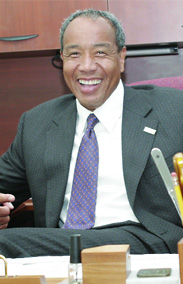
Michael Lee ChinOf course, one interesting feature of this entire affair is the fact that these two groups were headed by Black Caribbean men. That is exceptional, as a matter of fact and it required a serious break from our past to develop the required levels of investor confidence.
But the differences are even more interesting than the similarities – for example, it seems that AIC Finance has declared the true position and alerted its stakeholders properly as to its exit strategy.
The characterisation of this situation as being ‘Duprey’s fate’ made me smile. Quite frankly, that phrase seemed to be a device to create some public sympathy for Duprey when the facts are of another type altogether.
If the terms of the CL Financial bailout are examined, they are truly remarkable, even by our declining national standards. The principal terms are –
Amount – The amount of public money to be advanced is unspecified. Despite various official statements, this did not form part of the first MoU. The press release on the second MoU of 12th June 2009 was also silent as to the amount of money to be advanced in this CL Financial bailout.
Collateral – The original MoU specified that certain assets were to be disposed of to repay the funds advanced from the Treasury. That position was soon overtaken by reality when the Central Bank Governor announced on 7th April that all of CL Financial’s assets were already pledged – http://guardian.co.tt/business/business/2009/04/08/govt-left-empty-handed-cl-financial-bailout. The second MoU and recent statements by Mariano Browne, Minister in the Ministry of Finance, make it clear that no fire sale of assets will be undertaken. To quote the Minister, speaking on 15th October – “One needs to be judicious in terms of the managing of the assets at CL Financial Group, given the depressed state of the market both here and internationally. There is certainly no intentions (sic) of selling the assets. The position is to manage them and manage them well”http://guardian.co.tt/business/business/2009/10/16/browne-no-plans-govt-increase-shares-rbl. If we are to believe the Central Bank Governor and the Minister, there being no good reason to doubt either one, it seems that these advances are taking place without security.
Interest rate – The first MoU and the press release on the second MoU are both silent as to the interest rate charged.
Payback period – There is no stated period for repayment of the public funds advanced. There have been recent announcements as to the government taking over management of the CL Financial group for 3 years.
What fate? – Having arranged an urgent package of rescue financing on those terms, it seems that the shareholders of CL Financial have not had their equity position diluted and further, that Mr. Duprey has been allowed to keep all his personal assets. That is Duprey’s fate.
That summary is the best I can give, based on the limited information available to me. If it is an accurate one, the CL Financial bailout is tantamount to a huge injection of public funds to bolster the private interests of only 325 shareholders, the main one being Lawrence Duprey.
That is a real shame, given the state of our nation’s finances. The greater pity is that this is all taking place without proper public accountability or transparency. So far the Minister of Finance has not replied to my various attempts to get further information on these matters. But how much blame can we place on our rulers?
Our society is shaped by our collective aspirations, attitudes and actions. But the notion of collective values is an increasingly doubtful one in this arena. Insofar as the national economy is concerned, do we actually possess collective values and if so, who can say with certainty what those are? More and more, it seems that the real question is ‘Whose values will prevail as we go forward’? The progressive people in the society have a duty to make their voices heard, if we are to have a chance of influencing others. If we influence others to improve standards, then that is a positive move towards the inescapable future.
This CL Financial fiasco has been marked by the silence of the responsible people in the society. The nation seems to have been so heavily invested in the CL Financial group that the bailout was greeted with widespread relief. So much relief, that we seem to have taken our critical eyes ‘off the ball’. On 19th October I wrote an Open letter to the Institute of Chartered Accountants of Trinidad & Tobago (ICATT) to seek their involvement in calling for greater transparency and accountability in this entire bailout. That letter can be found at www.afraraymond.com. The week 19th to 23rd October was Accountants’ Week. The President of the ICATT, Anthony Pierre, writing to open that Week, stated that ‘We have the opportunity to raise the bar on new standards in corporate governance, accounting, auditing and ethics” and “We do so mindful of our continued responsibility to contribute to the further development of our people, our institutions and our country”.
I also intend to seek the involvement of other civic society organizations in promoting the calls for greater transparency and accountability in this entire bailout process.
Afra Raymond
This series on the CL Financial bailout can be viewed or readers’ comments made at www.afraraymond.com.
 VIDEO: First Up Simulcast Interview – 21 January 2010
 PODCAST: RICS Americas Interview – 14 January 2010

 I do not have the kind of space the Express affords my colleague, so this will be brief.