Afra Raymond sits with host, Fazeer Mohammed on the Morning Edition television show to discuss the Colman Commission into the CLICO/HCU collapse. Video courtesy TV6
- Programme Air Date: 24 March 2011
- Programme Length: 0:28:13
Afra Raymond sits with host, Fazeer Mohammed on the Morning Edition television show to discuss the Colman Commission into the CLICO/HCU collapse. Video courtesy TV6
This – clfFoI-1 – is a copy of the letter sent today from my attorney to the Ministry of Finance, requesting that they provide –
The letter invites the Ministry of Finance to send the documents in 10 days or we go to the High Court.
Given the current state of play at the Colman Commission, there are no prizes for guessing which of those is going to happen.
 CL Financial Annual Returns 17 February 2009
This is the official copy of CL Financial’s Annual Return from the Companies Registry, as at 17th February 2009 – it bears the official stamps and is signed by CLF’s then Corporate Secretary, Gita Sakal.
The company had a paid-up capital of $7.5M, with that number of $1.00 shares in issue.
The 325 shareholders are listed alphabetically, as at 7th September 2008, with details of their occupations and addresses also supplied. Of course, that list shows, at #289, the then Minister of Finance – Karen Nunez-Tesheira – as Karen Tesheira, Attorney-at-Law – holding some 10,410 shares.
Another thing that is striking is that Lawrence Duprey would appear to have only three blocks of shares in his ownership –
I am taking that to mean that Lawrence Duprey had under his direct control a maximum of 3,701,313 shares – i.e. 49.35% of the group’s entire shareholding…slightly less than half.
I am leaving it to the better-informed readers to help fill in the gaps in this story.
As to Andre Monteil, the recently-retired Group Finance Director, his 337,269 shares were transferred from Stone Street Capital Limited to First Street Capital Limited on 31st March 2008, the date he retired from the CLF group. Both companies’ registered address is the same – 33b Perseverance Road, Haleland Park, Maraval.
16th March 2011
Afra Raymond’s submission seeking to be made a party to the Commission of Enquiry into the failure of
CL Financial Limited
Colonial Life Insurance Company (Trinidad) Limited
Clico Investment Bank Limited
Caribbean Money Market Brokers Limited and
The Hindu Credit Union Credit Union Co-operative Society Limited
My name is Afra Martin Raymond and I am a Chartered Surveyor, being a Fellow of the Royal Institution of Chartered Surveyors. I am Managing Director of Raymond & Pierre Limited – Chartered Valuation Surveyors, Real Estate Agents and Property Consultants. I am also the President of the Joint Consultative Council for the Construction Industry (JCC), an umbrella organisation which represents the interests of Engineers, Surveyors, Architects, Town Planners and Contractors in this Republic.
This submission is being made in my personal capacity and does not represent the position of either Raymond & Pierre Limited or the JCC.
My work on this vital issue has all been based on the public record and can be seen at www.afraraymond.com.
I am willing to give oral evidence before the Commission.
I have been conducting a campaign in the public interest on this important matter. My work is unfunded and I have no assistance. Indeed, I have no legal adviser at this Enquiry.
Having followed the issue so closely and attended the opening session on Friday 11th March, I am of the view that the parties thus far identified in this Enquiry are all seeking to advance their own interest.
I am here seeking to be made a party to this Enquiry, in seeking the interest of the silent majority, the taxpaying public, who have had to pay for this huge financial fiasco.
I am making this submission under rule 2. of the Commission’s Rules of Procedure, as a person whose “…participation in the Enquiry may be helpful to the Commission in fulfilling its mandate…”
I await your reply.
——————————-
Afra M. Raymond B.Sc. FRICS
Port-of-Spain
This is the opening statement given by Sir Anthony Colman QC at the first sitting of the Colman Commission on Friday 11th March 2011.
https://afraraymond.net/wp-content/uploads/2011/03/commission-of-enquiry-clico-sir-a-colman.pdf
 If you think this title is for the latest brand of household cleaner, you would be wrong. I drew that title from the famous statement by deceased US Supreme Court Justice Louis Brandeis, in reference to corruption and fraudulent dealings: ‘sunlight is said to be the best of disinfectants.‘
Of course, this is all about the impending Colman Commission of Enquiry into the failure of CL Financial and other companies (including CMMB) and the Hindu Credit Union.
We are attempting to understand our situation in this financial fiasco – how was the entire collapse caused? Who is responsible? What can we do to avoid a repetition?
Our House needs a serious cleaning and we need a new commitment to serious retrospection if we are to succeed in understanding this scandalous situation.
To set the stage, there are four principalities being represented in this Enquiry –
My first point about this Colman Commission is how welcome it is, as a tangible sign of a change in how our country is being run. No, I did not vote for either group in the last election, but it seems to me that neither of the last two regimes (Manning or Panday) would have initiated a public enquiry into this financial fiasco.
As much as I approve the decision to have this public enquiry, the purpose of this article is to warn against some of the forces now being assembled to erode the enquiry’s effectiveness. Even though, in this respect, political times have changed, we need to remain vigilant if the Colman Commission is to be effective.
To be sure, the four principalities I listed comprise very powerful players for whom this enquiry is a literal nightmare, since they will be obliged to explain some of their biggest decisions and actions, which they would never have had to explain to anyone outside of their own circle.
If the Enquiry takes place as intended, we are going to be afforded an unprecedented insight into the workings, dealings, arrangements and situations in our leadership class – all of it at a depth and range never before recorded. Matters that had been only the subject of picong, ole talk and so-called urban legends will all now become part of the official record. Yes, our Republic will be coming of age.
Our country is a Republic, which to me means that no class of citizen ought to enjoy rights which are superior. But there has been a pattern of behaviour in this fiasco which has been very disturbing because it violates those Republican expectations. Of course, I am referring to the fact that a three-tier system seems to have been in operation during the entire meltdown.
Maybe I am entirely wrong and there was complete surprise when the CL Financial group collapsed. But if that is the case, one is really contemplating a slack system of management systems and an entire swath of our ruling elite who are not ‘fit and proper’. The question of who knew what and when, will be a main point of dispute, because either way you slice it, the picture is unappealing.
You can be sure that the people in the top layer will do anything in their power to protect themselves from the stern scrutiny of those in the lowest group, not to mention the public, who are paying for all this.
I wrote a previous column in this series, entitled ‘Taking in front‘ and on this occasion, in light of what is at stake, I, too, am taking in front. Having suffered a defeat in that the Colman Commission has now been established, the members of the Code of Silence can be expected to try halting, delaying or just diluting the Commission.

We have already had former Hindu Credit Union (HCU) chief, Harry Harnarine, defeated in the High Court in an attempt to stop the Colman Commission. I was not surprised to read reports that Harnarine is planning to appeal that decision. We can expect other strong challenges as this historic process unfolds.
If the members of the Code of Silence are unable to derail the Commission itself, we should not be surprised if they try to cloak the proceedings in some kind of blanket to prevent too much information escaping.
Readers, please note that the process of asking the Court to prevent publication of a particular piece of evidence is a very swift one, with the ruling expected in the very same sitting. That is because if those proceedings are too drawn-out, it can be actually self-defeating, since the matter which they are seeking to have concealed can be published and discussed while a decision is awaited.
That is the reason we need to beat this drum now. We cannot wait for the filing of injunctions and then seek to publish. By then, it would be too late.
The new algebra is simple and inescapable –
Expenditure of Public Money – Transparency = CORRUPTION
Whatever the negatives of the American Imperium, there are still aspects of that society which are worthy of emulation. The example which comes to mind is the recently-published report of the Financial Crisis Inquiry Commission.
The preface of that Report contains an instructive paragraph, at page xii –
“…This report is not the sole repository of what the panel found. A website — www.fcic.gov — will host a wealth of information beyond what could be presented here. It will contain a stockpile of materials — including documents and emails, video of the Commission’s public hearings, testimony, and supporting research — that can be studied for years to come. Much of what is footnoted in this report can be found on the website. In addition, more materials that cannot be released yet for various reasons will eventually be made public through the National Archives and Records Administration…”
The US legislature is determined that the inner lessons and testimony on this important crisis are available to all interested parties for the years ahead. That represents a solid commitment to a learning society, which will at least attempt to draw lessons from the bitterest of experiences. In my opinion, that commitment is worthy of emulation.
Has our society reached the stage of maturation to commit to an entirely transparent process of retrospection? That is the question which will be tested in the weeks and months to follow.
The entire proceedings of the Colman Commission must be held in public. The proceedings must be on TV and available on the internet. The Colman Commission needs a strong internet presence, with its own website.
Sunlight Disinfectant cleans brighter, you see?

We need to be mindful of the relationship between morals, ethics, law and of course, that scarce commodity, good sense. Obviously, law is the paramount authority, because we live in a republic ruled by laws, not men. No one should break the law and there are penalties for doing that. But we also know that in life we make many important decisions without referring to any laws. Those are sound decisions, which form norms, eventually described as custom-and-practice or culture. There are many acts, which are at one and the same time both deeply offensive to right-thinking people (and I think that most people are right-thinking) and in breach of no particular law. Many acts, with no need for examples, since this is a newspaper any child could pick up and read. There might even be laws against me describing such acts in print. Who knows?
The reality being that, as important as law is, the proper development of our society depends on far more than just law. Law is a necessary, but not sufficient ingredient for proper development. So, what do I mean by proper development? One of the key signs that we are moving forward would be an increased sense of consequence and the capacity to learn from our errors. Some examples of our failures in those respects were set out in the prior article in this series.
Some of the main points here were –
…If Dr Rowley is so concerned about the Parliamentary Code of Ethics, I want to ask him some questions this afternoon. “Why was he so silent when Mr. Manning appointed his wife, not once, not twice, but three times as a minister? “I want to ask him why he was silent when a Minister of Health had his son open pharmacies all over the country to sell CDAP drugs? Wasn’t that code of ethics broken then? “I want to ask him also why he was silent when another Minister of Health had his wife take all the insurance of the Government of Trinidad and Tobago to a company she owned? Why was he silent then?
See – http://guardian.co.tt/news/politics/2010/06/16/warner-i-have-broken-no-law
Strange as it might seem, a mere 3 weeks into the honeymoon, we were witnessing a premeditated statement by a senior Minister to the effect that ‘two wrongs make a right’. Mr. Warner was trying to silence Dr. Rowley, by reference to his condonation. That is a sad and rickety foundation from which to proceed, but even more telling is Warner’s implicit acceptance that his own position was wrong.
Warner’s attempt to diminish Rowley’s victory was also interesting –
Not contented that he removed Patrick Manning from office—he got the easiest political ride in history—he had the temerity to accuse me of breaking some law, or transgressing some code of ethics…
It has to make you wonder, if that is Jack Warner’s view of Rowley’s victory, what is his view of the PP’s triumph?
…Beloff said he was unaware of any precedent in any common law jurisdiction for a person holding at one and the same time, ministerial office and another post outside of the Government. “I have little doubt that a main reason is that the demands of ministerial office would usually preclude such dual appointment and the minister could be exposed to criticism for not devoting himself full-time to his government duties…
I say again that the State has a duty to be exemplary in its conduct. We have a right to reasonable, consistent and transparent decision-making by government. Another aspect of this is that this lawyer-driven decision seems, to me at least, to limit the PM’s power in Cabinet to control her team.
Apart from law, most of the people who supported Jack Warner on this issue seemed to proceed from either the ‘two wrongs’ principle or from the notion that Mr. Warner is a superior performer. It seems that, in this case, Jack Warner will have to ‘take win’ and all we can do is measure his reputation against his actual performance.
One of the fascinating aspects of this affair is the way in which power has been defined, and re-defined, in the unfolding. My favourite definition of power was always ‘the ability to set the agenda’. It has always been the case that the setting of the public agenda was a prerogative of the PM, leaving Leaders of the Opposition lagging one beat behind. As a result of that pattern, a lot of sound and fury became the norm of Opposition. In his opening statement on 4th June, Dr. Keith Rowley, as the new Leader of the Opposition, set out his objections to Jack Warner’s multiple appointments. We had comments from every sector of the society on this issue and many group exchanges on radio call-ins and the social media. Whatever one thinks of the actual objections raised by Dr. Rowley, it is clear that those objections shaped the public agenda. That is no bad thing. In this rounds, it seems that the change we voted for could be coming from unexpected places and with odd timing.
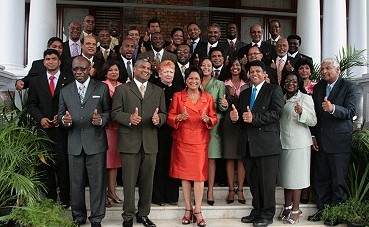
We are now in an interesting space, between the noise of the election campaign and the appointment of some of the most powerful government officials. The new Cabinet was sworn in on Friday 28th May and the appointment of officials to the SPEs and Statutory Corporations is about to take place.
As noted previously, these SPEs are arguably now more powerful than the traditional civil service, in both the scale of their operations and the loose oversight regimes within which they exist.
As I noted in the first part of this article, published on 16th April, our history is that newly-elected governments will select their own candidates to fill these vacancies. Apart from the issues of ritual dismissals which were identified then, there are further points to be made at this stage.
The People’s Partnership has won a resounding electoral victory and it seems that a significant number of voters were voting for a change from the large-scale corruption and bobol which had become commonplace.
There were some precedents set by the last PNM, which were so shocking, even by our elastic standards, that they must be highlighted, so we can ensure they are never repeated.
Even though the People’s Partnership is still in the ‘honeymoon period’, it is timely to set out these precedents for consideration –

Of course, these are all made more painful, by the fact that they are true and also, by the strange position of Jack Warner MP, our new Minister for Works and Transport. As far as I am aware, once one is appointed to serve in Cabinet, which is effectively the highest office, one is obliged to demit all other offices at once. The notions at work here being the general principle that it is impossible to serve two masters and also this instance being one in which the responsibilities are so serious that ones service must be total and dedicated.
Jack Warner has confirmed that he will be keeping his roles as a Vice-President of FIFA, President of CONCACAF and Special Adviser to the Trinidad & Tobago Football Federation. Simply amazing. Of course, I am subject to correction, but it seems to me that this is an absolutely unacceptable situation. It is impossible for Warner to serve two masters and this is not a precedent which should be tolerated at all, at all.
I want change, not exchange – Question is “Can the People’s Partnership deliver that?”
 AfraRaymond.net