Property Matters – Procuring State Housing – Part 2

Some concerns have emerged on the concentration of a large number of land agencies and, of course, the newcomer, LandMarkTT Properties Ltd, into the portfolio of Land and Legal Affairs Minister Saddam Hosein. While it is true that there are now a large number of state agencies under this Minister’s control, I balance that against two perspectives.

  1. Firstly, Trinidad and Tobago has always had severely oversized Cabinets, given our modest size, so as a point of principle, a large number of agencies under one Minister is not in itself offensive to good order. That would really depend, in my view, on the quality of the various Boards and Officials of those agencies.
  2. Secondly, the OPR has a statutory role in ensuring compliance with the Public Procurement & Disposal of Public Property Act, which Minister Hosein expressly affirmed when explaining how these agencies will work together. See Govt clarifies Landmark TT housing model amid criticism – Trinidad Guardian.
According to its own website, LandMarkTT Properties is expressly catering to ‘…the growing demand for high-quality, unsubsidized housing…‘ see Home – LandmarkTT Properties Limited – GovNeTT Digital Experience Platform.

Under the OPR rules, LandMarkTT Properties is required to publish all contracts awarded, but reportedly did not do so for that ‘Allamby’ contract until after the OPR’s formal request. That is the ‘thing’, but what is the ‘meaning of the thing’? Was it that those public officials knew of the legal requirement and just ignored it, or was it that those officials were simply unaware of that requirement? More to the point, which of those alternatives is worse? So why can’t this ‘Allamby’ contract be published now?

Minister Saddam Hosein

Just consider Minister Hosein’s statements to Parliament on Friday 15th May 2026 that no Public Money is being spent on this ‘Allamby’ project –

…the State is not required to seek financing for any of these housing projects, as no public funds will be used for the construction of those houses…

…The developers will be required to fund the entire construction and infrastructural cost of the projects…”.
(both citations are from pg 7 of that day’s Hansard)

Two questions need to be answered –

  1. Firstly, what is the area and value of the State lands committed to this project?
  2. Secondly,the ‘Allamby’ Contract sum is disclosed as $129,283,650.00 at the Contracts Awarded – LandmarkTT Properties Limited – GovNeTT Digital Experience Platform website. So, if ‘no public funds will be used’ on this project, what does the reported figure of $129.3M refer to?

Moving beyond ‘Allamby’, if we accept the express statements on LandMarkTT Properties along with the disclosed contract sum, these are investments of public resources in a part of the housing market already served by the private sector. That is ‘crowding-out’ of private sector developers, which really only ought to be done if there are strong externalities to justify the action.

To my mind, there does not seem to be any visible difference between the programs of the HDC and LandMarkTT Properties.

The LandMarkTT Properties’ contract, now under OPR review, and the HDC’s intended award of eleven contracts totalling $3.48 Billion to create 3,700 new homes are a continuation of the misguided public housing program under the 2002 National Housing Policy. That Policy finds statutory expression in the HDC Act (No 24 of 2005) at Section 13(1)(a), which mandates HDC to create affordable housing for low and middle income applicants.

Just consider the basic arithmetic, which shows us that those new HDC contracts would produce housing at a contract sum averaging $940,000.

[$3,480,000,000 ÷ 3,700 = $940,540].

Please remember that the land is never included in these announcements, so those sale prices would be in the $1.0M range, which would require monthly mortgage payments in the $7,000 range and a monthly household income in excess of $21,000. The most recent CSO research was the 2011 census, which showed that 70% of our households have a monthly income of less than $9,000. So, what are we really doing?

The issue here is that most of the HDC applicants cannot qualify for a mortgage, simply because they are too poor. At least 95% of those HDC applicants are in that predicament, while getting news of these huge new projects with no provision for any poor families. None for them. Despite the self-serving press statements and the utter abuse of the word ‘affordable’, the entire new program comprises new homes for sale. Not one new home for rent. There is an undeclared ‘cozy consensus’ between our political parties on this important issue, at least insofar as remaining silent on new homes for our neediest citizens.

That undeclared consensus can embolden public officials to make entirely bizarre statements. Just consider Minister Hosein’s reported statement to Parliament (p.6) on Friday, 15 May 2026:

“Under the PPP model, the State shall make lands available to private-sector investors and developers who shall, in turn, construct fully planned housing communities targeted at mid-to-upper income earners. These housing units will be situated in gated communities, with modern design and amenities to cater for the working class.”

So, ‘mid to upper income earners’ are now being openly portrayed as ‘the working class’. Well, I tell you eh.

Going further, there is a pregnant issue when one considers the intersection between these Housing Policy issues and the Public Procurement and the Disposal of Public Property Act (PPDPPA). The established learning is that Public Money is to be managed and accounted for to a higher standard than Private Money. That is fundamental in understanding the importance of high standards of Public Sector Governance. Our Housing Policy and its statutory root require that HDC dedicate itself to creating affordable housing for low- and middle-income applicants. Alongside those obligations in its originating statute, HDC is also required to comply with the PPDPPA and the OPR regulations. The PPDPPA/OPR mandates that every project, before it is advertised, must have satisfied a Needs Assessment, which requires the deep consideration of these questions: What are we doing? and Why are we doing it?.

Interestingly enough, that process is part of the internationally accepted Procurement Cycle used in both the Public and Private sectors.

When one juxtaposes the demonstrated Housing Policy dysfunction with the legal requirement for a Needs Assessment, it is inconceivable that those projects, which do not at all conform to HDC’s legal requirements, could have satisfied any proper Needs Assessment. Of course, it is open to HDC to show us otherwise, after all we are paying for the whole exercise, not so?

Thus far, our reports and debates on these issues have been confined to the usual claims of connected contractors, politically favoured players and allegations of improper behaviour. None of those issues are unimportant and they must be treated with due seriousness, but what is emerging here is the far more serious implications of our entrenched practices. The PPDPPA established ‘Value for Money’ as being fundamental, but if we are to recognise the moment for what it is, what we now need to develop and advance is the notion of ‘Value for Public Money’. We must explicitly behave as if Public Money is more important than Private Money, there is no alternative. We have to advance these concepts to properly defend the Public Interest.

Given that ‘cozy consensus’ between the political parties, we cannot expect these critical issues to be raised by any of those. Issues of this kind ought to attract the attention of our scholars at UWI and UTT, but here we are. Between a rock and a hard place, what a disgrace.

Property Matters – Procuring State Housing – Part 1

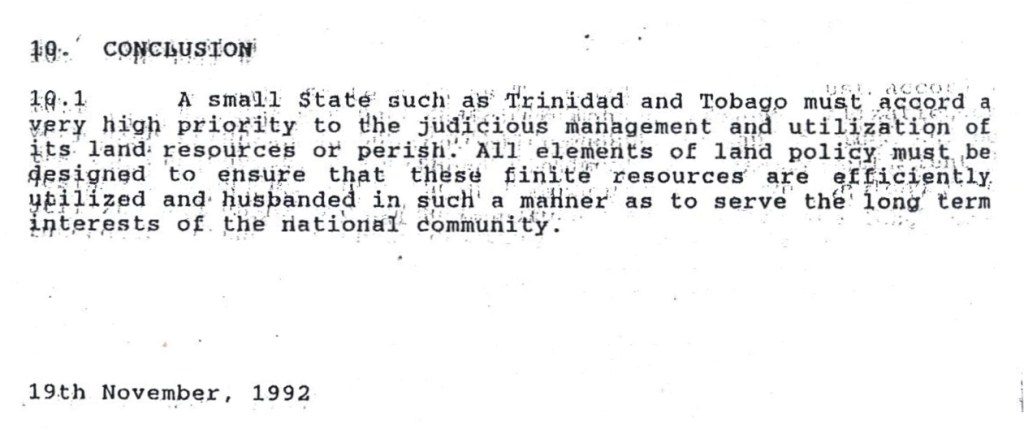
Conclusion of National Land Policy 1992

This is the first part of my two-part analysis of some fundamental and large-scale issues of the State’s Land and Housing Policies and Programs. This first part deals with the background, while the second part will deal with the unfolding issues on the Trinidad and Tobago Housing Development Corporation (HDC) and LandMarkTT Properties programs. This analysis is based on the relevant policies, laws, official statistics, and published statements.

Showing Trinidad and Tobago A New Way Home

Our country actually has a National Land Policy (1992) and a National Housing Policy (2002), both of which have been effectively erased by successive political administrations. So that is why none of the officials busily commenting on land and housing ever refer to our existing national policies. If one were to try searching official websites for those policies, it would be fruitless, far less to actually request those policies from one of the responsible State Ministries or Agencies. Our public officials make bold public statements, while we are witness to huge public investments in this critical arena, all without regard to the approved national policies. That is the framing for the collective fix that we are in, and this has been the case for over 20 years now, since the official policies became inconvenient.

I will demonstrate how the official land and housing programs have unfolded in an increasingly contrary manner when compared to the objectives of the official policies. Policy Review is a normal procedure to ensure proper alignment between objectives and outcomes. The problem in this instance is that a policy review would have required a full statement of the facts in terms of both spending and performance, together with public consultations. Those practices are serially avoided by successive political administrations, so the solution was to simply ‘erase’ those national policies from view and carry on regardless. This is the detrimental sly erasure which has ensured that those beneficial policies are effectively concealed from the public it is intended to serve. That is the background to the ongoing silence on our National Land and Housing Policies. I have kept those Policies, hence my continuing series of challenges.

The Land for the Landless program, which is handled by the Land Settlement Agency (LSA), needs a significant adjustment to its rules, since although that program was intended for those applicants outside HDC criteria, its monthly income limit is $30,000, while the HDC’s monthly income limit is $25,000. (Click here for Frequently Asked Questions on HDC website). Quite frankly, apart from the re-establishment of an LSA limit which is lower than the HDC limit, both those monthly income limits need to be greatly reduced to reflect reality. We often hear of fact-based decision-making as a desirable approach to complex problems, so the qualification criteria for these State land and housing programs must be reconsidered in light of the most recent CSO research (2011 census) showing that 70% of our households have a monthly income of less than $9,000. That means that the monthly income limits for these programs are far too high if the intention is to address the dire situation of the neediest households.

The actual household income levels in our country are so low that over 95% of the applicants on the HDC’s waiting list cannot ever qualify for a mortgage, simply because they are too poor. We set these unrealistic maximum income levels for applicants, and the result is plain to see. Most applicants cannot afford to buy, and yet we have a state housing program supposedly intended to assist the neediest families, which almost exclusively focuses on homes for sale. The HDC is a Statutory Agency, established by Act No. 24 of 2005. It is a creature of Statute and therefore bound to follow that law. Section 13 (1) (a) of the HDC Act requires it to provide “affordable shelter and associated community facilities for low and middle income persons”. That sequence is no accident; the very HDC Act gives precedence to the low income persons, it’s in the law. The income profile amongst applicants and the text of the originating Act gives priority to HDC building homes for rent in preference to homes for sale. Yes, that is the law, so what is the actual result? My detailed research into the current 2002 Housing Policy shows that HDC has never built more than 21% of its new homes for rent. Those findings are from 2003 to now, so the lack of focus and sheer misallocation of vast sums of Public Money spans several political administrations. In this one thing at least, there is some kind of unusual consensus between supposed political rivals.

Saddam Hosein, MP, Minister of Land and Legal Affairs

Public Private Partnership (PPP) approaches to housing provision are now in vogue, but we need to consider the extent to which that model can deliver the decent housing so desperately needed by our poorest citizens. In addition, while we note the Minister of Land and Legal Affairs, Saddam Hosein’s declaration that no State monies are to be spent on these projects, two issues arise. Firstly, there is a long-term and detrimental blind spot in how projects are discussed in our country in that we never, ever mention the value of the lands being dedicated to these projects so that the only figure mentioned is the contract sum for the construction. That needs to change – the State needs to explicitly declare the value of the lands being dedicated to these projects if we are to have a clear picture of the total cost of these developments. Secondly, the PPP agreements I have seen all have provisions that effectively inoculate the private sector party from any losses if there should be a shortfall in the projected sales. In such cases, the State is in fact guaranteeing the return of the private sector by removing those risks, so one is entitled to wonder just what risk the private sector is bearing. If the answer is that the private sector is bearing no risks, that means that we have been pursuing a detrimental PPP model, thus far.

Minister Hosein’s statements that the State has not contracted to make any payments within those arrangements needs to be carefully scrutinised. Firstly, as I stated earlier, we need to include the value of the land in our consideration of these projects, it is not possible to appreciate the full scope of these projects if we continue to omit the land value. That is also ironic given that the ‘Land and Legal Affairs Minister’ is going to be playing a leading role in these arrangements going forward. Secondly, apart from disclosing those previously concealed land costs, we also need to acknowledge that these contracts commonly allow private developers to get paid by the State if the projected commercial outcomes are not met. Quite simply, I do not at all accept the notion that no Public Money is at risk in these projects. It all comes down to the difference between the cash and accrual approaches to accounting and that can be a challenging matter for some people.
