“…Whereas the People of Trinidad and Tobago—…(b) respect the principles of social justice and therefore believe that the operation of the economic system should result in the material resources of the community being so distributed as to subserve the common good…”
From the preamble of our Republic’s current Constitution (1976)
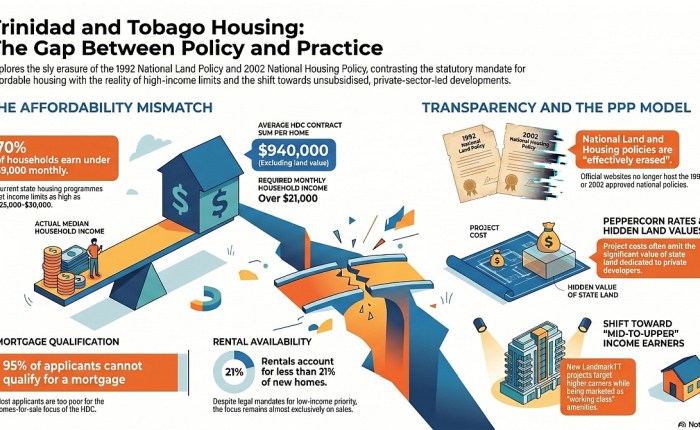
The simple truth is that the overwhelming majority of HDC’s applicants can only afford to rent, but nothing is being built for rent. That is the challenge we face in terms of realising the objectives of our Housing Policy.
I thought this would be a two-part analysis, but the final conclusions required a fuller treatment, hence this closing article to place those issues in a public policy context. My analysis led me to the conclusion that the HDC’s projects could not in any way have satisfied a proper needs assessment, as required by the Public Procurement and Disposal of Public Property Act (PPDPPA). As such, this is a call for the OPR to engage these public policy issues with the required seriousness.

 This is my second essay on the size and meaning of the Housing Gap. That is the gap between the beneficial intentions of the Housing Policy (2002) and the needs of the actual applicants, the neediest citizens, in this my Season of Reflection. The State Institution with responsibility to close that gap is the Housing Development Corporation (HDC). The Land Settlement Agency has responsibility for providing serviced lots but that is a minor part of the output.
 The inescapable challenge for our national housing program is to provide sufficient affordable housing options of a decent quality. The HDC’s waiting-list is now in excess of 176,000 individual applicants, which excludes co-applicants or dependents. Over 90% of those applicants cannot afford a mortgage or to ever buy their own homes. They are just too poor to do so.
