Afra Raymond sits down with Jessie May Ventour and Fazir Mohammed for a discussion on the new initiative by the new Government to the ongoing CL Financial bailout.
Afra Raymond sits down with Jessie May Ventour and Derek Ramsamooj for a discussion of matters pertaining to the CLICO and CL Fianacial bailout prior to the national elections.
On Sunday 6th June the Trinidad Express’ Investigative Desk published yet another series of exclusive reports from Camini Marajh and those are once again, raising more questions than answers.
The reports revolved around some of the recent dealings of Home Construction Limited and their financing via First Citizens’ bank. The Home Construction group of companies is an important part of the CL Financial empire – that CLF empire is being bailed out by the State.
The key issues arising from the reported information would seem to be –
Interest rate – It was reported that First Citizens’ bank extended a credit facility to Home Construction Limited in excess of $1.0Bn as a 5-year demand loan. The interest rate was reported to have been at 7.5% and that seems very low when one considers that commercial demand loan facilities are being offered now by the banks in the 10-11% plus range. But that interest rate could also be explained by other factors.
Markdown of Security – For example, there may have been measures taken by the lender to obtain beneficial markdown on the various securities held against the funds advanced. In this case, it is being claimed that the property valuations obtained from a Miami-based firm were on the conservative side and that may be grounds to consider that HCL offered a greater measure of security for the funds advanced. The point here is that asset values are indeed lower than they have been in recent years and those are the current values, however uncomfortable that might make the borrowers.
State guarantee – The other aspect of the matter is that the terms of the bailout are tantamount to a State guarantee for the debts of the CL Financial group and that would have to include the HCL group of companies. In the circumstances, the importance of the underlying, written guarantee is such as to almost eclipse the properties held as security.
Timing – An interesting point is that the deal is reported to have been signed on Thursday 20th May, virtually on the brink of the recent general election.
Over-concentration of risk – One of the fundamental guidelines to prudent financial behaviour is that one should avoid putting all ones eggs in one basket. When one examines the CL Financial fiasco, over and over, this basic principle has been violated. In ‘Taking in Front‘, published in the Sunday Guardian on 25th April – see also http://guardian.co.tt/business/business/2010/04/25/taking-front – I analysed how the NGC’s prudent rules for placement of deposits appeared to have been compromised by the attractively high interest rates offered by the CLICO Investment Bank. As another example of this, there are people, who had put virtually all their savings into the CL Financial group. In this case, we have yet another sobering example. This demand loan was stated to have been for $1.073Bn to HCL for a period of 5 years at an interest rate of 7.5%. According to the audited accounts which form part First Citizen’s 2009 Annual Report – see https://www.firstcitizenstt.com/dms/AnnualReports09/FC-Annual-Rpt2009-3/FC-Annual-Rpt2009-3.pdf – its total loan portfolio as at 30th September 2009 was $11.87Bn. This single facility therefore comprises over 9% of its loan portfolio, to a single borrower, known to be in financial difficulties. That seems to be an over-concentration of risk. A related question would have to be whether the CL Financial group has further borrowings from First Citizen’s, apart from the load assumed from CLICO Investment Bank.
Crisis measures – We should not be surprised that the present financial crisis is being used to justify the unorthodox crisis measures being deployed to handle various situations. The purpose of this demand loan facility was stated to have been for the restructuring of HCL’s existing facilities. Which means that this level of indebtedness pre-existed the collapse of the CL Financial group.
Related Parties – According to the Governor of the Central Bank, speaking at the press conference to announce the CL Financial bailout, one of the main causes of the collapse was ‘…excessive related-party transactions…’. In this case we have the boards of CL Financial, HCL and First Citizen’s bank, all being appointed by government, with a huge single loan to a single borrower.
The State’s position – The most astonishing part of the entire Sunday Express story was the question as to whether the various Directors of the Boards of companies within the CL Financial group would be resigning. Marlon Holder, CEO of the group and Chairman of CLICO is reported to have said that
…there was no need since CL Financial was not a statutory State company, and the shareholders’ agreement signed between Lawrence Duprey and the Government required agreement by both sides before any change could be instituted…
If I am reading that right it would seem that the terms of the June 12th 2009 Shareholders’ Agreement were being invoked to secure the positions of the present holders of high office in the CL Financial group. If this position as outlined by Holder is indeed correct, then there seems to be an urgent need for those terms to be re-examined and/or renegotiated.
SIDEBAR: The importance of Critical Thinking
Dr. Bhoendradatt TewarieDr. Bhoendradatt Tewarie is a former UWI Principal, Director of CL Financial and Republic Bank Limited. In ‘People’s Partnership Position’ on 23rd May – see http://wp.me/pBrZN-fG – I was critical of his continued silence on the collapse of this, the Caribbean’s largest conglomerate.
Apparently Dr. Tewarie is also the Director of the Institute of Critical Thinking at UWI. Listen to his conclusion to the Director’s Statement –
…The present in which we now live has already been created for us or we ourselves might have knowingly or unknowingly conspired to create it. But we live and we learn. The important thing is that we learn. When we learn we grow and evolve and are better able to deal with the inevitable new challenges. And so we press on…
We need a proper account from Dr. Tewarie on the last days of the CL Financial group. The people who are responsible for this scale of collapse must render an account. To fail to do so would only compound their failure and we would have to banish them to obscurity.
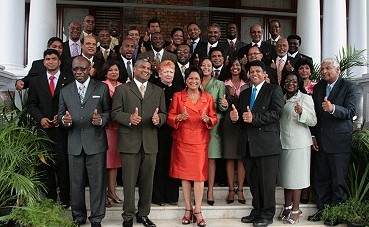
Newly sworn-in TT Cabinet and other high government officials.
We are now in an interesting space, between the noise of the election campaign and the appointment of some of the most powerful government officials. The new Cabinet was sworn in on Friday 28th May and the appointment of officials to the SPEs and Statutory Corporations is about to take place.
As noted previously, these SPEs are arguably now more powerful than the traditional civil service, in both the scale of their operations and the loose oversight regimes within which they exist.
As I noted in the first part of this article, published on 16th April, our history is that newly-elected governments will select their own candidates to fill these vacancies. Apart from the issues of ritual dismissals which were identified then, there are further points to be made at this stage.
The People’s Partnership has won a resounding electoral victory and it seems that a significant number of voters were voting for a change from the large-scale corruption and bobol which had become commonplace.
There were some precedents set by the last PNM, which were so shocking, even by our elastic standards, that they must be highlighted, so we can ensure they are never repeated.
Even though the People’s Partnership is still in the ‘honeymoon period’, it is timely to set out these precedents for consideration –
The Spouse factor – Our last PM made local history when he appointed his wife, Hazel Manning, to the Cabinet in 2001. The PM went to pains to list his wife’s qualifications to head the Education Ministry. A few weeks later, he defended his appointment of Howard Chin Lee as Minister of National Security, saying on that occasion that no one needed particular qualifications to serve in his Cabinet. That was bare nepotism, which paved the way for much of what was to follow.
Shareholdings – Almost everyone was shocked to read in these pages the revelation that the then Minister of Finance, author of a learned work on the ethics of the legal profession, was in fact a shareholder of the CL Financial group, which had been bailed out on sweetheart terms, with no punitive action against any of the main players – see http://www.trinidadandtobagonews.com/blog/?p=997. A Blank Cheque Bailout. What shocked almost no one was the PM’s stout defense of his colleague “I wish to re-affirm the confidence that I had in the Minister of Finance…” or his bizarre insistence that the criticisms of the Minister’s obvious conflict of interest was rooted in a desire, by those opposed to the government, to erect impediments in its way – see http://www.newsday.co.tt/news/0,96934.html.
Multiple Directorships and Chairmanships – Another bad one was the fact that five (5) Chairmanships of major State-controlled companies were held by a single individual. That has never happened before and it is impossible for any individual, however talented or hardworking, to discharge all those duties properly. Although what I am saying is basic good sense, an entire Cabinet acceded to that level of sheer recklessness. In simple terms of the long-time saying about all of ones eggs in one basket, that situation was a good example of collective irresponsibility on a tragic scale.
Overlapping of appointments and portfolios – In the case of the so-called Independent Senator, Michael Annisette, we had to endure that appointment at the same time as he held Directorships in 5 State-controlled companies. Of course Annisette’s position was completely implausible and conflicted, which became obvious when he became an outspoken defender of UdeCOTT during the recent revelations. Simply unbelievable, but true – all at the same time.
Non-accountability of Special Purpose Entities – For example, UDeCOTT has had no audited accounts since the end of 2006 and yet they have enjoyed the PM’s praises, with no censure at all. The peril this creates is that we can end up with SPEs which are totally out-of-control, with borrowings – all ultimately forming part of the State’s indebtedness – which are concealed due to the lack of accounts. That is a truly dangerous place to be and what is worse, the people who oversaw this collapse of normal prudent values and good management principles are unlikely to suffer any penalty or loss. That must change.
Parliament proper role – Parliament has to be restored as the principal place in which the people’s business is discussed and the one I am thinking about here is the Caribbean Airlines/Air Jamaica deal. That was first announced in January and we were told that there would be no monies invested from Trinidad & Tobago. After much talk about the limits imposed by the confidentiality clause, we learn on 1st May, in the midst of the election campaign, that the deal was signed at a cost of $50M USD – see http://www.usatoday.com/travel/flights/2010-04-30-carribbean-air-jamaica_N.htm. Parliament was never the forum for any proper discussion of this matter, with all its long-term implications yet unrevealed. We need to restore Parliament to its proper place.
Austin "Jack" Warner, MP, Minister of Works & Transport and UNC Chairman
Of course, these are all made more painful, by the fact that they are true and also, by the strange position of Jack Warner MP, our new Minister for Works and Transport. As far as I am aware, once one is appointed to serve in Cabinet, which is effectively the highest office, one is obliged to demit all other offices at once. The notions at work here being the general principle that it is impossible to serve two masters and also this instance being one in which the responsibilities are so serious that ones service must be total and dedicated.
Jack Warner has confirmed that he will be keeping his roles as a Vice-President of FIFA, President of CONCACAF and Special Adviser to the Trinidad & Tobago Football Federation. Simply amazing. Of course, I am subject to correction, but it seems to me that this is an absolutely unacceptable situation. It is impossible for Warner to serve two masters and this is not a precedent which should be tolerated at all, at all.
I want change, not exchange – Question is “Can the People’s Partnership deliver that?”
In view of the season and the issues raised so far in this series, I am setting out some ideas about the scale of challenge we must overcome to achieve change, not exchange.
The State-owned Special Purpose Entities (SPEs) are an important part of the picture in the provision of goods and services to our country.
“The idea that important SPE/State jobs and contracts are available for those in political favour is one of the things we have to change.”
Who is to run these important entities? In what manner? These questions of “w” are central to the sharp public concerns over the level of corruption at and performance of, these agencies. My contention is that there are two contending tendencies in the minds of those who make that sort of decision.
The first of these is the professional, sensible idea that some elements of the SPE-world are so complicated and important that the best people have to lead them, regardless of their political affiliation. In this space I am sketching, that would include elements like First Citizens’ Bank, Unit Trust Corporation, National Insurance Board (including its affiliates NIPDEC and TTMF), UDeCOTT, HDC, NIDCO, WASA, TTEC, TSTT and so on. It seems reasonable to take the position that these companies should be run by the most competent staff of integrity and along ‘best-practice’ guidelines.
The second of these is the idea that having been victorious in a national election, the ruling party has the right to appoint whomsoever it wants to key positions. Some would go so far as to say, it is not just a right, but a duty, given the sacrifice and contribution of certain supporters. The rationale here being that we exist in a democratic system and the best positions in the State empire rightfully belong to the ruling party, to give to those in political favour. Those people may be seen as being more sympathetic to the objectives of the ruling party.
The two ideals exist in fundamental tension, moreso since other aspects of the question are also in flux.
There is no clear agreement as to the boundary between the critical SPEs and the rest. Some of the players believe that every SPE should be subject to their political whims, while others have clear ideas as to which ones must be managed professionally.
Also, it is quite likely that the two ideas co-exist in the minds of some of the main players. That is, they are themselves severely conflicted on the entire subject.
The idea that important SPE/State jobs and contracts are available for those in political favour is one of the things we have to change.
At this moment we are poised before a snap election, with a highly-charged atmosphere on the issue of SPE corruption. Even devotees of the ruling party seem to be shocked by the scale of the problem. Whatever the outcome of this election, there is likely to be considerable action on this aspect of public affairs.
If the present ruling party wins convincingly, we are likely to see a triumphant return to the stated policy of Expediency in Public Affairs. Those winners could declare that the policy approaches which brought us to this sorry place are the right ones, which were endorsed by the electorate, so we return to mismanagement and dishonesty.
The possibility of a victory of the Peoples’ Partnership also holds challenges in this area, since they could return to old habits. By that I intend to remind readers that when UNC took office in 1995, there was a widespread series of dismissals of top-level staff at SPEs. It was so large-scale that the late Grand Master wrote a 1997 calypso on it – ‘De No-Work Band’. It was never a very popular one of Kitch’s numbers, but those people who suffered sudden and unjustified dismissal will remember the tune, as well as the words. Plenty names and bitter-sweet too bad. PNM did much the same thing when they returned to office in 2001. No kaiso for PNM, though.
That pattern of brusque dismissals and crude exchange is highly questionable, given that both parties have fundamentally similar economic and social policies. It seems to me that the dismissals are motivated more by by vengeance and a desire to control the vacated jobs, than by any actual difference in ideology or approach..
This is what I mean, in saying that we need change not exchange.
It might seem unlikely, but we could very soon be confronting these issues of who runs our SPEs and how, in what is likely to be a harsher, sharper fashion than ever before.
The ingredients are all there –
High stakes in terms of highly-paid jobs;
Huge contracts to be distributed;
The atmosphere of hubris which seems to fill the highest chambers of our Republic;
Either the thrill within the Peoples’ Partnership upon winning this snap election or the sheer triumphalism of the current ruling party to have beaten all its united detractors;
The poor moral fibre of those involved.
Yes, come 25th May, we could be seeing a situation which eclipses all the wildness which has gone on so far in this country of ours.
It is clear that there are certain SPEs which must be forensically investigated, with people charged under the law with a view to recovering the stolen funds and restoring a healthy atmosphere to public life in this country of ours. I have already given a lot of detail on those SPEs. My point holds ‘irregardless’ of who wins the election. The situation of gross mismanagement and unpunished corruption is too dangerous to our good health as a nation to be allowed to continue just so.
It is equally clear to me that there are serious, capable and committed people in our SPEs. Those people have been exemplary in the execution of their duties and added real value to the public service in this country. They are all now at risk of suffering the fate of other ‘political appointees’ when the other side wins.
It is not good enough for us to shrug and murmur that that is how these things go. We are a small country, with limited human resources and we cannot spare the intellectual capital which is evaporated every time we go through these purges.
The reflections continue this week, by drawing heavily on the text of the Uff Report and the transcripts of the Uff Commission, to set some of the scandalous facts into context. This is for those who are still wondering ‘What was it all really for?’
Last week I wrote that the State must behave in an exemplary fashion. It is also important to know that the State has a responsibility beyond the moral plane. On an entirely practical level, it is clear that the State controls the majority of economic activity in our nation. As such, it is responsible for the majority of construction projects in the country. If we exclude the exceptional projects built for the energy sector, over 75% of the construction in the country is carried out by the State.
Apart from statutory undertakers – like TTEC, WASA, TSTT etc. – the State carries out most of its capital investment via various SPEs. Those would include:
National Infrastructure Development Co. (NIDCO)
Housing Development Corporation (HDC)
Urban Development Corporation of T & T (UDeCOTT)
University of Trinidad & Tobago (UTT)
Evolving TecKnologies and Enterprise Development Company Limited (e TecK)
Education Facilities Co. Ltd (EFCL)
The conduct of the State is therefore fundamental to the conduct of a huge slice of the business activity in our country. If the behaviour in the majority of our commercial relationships is improper, that is good reason for the cynical attitudes and poor standards which flourish.
Yes, there is considerable ambiguity in the term ‘improper’ and I am therefore going to illustrate.
The role of Boards of SPEs – As I said when warning against the appointment of Michael Annisette as an Independent Senator – see https://afraraymond.wordpress.com/2010/04/22/2008/01/12/an-unhealthy-choice/ – speaking of “…Directorships in significant State-owned enterprises…it is a widely-held view that such appointments, especially to those who are not experts in the relevant fields, are only offered to those in political favour. To put it plainly, one would hardly expect to see UNC or COP members, however expert, on State Boards under a PNM administration…” Despite the fact that there are many excellent and hardworking Directors of SPEs, that is the background to those appointments. Just to make sure, given the ‘silly season’ we have entered, I am equally convinced that when UNC was last in power they also allocated those SPE Directorships in a similar fashion.
The role of the Executive Management – Suffice to say that there is little difference in the considerations when making those appointments.
The role of consultants and contractors – It is impossible to say who these stakeholders support, apart from themselves.
One of the perennial questions is ‘How come State projects are almost always overbudget and late?’ That is a truly universal question and the problem, if only the main element is isolated for discussion, is that the parties are too close.
The typical contractual and managerial controls of budgets, accounting systems, independent professional advice and penalty clauses were all violated wantonly. Our Treasury has been plundered. See the sidebar for an extract from the Uff Report.
UDeCOTT and the HDC are the State’s two main agencies in the move to physical development, they are both under the Ministry of Planning, Housing and the Environment.
We are now clear that both have been failures when measured against the goals set for them. The sheer scale of the failure will be set out next week in this space, again with extracts from the published record.
We need to ask what has to happen differently? Can we make the change?
SIDEBAR: What is ‘Good Governance?’
Governance is one of the vexed aspects of this discussion on the purpose and performance of Special Purpose Entities (SPEs). Whether we are looking at the HDC or UDeCOTT, the concerns are similar.
At the national level, we can have a broad description of good governance which includes elements such as – equity, participation, accountability, transparency and conforming to the rule of law. Of course, when we focus on the SPEs, there is a narrower definition of good corporate governance being the rules which are followed by a Board of Directors to achieve fairness, accountability and transparency in the relations with the company’s stakeholders.
When one considers that the SPEs were introduced to overcome the delays of the old civil service rules, their corporate governance rules are key in achieving those elusive levels of performance.
Extract from the Uff Report – Paras 62 and 63 at pages 33/34.
“Holding to account
62. We have observed, in the context of contractual issues as well as regulatory matters that there exists a culture of non-enforcement which appears to operate on a mutual basis. Contractors seem reluctant to issue proceedings for payments overdue or to enforce claims and employers in turn refrain from enforcing time obligations which are routinely not complied with. In regard to delay issues, the point was demonstrated by the fact that no witness or representative appearing at the enquiry was able to quote any case in which a contractor had actually been required to pay or had been debited with liquidated damages. In the wider field there was a tacit acceptance that regulatory approvals, particularly as to planning, were rarely given in a final form before the work was performed, this coupled with an expectation that such approval would be forthcoming retrospectively.
63. At the same time we had the impression that one contractor who made a habit of enforcing contractual rights, if necessary by formal proceedings, was regarded as being “confrontational”. Such an attitude does not sit well with the careful drawing up of commercial agreements; nor with competitive tending, which is carried out on the basis that contracts will be enforced. It is also inconsistent with the clear duty of directors of companies and public bodies to enforce the contracts they negotiate and enter into. If there is a desire to promote the timely and proper performance of public sector contracts, this will only be achieved by holding parties to account for any breaches of contracts freely entered into; as well as enforcement of legal duties in regard to regulatory matters. Enforcement must also be assured through efficient and timely processes of courts and other tribunals.”
One of the abiding questions on the CL Financial issue is – ‘What main event/s caused the group to fail?‘
One of the main rumours making the rounds at the time of the bailout was that the State-owned National Gas Company had made heavy withdrawals from CLICO Investment Bank. Those withdrawals and the requests for the return of further deposits were said to have triggered the ‘crash’ within the CL Financial group.
Another major issue which was raised in the Parliament by the current leader of the opposition was the allegation that the Minister of Finance and Governor of the Central Bank had used ‘insider information’ to withdraw their own deposits from CIB. Despite the explanations by these officials, which form part of this article, those perceptions persist among the population.
Ultimately, the questions have to be ‘What did they know?‘ and ‘When did they know it?‘ This article will delve into some of those issues, using the published record, as is my practice.
The main points are –
Frank Look Kin, Former NGC President
The NGC press release – This was published in the daily newspapers on 4 February 2009, as a corrective to the widespread and potentially-damaging rumours. It was issued under the hand of the NGC President, Frank Look Kin – it is the penultimate item on its publications page, under the title ‘Press Release- NGC’s Management of Its Financial Investments‘. Due to its huge revenues (stated to be $14.0Bn in 2008), over 90% of which are in US dollars, the NGC has established a policy for the management of its large-scale, short-term investments. According to the press release, those funds are placed in either approved financial institutions or investment-grade rated foreign banks. The placement of those deposits is guided by limits for the percentage of funds allocated to a financial institution or group of financial institutions. The selection of deposit-taking institutions and the establishment of placement limits are both good financial practice in terms of risk management.
NGC’s placement limits – These were not disclosed in the NGC press release, but we are told that at the start of 2008, the CL Financial group was allocated 40% of the NGC’s deposits, which by the end of 2008 had been slightly reduced to 37%. At another point we are told that in 2008, NGC withdrew an average of $151M USD per quarter, with CL Financial’s portion of that being 45.7% – more than the 2008 allocations stated earlier.The silence on the actual placement limits means that we cannot determine whether the 2008 deposits in the CL Financial group complied with that policy. The only deposits for which we are told ‘…the deposits were within the maximum percentage limits…’ were CIB deposits in 2001, but no percentages were given in that case.We are also told that “…In the 4th quarter of 2008, deposits were recalled upon maturity from…seven financial institutions in Trinidad & Tobago and the USA…” Even if we only count the local ones, there are 6 large banks and 19 other approved financial institutions available to accept deposits under NGC’s policy. It is passing strange that up to 45.7% of NGC’s funds could be allocated to a single group. If that allocation of funds in 2008 was in conformity with NGC’s deposit placement policy, it is indicative of a tremendous measure of confidence in the CL Financial group, to put it in its best possible light. Even if CL Financial were a ‘blue-chip’ group, which they were not, such an allocation of deposits could be viewed as reckless behaviour by the responsible parties.Despite its claims of a policy to manage the risks associated with being responsible for such huge, short-term investments, it seems that the NGC may have yielded to the temptation of the unrealistically high interest rates offered by the CL Financial group. Again, on a governance note, one has to ask – ‘What good is a prudent policy, if it is violated in practice?’It seems that we may need to examine more closely how our energy revenues are invested.
November 2008 – We are also told in that press release that “…In November 2008 CIB failed to return the principal and interest upon the maturity of an NGC deposit (US$10 million). This deposit, plus interest, was paid in two amounts during the first week of December 2008…” From that statement it seems certain that CIB’s inability to repay was known to NGC, a huge, State-owned corporation. It is difficult to imagine that news of that importance would not have traveled to the very highest levels. Indeed, one could argue that proper management of the State’s financial resources would have required such a piece of news to be formally reported to the relevant officials.When one juxtaposes the fact that CIB “…failed to return…” $10M USD to NGC with the measure of confidence one can infer from the extent of their dealings, it is impossible to imagine such an episode passing off quietly.
The Minister’s response – That was a statement in Parliament on the very day and it is at pages 626 to 631 of http://www.finance.gov.tt/documents/news/spF82F5F.pdf. At the time of the CL Financial collapse, the Governor was clear in identifying the prime cause to be “…excessive related-party transactions…” and this NGC/CIB situation bears a strange resemblance.We need to strive for better norms of governance and prudence if we are to avoid a recurrence.History is said to be rich in irony, never more so than in this situation, since the defensive statements by both officials were made on the very day the NGC published its own defence. Wednesday 4February 2009.
SIDEBAR
Approved Financial Institutions
Those are taken to mean the 25 companies licenced under the Financial Institutions Act 2008. Those companies are all required to be members of the Deposit Insurance fund and their names can be viewed at http://www.dictt.org/deposit_insurance/index.php?pid=2006. There are 6 main banks on the list – Citibank, First Caribbean, First Citizens’, RBTT, Republic Bank and Scotiabank. Two smaller banks on the list are Intercommercial Bank and Bank of Baroda.
Interlocking Directorships
A continuing concern, in light of the growing challenges to the old order of the commercial and financial world, is the role of inter-locking Directorships. That is the situation in which a very small group of people control most of the major companies and activities in a society.
Critics of that situation would say that such situations are a recipe for corruption and self-serving behaviour. The small group of people can enrich themselves, leaving the leftovers for everyone else. Those who support that situation would say that the emergence of such a small group of leaders is natural, particularly in a small society such as ours, and the real challenge is to develop rules and norms which limit the possible negatives.
This is an issue which I am exploring in the ongoing series to examine the governance implications of the UDeCOTT fiasco. It is not surprising that it is also a feature of the CL Financial collapse and there is an example of that in the case of NGC and CIB.
The CIB Directors
At the time of the collapse, the Board of Directors of CLICO Investment Bank comprised –
Mervyn Assam (Chairman)
Amjad Ali
Anthony Rahael
Maria Thorne
Michael Callendar
Faris Al Rawi
The NGC Executive
At that time, the National Gas Corporation’s executive management included –
A Kaiso title for the Election season. And yes, we are told that CL Financial will rise again. The picture is even more clouded than a year ago and the rumours abound.
The latest developments are –
Press conference of 24th March – Justice Carlton BestFollowing a front-page Express story, on the impending lawsuit by Justice Carlton Best to recover his $57,000 CLICO deposit – see ‘I want my Cash’ at http://www.trinidadexpress.com/index.pl/article_news?id=161613671 – the Governor of the Central Bank held a press conference that very day to tell us that those waiting for the return of their deposits would have to hold strain – see http://guardian.co.tt/news/general/2010/03/25/delay-your-redemptions. The further shocking news, after all the emphatic official statements that the group had good assets, was that if those were liquidated there would only be 10 to 15 cents in the dollar available to pay claims. Now how could that possibly be the case? How are we to reconcile these conflicting accounts of the situation with CL Financial’s assets? Is it that they are fully-pledged, over-pledged, or is there actually any ‘headroom’ within which the taxpayer can have a chance to recover the huge sums advanced so far? Which is it? Please note that this is not an isolated situation, as shown by another threatened lawsuit from a former Attorney General of Guyana for the recovery of over $500,000 from CLICO – see http://www.kaieteurnewsonline.com/2010/03/27/former-attorney-general-threatens-to-sue-clico-trinidad/
Post-Cabinet Press Briefing – The Minister of Finance confirmed the Governor’s position to the media the next day, as reported in this paper – http://guardian.co.tt/business/business/2010/03/26/tesheira-clico-policyholders-be-patient. In that article, the Minister is reported to have affirmed, again, that “…“The CL Financial Group had sound assets that were valued at more than $100 billion…” Both the Governor and the Minister took steps to recover their own funds before the group’s financial troubles were public knowledge and that sits awkwardly, in the public mind, with their current appeals for patience.
Dr. Euric Bobb – At a Central Bank press conference on 31st March, resigned as Chairman of CLICO and as a Director of CL Financial, of which he was the Chairman, until his resignation late last year.
Governance – His statements as to the poor governance at CLICO, the leading company in the CL Financial group, were astonishing, to say the least – see “Governance was an alien term in CLICO’ at http://guardian.co.tt/business/business/2010/04/01/bobb-governance-was-alien-term-clico. No reconciliation of the company’s bank accounts. No audit committee. Those are serious shortcomings in the basic accounting and governance controls in any company. For one which had investment as its centrepiece, those are shocking. They give the impression of unprofessional and haphazard management of a significant part of our nation’s savings. They detract from the reputation of the CL Financial chiefs. Surely these shortcomings found their way into the Management letter from the Auditor to the Board and Shareholders? Was the Central Bank aware that these elementary controls were absent? Even if there are serious shortcomings in the financial procedures at CLICO, are we not entitled to rely on the Supervisor of Insurance or Inspector of Financial Institutions to resolve those in favour of the investing public?
Marlon Holder – At the same press conference, we heard that he resigned his job as Executive Director of the Unit Trust Corporation to become CEO/MD of CL Financial and Chairman of CLICO – see http://guardian.co.tt/news/general/2010/04/01/utc-boss-takes-over-clico-chairman. Mr. Holder has had a high-profile career in the financial services industry at Citibank, FCB and the Unit Trust Corporation, before this latest move and we await his recovery strategy.
Reporting the changes – Both the CL Financial Chairman and the new CEO/MD recently confirmed that one of their leading priorities was to furnish a report on the state of the group and the progress towards its re-structuring. That report is anxiously awaited and must include the audited accounts for 2008 and 2009. As stated before, this is not negotiable and will be most revealing as to the apparent discrepancies in the asset values.
The Private assets – We also read recently that former CL Financial chief, Lawrence Duprey, had taken steps to limit the information he was required to furnish to the liquidator of CLICO (Bahamas) as to his private assets, allegedly acquired with CLICO funds – see http://www.trinidadexpress.com/index.pl/nart?id=161623489.
Hence this week’s title. We await the audited figures.
Those moves by the Inspector of Financial Institutions represent, as far as I am aware, the first time that legal action is being taken on this scale to tackle those accused of ‘white collar’ crime. It is a decisive step to tackle the widespread impression that jail is not for the rich or lettered class in this society. The course of this trial will be closely observed as it is the first step in a very long and necessary journey.
Our notions of development are rooted in the aspiration toward equality and opportunity. Those worthwhile concepts must be extended to include true equality under the law.
One of the really fascinating aspects of this unfolding financial debacle, which includes the UdeCOTT collapse, is the idea that those accused of this sort of wrongdoing have extensive rights. That kind of consideration is seldom offered to those accused of run-of-the-mill crimes. If nothing, else, the CIB trial will be a kind of long-overdue ‘Open University’ course in the boardroom dealings which are masked from most of our people.
Former UDeCOTT Board, (l-r) Dr. Krishna Bahadoorsingh, Sen. Michael Annisette, Mr. Anthony Cherrie, Mr. Wendell Dottin
The leaking of the Uff Report, the delayed dismissal of the remaining, ‘squeaky-clean’ UdeCOTT Board members and the dissolution of Parliament are all part of a major distraction operation. The fallout from suppressing the Uff Report would have been huge and unpredictable, so the name of the game was spin. That spin is what we have been getting from government ever since we entered the end-game. The ultimate attempt to distract us was of course the dissolution of the Parliament by FAX on Thursday 8th April.
The strategy seems to be an attempt to provide the media and the population with even more interesting talking points, so that the Uff Report slips into obscurity. I expect that if the incumbent party is returned to office, there will be attempts to claim that the ‘mandate’ granted by that vote is a justification for the matters revealed in the Uff Report. Already a large slice of attention has been shifted to the impending elections, as expected.
I have no intention of allowing those distractions to take hold. I will continue to write on the lessons of the UdeCOTT fiasco.
This entire series of revelations is historic in that finally we have a Report by a Commission of Enquiry published. The second note for us is that it raises once again sobering governance issues, including matters of professional integrity and Directors’ responsibility. Those are aspects into which Property Matters will delve in the coming series.
Some main points for us to consider –
Cleaver Heights – The Uff Report makes it clear that there is no missing money. None. There are other serious concerns addressed in the Report as to the change in the form of contract and the fact that some $140M was paid to the contractor without title having passed to the State. I do agree that those are matters worthy of further investigation. To be clear, the questions would have to be whether any undue benefit was enjoyed by the contractor and, if so, how did the HDC’s checks and balances fail to detect and arrest this? Please note that the entire contract sum was never estimated to exceed $150M for this project. That said, we still have two mysterious parts of the puzzle to figure out – firstly, now that, under cross-examination, everyone has denied doing so, ‘Who told the Prime Minister that blatant untruth about ‘missing money’? Secondly, the renowned Forensic Accountant, Bob Lindquist, has been investigating the Cleaver Heights project for some considerable time now, so what are his findings? Note well that I am not asking for his report, since some ‘bright’ person would be quick to say that he never submitted his report or that it is incomplete. I am asking for his findings, even the interim ones, before we spend more money on more investigations.
The non-gazetting of the Uff Commission – We were all shocked to learn, at the end of August 2009, that the Enquiry had not been properly set-up, due the failure to ‘Gazette’. A special, one-man Enquiry into that episode was launched by the AG, with a final report handed into the AG on 9th December 2009 by retired Judge, Anthony Lucky – see http://guardian.co.tt/news/politics/2009/12/10/lucky-report-goes-cabinet-today-lead-pg3. What are the findings of the Lucky Report, Mr. AG? I think that we need to know and now, please.
Was there any evidence of criminal wrongdoing by UdeCOTT? – According to Para 14.41 of the Uff Report – “…there should be an investigation by an appropriate criminal law Authority into the award of the MLA contract to CH Development to include the role of Mr. Calder Hart and the conduct of the Board in not ensuring that an enforceable guarantee was given by the parent company of CH Development….”
Calder Hart – Was Calder Hart a good executive manager, who may have just ‘over-reached’ his authority in an effort to meet his demanding targets? According to Para 12.55 of the Uff Report – “…We have noted the apparent absence of any note of criticism or dissent within the UdeCOTT staff and the dominant influence of the Executive Chairman, Mr. Calder Hart. To the extent the failure of senior staff and directors to raise any voice in opposition to the level of financial irregularity found on the Brian Lara Project amounts to loyalty, such loyalty is clearly misplaced…”
That UdeCOTT Board – It was a relief to see the dismissal of these Directors. In fact, the more one considers their bizarre and reckless statements, the more obvious it was that this was indeed a large corporation in crisis. Problem was, that it was our money they were wasting and worse yet, failing to publish audited account for three years. A sad example of wrong and strong. The AG said, on 1st April as he announced that the Uff Report would be published in full, that Calder Hart was just ‘an ordinary citizen’. It seems to me that Calder Hart enjoyed benefits far beyond those extended to the ‘ordinary citizen’. I have never heard of the PM tipping off anyone else under serious investigation. The other UdeCOTT Board members were not given the ‘tip’ to resign and have had to be fired. There must be a lesson in there, somewhere.
The Model – This colossal failure is such as to prompt a serious re-examination of the idea that the Special Purpose Entity (SPE)is the preferred vehicle for our national development. The continued down-sizing and sidelining of Ministries and the promotion of SPEs have continued apace, most recently in the TTRA proposals. I am saying that it is time to soberly re-examine these ideas against the actual results, so that we can chart a better way forward.
Next, I will be examining the implications of the SPE model and its effects on the nation.
The Attorney General announced at the Post Cabinet press briefing on Thursday 1st April that the full Uff Commission Report will be laid in the Senate on Tuesday 6th April – see http://guardian.co.tt/news/politics/2010/04/02/uff-report-senate-tuesday. I was pleased to hear that, but there remained a widespread attitude of skepticism as to the outcome of the AG’s promise. One can hardly blame people for having those feelings since, as TTTI’s President, Victor Hart, has recently reminded us, PM Manning broke his promise to publish the report of the Bernard Commission into the Piarco Airport project. That was over 6 years ago and still no Bernard Report yet.
I received a copy of the Uff Report in my email on Saturday and several other concerned citizens as well, so it seems that some publicly-minded person wanted to ensure that it was not either suppressed or edited. Thank you, whoever you are.
The Uff Report is 512 pages long and contains 91 recommendations, so its sheer volume and the limited time available mean that I am unable to give a detailed review. This week’s column will therefore comprise an overview of the main concerns raised in the Enquiry and the way in which the Report has handled those.
CORRUPTION
Q – Does corruption exist in the manner alleged by the government’s critics?
A – At para 59. the Uff Report states that “…It is accepted that corruption is a problem of serious proportions in Trinidad & Tobago…to which the construction industry is particularly prone…”
Was there actually something corrupt or wrong at UDeCOTT?
Q – Is there good reason for concern at UDeCOTT’s operations, or is it a case of politically-motivated attacks?
A – Para 14.36, from the Commission’s discussion of the Ministry of Legal Affairs Tower/CH contract, is a classic of understatement – “…UDeCOTT’s application of its own rules discloses a worrying lack of transparency as well as inconsistency…”
Para 14.37 states – “…the appearance of Mr. Calder Hart’s fax number on the notepaper, which was no doubt hurriedly printed by CH Development, remains unexplained…”
Para 14.41 –“…there should be an investigation by an appropriate criminal Law Authority into the award of the MLA contract to CH Development, to include the role of Mr. Calder Hart and the conduct of the Board in not ensuring that an enforceable guarantee was given by the parent company of CH Development…”
LOCAL VS FOREIGN
Q – Are local contractors being unfairly replaced by foreign contractors or do the foreigners really deliver better performance?
A – Para 6.18 states that – “…no convincing comparison has yet been presented from which reliable conclusions can be drawn as to the relative performance of local and foreign contractors or consultants…”
PROCUREMENT
Q – Is it better for the government to try using Design and Build or should they stick with the traditional Design and Tender method of procurement?
A – Para 7.20 states that – “…there is no single system of procurement which should be preferred in all circumstances…”
The Hart legacy –
According to Para 12.55 – “…We have noted the apparent absence of any note of criticism or dissent within the UdeCOTT staff and the dominant influence of the Executive Chairman, Mr. Calder Hart. To the extent the failure of senior staff and directors to raise any voice in opposition to the level of financial irregularity found on the Brian Lara Project amounts to loyalty, such loyalty is clearly misplaced…”
The Property Matters critique of UDeCOTT started in 2008 on the theme ‘A considerable concentration of power’, which attempted to draw lessons from the Cadbury Commission as to the perils of the Executive Chairman.
The role of UDeCOTT’s Board and its Executive Chairman came in for heavy criticism, with the Report calling for full investigations into the Ministry of Legal Affairs Tower and the Brian Lara Cricket Academy. Furthermore, there is a recommendation that the roles of Chairman and CEO should be separated.
The Rowley saga –
Q – Was there really any money missing at Cleaver Heights?
A – Para 27.11 – “…the entirely erroneous addition of $10,000,000…”
SIDEBAR: Notes to Jearlean John
Jearlean John, Chairman UDeCOTT
On Tuesday 16th March, I spoke at a JCC press conference and took the opportunity to issue two calls to Ms. Jearlean John – the MD of the Housing Development Corporation and newly-appointed Chairwoman of UDeCOTT. See http://www.caribdaily.com/article/267861/publish-udecott-accounts/.
On the question of the HDC’s fundamental role and its performance, I again raised the issue of their output. In the course of the Enquiry and in this column, I have pointed out the serious output shortfall of the HDC, the primary function of which is contained in its name. Housing Development. At the press conference I was openly skeptical about the often-repeated figure of 26,000 new homes built by the HDC in the execution of the present national housing policy (implemented in 2003) which set a target of 100,000 new homes in a decade. I doubted that even half that amount had actually been built and requested that Ms. John should publish a list of where and how many new homes were completed. On Sunday 28th March, this newspaper carried a two-page ‘Special Report’ on UNC claims of voter-padding and that included the requested information. The article was probing another aspect of the housing riddle, but the two figures which struck me were ‘15,394 housing units constructed by the government in 2003-2009’ and the table detailing the locations and unit numbers with a closing total of 13,677 units. Either way, the total is far less than that claimed thus far and using the upper figure equates to an average of just about 2,200 new homes per year. That is a far cry from the original annual target of 10,000 new homes and even the revised target of 8,000. One can only wonder where the wrong, inflated figure came from and, those having been fed into the budget process, how accurate is our planning? It is all reminiscent of the outstanding query from the Uff Commission as to the Cleaver Heights housing project and the false claims as to missing money – Who told the PM that false information for him to have made those baseless and misleading statements to the Parliament? No one ever admitted to that in the course of the Uff Commission.
Thank you for releasing that info, Ms. John, even if it was in response to another call. Given our persistent culture of secrecy, especially in public matters, it is a welcome change.
My second call to Ms. John at that press conference was to publish the UDeCOTT accounts without further delay. As I put it – ‘Ms. John, if you want to be noted for integrity and transparency, you must publish the UDeCOTT accounts without delay. UDeCOTT has published no audited accounts since the end of 2006 and I was pleased to see the Ms. John’s positive response to those calls. See – http://www.caribdaily.com/article/268401/john-udecott-will-publish-accounts/.
Ms. John was reported to have been appointed and met with UDeCOTT’s Board on 25th March – See http://guardian.co.tt/news/general/2010/03/26/udecott-pushes-complete-priority-jobs. That report in this newspaper concluded with a telling quote from the Deputy Chairman – “Bahadoorsingh said John was an excellent chairman, “Highly competent, very knowledgeable, no nonsense and to the point and very friendly, a pleasure to work with. “It’s a new era with this new chairman. I’m very impressed,”
We are waiting for either the prompt publication of UDeCOTT’s Annual Report, accompanied by audited accounts, or some cogent public explanation for the unacceptable delay in so doing. For all this time to pass, with neither of those events to taking place, can only deepen the atmosphere of distrust. We, the taxpaying public, expect better from you, Ms. John.
 VIDEO: First Up Interview – 8 July 2010






 AfraRaymond.net