PODCAST: RICS Americas Interview – 14 January 2010

PODCAST: RICS Americas Interview – 14 January 2010

RICS logo
This is a podcast Afra Raymond did while in New York on Thursday 14th January at the offices of RICS Americas, the regional HQ of the international professional body, the Royal Institution of Chartered Surveyors.

As you will hear, Afra Raymond was speaking from his positions as a Chartered Surveyor, Managing Director of Raymond & Pierre Limited and of course, President of the Institute of Surveyors of Trinidad & Tobago. He focused on 2 matters

  1. the new Property Tax recently passed by our Parliament and,
  2. the Uff Commission of Enquiry into the Public Sector Construction Industry.

He concluded by reminding listeners that the RICS’ principal cause was that of “serving the public interest” and that that was one of the main engines for him as a campaigning surveyor.

  • Programme Date: Thursday, 14 January 2010
  • Programme Length: 0:05:34

The Uff Commission – The Final sitting

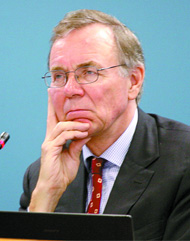
John Uff. Photo courtesy Trinidad Guardian
John Uff
The controversial Uff Commission is to start the final round of its hearings tomorrow. Please click here for the timetable. This Commission of Enquiry was established to examine and report on the Public Sector Construction Industry, with particular reference to UDeCOTT and the HDC’s Cleaver Heights housing project in Arima.

The huge sums of money involved and the egos of the parties all combined with irregular practices in this matter. The combination produced an unflattering and unforgettable picture of our nation’s leading players under the bright lights of the Uff Commission.

The legal challenge against and resulting resignation of Israel Khan as a Commissioner was just one outcome of the bold stance taken by the UDECOTT Board in this matter. The continuing legal challenges mounted by UDeCOTT against the Uff Commission have greatly diluted the credibility of this government, even in the eyes of its most loyal followers.

The failure to gazette the Enquiry was yet another strange aspect of the matter and, although that lapse has now been rectified, we are yet to hear a cogent explanation as to who was responsible and what was the reason for the failure. On this count alone, we are nurturing irresponsible behaviour by allowing this to pass quietly.

The Commission of Enquiry can only make findings based on the evidence which is properly submitted to it and that is where my concern is rooted. We are down to the final few days of hearings and it is my view that the proposed agenda for the final week of hearing is deficient since it leaves some seminal issues outstanding.

These are key points which could be addressed, even at this late stage, by the Commission issuing the necessary legal notices to have these items placed in evidence.

In order of importance, the outstanding issues are:

  1. UDeCOTT’s missing accounts – The main subject of the enquiry is the operation of UDeCOTT and we have not had their audited accounts for 2007 or 2008. The Performance Monitoring Guidelines for State Enterprises, published by the Investment Division of the Ministry of Finance, requires that these should have been published by now. UDeCOTT’s Executive Chairman, Calder Hart, while testifying to the Commission under oath on 28th January, stated that all the outstanding issues with the audit had been resolved and that those accounts would be published in “…a week or two…”. That testimony can be accessed from the CoE website at http://www.constructionenquiry.gov.tt/getattachment/6f957486-f0f4-4aad-b585-d644f3212806/COE-Construction-Industry-20090128-Merged-doc.aspx on page 43. For any Enquiry into the operation of UDeCOTT to make sound findings, those accounts need to be published now. At the least, UDeCOTT should write to explain the breach of the guidelines issued by its shareholder and the undertaking, given under oath by its high-performing Executive Chairman. Again, I ask, “Is UDeCOTT insolvent?”
  2. Bob Lindquist’s missing report – The original concern on the Cleaver Heights housing project arose when the Prime Minister raised concerns as to ‘Where the Money gone?’ and much was made of $10M or $20M which was said to be missing. The PM used the Budget debate in Parliament last year to ask the question of the former Minister of Housing – Dr. Keith Rowley. We were told that the Housing Development Corporation had appointed the respected forensic accountant, Bob Lindquist, to probe the project in question. The Minister of Planning, Housing and the Environment was reported to be silent on details when questioned on the results of that probe by reporters. [See – ‘Not me and the bacchanal’ published in Newsday on August 29th 2009 – http://www.newsday.co.tt/news/0,106338.html That is simply not good enough and the Commission needs to get Mr. Lindquist’s findings into evidence. We cannot have a satisfactory Enquiry if the government is able to control the flow of evidence.
  3. Housing Development Corporation’s output deficit – The Uff Commission’s terms of reference include ‘project delivery’ and the HDC has failed to account for this chronic deficit in satisfying its prime objective – Housing Development. The entire time spent by this Enquiry on housing has been only in respect of the Cleaver Heights project, but the HDC has never produced more than 50% of its target output in terms of the numbers of new homes built each year. The question remains as to whether the HDC is aware of the reasons for this continuing shortfall. This is a flagship state policy and the shortfall in numbers of new homes produced is itself deserving of proper attention from this Enquiry and the responsible State Enterprise. I submitted a series of written questions on this to the Enquiry and one would hope that some written response is forthcoming from the HDC or the Ministry.

The remaining Commissioners can take steps to preserve their reputations and have the key elements of outstanding information put into evidence. We await with interest.

Afra Raymond is Managing Director of Raymond & Pierre Limited and President of the Institute of Surveyors of Trinidad & Tobago. Comments can be sent to afra@raymondandpierre.com.

Open letter to the Minister of Finance on The CL Financial bailout

Honourable Minister,

This government agreed a bailout of the CL Financial group and announced that on 30th January 2009.

It was an historic step and the stated reasons for so doing were to ensure the stability of the national/regional financial system.  The size of the CL Financial group at some $100Bn, as well as the sheer reach of its activities, were cited as part of the rationale for the bailout.  The interests of depositors and policyholders were to be safeguarded by this State intervention.

Since the signing of the Memorandum of Understanding on 30th January 2009, several serious concerns have come to light and those have been highlighted in the press.

This letter is intended to form part of the formal record in this matter.  Its principal concern is the actual size of the bailout commitment.  According to your statement to Parliament on Wednesday 4th February 2009, the Executive Chairman of CL Financial estimated its assets as being worth $23.914Bn.  That statement is taken from page 628 of Hansard and can be accessed at http://www.ttparliament.org/hansards/hh20090204.pdf.  Mr. Duprey’s estimate was stated by you to form part of his letter of 13th January, as Executive Chairman of CL Financial, to the Governor of the Central Bank.

What possible justification could there be for repeatedly stating that the CL Financial group had about $100Bn of assets, if Mr. Duprey estimated the figure to be $23.914Bn?

There are 3 possibilities here –

  1. Firstly, PWC’s Consolidated Balance sheet for the CL Financial group is accurate in disclosing an Asset Value of $100.666Bn.  CL Financial’s Consolidated Balance Sheet is at page 23 of their Annual Report 2007 ‘The Next Wave of Growth’ – http://www.clico.com/pdf/AR07/CL%20Financial%20Annual%20Report%202009.pdf.  Those audited accounts, as at 31st December 2007, were published on 18th November 2008.
  2. Secondly, CL Financial’s letter of 13th January 2009 to the Governor of the Central Bank, signed by its Executive Chairman, Lawrence Duprey, is accurate in disclosing an asset value of $23.914Bn.
  3. Thirdly, if we accept that the first and second statements are both correct, we would have to somehow account for the dramatic decline in the CL Financial Asset values.

In his prepared address to the 30th January press conference to announce the CL Financial bailout, the Central Bank Governor was clear in his appreciation of Mr. Duprey’s stance in the matter “..I would like to acknowledge the high level of cooperation that we have received from Mr. Duprey in our efforts to address what must be a very difficult period for the CL Financial Group.”  It is reasonable to assume that the high level of cooperation referred to by the Governor would have been accompanied by levels of frankness, good faith and full disclosure.  It is therefore all the more puzzling when one considers the Governor’s statement, made in that very address –

“…For the record, ladies and gentlemen, the CL Financial Group has an imposing presence with potentially systemic consequences for the financial sector and the economy of Trinidad and Tobago and the entire region.

For example,

  1. The Group controls over ($100) billion of assets in at least 28 companies located throughout the Region and the world.
  2. The Group’s financial interests cover several industry sectors including banking and financial services, energy, real estate and manufacturing and distribution. The four largest financial institutions in the Group manage assets of over $38 billion, over 25 per cent of the country’s GDP.”

How can one possibly reconcile that official account, made to justify the bailout, with Duprey’s letter, clearly stating that the assets are worth $23.914Bn?

What could have caused such a dramatic decline in CL Financial’s asset values?  The intervening period could either be 12 months and 13 days or 56 days, according to how you count it.  Either way, it is a tremendous decline.  Our Treasury is now committed to restoration of asset values – as per the Angostura Notice to Shareholders of July 2009 – we must understand the reasons for the decline in asset values.

The audited accounts of the CL Financial group for 2008 are now easily overdue and it would be instructive to consider the Balance Sheet as at 31st December 2008.  That would be a mere 13 days before Mr. Duprey wrote to the Central Bank Governor.  Has CL Financial’s audit for 2008 been completed?  If not, why not?  If yes, why the delay in its publication?
This is an aspect of the fiasco which has not been discussed in public, so far.

Your urgent and public response is now needed on these important points –

  1. CL Financial 2008 Audited Accounts – When are these to be published?  What is the reason for the delay in doing so?
  2. The second MoU with CL Financial – The first MoU was published on the Ministry of Finance website on 9th April, 9 weeks after it was signed.  Using even that slow timetable, the new MoU is overdue for publication.  Some 16 weeks have now elapsed.  What is the reason for its omission from the Ministry’s website?  The second MoU creates new and onerous commitments for the country and its publication must no longer be delayed.  I emailed you on 19th September to request your clarification on this, but there has been no reply.
  3. Forensic Audits – We have seen various official reports of forensic audits being carried out at CL Financial and some of its subsidiaries.  Have these been completed?
  4. The interest rate – What is the interest rate being charged to CL Financial for this open-ended financial assistance?
  5. Status Reports – We have had no interim reports as to the disbursement of State funds or the disposal of CL Financial Assets.  When do you intend to start providing regular reports on the progress of the bailout to the public?
  6. The equity position – How is the equity position of the shareholders being adjusted in this deal?  Has their shareholding been diluted to reflect the position?  Has the State now taken an equity position in the group?  If not, what is the upside for the State in all this?

Afra Raymond

The Uff Commission – A Final Fix?

It might seem impossible, but we have been pushed into greater confusion by the events of the fortnight since the last Property Matters appeared.

Despite a fresh round of confusing denials, UDeCOTT are reported to have maintained their legal action to challenge the Uff Commission.   That challenge includes claims as to the alleged bias of the Commissioners.  UDeCOTT continues to deny that the purpose of these legal challenges is to de-rail the Uff Commission.  If those actions were to be sustained and to eventually succeed, the Uff Commission would be de-railed.  Some attorneys have pointed out to me that there have been no studied statements as to whether an Enquiry with a reduced number of Commissioners is still effective under the law.  Even so, justice must not only be done, it must appear to be done.  Point being, even if the Enquiry with a reduced number of Commissioners is lawful, it will hardly be able to command any moral authority.  It is my view that a successful legal challenge from UDeCOTT would have the effect of killing the Uff Commission entirely.

I am reliably informed that the hearings for this UDeCOTT challenge could take at least one year.

Some of the major highlights in the swarm of contradictory comments were –

  • Conrad Enill’s opaque statement on the State paying UDeCOTT’s legal fees.  The PNM Chairman referred the question to the Minister of Planning, Housing and the Environment, Dr. Emily Gaynor-Dick-Forde.
  • Attorney General John Jeremie made strong, stirring statements on his no-nonsense approach to white-collar crime.  Mr. Jeremie was adamant that all the necessary steps would be taken to ensure the proper completion of the Enquiry.
  • Minister Gaynor-Dick-Forde is reported to have given a telephone interview to affirm that ‘UDECOTT is right’ in making its legal challenge.  http://guardian.co.tt/news/politics/2009/09/26/udecott-right That incredible assertion can only dilute the limited authority of this Minister, who took prompt action to dismiss the entire HDC board of Directors earlier this year.  The Minister’s explanation was that there was a ‘governance crisis’ at the HDC.  If this behaviour by UDeCOTT does not count as a ‘governance crisis’ of the first order, we have to wonder about the quality of this Minister’s judgment.  Dr. Gaynor-Dick-Forde went so far as to say that the AG and UDeCOTT were saying ‘one and the same thing’.  This Minister is a highly-lettered scholarship winner and has affirmed herself to be a Christian with a ‘big C’.
  • Independent Senator and UDeCOTT Board member Michael Annisette, gave a strong defence to UDeCOTT in his contribution to the budget debate.  More on this later.

UDeCOTT also made a public statement to compare their legal challenge to Dr. Keith Rowley’s action vs. The Integrity Commission, when he was a member of the Cabinet.  That comparison is baseless and misleading, as are so many other statements in this sorry affair.  Just to list three important differences –

  1. Firstly, Rowley paid his own legal fees while UDeCOTT is using taxpayers’ money to defy the government.
  2. Secondly, Rowley sued in his private capacity – i.e. to preserve his reputation – while it is clear that UDeCOTT is suing as a body corporate.
  3. Thirdly, the Rowley lawsuit was against an independent Constitutional Commission, appointed by the President.  In contrast, UDeCOTT is challenging the acts of an Enquiry whose members have been selected and terms specified by the Cabinet.  The President issued the documents for the appointment of the Commission, but the entire Enquiry is a creature of the government’s creation.  For a State Agency to challenge such an Enquiry is utterly unprecedented and scandalous behaviour.

The original Cleaver Heights allegations have been discredited and the attempt to introduce fresh material on that project was compromised with the surprise appearance of Mr. Carl Khan as a witness on the CH allegations.  The last hearings of the Enquiry had the potential to reveal the extent of the waste and corruption which all citizens know to be a reality.

It is clear for all to see that this important Enquiry is being willfully undermined.  The damage to the credibility of the members of the Cabinet is immense.  Even docile and obedient party members are now asking ‘Who really in charge here?’.

Further legal and reasoned justifications will only deepen the loss of faith.  UDeCOTT Board members are acting in defiance of stated government policy.  Or are they in fact following a policy of concealment?  A Board which was acting in defiance of the PM would have been dismissed already.

Only swift, direct and unambiguous action by the PM can retrieve this fiasco.  The confusing antics by the others are fooling less and less people.

SIDEBAR: Is UDECOTT insolvent?

Amidst all the scandal and name-calling, I am reminding readers that UDeCOTT has filed no accounts for 2007 or 2008.  We are entitled to wonder why.

To continue from last week, I have been involved in a series of email enquiries on this question with Minister in the Ministry of Finance, Mariano Browne.  His replies have advised that all the remaining issues on this audit have been resolved, but that there are non-technical reasons why PWC cannot issue the accounts.  He has not advised what those ‘non-technical issues’ were.

This Property Matters series on UDeCOTT has been running for over 2 years and it is useful to step back from the details and return to first principles.

UDeCOTT is a State Enterprise which lists Value for Money, Professionalism and Accountability among its Core Values.

UDeCOTT has been carrying out a large-scale construction programme and has borrowed most of the funds for that.  While the projects were under construction UDeCOTT’s accountants calculated their value by adding the estimated value of the sites (as if they were vacant) to the cost of the completed works (that is called ‘value’ in the Quantity Surveying/Engineering parts of the construction profession).  That method is an acceptable one.

The problem is that upon completion, those projects have to be put onto the Balance Sheet at Market Value.  That means that the properties have to be valued at the estimated price they would fetch in the open market.  Those are the requirements of International Accounting Standards.  We have repeatedly said that not one of these projects represents value for money.  Not one.  The largely vacant International Waterfront Complex was financed via a 15-year bond which, by my calculations, would now be requiring a monthly payment of the order of $14.0M.  That project is UDeCOTT’s flagship and as such it formed a key part of the Executive Chairman’s report in 2006.  The phrase was – “…project financing on competitive terms without the requirement of a Government Guarantee or Government Letter of Comfort…”  In the absence of either of those, how is UDeCOTT paying the financiers for this project?  More to the point, how is the carrying-cost of the largely vacant complex being shown in the accounts.

The terms of finance secured by UDeCOTT were very competitive – the rental value of the complex, if it were occupied, would barely cover the debt service.  How is the high cost of maintenance to be factored into the property valuation and consequently, the accounts?

One of the recurring themes in this series on UDeCOTT has been the fact that the true ‘break-even’ rent of these projects are in fact unachievable in a market flooded by the very same space.  The plain meaning of that is they are all now liabilities in terms of market value, since their rent is insufficient to cover the real cost of land plus the building.

All these issues are present across the entire portfolio of projects many of which are now completing, post-2006.  If I am right, the accounting effect of all this will be a sudden decline in asset values and a simultaneous leap in debt-servicing/maintenance requirements.

Independent Senator and UDeCOTT board member Michael Annisette made recent comments on the indebtedness and accounts of State Enterprises – http://guardian.co.tt/business/business/2009/09/25/williams-regulate-state-debt

Michael Annisette, president of the Seamen and Waterfront Workers Trade Union, said if regulation is not followed through on a timely basis government must clamp down on those entities.

“I agree that monitoring must be exercised in a timely fashion. There must be oversight and superintending of the accounts in a sustainable and fundamental way, that’s the only way you can have checks and balances on these institutions.

“There are cases where action starts after the fact and not before. The action must be preventative and not reactive,” Annisette said. He said people who are given responsibility are not always accountable. Accountability demands a responsibility if you don’t account you pay the price. There must be a deterrent mechanism in place.” Annisette added. “…The state enterprises are simply ignoring these regulations and no one is following up to ensure compliance…”

Afra Raymond is Managing Director of Raymond & Pierre Limited.  Comments can be sent to afra@raymondandpierre.com

The Uff Commission – A Quality Finish?

To produce good, lasting results, it is vital that project managers pay particular attention at the closing stages, since the finish is often the most lasting impression which a project can make on its users.  Thus with the Uff Commission.

It requires fortitude to resist the distractions posed by the ongoing discussions on the proposed property tax revisions.  Those proposals were set out in the 2009/2010 budget, which was laid in Parliament on Monday 7th September.  Coincidentally, that was the same day that Professor John Uff, Chairman of the Enquiry, held his press conference.

Property Matters will keep its focus on the Uff Commission.

The first question arising is – ‘Whose job was it to ensure that the Enquiry was properly established in law/Gazetted etc.?’  Just about everyone I have spoken with either knows and is not saying or does not know and expects no answer.  That is a perturbing part of the reality out here, when one considers that this is supposed to be an educational process towards betterment of a significant national activity.

We have read reports of the obscure stance taken by the last Attorney General when faced with questions as to her possible responsibility.  Her quote is sobering – “My whole attitude to this is that I have reverted to private life and I have no comment (on what cause the non-gazetting)…”  That was reported in the Express of 10th September at http://www.trinidadexpress.com/index.pl/article?id=161529620.

We have also seen reports that the Attorney General has taken the necessary steps to ensure that the oversight is addressed and that is encouraging, for all the reasons stated in last week’s Property Matters.  The opposition UNC is also reported to have pledged their support for any measures brought to Parliament in this matter.  Both these are positive signs.

Restoring the Enquiry’s legality is an important part of a good finish to this important public work, but there is a vital ingredient, which has been missing so far.  I am referring to the constant resistance being mounted by UDeCOTT’s attorneys.  Given the PM’s strong statements to the effect that this government has nothing to hide, it is almost unbelievable that these attorneys acting for Calder Hart and UDeCOTT have taken certain positions.  Unbelievable, but true.  It is like a subsidiary company resisting or obstructing lawful instructions coming from its parent company.  The missing ingredient here would have to be that the Board of UDeCOTT be instructed to desist from such actions, since those are contrary to the atmosphere of transparency and probity which the PM is advocating.

As a reminder to readers, please note that UDeCOTT is one of the State Agencies within the Ministry of Planning, Housing and the Environment (PHE).  The Housing Development Corporation is another State Agency within that Ministry.  The point I am driving at here is to remind readers of the actions of that very Minister when the HDC were trying to complete its second submission to the Enquiry.  The entire HDC Board of Directors, save its Chairman, Andrew McIntosh, were dismissed.  The Minister cited a ‘governance crisis’ and no further explanation has been offered.  A new Board was appointed with the former Chairman staying in place and Abigail Cox re-appointed as a Director.  One can only wonder what kind of governance crisis could lead to the sudden dismissal of an entire Board of Directors and the retention of its Chairman.  How could any ‘governance crisis’ emerge, if the HDC Chairman had been an effective one?  If he was ineffective, what is the thinking of a Minister who would re-appoint such a Chairman?

The simple point is that the government can dismiss an entire Board of Directors for some infraction or other cause.  In that very Ministry they already have, in the course of the Uff Enquiry.  The retention of the UDeCOTT Board of Directors, in these circumstances, is a clear and present peril to the PM’s stated notions of integrity in public affairs.  That those UDeCOTT Directors remain in place is a clear vote of confidence from the PM.  Any further attempts by Mr. Hart’s or UDeCOTT’s attorneys to de-rail the Enquiry would be a recipe for a complete loss of the limited confidence the PM now enjoys.

Insofar as the Enquiry’s examination of the HDC’s performance, I make 2 points.  Firstly, I submitted questions on the project delivery shortfall to the Enquiry to direct to the Minister of PHE.  One would expect that the Enquiry would require that the Minister make a written reply to those legitimate queries.  Secondly, the Bob Lindquist report is also in question.  The renowned Canadian forensic accountant, Bob Lindquist, was hired by the HDC, amidst much fanfare, in January this year, to investigate the alleged missing funds from the Cleaver Heights housing project.  We have never been given an update on his findings, but have recently seen reports of this Minister refusing to answer questions as to whether the report has been completed or will be published.  I smiled while reading the Minister’s firm statement – “…We aren’t interested in all the bacchanal and back and forth people seemed to be focused on…” That story is at http://www.newsday.co.tt/news/0,106338.html.  We would also suggest that the Enquiry use its legal powers have the Bob Lindquist report submitted without delay.

Finally, we come to the big and truly disgusting one.  Yes, I am referring to UDeCOTT’s missing accounts.  According to the Ministry of Finance guidelines published in January 2008, State Enterprises are “…required to publish…audited financial statements…within 4 months to (sic) the end of their financial year…”.  UDeCOTT’s last audited accounts are up to the end of 2006.

On Monday 8th June, the Minister in the Ministry of Finance, Mariano Browne, addressed a corporate governance meeting for leaders of State Enterprises.  In doing so, Senator Browne set out some very clear points – “..you are now required to ensure the timely submission of board minutes, strategic plans, financial statements, cash statements of operations and loan overdraft portfolios…”.

Calder Hart told the Enquiry, under oath on 28th January, that all the outstanding issues for UDeCOTT’s 2007 accounts had been resolved and that those accounts should be available in about 2 weeks’ time.  Yet it seems that we are drifting into the closing chapter of this Enquiry without any accounts for either 2007 or 2008.  That is a breach of the published Guidelines and I am again suggesting that the Enquiry use its powers to seek some public account of these colossal sums of our money.

Afra Raymond is Managing Director of Raymond & Pierre Limited.  Comments can be sent to afra@raymondandpierre.com

The Uff Commission – Foundation Failure?

Last week’s Property Matters ended on the note of predicting that ‘amazing scenes would be witnessed’ and here they are, in spades.

The shocking news that the Uff Commission has been functioning in breach of the Commissions of Enquiry Act could only increase the cloud hanging over these proceedings.  From the outset, there have been questions as to the underlying purpose of the Enquiry; the behaviour of UDeCOTT’s and Calder Hart’s attorneys; the continuing probe into the Cleaver Heights housing project and the official silence on the Bob Lindquist findings, to name just a few.  This latest news that the Enquiry was ‘stillborn’ is likely to increase these concerns and deepen the atmosphere of public scepticism.

A key part of my concern is with the official version, which has recently taken root, that the Enquiry must be completed and its report considered by Cabinet, before any possible criminal charges can be laid.  That is a most alarming informal statement that the police are under the direction of Cabinet.  If that is really the case, we are seeing two detrimental things at once.

Firstly, the reason why the vast majority of the Commission’s time has been spent on matters better explored by the Police Service and the Courts.  That focus on investigating alleged illegal acts has denied the Enquiry the time necessary to probe the broader strategic issues which underlie the performance issues in the public-sector construction industry.  To have made a difference, the greater part of the Enquiry’s time should have been spent on probing the decisive issues of project selection, ranking, costs, quality and delivery.  Even if all the wrong-doers are found guilty and punished by the Courts, we have not, in my view, made a proper enquiry into the failures of process that got us into this mess.  If we did not ask the right questions, there is no way we can do better.

Secondly, we are being told, in not so many words, that unless and until the Cabinet approves such, no one is to face criminal charges.  To my mind, that is plainly wrong and could only undermine our progress to ‘developed nation status’.  Despite the stated goal of modernity, we seem to remain in thrall to Sacred Cows.  How to escape the culture?

I was present on Monday morning (7th September) at the press conference held by Professor John Uff, the Chairman of the Enquiry.  The text of his prepared statement can be accessed at http://www.constructionenquiry.gov.tt/News/Professor-Uff-s-Press-Statement-09-07-09.aspx.

Despite several questions, Professor Uff, declined comment on what could be the cause of this failure to properly establish the Enquiry on a legal footing.  It seems that the fact that the Uff Commission was not published in the T&T Gazette only emerged on Friday 4th September and Professor Uff told us that he was only told on Saturday afternoon.

The Uff Commission was a remarkable spectacle, even by our unique standards.  I have never seen so many lawyers in one room and it did make me nervous from the start, for whatever reason.  Two of the original Commissioners and the head of the team of legal advisers to the Enquiry are silk and there was an impressive roll-call of other silk representing their clients –

  • Frank Solomon, appearing for Calder Hart;
  • Russell Martineau (former Attorney General), appearing for NIPDEC;
  • Deborah Peake, appearing for the Housing Development Corporation;
  • Gilbert Peterson, appearing for Dr. Keith Rowley MP;
  • Douglas Mendes, appearing for the Attorney General;
  • Alvin Fitzpatrick, appearing for the JCC;
  • Andrew Goddard, appearing for UDeCOTT.

I am finding it very difficult to believe that so many learned colleagues missed this legal oversight and one has to wonder when it was really discovered.  I leave that there.

What is the solution?  By now, we have heard the conflicting opinions as to whether a retrospective ‘gazetting’ of the Enquiry can imbue it with legality and whether a ‘Validating Act’ of Parliament can have better effect.  However you look at it, there is no doubt that the decisions on what, if anything, to do and how to do it, are for the government to make.  That is where the whole situation gets fascinating, since this new twist to the Enquiry is both an opportunity and a threat to the government.

Throughout this process our PM has been unswerving in his support of UDeCOTT as a flagship State Enterprise, doing outstanding work on the road to ‘developed nation status’.  In his historic address to the Senate on 13th May 2008, the PM was absolutely clear that his government has nothing to hide and further, that he was confident that any Enquiry would vindicate their faith in UDeCOTT.  Considerable political capital has been invested in supporting UDeCOTT and the stakes are clearly very high.

At this point, cynics might say that the Enquiry has uncovered troubling issues in the operation of UDeCOTT, which must have been of growing concern to the PM, given his earlier declaration of faith.  One could even go further to say that the recent discovery of this legal oversight would give a nervous government a handy way to thwart what could have been a damaging report.

I have another view.  It seems to me that the PM’s declaration of support was an unmistakable statement of integrity and purpose.  It would be impossible to resile from that position without inflicting deep damage to ones own notions of integrity in public life.  I cannot easily imagine our PM leaving this situation to fester without ensuring that the necessary legal steps are taken to ensure the Enquiry’s legality and proper completion.  It would be an ‘own-goal’ of shocking proportions and it seems to me very doubtful that the PM would allow that outcome.

Which leads to the dreaded possibility of the ball being ‘kicked into the long grass’.  Yes, I am referring to the probability of this entire Enquiry descending into a legal mangle of epic proportions.  Professor Uff did say that he was trying to have the issues resolved by agreement.  Given the atmosphere at the Enquiry, I am doubtful that an agreement between the parties is possible, or indeed, even desirable.

I have taken the unusual, and possibly unwise, step of making a political prediction in this column and yes, only time will tell.

SIDEBAR

I am happy to admit my error in last week’s reference to V.S. Naipaul’s classic phrase – ‘…amazing scenes were witnessed…”, it is, of course, from the ‘House for Mr. Biswas’, not ‘Miguel Street’.  I must have been thinking of busy men eternally building a series of mysterious things until the police arrested them.  The small boy would ask the busy men – “What all-you making?” and he always got the same enigmatic reply “We making the ‘thing-without-a-name…

Afra Raymond is Managing Director of Raymond & Pierre Limited.  Comments can be sent to afra@raymondandpierre.com

The Uff Commission – The Final Chapter

After a necessary and prolonged pause to review other matters of public interest, Property Matters returns to the high-profile Uff Commission as its final hearings are set to begin on Monday 7th September.

This series of hearings was not a part of the original agenda for the Commission of Enquiry.  It was only announced at the close of its last sitting in May that the Commission would sit again to hear further evidence on the Cleaver Heights project and the testimony of Mr. Carl Khan.

I already wrote here on 18th January 2009 of the vigorous stand taken by UdeCOTT’s and Calder Hart’s attorney in the early stages of the Enquiry.  At the time, I was very critical of their stance – “It is difficult to imagine a less-cooperative or more disdainful stance from a party under investigation…

In their latest sally on 24th July, these attorneys issued a 12-page letter to the Uff Commission, challenging the impartiality of the Commissioners.  That letter made allegations against Israel Khan, Keith Sirju and the Chairman, Professor John Uff.  It ended by calling for all 4 of the Commissioners to recuse themselves.  Ours is a country which can guarantee a daily surprise, but this one took the prize.  UdeCOTT was continuing to resist the lawful investigation being undertaken on behalf of its owners, the people of this country, as represented by their government.

There were reports on 6th August that the Board of UDeCOTT was instructed to withdraw those legal threats.  http://www.trinidadexpress.com/index.pl/article?id=161513988 UDeCOTT withdrew those threats, albeit conditionally.  UDeCOTT placed full-page advertisements in the press to deny the statement by Dr. Keith Rowley that they were attempting to ‘de-rail’ the Uff Commission.  The threat of legal action by UDeCOTT and its rapid withdrawal is indicative of a deep divide between the Cabinet and this flagship State enterprise.  It is the only way to make sense of the UDeCOTT Board’s incredible decision to attempt to thwart the government-appointed Commission.  The published denials made no sense at all.  You really have to wonder how many people believed UDeCOTT’s assertions that they were not trying to ‘de-rail’ the Uff Commission.  Then on 11th August, Israel Khan SC, resigned.

There have now been further attempts by UDeCOTT’s lawyers to dislodge Commissioner Kenneth Sirju, with allegations of conflict of interest.  The Commission is trying to overcome those objections by seeking consensus on the Cleaver Heights part of the session and that is expected to be decided on Tuesday 2nd September.

The main issues arising at this stage are –

  • The local limits of integrity standards – The accusations of conflict of interest made against Commissioner Sirju seem to suggest some real limits as to the extent to which we can effectively import first-world norms as to integrity and conflicts of interest.  We need to develop our own effective norms on integrity in public affairs, but, in this case, the deciding factor would be the declarations made by Commissioner Sirju.
  • Cleaver Heights – Apart from the turbid result of the Enquiry into the ‘missing money’, there are two serious side-effects of the Cleaver Heights saga.  Firstly, the inimical effect of the State seeming to target a perceived critic/rival of the PM.  In my view, that widespread impression of the State targeting Dr. Rowley is toxic to our nation developing healthy habits of public debate and dissent.  Secondly, the fact that we seem to have become distracted by Cleaver Heights and lost the opportunity to delve into substantive questions on the poor output of the national housing program.  As stated in Property Matters of 25th January, the HDC is producing less than 50% of the reduced annual target of 8,000 new homes.  The Uff Commission was appointed to enquire into the public sector construction industry and it is now drawing to a close with no time spent on this strategic shortfall.  That is a real shame.
  • The personal aspect – I have never encouraged any discussion or interest in the personal lives of the key players in this Enquiry, notably Calder Hart and his family.  To my mind, that was just sheer bacchanal which distracted from the main issues of poor process.  That said, and having heard much of the evidence, it would be interesting to see if there is indeed any ‘fire’ here, amidst all the ‘smoke and mirrors’.
  • UDeCOTT’s accounts – It is impossible to enquire into the operations of a commercial company without considering its financial situation.  On 28th January, the CoE heard sworn testimony from the Executive Chairman of UDeCOTT, Mr. Calder Hart, while he was being cross-examined by Alvin Fitzpatrick SC, to the effect that the 2007 accounts would be ready within a week a or two.  Yet we seem to have drifted into a situation in which the Commission will have to deliver its report without having considered any accounts from UDeCOTT after 31st December 2006.  If that were the case, it could have the effect of significantly discrediting the Commission’s findings as to UdeCOTT’s operations.

Our locally-grown, Nobel Prize-winning author, V.S. Naipaul created, in the seminal ‘Miguel Street’, a pregnant phrase which has come to typify this place…“…amazing scenes were witnessed…”  I expect the final series of hearings of the Uff Commission to contain many ‘amazing scenes’ as parties battle to defend their honour and, in some cases, preserve their liberty.

SIDEBAR: – The upcoming agenda

The expected agenda for the final sitting of the Uff Commission includes –

  • The testimony of Carl Khan – This is the surprise witness who gave his evidence on 19th May on his previous marriage to the present wife of UDeCOTT’s Executive Chairman, Calder Hart.  Khan also referred to the Mrs. Hart’s relatives.  This would be the first evidence to the Commission on the matters raised by Ramesh Maharaj in Parliament on 23rd May 2008.
  • The Cleaver Heights Saga – At the end of May, the government announced the new hearings for the Uff Commission to include further evidence on the Cleaver Heights project.  The initial report on Cleaver Heights was prepared by Mr. Jerry McAffrey of UK-based construction consultants, ACUTAS.  That report did not support the original allegations, made by the PM during the budget debate in October 2008, as to a ‘missing’ sum of money, said to be $10M.
  • Mrs Sherrine Hart – There have been recent reports that Mrs. Hart will be testifying in this session of hearings.

Afra Raymond is Managing Director of Raymond & Pierre Limited.  Comments can be sent to afra@raymondandpierre.com