CL Financial Bailout – The final AGM

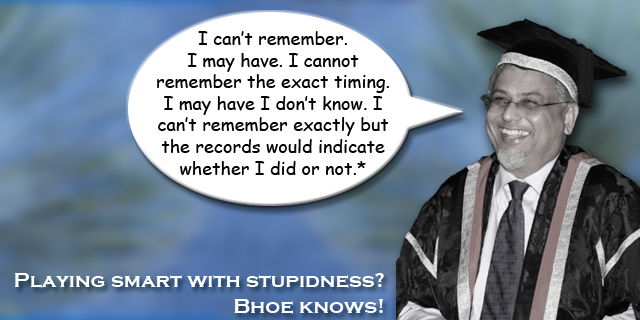
bhoe-knows* In response to a question whether he took part in the reported decision to pay CLF dividends even after the approach to the State in 2009.

CL Financial’s final Annual General Meeting was the most interesting meeting in the saga of its collapse.

That meeting took place at the Trinidad Hilton on Friday 23 January 2009, so consider the timeline –

  • 18 November 2008 – CLF publishes its 2007 Annual Report, including its audited accounts, which showed assets of $100.666Bn and after-tax profits of $1.74Bn.
  • 13 January 2009 – CLF writes, under Lawrence Duprey’s signature, to the Governor of the Central Bank to request urgent financial assistance.  See pg 628 of Hansard of 4 February 2009 for the text of that letter, which specified that CLF’s asset value was $23.9Bn.
  • 16 January 2009 – CLF pays a dividend of $3.00 per share.
  • 23 January 2009 – CLF convenes its final AGM before the ‘official’ collapse.
  • 30 January 2009 – The bailout of CLF is announced at a Press Conference at the Central Bank.  All the speakers at that event stated the CLF asset value at $100Bn.

Given that the normal function of an AGM is to inform a company’s shareholders and stakeholders of its performance and prospects, that timeline raises some intriguing questions.

For whatever reason, there have been no published reports of that final CLF AGM, so I posed these questions to a CLF shareholder in an email exchange –

Q       Did you attend that AGM?
A        Yes
Q       Was it at the Ballroom of the Trinidad Hilton on Friday 23rd January 2009?
A        It was at the Hilton but not in their ballroom. It was in one of the restaurants/meeting rooms that overlooks the Savannah. Can’t remember the name.
Q       About how many shareholders were there in attendance?
A        I would guess about 30-40
Q       Which Directors were present?
A        Clinton Ramberansingh, Rampersad Motilal, Bhoe Tewarie, Gita Sakal and Michael Carballo.
Q       Which Executive Directors were present?
A        Roger Duprey (I think)
Q       What was the ‘tone’ of the meeting?  Was there any clue as to the grave difficulties facing the CLF group?  Was the ‘bailout letter’ mentioned at all?
A        The tone of the meeting was “normal”. There certainly was no indication that CLF  (or the CLF group) was in any imminent danger. The effects of the global downturn was mentioned in light of the reduced dividend (from $5 to $3) and we were told by Carballo that although the group, like everyone else, was feeling the effects of the global recession, it was still performing well and that he expected the performance to improve over the course of the coming year. One interesting “fact” that did emerge (I say “fact” because I have no idea as to the veracity of the claim) had to do with the value of CLF shares. One shareholder had complained about not really being able to derive any value from his CLF shares apart from receiving a dividend. No bank would accept it as security. Carballo advised that CIB would accept the shares as security for a loan………….had I known I’d have taken a big loan and never paid it back!! Certainly the bailout letter was never disclosed to the shareholders.

If true, this account of the events is deeply disturbing.

The question is whether CLF’s Independent Directors were aware of its true position.  Could it be that the Board was unaware of Duprey’s letter and that they were surprised when the bailout was announced?  If that were the case, it would mean that Board of Directors was kept in the dark over this bailout.

If the Board was informed as to the bailout letter, we would be contemplating an even more unacceptable case.  If that is what happened, it would have been fraudulent for the CLF Directors to have carried out that AGM without informing the shareholders of the company’s true position.

Michael Carballo was the CLF Group Financial Director since Andre Monteil’s retirement in early 2008. Given Carballo’s position in the group and the high quality of his professional skills, it is very difficult to accept that he did not himself know CLF’s true position.

Dr Bhoe Tewarie swearing-in

According to this email exchange, neither Lawrence Duprey nor Andre Monteil attended CLF’s final AGM. With only one week to go, they would likely have been attaching more priority to the negotiations for the bailout.

So, Dr. Tewarie – a shareholder and former Director of CLF – is now appointed to Cabinet at the very moment that it is reviewing the bailout of the same CL Financial group.  That man, noted in the field of business education – his last post, before this appointment, being Director of UWI’s Institute of Critical Thinking – when asked about his attendance and participation in the Board meeting which approved those CLF dividends is reported to have said – “I cannot remember, I may have, I cannot remember the exact timing, I may have—I don’t know…The records would indicate whether I did or not...”.

We are being asked to believe that Dr. Tewarie cannot really remember this meeting, probably the final one before CL Financial folded and likely the most eventful in even a high-profile career such as his.  The old people have a saying that you start as you mean to go on.  Dr. Tewarie’s reply can hardly inspire confidence.  It verges on being dismissive and  disrespectful of the public.  We are paying for all the mess created by CL Financial and yes, that is the same public Dr. Tewarie just swore to serve.  It does not augur well.

The essential questions for Dr. Tewarie include his attendance and participation in this final AGM and what he knew about the state of the group at the time.

It seems unacceptable to me for holders of high office in our country to be persons who would be disqualified under the ‘fit and proper’ criteria.  That practice must be revised as part of the New Politics we are being promised.

Given the tremendous stakes and the complete silence by all the responsible people, we need to ensure that this affair does not carry our country any further into peril.

These responsible and silent people must be banished into obscurity, at the very least.

SIDEBAR

PricewaterhouseCoopers
It is a well-established custom that AGMs of large organisations are attended by the responsible partner of the auditor’s firm, who reads the auditor’s letter to the audience.  Did a partner of PriceWaterhouseCoopers attend this meeting?  Which one?  Did a PwC partner read aloud that auditor’s letter?

Real Responsibility
On the one hand, a Cabinet Minister is dismissed over a $100,000 contract and I consider that to be good progress in the correct direction.  The fact that a reasonable suspicion had arisen cost that Minister her job, which is good.  In keeping with the State’s exemplary behaviour, our leaders should not behave in a fashion which causes suspicion or derision.

On the other hand, we are seeing a replacement Cabinet Minister, who at last record was known to be a shareholder of the huge, failed CL Financial group and one of its Board Directors at the time of the colossal crash.  The official version is that CL Financial is a $100Bn group.  There have been recent reports that the Cabinet is about to consider a new approach to the bailout and the public is bound to wonder at the timing of this appointment.

Fit and Proper
The Central Bank’s ‘Fit and Proper’ Guideline (sic) sets out the official position as to the type of person held to be ‘fit and proper’ to be a Director or Officer of a Financial Institution.

It states –

3.1 In accordance with governing legislation a person is considered to be fit and proper if the person essentially is of good character, competent, honest, financially sound, reputable, reliable and discharges and is likely to discharge his/her responsibilities fairly.

Setting the Standard

The PP government is establishing a ‘new normal’ insofar as ethics and acceptable standards of behaviour in public office are concerned.  As with any real-time and complex situation, the signals are mixed, but from my point of view, the direction is a welcome one.

To me, the main positive signs were –

  • Coup Enquiry – The July announcement of the Commission of Enquiry into the 1990 attempted Coup, now underway, was most welcome.  It seems certain that we would still be waiting in vain, if either Manning or Panday were still in power.
  • CL Financial bailout – Dookeran’s decision to review the payout to beneficiaries of the bailout was necessary and long-overdue.  Dookeran has done his cause no favours by with-holding the accounts and seeming to suppress vital information, but the decision to revise the bailout terms was a sound one.  On that occasion, he also took the steps of introducing relief for Hindu Credit Union depositors, which was a step in the direction of equity. Even those of us who did not support any bailout can concede that point.
  • On October 1, the Prime Minister resisted the temptation to use the PP’s Parliamentary majority to force through a new law to limit the legal rights of CLICO policyholders.  The PM chose to set aside that legislative proposal and embark on an act of persuasion.  That was a defining moment in our nation’s development of a democratic culture.  The announcement of a Commission of Enquiry into the entire financial collapse (CL Financial and HCU) was another high point.
  • Nizam Mohammed’s removal as Chairman of the Police Service Commission was overdue in my view, but not because of his ‘last-ditch/red-herring‘ attempts to martyr himself.  His primary and unpardonable offence, given his position, was his bold-faced abuse of power in that traffic police episode.
  • mary king
    Mary King

    Even Mary King’s removal from office earlier this week was a welcome sign despite the doubts over who knew what and when.  That was a good move because it is the first time a Minister has been fired for acting in a manner which causes reasonable suspicion.  Up until now in this country the rule followed by the various Ruling Parties has been the ‘wrong and strong‘ one, joined-up with the ‘do as I say and not as I do‘ one.  To have moved away from those immoral practices is a big step in the right direction, despite the ragged edges.

Even when I consider the disastrous Reshmi-gate episode, that list adds up to substantial progress in the right direction.  Democracy is a messy affair and coalition politics has particular challenges, so progress will be uneven, with some pauses along the way.  But progress we must.

The Prime Minister reportedly commented that there was no pressure from COP to replace Mary King with another of its members, so that the replacement would be chosen on merit.

I am very concerned at the fact that the CL Financial collapse has cast a literal shadow over our country.  Aside from the financial costs, there are significant areas of collateral damage which are now becoming visible.  I referred in an earlier article to one of the main externalities in this episode being the fact that many of the CL Financial chiefs are deeply embedded in our political parties.

Even now, with this new government – their honeymoon will end on the first anniversary, I think – we are witnessing acts which can make one wonder if the CL Financial disaster ever really happened.

The official Terms of Reference for the Colman Inquiry into this financial fiasco were published in the Trinidad and Tobago Gazette of 17th November 2010 – No. 144 in Volume 49.  Here is the first sentence in the second paragraph –

…And whereas the President on the advice of the Cabinet has deemed it advisable and for the public welfare that a Commissioner be appointed to enquire into the failure of CL Financial Limited, Colonial Life Insurance Company (Trinidad) Limited, CLICO Investment Bank Limited, British American Insurance Company (Trinidad) Limited, Caribbean Money Market Brokers Limited and the Hindu Credit Union Cooperative Society Limited with a  view to ascertaining why such events occurred…

robert mayers
Robert Mayers

Caribbean Money Market Brokers (CMMB)
The first example is Robert Mayers, former Managing Director of CMMB up until 7 December 2008 – see here.   Mayers is also a Deputy Political Leader of the Congress of the People (CoP), a leading element in the Peoples’ Partnership government.  CMMB collapsed along with some of the significant companies in the CL Financial group – the Terms of Reference for the Colman Commission refer.

On 20 November, there were reports that Robert Mayers had been offered a position as a Director of our Central Bank.  Mayers is reported to have declined that offer on the basis of a conflict of interest.  The burning question has to be ‘What kind of process could produce such a recommendation?

Consider this arresting headline ‘Investment pros set up new business‘ at page 10 of the Business Guardian of 9th December.  It was reported that a new investment house, KSBM, was launched and it seemed that they were profiling.

Given that all four of KSBM’s Executive Directors are ex-CMMB chiefs, Robert Mayers among them, there are inescapable questions –

How come the former chiefs of CMMB, a financial institution which is known to have failed on this scale, can be permitted to open another one?  We are acting as if we have no capacity to learn from our errors.  Just carrying on as though nothing happened.  What is the role of the SEC and the Central Bank in all this?  Have we learned nothing?

mervyn assam
Mervyn Assam

Clico Investment Bank (CIB)
Mervyn Assam was the Chairman of CIB at the time of the collapse.  Assam had been one of CIB’s founders in 1990 and was reportedly ‘cleaning house’ at the bank, which I do believe to be true.

But the picture is far from a simple one.  On 22 January 2009, CIB hosted its inaugural Investment Seminar at the CL Duprey box at the Queen’s Park Oval – I spoke at that event, together with Professor Patrick Watson.  Now, according to  para 5 of the April 2010 affidavit submitted to the High Court by the Inspector of Financial Institutions, Carl Hiralal, in the CIB winding-up petition, the CIB liquidity problem was disclosed to him in a meeting on the 15 January.  I have serious doubts as to the veracity of that statement, but yes, it is still a full week before the Investment Seminar.

Assam held 7,500 shares in CLF as at 7 February 2009.

Assam also launched a lawsuit to recover $1M he had deposited with CIB, that case went against him in January this year – see the judgment – and he is reported to have filed an appeal.

In October, Assam was appointed as Ambassador Extraordinaire and Plenipotentiary of Trade and Industry.  He has served in the NAR period as High Commissioner to London and as a UNC Senator, both in Cabinet and during their recent spell in opposition.

Dr. Bhoendradatt Tewarie

CL Financial (CLF)
Dr Tewarie was a Director on the Board of the parent company, CLF, which wrote to the Central Bank, seeking a bailout, on 13 January 2009.  On 16 January 2009, CLF paid dividends of $3.00 per share to its shareholders.  According to the CLF Annual Return of 7 February 2009, Dr Tewarie held 1,171 shares.

As I write this, we are informed that Dr Tewarie has been sworn in, to replace Mary King.

To be perfectly clear, I am making no allegation of theft against Mayers, Assam or Dr. Tewarie.

Does the ‘fit and proper’ criteria apply to these CLF chiefs?  Should those criteria apply to the holders of high office in our country?  What do you think?

We need new politics like no time before in our country, but that must involve new thinking.  The State must behave in an exemplary fashion if we are to uplift ourselves without civil disturbance and unnecessary confusion.  The State needs to set the standard.

I trust that the Colman Commission will give the proper attention to these episodes.

Freedom of Information in the CL Financial bailout

This – clfFoI-1 – is a copy of the letter sent today from my attorney to the Ministry of Finance, requesting that they provide –

  • ‘The Duprey letter’ – The fateful 13th January 2009 CL Financial letter, signed by Lawrence Duprey, seeking urgent and massive financial assistance from the Central Bank.
  • CL Financial’s 2008 audited accounts – These should have been prepared by PriceWaterhouseCoopers, as at 31st December 2008 and of course those are of great interest, since the 2007 audited accounts (published on 18th November 2008) disclosed assets of $100.6Bn, while ‘the Duprey letter’ showed assets of $23.9Bn.

The letter invites the Ministry of Finance to send the documents in 10 days or we go to the High Court.

Given the current state of play at the Colman Commission, there are no prizes for guessing which of those is going to happen.

CL Financial’s Annual Return as at 17th February 2009

CL Financial Annual Returns 17 February 2009

This is the official copy of CL Financial’s Annual Return from the Companies Registry, as at 17th February 2009 – it bears the official stamps and is signed by CLF’s then Corporate Secretary, Gita Sakal.

The company had a paid-up capital of $7.5M, with that number of $1.00 shares in issue.

The 325 shareholders are listed alphabetically, as at 7th September 2008, with details of their occupations and addresses also supplied.  Of course, that list shows, at #289, the then Minister of Finance – Karen Nunez-Tesheira – as Karen Tesheira, Attorney-at-Law – holding some 10,410 shares.

Another thing that is striking is that Lawrence Duprey would appear to have only three blocks of shares in his ownership –

  • #47 – CL Duprey Investment Trust – holding 1,634,335 shares, but we are unable to find the details on that company.
  • #78 – DALCO Capital Management Company Limited of #37 Frederick Street, POS – holding 1,947,833 shares.  I am assuming that DALCO is a play on his initials – Lawrence Andre Duprey LAD, reversed.
  • #302 – Trustees of CL Financial Limited – holds 119,145 shares.

I am taking that to mean that Lawrence Duprey had under his direct control a maximum of 3,701,313 shares – i.e. 49.35% of the group’s entire shareholding…slightly less than half.

I am leaving it to the better-informed readers to help fill in the gaps in this story.

As to Andre Monteil, the recently-retired Group Finance Director, his 337,269 shares were transferred from Stone Street Capital Limited to First Street Capital Limited on 31st March 2008, the date he retired from the CLF group.  Both companies’ registered address is the same – 33b Perseverance Road, Haleland Park, Maraval.

Afra Raymond’s submission to be made a party to the Colman Commission

16th March 2011

Afra Raymond’s submission seeking to be made a party to the Commission of Enquiry into the failure of

CL Financial Limited
Colonial Life Insurance Company (Trinidad) Limited
Clico Investment Bank Limited
Caribbean Money Market Brokers Limited and
The Hindu Credit Union Credit Union Co-operative Society Limited

My name is Afra Martin Raymond and I am a Chartered Surveyor, being a Fellow of the Royal Institution of Chartered Surveyors.  I am Managing Director of Raymond & Pierre Limited – Chartered Valuation Surveyors, Real Estate Agents and Property Consultants.  I am also the President of the Joint Consultative Council for the Construction Industry (JCC), an umbrella organisation which represents the interests of Engineers, Surveyors, Architects, Town Planners and Contractors in this Republic.

This submission is being made in my personal capacity and does not represent the position of either Raymond & Pierre Limited or the JCC.

My work on this vital issue has all been based on the public record and can be seen at www.afraraymond.com.

I am willing to give oral evidence before the Commission.

I have been conducting a campaign in the public interest on this important matter.  My work is unfunded and I have no assistance.  Indeed, I have no legal adviser at this Enquiry.

Having followed the issue so closely and attended the opening session on Friday 11th March, I am of the view that the parties thus far identified in this Enquiry are all seeking to advance their own interest.

I am here seeking to be made a party to this Enquiry, in seeking the interest of the silent majority, the taxpaying public, who have had to pay for this huge financial fiasco.

I am making this submission under rule 2. of the Commission’s Rules of Procedure, as a person whose “…participation in the Enquiry may be helpful to the Commission in fulfilling its mandate…

I await your reply.

——————————-
Afra M. Raymond B.Sc. FRICS
Port-of-Spain

CL Financial bailout – Sunlight Disinfectant

If you think this title is for the latest brand of household cleaner, you would be wrong.  I drew that title from the famous statement by deceased US Supreme Court Justice Louis Brandeis, in reference to corruption and fraudulent dealings: ‘sunlight is said to be the best of disinfectants.

Of course, this is all about the impending Colman Commission of Enquiry into the failure of CL Financial and other companies (including CMMB) and the Hindu Credit Union.

We are attempting to understand our situation in this financial fiasco – how was the entire collapse caused?  Who is responsible?  What can we do to avoid a repetition?

Our House needs a serious cleaning and we need a new commitment to serious retrospection if we are to succeed in understanding this scandalous situation.

To set the stage, there are four principalities being represented in this Enquiry –

  1. CL Financial Chiefs – The people who had Direction and Control of the entire failed group – that would include the shareholders.
  2. The Regulators – The Supervisor of Insurance, Securities and Exchange Commission (SEC) and the Central Bank.
  3. The Auditors – PriceWaterhouseCoopers and Ernst & Young – the former being auditors for the CL Financial group and the latter acting for the Central Bank.
  4. The aggrieved Policy-Holders and Depositors – Several groups have been formed to seek the return of all the monies owed to these investors.

My first point about this Colman Commission is how welcome it is, as a tangible sign of a change in how our country is being run.  No, I did not vote for either group in the last election, but it seems to me that neither of the last two regimes (Manning or Panday) would have initiated a public enquiry into this financial fiasco.

As much as I approve the decision to have this public enquiry, the purpose of this article is to warn against some of the forces now being assembled to erode the enquiry’s effectiveness.  Even though, in this respect, political times have changed, we need to remain vigilant if the Colman Commission is to be effective.

To be sure, the four principalities I listed comprise very powerful players for whom this enquiry is a literal nightmare, since they will be obliged to explain some of their biggest decisions and actions, which they would never have had to explain to anyone outside of their own circle.

If the Enquiry takes place as intended, we are going to be afforded an unprecedented insight into the workings, dealings, arrangements and situations in our leadership class – all of it at a depth and range never before recorded.  Matters that had been only the subject of picong, ole talk and so-called urban legends will all now become part of the official record.  Yes, our Republic will be coming of age.

Our country is a Republic, which to me means that no class of citizen ought to enjoy rights which are superior.  But there has been a pattern of behaviour in this fiasco which has been very disturbing because it violates those Republican expectations.  Of course, I am referring to the fact that a three-tier system seems to have been in operation during the entire meltdown.

  1. The lowest tier comprises those many persons who are now fretting over their investments with this failed group.  Those people have to decide between continued protest action, legal action or just plain pleading to get some relief.  A significant number of them would have placed undue reliance on the CLF products and would be suffering extra stress because they put too many, or all, of their eggs in one basket.
  2. The middle tier is the lucky and/or well-connected people who were able to get back their money after the group collapsed.  When the Prime Minister announced this Enquiry on 1st October 2010, she promised to release details of who received the monies disbursed in that period – i.e. after 30th January 2009.  That list of names and who received what sums would be an absolutely explosive one.
  3. Of course, the top tier and the absolute insiders would be those who had early warning of the oncoming collapse and took steps to preserve their wealth.  That group would have to include the top CL Financial chiefs who left in the 12 months before the collapse – Monteil, Fifi and Mayers.  Major depositors and investors would also have been part of this privileged group.  The Governor of the Central Bank and the last Minister of Finance also withdrew monies just before the collapse.

Maybe I am entirely wrong and there was complete surprise when the CL Financial group collapsed.  But if that is the case, one is really contemplating a slack system of management systems and an entire swath of our ruling elite who are not ‘fit and proper’.  The question of who knew what and when, will be a main point of dispute, because either way you slice it, the picture is unappealing.

You can be sure that the people in the top layer will do anything in their power to protect themselves from the stern scrutiny of those in the lowest group, not to mention the public, who are paying for all this.

I wrote a previous column in this series, entitled ‘Taking in front‘ and on this occasion, in light of what is at stake, I, too, am taking in front.  Having suffered a defeat in that the Colman Commission has now been established, the members of the Code of Silence can be expected to try halting, delaying or just diluting the Commission.

Harry Harnarine, former HCU president. Photo © newsday.co.tt

We have already had former Hindu Credit Union (HCU) chief, Harry Harnarine, defeated in the High Court in an attempt to stop the Colman Commission.  I was not surprised to read reports that Harnarine is planning to appeal that decision.  We can expect other strong challenges as this historic process unfolds.

If the members of the Code of Silence are unable to derail the Commission itself, we should not be surprised if they try to cloak the proceedings in some kind of blanket to prevent too much information escaping.

Readers, please note that the process of asking the Court to prevent publication of a particular piece of evidence is a very swift one, with the ruling expected in the very same sitting.  That is because if those proceedings are too drawn-out, it can be actually self-defeating, since the matter which they are seeking to have concealed can be published and discussed while a decision is awaited.

That is the reason we need to beat this drum now.  We cannot wait for the filing of injunctions and then seek to publish.  By then, it would be too late.

The new algebra is simple and inescapable –

Expenditure of Public Money – Transparency = CORRUPTION

Whatever the negatives of the American Imperium, there are still aspects of that society which are worthy of emulation.  The example which comes to mind is the recently-published report of the Financial Crisis Inquiry Commission.

The preface of that Report contains an instructive paragraph, at page xii –

“…This report is not the sole repository of what the panel found. A website — www.fcic.gov — will host a wealth of information beyond what could be presented here. It will contain a stockpile of materials — including documents and emails, video of the Commission’s public hearings, testimony, and supporting research — that can be studied for years to come. Much of what is footnoted in this report can be found on the website. In addition, more materials that cannot be released yet for various reasons will eventually be made public through the National Archives and Records Administration…”

The US legislature is determined that the inner lessons and testimony on this important crisis are available to all interested parties for the years ahead.  That represents a solid commitment to a learning society, which will at least attempt to draw lessons from the bitterest of experiences.  In my opinion, that commitment is worthy of emulation.

Has our society reached the stage of maturation to commit to an entirely transparent process of retrospection?  That is the question which will be tested in the weeks and months to follow.

The entire proceedings of the Colman Commission must be held in public.  The proceedings must be on TV and available on the internet.  The Colman Commission needs a strong internet presence, with its own website.

Sunlight Disinfectant cleans brighter, you see?

Third submission to the Commission of Enquiry into the failure of CL Financial Limited, et al

14th February 2011

Afra Raymond’s third submission to the Commission of Enquiry into the failure of CL Financial Limited, Colonial Life Insurance Company (Trinidad) Limited, Clico Investment Bank Limited, Caribbean Money Market Brokers Limited, and The Hindu Credit Union Credit Union Co-operative Society Limited

My name is Afra Martin Raymond and I am a Chartered Surveyor, being a Fellow of the Royal Institution of Chartered Surveyors.  I am Managing Director of Raymond & Pierre Limited – Chartered Valuation Surveyors, Real Estate Agents and Property Consultants.  I am also the President of the Joint Consultative Council for the Construction Industry (JCC), an umbrella organisation which represents the interests of Engineers, Surveyors, Architects, Town Planners and Contractors in this Republic.

This submission is being made in my personal capacity and does not represent the position of either Raymond & Pierre Limited or the JCC.

My work on this vital issue has all been based on the public record and can be seen at www.afraraymond.com.

I am willing to give oral evidence before the Commission.

My area for focus in this submission is that of Political Party Financing.
In the case of Hindu Credit Union (HCU) these are good references – http://legacy.guardian.co.tt/archives/2004-12-05/business1.html or http://legacy.guardian.co.tt/archives/2008-07-27/news10.html

Questioned about allegations that he had helped finance the PNM’s campaign leading up to the last general election, Harnarine replied: “We have assisted all major political parties in consideration of the HCU’s membership, which has a large base.”
Harnarine said he went out of his way to help the UNC, COP and even organised a meeting between Manning and the Indian businessmen.

It is my view that these persons must be questioned by the Enquiry if we are to properly comprehend the extent of the financiers’ influence –

  • former Prime Minister Basdeo Panday
  • former Prime Minister Patrick Manning
  • former PNM Chairman and Minister in the Ministry of Finance, Conrad Enill.  Enill was also the Campaign Manager during the 2007 and 10 elections, so he will possess a clear knowledge of the campaign finance trail.
  • former PNM Treasurer and Minister in the Ministry of Finance, Mariano Browne.

I do believe all the items in this submission to be true and correct.

……………………………………………..

Afra M. Raymond B.Sc. FRICS


Second submission to the Commission of Enquiry into the failure of CL Financial Limited, et al

14th February 2011

Afra Raymond’s second submission to the Commission of Enquiry into the failure of CL Financial Limited, Colonial Life Insurance Company (Trinidad) Limited, Clico Investment Bank Limited, Caribbean Money Market Brokers Limited, and The Hindu Credit Union Credit Union Co-operative Society Limited

My name is Afra Martin Raymond and I am a Chartered Surveyor, being a Fellow of the Royal Institution of Chartered Surveyors.  I am Managing Director of Raymond & Pierre Limited – Chartered Valuation Surveyors, Real Estate Agents and Property Consultants.  I am also the President of the Joint Consultative Council for the Construction Industry (JCC), an umbrella organisation which represents the interests of Engineers, Surveyors, Architects, Town Planners and Contractors in this Republic.

This submission is being made in my personal capacity and does not represent the position of either Raymond & Pierre Limited or the JCC.

My work on this vital issue has all been based on the public record and can be seen at www.afraraymond.com.

I am willing to give oral evidence before the Commission.

My areas for focus in this submission are –

Fiduciary Duty of Directors and Officers

The burning question is – When did the Directors and Officers of CL Financial (CLF) know that the group was heading to collapse?  When did the Directors and Officers of the failed subsidiaries know? What did they know and when did they know it? How much warning did their management controls give them?

The question is pertinent and the time-line is instructive –

  • 31st March 2008 – Andre Monteil retires as CLF’s Group Finance Director.
  • 6th August 2008 – Anthony Fifi retires as Managing Director of the Home Construction Limited group, which is wholly-owned by CLF.
  • Mid-October 2008 – CLF purchases Jamaica Money Market Brokers’ 45% shareholding in CMMB.   Please note that CLF owns 40% of JMMB.
  • 7th November 2008 – Michael Carballo, CLF’s Group Finance Director gives an interview to the Business Guardian that the group had assets of $100Bn and could weather any storm.
  • 18th November 2008 – CLF 2007 Annual Report is published – its Consolidated Balance Sheet disclosed a Total Asset Value of $100.666Bn.
  • 8th December 2008 – Robert Mayers proceeds on pre-retirement leave from CMMB, pending his scheduled retirement, on 28th February 2009, as Managing Director.
  • 13th January 2009 – Lawrence Duprey, CLF’s Executive Chairman writes, detailing an asset value of $23.9Bn, to the Governor of the Central Bank to seek urgent financial assistance.  See ‘Finding the Assets‘ published on 23rd August 2009 for the text of that letter.
  • 16th January 2009 – CLF pays a dividend of $3.00 per share.
  • 23rd January 2009 – CLF has its Annual General Meeting at Trinidad Hilton.
  • 30th January 2009 – The bailout is announced at a Press Conference at the Central Bank.

So, there is this contradictory financial manoeuvre in the dying stages of the group.  I am speaking about the CMMB share purchase, in which CLF purchases Jamaica Money Market Brokers’ 45% shareholding in CMMB at a reported $41.37M USD.  That price equates to 16.5 times earnings, given that CMMB’s profit as at March 2008 was $35M.  It is impossible to reconcile that earnings multiple with CMMB’s exceedingly low profit rate and the rapidly-approaching collapse.

Was a professional, independent valuation of those shares obtained prior to the purchase?  How can it have been a proper discharge of their fiduciary duty to shareholders for the CLF Directors to have agreed such a massive, questionable purchase without proper advice?

That transaction drew $262M out of CLF’s rapidly-depleting coffers on terms which are suspect.  It demands close examination.

Another inescapable episode is the last CLF Annual General Meeting, the timing could hardly be better for an insight into the sensibilities of these chiefs.  At the date of that AGM, Friday 23rd January 2009, the bailout letter was 10 days’ old, the dividend cheques were one week old and the bailout itself was a week ahead.

What was the atmosphere at that meeting?  Were the shareholders told frankly of the major challenges and that the group had been forced to seek a State bailout?  Did the Directors offer an explanation for the failure of the group?

It would be important to examine that AGM very carefully.

The Second issue is the treatment of departing Directors and Officers.  Note that three of the most important and senior CLF chiefs departed in the 12 months prior to the collapse.  It is most unlikely that those departures were mere good fortune or coincidence.

It is difficult to probe and verify such agreements when they are oral, much less when they are between parties who are actively collaborating.  Memory can be notoriously unreliable.

I am submitting that those departures can be examined from the documents if one were to approach from the compensation aspect.  What I mean is that these chiefs would have been paid upon departure and that would likely have been documented.

If that approach were taken, the suggested questions would be

  • How much did Messrs. Monteil/Fifi/Mayers receive upon retirement?
  • Was that sum reduced to reflect the impending crash?
  • Were the amounts arrived at by a ‘set’ formula?
  • Were the amounts arrived at by an interpretation of an employment contract which divorced pay from performance?

This would make it possible to have some insight into the way these chiefs treated with themselves, their shareholders and the other stakeholders of the group.

Executive Flexible Premium Annuity (EFPA)

I have written extensively on the EFPA, its growth and the effect of that size upon the entire CL Financial group.

I have no further points to make on those aspects.  My submission here is on the point of set-off and the burden to the taxpayer.

My submission is that in relation to the intended payments from the State to EFPA claimants is that the State must conduct itself in an exemplary fashion.  The State must not be placed at any further disadvantage, having already shouldered this enormous, exceptional payout.

There are now anti money-laundering (AML) laws which require depositors to make declarations as to the Source of Funds, all in an effort to prevent the proceeds of crime from entering the legitimate economy.  In my view it is necessary for the government to be satisfied that the various sums being  claimed were properly declared under the AML laws.  We have had shocking reports about the elementary management controls which were either absent or awry in the CL Financial group, so it would not surprise me if their AML-compliance was lax.  That needs to be thoroughly checked.  It would not be at all acceptable for our taxpayers’ monies to be used to rinse ‘dirty money’.

Also, the claimants who owe on their taxes – VAT, PAYE, Corporation Tax, Income Tax and so on – should not be refunded.

Finally, there is the issue of the many borrowers from Clico, British-American, Clico Investment Bank (CIB).  In the case of CIB alone, we are told that about $1.0Bn of those loans are ‘non-performing’ – which means that the borrowers are not repaying their loans.  It would be perverse for some of those non-performing borrowers to receive refunds from the State.  This is a live part of this situation, since in the case of CIB itself, the very Inspector of Financial Institutions swore in his affidavit filed in the winding-up action for that failed bank –

…With respect to the Creditors of the Petitioner, the Petitioner has met the statutory obligations for the Board of Inland Revenue (except for Corporation Tax Returns for 2007, 2008 and 2009 which are being prepared and remain outstanding)…

That is a glaring example of the kind of wanton wrongdoing at the heart of this mess.  CIB fails to file its Corporation Tax returns for three years, yet keep their banking licence and arrange for the taxpayer to bail them out when it all goes sour.

Some claimants may try to invoke the ‘corporate veil’ to shield themselves from various breaches committed by their companies, but this is an exceptional situation in which the State is making an offer.  In my view, the corporate veil ought properly to be ignored, so that the long-standing commercial principle of ‘set-off’ can be applied to the claimants.

I am submitting to the Commission that everyone over seeking bailout funds exceeding $75,000 be subject to a BIR audit for themselves and any business interests that they may have earned revenues from and they should be denied a taxpayer-funded bailout if they were found to have not paid their taxes.

Political Party Financing

It is my submission that the means by our political parties are financed is at the very heart of this affair.

Governance models, regulatory frameworks and accounting conventions are all important parts of the interlocked issues, but those pale into insignificance beside the influence of this major party financier.

There can be no doubt that CLF was one of the leading contributors to political parties in this country.

In the case of the United National Congress (UNC), which is the leading element of the existing coalition government, their last leader was convicted and imprisoned for failing to declare substantial donations received from Lawrence Duprey – see here and here.

In the case of the People’s National Movement (PNM), there have been published reports as to the payment of sums of the order of $20M to that party by CLF in the 2007 general election – see here and here.

In the case of the former political party, the entire CLICO issue was raised by the respected economist Trevor Sudama MP in the 2002 budget debate.  Sudama was a UNC Cabinet member and posed the question as to whether CLICO, having been found to be insolvent by the Supervisor of Insurance, should be allowed to continue in business.  Sudama was strongly opposed in the debate and eventually removed from the Cabinet.  This can be corroborated from Hansard (p. 757 and 800) and the reports of the Supervisor of Insurance.

In the case of the PNM, the link was even deeper, with the same individual being that party’s Treasurer, CLF’s Group Finance Director and Chairman of two banks – Home Mortgage Bank and CLICO Investment Bank as well as two major State enterprises in the construction sector – Housing Development Corporation and the Education Facilities Company Limited.  That individual is Louis Andre Monteil.

It is clear from the many statements of the Governor of the Central Bank that they were very limited in what they could do as regulators and it is difficult to escape the impression that an undue influence was brought to bear in the case of CLF.

The last Minister of Finance, Karen Nunez-Tesheira – a former law lecturer – was found to have withdrawn her own and her family’s monies from the CLF group just before the crash, was a shareholder of CLF and accepted dividends after the bailout was requested by the beleaguered group.

Only when Nunez-Tesheira was confronted by an informed and relentless media did she admit any of those transactions.  We have never had an account of those dividends.

There is a long-standing and widely-accepted doctrine of Cabinet secrecy.  It is my submission that this is one of those exceptional cases in which the very purpose of the Enquiry will be frustrated unless the Terms of Reference are robustly interpreted.  In this case the situation demands an examination of  the conduct of these matters at the political level.

For a proper understanding of this issue, it is essential that Karen Nunez-Tesheira, Trevor Sudama and Louis Andre Monteil be cross-examined on this political aspect. It is my view that former Prime Ministers Basdeo Panday and Patrick Manning must be questioned if we are to properly apprehend the extent of the financiers’ influence.

I am basing that submission on part (i) of this Enquiry’s Terms of Reference -To enquire into “…the circumstances, factors, causes and reasons leading to the January 2009 intervention…”.  There is no way to satisfy the first part of your mandate, to understand the root causes of the crisis, without getting into this fundamental issue.  Political Party financing is at the centre of the fiasco.  The learning from the Wall Street crisis on this question is unequivocal as to the pernicious influence of these political financiers and lobbyists.

For this Enquiry to achieve the required level of interrogation, information and insight, it must pierce the conventional veil of Cabinet secrecy.  To do that, you need to take a robust view of your Terms of Reference.

I do believe all the items in this submission to be true and correct.

……………………………………………..

Afra M. Raymond B.Sc. FRICS

www.afraraymond.com