
CL Financial bailout – Closing the circle

Inquiring What Went Wrong. Illustration by NiCam GraphicsAmidst the raging debate on the rights of the disappointed depositors versus those of the anxious taxpayer, I am continuing to examine some more of the fundamental issues. Yes, I accept that there are depositors amongst the taxpayers, but those interests are not in alignment, hence the discussion.

By making a legislative proposal to frustrate the CLICO Policyholders Group (CPG) litigation, the government seemed to have conceded the merit of the protestors’ case. Those proposals have now been withdrawn and on Friday 1st October, the Prime Minister gave an extensive reply to the CPG. The strategic decision seems to have been to retreat from the narrow corridors of legality and strive for the broad perspectives of the entire nation. The apparent decision is to favour an act of persuasion over one of sheer power. Given our norms of governance in these parts, that is no small shift and it is a welcome sign, quite apart from my agreeing with the stance taken.

Most importantly, the Prime Minister announced a Commission of Enquiry into the collapse of both CL Financial and Hindu Credit Union (HCU).

Once again, I am going to refrain from discussing the legal issues, despite the tempting developments in this aspect of the matter. I am going to keep deepening this discourse so that we can have a better quality of discussion

What was the EFPA?

Firstly, it is necessary to spend a little time on the true nature of the Executive Flexible Premium Annuity (EFPA), since that product is what the majority of this dispute is about. The product was approved for marketing by the Supervisor of Insurance in 1990.

An annuity is an investment product for an individual, to save for a specified future expense by means of periodic payments. CLICO had an approval for a Flexible Premium Annuities, which was attractive to those people who had fluctuating incomes, but soon led to the sale of Single Premium Annuities. Those are investments in which the investor pays a single premium and receives the benefits after CLICO had held the funds for a short term.

So the single premium can be viewed as a deposit, which is what many of the agents called it. While the annuity, traditionally a long-term investment product, then assumed a norm in which most EFPAs were held for 5 years or less.

In saying so, it is interesting to consider the question of just how an organisation can purchase an annuity, which is an investment product for an individual. The fact that so many organisations did so, does damage to the notion that this EFPA was sold in conformity with its true nature.

So, in summary we have an approved annuity, which is mainly sold as a single-premium, short-term, high-interest investment product to anyone who wants one, including Credit Unions, private companies – several CLICO agents tried, repeatedly, to get deposits from our firm – and State-owned corporations. At some point that annuity morphed, by this series of changes, which seem, to me at least, to have fundamentally altered the character of the approved instrument

All of which returns to the basic accounting principle that when one is trying to interpret a situation such as this, the correct procedure is to be guided by the substance rather than the form of the transaction. That is the background to my assertion that the correct interpretation of the EFPA is as a deposit.

When you consider the very high interest rates offered and the unique way that CLICO altered the EFPA, one has to wonder how the regulator viewed these activities. But more on the regulators later.

What did CLICO become?

Even beyond the changes which the EFPA underwent in the hands of CLICO, the reverse was also to take place. That happened because CLICO changed the EFPA to suit the strategy of its parent company, CL Financial, but the parent group (and ultimately CLICO) in the end were irreversibly changed and then destroyed by the EFPA’s success. Let me explain –

In our system, there are 3 species of financial institution –

  • Banks and other Financial Institutions (approved as Deposit-taking Institutions by the Deposit Insurance Corporation);
  • Insurance Companies and
  • Credit Unions.

CLICO’s liabilities, as stated by the Finance Minister, were $6Bn to traditional insurance policyholders and $12Bn to depositors. The question being, given that two-thirds of their liabilities are non-insurance, how could it be legitimate to consider CLICO an insurance company? More to the point and looking forward, where does a company like CLICO fit into our regulatory framework? That is an important aspect for us to consider for the future of our financial services market.

What were the Regulators doing?

The Regulators! Coulda, Woulda, Shoulda!That is the burning question at this time and a large part of the blame for the CL Financial collapse must lay with the regulators.  In this case it seems that the Governor of the Central Bank and Inspector of Financial Institutions both have serious questions to answer.  The situation is really too much to even imagine, but a few examples –

  • The Governor repeatedly stated his doubts on the stability of the CL Financial group, yet admitted later, in a written statement – see http://www.central-bank.org.tt/news/releases/2009/mr090204.pdf – that he had deposited money at CLICO Investment Bank (CIB).
  • The Governor stating his strong disapproval the conduct of the CL Financial chiefs – The Governor spoke on 23rd April 2009 – “If you ask me whether CL Financial did everything that was honourable and beyond reproach, the answer is no! The answer is no!”  see – http://guardian.co.tt/business/business/2009/04/24/cl-financial-bailout-cost-5-billion-over-two-years .  Yet he has not invoked ‘fit and proper’ regulations to disqualify those offending people from holding office in any financial institution, which is within his ambit.
  • Carl Hiralal, Inspector of Financial Institutions, swears an affidavit in the CIB winding-up action in which, at para 23, he confirms that CIB had filed no Corporation Tax Returns in 2007, 2008 or 2009.  The plain meaning of which is that they did not pay their taxes, yet  were able to keep their banking licence and when it all went wrong, were also able to get a bailout.
  • The Statutory Fund – We have heard many statements since this collapse that the CLICO Statutory Fund was not paid-up in full and yet they too were able to retain their licences.
  • When, if ever, did the CLICO sales force stop selling?   Answer is they never did, and have continued to remain open for business despite their self-confessed insolvency.  Is it true that CIB was seeking deposits up to the last?
  • Mismatch of funding tenor and risk – It was clear that CL Financial, in addition to morphing an approved product beyond recognition, then ballooning those receipts up to over-balance the entire company, operated with a fundamental ill at the heart of the thing.  Having coaxed many investors to place their eggs in one basket, the very company they had trusted with their savings turned around and broke yet another fundamental financing rule.  CL Financial used short-term/high-interest funds to finance long-term investments, which was evident from its accounts.  Did the regulators have a risk ranking or some other tool to allow closer monitoring of these activities?
  • The Nature of the thing – Finally, we have the issue raised above – i.e. the EFPA that became something else and the insurance company that also became something else. Like some bizarre horror or science fiction movie, but is our country.  My question being that there must be some point at which an approved product stops resembling the original one, to the extent that the regulator needs to have the clarity and integrity to stop those sales.  In consequence of the prior failure, CLICO stop resembling CLICO and also became something else.

What is to become of these self-confessed, slack regulators?  The state has already saddled a considerable burden in assisting these depositors, but are we to have a continuation of this disastrous performance?

I ask the question because the CLICO pattern is not over, not at all.  There are still other doubtful financial institutions offering incredible rates of interest, with special incentives for the vulnerable.  Yes, it is still going on – see the sidebar.  Do we have the will to do differently?  Can we do better?

As a matter of urgency, we need to have published the full details of those who gained from the $7.3Bn already spent in this scandalous bailout.  We need names, addresses, amounts of capital and interest and date of payments as a minimum.  Those monies are public monies and if it was correct to insist on disclosure in the shocking case of the ‘Secret Scholarship Scandal‘ last year, it is equally right in this disgusting case.

What is good for the Goose is Good for the Gander’.

Expenditure of Public Money – Accountability and Transparency = CORRUPTION

We also need to have published the full details of the $1.0Bn of ‘non-performing’ loans on CIB’s books.

The Impossible Claim – denied?

The size of the outstanding claims is a total of about $18Bn, which is colossal when compared to the largest pool of money available to the state – i.e. the Heritage and Stabilisation Fund, which itself holds about $18Bn.  The state cannot bankrupt itself

SIDEBAR: The case of AIC Finance

AIC Finance is owned and run by the Jamaican billionaire, Michael Lee-Chin, who came in for mention in this debate in Anthony Wilson’s 15th October 2009 BG View ‘Will Lee-Chin avoid Duprey’s fate?’ – see http://guardian.co.tt/business/business-guardian/2009/10/15/will-lee-chin-avoid-duprey-s-fate.  I commented on that in Trinidad & Tobago Review of 2nd November 2009 in ‘Duprey’s fate’ – see http://wp.me/pBrZN-43 or http://www.tntreview.com/?p=887 and the point is again pertinent.

AIC Finance defaulted on a USD bond last year – in other words, they were unable to pay their debts – see http://guardian.co.tt/business/business/2009/06/06/lee-chin-late-us47m-bond-payment or http://www.jamaica-gleaner.com/gleaner/20100818/business/business1.html.
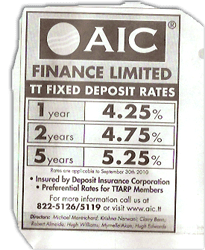
AIC advertIn the last fortnight or so, the same company has been advertising surprisingly high rates of interest in daily newspaper adverts which also offer ‘Preferential rates to Trinidad & Tobago Association of Responsible Persons (TTARP) members’.  Those interest rates range from three to four times the rates being offered by the commercial banks.  If CL Financial could not sustain this strategy, how can AIC continue to offer these rates in today’s market?

That is the question.

SIDEBAR: Two points in the PM’s speech need emphasizing

The First, is in the positive, democratic interpretation of the revised bailout being offered to the estimated 250,000 people affected as policyholders and depositors.  All 225,000 policyholders – those with life, pension and health insurance policies – will have their claims honoured by the State.  10,000 of the 25,000 depositors are owed amounts less than $75,000 and those claims can be settled now.  Which leaves 15,000 depositors to choose between litigation or accepting the present offer of a discount on their monies.

In summary, 235,000 of the 250,000 claimants are being fully settled and that is 94%.

The Second, is in relation to the erroneous portrayal of the impact of discounting on the claimants who accept the government’s offer.  There seems to be an error in the calculations upon which the PM relied in making her statement –

…We are going to give some help.  These installment instruments I am saying can be cashed in early at financial institutions.  Yes, they will be cashed in at a discount. But I have been informed by the hon. Minister of Finance, Mr. Winston Dookeran, that based on discussions with local financial institutions, that if the first five years of installment notes were cashed in, the discount could be as high as or as low as—when we look at it the glass is half-full or half-empty, depending on how you look at it—5 to 10 per cent.  What this means is for every dollar, you could get between 90 to 95 cents per dollars if you decide to discount.  I am so advised…

Apart from my not understanding the selection of the first five years of investment notes as a point for discussion, the calculations are misleading, since the actual discount at those rates (with which I concur) will have a far greater impact – see http://wp.me/pBrZN-qh for a detailed explanation.

CL Financial bailout: Disturbing Arrangements in the 2011 Budget

A Bailout Cheque payed by taxpayers to CLICO was stoppedWinston Dookeran’s budget proposals to re-order the ongoing CL Financial bailout have sparked considerable controversy. Dookeran stated his first priority to be “…Stop the drift and indecision…” – ironically enough, it appears that the sentiments of the public are moving in another direction entirely. A new mood of protest and threats of impending lawsuits have emerged. This is a live example of the law of unintended consequences.

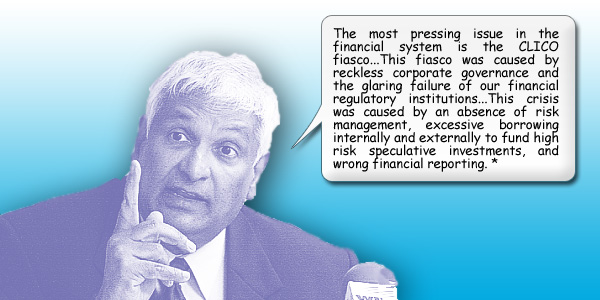
The budget’s revised proposals are –

  • Immediate stop on all interest payments;
  • $75,000 claims from depositors to be settled immediately;
  • Balances exceeding that threshold to be repaid over 20 years, with no interest payable. For an example, click here;
  • The group to be re-structured, with CLICO and British-American Insurance Company (BAICO) to be merged and prepared for divestment;
  • …Those responsible for this crisis must be held accountable.…

Clearly, Dookeran took the decision to review the MoU of 30th January and the Shareholders’ Agreement of 12th June 2009. He reduced the burden on the State by increasing the sacrifice of those who were anticipating the return of all their funds under the terms of the original agreements. The latter aspect is arousing serious protest, but there are other areas which also deserve attention.

The entire picture is very confused, which seems to be deliberate.  There were two main types of investments made in this situation – firstly, the basic and traditional insurance products such as pensions; life, health and general insurance and secondly, the depositor who was seeking high returns.  It is true that the pension products offered an optimistic 12% rate of return, but the short-term depositors were different.

Much of the current discussion and argument is actually about the repayment of the depositors, not the traditional insurance policyholders.  The fate of the policyholders is often invoked by people who are actually arguing for the return of their own deposits and that is why the separation between the two, which Dookeran makes, is so important.

To quote  – “The number of traditional, long term policyholders affected by this crisis, covering pensions, life and health insurance, is around 225,000 persons and accounts for $6 billion in liabilities…”  That is an average of $26,666 per policyholder.

Again – “…There are approximately 25,000 customers holding these short term contracts, and the liability to this group is in the region of $12 billion…”  That is an average of $480,000 per depositor.

Ironically enough, the voice of the traditional policyholders, who outnumber the depositors nine-to-one, is virtually silent in all this.  But then again, it is clear that by far the greater liability lies with the depositors and further, that they appear, on average at least, to be owed about 18 times more than the typical policyholder.  Yes, I am aware that there are depositors who are also policyholders and so on.

For those of us who did not invest with CLICO, the mere idea of our taxpayers’ funds being used to rescue those who placed high-return deposits is deeply offensive. Both the CL Financial chiefs and the depositors who took the chance at investing at those incredible rates of return are being spared the consequences of their decisions by the bailout process. But those groups are being differently treated from each other and that is the point in this commentary.

On the principle, the absence of consequence is inimical to any development, personal or national.

When I consider the appeals from Credit Union and Trade Union leaders, as well as individual investors, it makes me wonder if there is a live concept of responsibility in this place. All those people withdrew money from the slow-but-steady accounts of the traditional banks and put it into the high-interest accounts at CL Financial and HCU were indulging in riskier choices. How can they be so bold-faced as to tax the rest of us for their adventure?

Some members of the CLICO EFPA group including (l-r) William Aguiton, Selwyn Ryan, Norris Gomez and Peter Permell
CLICO EFPA Policyholders group at press conference on Sept. 21

There are now two groups organized to lobby for the interest of the disappointed depositors – the ‘CLICO EFPA Policyholders’ and the ‘CLICO Depositors Interest Group.’ Some of the leading members are themselves leading CLICO sales agents, so the decline continues. They are asking for an urgent meeting with the Minister of Finance and litigation is threatened, so this will form part of this ongoing series.

Credit Unions fear collapse’ was the headline of a story in this newspaper on 17th September – at http://guardian.co.tt/news/general/2010/09/17/credit-unions-fear-collapse – reporting on the concerns of the Credit Union League (CUL), given the scale of their investments in the CL Financial group. Figures were presented for four large credit Unions and those have an average of less than 4% of their assets in CLICO. See the table here:

CREDIT UNIONS’ reported CLICO Holdings
Credit Union CLICO Deposits Total Assets Proportion
Eastern CU $17,000,000 $1,234,000,000 1.37%
Teachers’ CU $24,000,000 $503,000,000 4.77%
Rhand CU $28,100,000 $395,000,000 7.11%
Venture CU $21,000,000 $333,000,000 6.29%
Summary $90,100,000 $2,474,700,000 3.64%

Note – The data in this table is taken from the Guardian article cited, except for the Eastern Credit Union Asset Value which is from its 2009 Annual Report.

The CUL has not made any convincing case for a possible collapse and it seems reckless to even suggest further collapses on the basis of these figures.

But the confusion is continuing, with contradictory positions being taken on this issue. The idea that the Credit Union movement is under threat is a very serious one, which would be of great public concern, so we need to examine these statements carefully.

At page 10 of the Express of 22nd September ‘Credit Unions seek help from Rowley’ – see http://www.trinidadexpress.com/business/Credit_unions_seek_help_from_Rowley-103498744.html?corder=reverse – the Credit Union League met with the Opposition Leader, Dr. Keith Rowley. Once again, the idea that Credit Unions are in serious trouble was advanced – “…They said they would not be able to sustain daily operations. …” That is a very startling statement, this time given without any attempt to provide evidence.

To add to the confusion, the Guardian of that same day (22nd September) reported, at page 13 “CFF welcomes move to meet with CU on Clico” – see http://guardian.co.tt/news/general/2010/09/22/cff-welcomes-move-meet-cu-clico – on statements by Esme Raphael, President of the credit union’s Central Finance Facility (CFF) on this situation – “…Raphael said while the credit union movement was under no threat of collapse, the 20-year repayment plan would make it less competitive in delivering credit union services…”.

These contradictory messages will detract from the credibility of the Credit Union movement and must be clarified.

The idea that there is any such thing as a ‘guaranteed investment’ is preposterous. An absolute oxymoron is generating all this argument.

Yes, the last government made certain pledges and I have been critical of those, but here we are entering an even more turbid situation.

As outlined above, the PP government has decided to alter the terms of the existing bailout agreement as to refunds to depositors, so it is clear that it regards the terms of those agreements to be negotiable.

In my view, the most odious aspect of the entire bailout is that the wealthiest individual in the Caribbean was able to negotiate the largest-ever loan from our Treasury at zero interest on the basis of a letter. If the terms of the bailout agreement are negotiable, why are we not insisting on charging a proper rate of interest to compensate the State for these massive loans? Who is protecting our country’s wealth? In view of the fact that they are essentially unsecured loans, the only proper interest rate would be a punitive one.

There are live, cogent notions of financial equity and economic justice which are being abused in this entire scenario, but that is for a separate series.

The amounts involved are massive – “…The total funding provided as at May 2010 by the Government and the Central Bank, excluding indemnities and guarantees to First Citizens Bank amounted to approximately $7.3 billion” Emphasis in the original. That equates to over $456M a month to rescue Mr. Duprey. I wonder how much is the total of the indemnities and guarantees?

The bailout terms were revised to reduce the amount of the State payout to the depositors, but no additional pressure is being put on the CL Financial group in terms of interest payments. It is resembling a comfortable arrangement for Duprey.

Another aspect of the budget which was difficult to follow was the shifting focus between CLICO and CL Financial.

The proposal to merge and prepare CLICO and BAICO for divestment needs a fuller explanation. That is because the leading insurance ratings agency, AM Best, just de-listed CLICO, due to its failure to provide financial data – see http://insurance-technology.tmcnet.com/news/2010/09/14/5004871.htm. In addition, BAICO was declared insolvent in November 2009 – see https://afraraymond.net/wp-content/uploads/2009/11/baico_resolution_strategy.pdf – and filed for bankruptcy in the Florida courts in March – see http://www.thevoiceslu.com/local_news/2010/march/02_03_10/British_American_Files_for_Bankruptcy.htm. To quote Dookeran – “…As of June 2010, CLICO and British American combined total liabilities were approximately $23.8 billion but total assets were $16.6 billion” Emphasis his. That is an insolvency of the order of $7.2Bn and it is not at all clear how, if at all, that can be divested.

We need a better quality of information to move ahead with this, so it was encouraging to hear Dookeran’s clear post-budget statement “…No more shall we have secret government,…” – see http://www.newsday.co.tt/news/0,127330.html.

Minister, these facts need to be made public if we are to eliminate secret government :

  • The original Duprey letter of 13th January 2009 – I have applied twice under the Freedom of Information Act for this and the second application has been in your Ministry since 28th June, unacknowledged.
  • The audited accounts of the CL Financial group for the year ending 31st December 2008 – Have PwC completed that? When are they to be published?
  • The Lindquist Report – Bob Lindquist was reportedly appointed to examine CLICO. Has he submitted a report? Are we to be told of any of his findings?
  • The Mottley Report – There was a team of three advisers – Wendell Mottley, Colin Soo Ping Chow and Steve Bideshi – appointed to examine the CL Financial group and we need to know what were the findings of this group.
  • The Central Bank’s winding-up petition for CIB in the High Court has given us a disturbing insight into the operations of ‘The House on the Corner’. When are we going to get reports into the collapses at CMMB, British-American or CLICO?
  • Given that we are being asked to bailout and clean-up Mr. Duprey’s crisis, I feel we need to be told who are the borrowers of the $1.0Bn of ‘non-performing loans’ in CIB’s portfolio. The fact is that these are some of the delinquents we are being asked to bailout and the names would surprise the public. Local banks customarily publish the names etc of people who have non-performing loans, so why can you not do the same thing in this case?
  • To quote the budget statement – “…This crisis was caused by…wrong financial reporting…” False Accounting is a criminal offence under our laws – When are criminal charges to be laid? Those people – the accountants who were accused of that grave offence – belong to professional bodies, both here and overseas. Is there any intention to make formal reports to these professional bodies?
  • Quoting again – “…This fiasco was caused by reckless corporate governance and the glaring failure of our financial regulatory institutions…” What action is to be taken against these slack regulators?
  • Is there any intention to invoke the ‘Fit and Proper’ provisions against any of the CL Financial Directors or Officers?
  • Finally, do you intend to insert an interest clause into the ‘sweetheart bailout agreement’?

Mr. Dookeran, you have the opportunity to inject notions of solid responsibility and proper conduct into this sorry situation.

Next, I am going to delve into the promise to ensure accountability of the responsible persons.

SIDEBAR: The Hindu Credit Union peril

Amidst all this and completely to be expected, the PP government is bailing-out HCU depositors on identical terms to those now being offered to CL Financial depositors. For the record, the Finance Minister’s statement was as plain as it was unsettling –

“…Although the failure of HCU did not carry a systemic risk to the financial system since it represents less than one percent of the total assets of the financial sector, this Government is of the view that these funds of these small investors must be protected…”

We were told directly that this HCU collapse is not a risk at all to the system, but these disappointed savers are still to be rescued by the Treasury.

This is a poor precedent, since when the next Financial Institution collapses, the then Minister of Finance would have to deal with those unrealistic expectations.

CL Financial bailout – The House on the Corner 2

Winston Dookeran sounds off on CLICO

—* Finance Minister Winston Dookeran, speaking on the CL Financial bailout, during his inaugural Budget Speech on 8th September 2010

More insights into CIB

The examination of CLICO Investment Bank (CIB) continues, based on the affidavits in the Central Bank’s winding-up action.

Firstly, as an overview, I consider the various versions of the accounts and their implications –

  • CIB’s 2007 audit – Was performed by PricewaterhouseCoopers (PwC) as at 31 December 2007, with the Balance Sheet showing Total Assets of $12.587Bn and Total Liabilities of $11.699Bn. Please note that those accounts were unqualified – PwC gave a ‘clean’ audit to CIB at the end of 2007. (See – https://afraraymond.net/wp-content/uploads/2010/09/cib_2007_accounts.pdf)
  • CIB’s Management Accounts – As at 31st January 2009, showed Total Assets of $12.264Bn and Total Liabilities of $10.692Bn. Those figures are broadly in line with the audit figures 13 months earlier, at the end of 2007. (See – https://afraraymond.net/wp-content/uploads/2010/09/cib_mngt_acc.pdf)
  • Ernst & Young’s Statement of Affairs – As at 31 January 2009, that showed Total Assets of $6.387Bn and Total Liabilities of $11.080Bn. Virtually $5.9Bn of assets seem to have vanished in a mere 13 months – a weekly rate of ‘withdrawal’ close to $105M – leading inevitably to the estimated insolvency of $4.693Bn. (See – https://afraraymond.net/wp-content/uploads/2010/09/cib_stmnt-of-aff.pdf)
  • The size of the CIB insolvency – Apart from its size as a proportion of the entire CIB Balance Sheet, this gap can give one an idea of the composition of the missing $76.1Bn from the CL Financial Balance Sheet – see ‘Finding the Assets‘ published in the Business Guardian on 19th November 2009.
  • The Return on Assets – This is a benchmark of company performance, being the net income as a proportion of the total assets. In the case of CIB, according to the PwC 2007 audit, the RoA is less than 1%.  That is an exceedingly poor rate of return which would normally denote weak management, but it seems that CIB functioned well as an operation to raise cheap finance for the CL Financial group.
  • Statutory Deposit – Note 4, at page 45, of CIB’s 2007 financials states a legal requirement for CIB to maintain a non-interest bearing Reserve Account with the Central Bank equivalent to 9% of its deposits and other specified liabilities. Given that the 2007 Balance Sheet discloses Customer Deposits and accrued interest of $5.509Bn, the Reserve Account ought to have been holding about $495M, as a buffer against just this sort of situation. Was that Reserve Account credited in accordance with the stated requirements? Were those funds expended first in the crisis, or has the Treasury taken the full cost of CIB’s failure?

That is an overview of the CIB position, which leaves the burning question – ‘Where did all this money go?‘  For $5.9Bn in assets to vanish in 13 months is an incredible failure of corporate governance and state oversight.  Given paras 5 and 6 of Hiralal’s affidavits – which effectively seek to claim that the events of the 15 January 2009 were unexpected – it seems that neither the auditors nor the regulators performed properly in this case.  But more on that later…

Devilish Details

Here are some details of where the money went and how it was handled.  This is taken from para 7 of the affidavit of Ernst & Young Director, Maria Daniel

  • Financial Records

    …The financial record keeping in CIB was weak.  The financial accounting system was not appropriately designed and implemented…

  • Bank Records

    …Bank reconciliations were not properly prepared.  CIB’s reconciliations contained numerous errors that were not corrected on a timely basis …

  • Loan Portfolio

    …In general the loan portfolio comprised a significant percentage of high risk real estate projects…and the rest of the portfolio was of poor credit quality.  Additionally, there was a lack of supporting documentation and/or appropriate security for many of the files inspected.  There was little evidence to suggest that the loan portfolio was being properly administered by management, and generally, recovery efforts on delinquent loans were inadequate…

  • Loan Arrears

    …The arrears report as prepared and presented by CIB’s management as at 31 January 2009 showed only $111M in arrears, which is approximately 5% of the loan portfolio…

    That 5% bad-loan proportion would be considered acceptable by banking norms and would raise few alarms.  Given that CIB was in crisis, it seems unbelievable that this crucial indicator was at 5%, but the very next sentence reads –

    …However, upon further examination Ernst & Young identified at least $1Bn in loans that should have been classified as non-performing or on a watch-list…

    From those figures it seems that the true level of delinquency in the loan portfolio was of the order of 45% and one can only wonder what CIB’s management were trying with the 5% arrears story.

  • Investment Portfolio

    …The profile of the investment portfolio was not commensurate with the liquidity requirements on the funding side of CIB’s balance sheet, with less than 1% of the portfolio invested in government securities and money market instruments…In addition, 88% of their investment portfolio, including the investment in Republic Bank shares, represented investments into other CLF Group companies…

I said ‘some details’ and the full affidavit can be viewed at https://afraraymond.net/wp-content/uploads/2010/09/cibey1.pdf.

Well, William?

Well, William?William Lucie-Smith, the erstwhile Managing Partner of PwC until his retirement in June 2004, commenting on the CL Financial bailout, recently stated “…Indeed I dont (sic) know why anyone assumes the books were wer (sic) wrong at any time and did not reflect accurately what was happening…

Mr. Lucie-Smith, the people questioning the accuracy of those CL Financial books now includes Ernst & Young and our Finance Minister, not just this Chartered Surveyor.  Given the quantity and quality of the information presented here, I am wondering if you are going to stick with that opinion.  Will Lucie-Smith resile from those views?  That kind of reversal would require real character and integrity.
** See http://www.trinidadexpress.com/commentaries/CL_Financial_A_new_strategy_required_.html.

Where does the Truth Lie?

If PwC’s audits were properly done, based on true accounts received from CIB and the relevant accounting standards, then the Inspector of Financial Institutions has been at fault to allow this failed institution to retain its licence.  If, as an alternative, the Inspector relied on misleading accounts, then one could hardly lay the full blame onto them.  In the latter case, either CIB’s in-house accountants, or the auditing firm PwC bears a heavy responsibility for this entire crisis.  EYvsPwCCompare and contrast the different results of the PwC 31 December 2007 audited Balance Sheet and the E&Y 31st January 2009 Statement of Affairs.  The discrepancies between the CIB Management Accounts and E&Y’s Statement of Affairs of 31 January 2009 are astonishing.



One can be escapist and say ‘on the one hand this, but on the other hand that‘ for only so long before reality sets in.  The fact is the group collapsed because it ran out of money.  Exactly how it ran out of money is a huge story of our age, supposedly an enlightened and more educated one.  That is the $57,000 question.

But the allocation of responsibility would also have to go beyond the role of the auditors to include the failure of the Inspector to detect the fact that CIB had filed no Corporation Tax returns for 2007.  Or was it that the Inspector’s office did note that and simply took no action?

Auditing the Accountants

What is the role of ICATT in all this confusion?  I tried with an open letter on 19th October 2009 and several dialogues with various of their Board of Directors.  Is ICATT investigating any aspect of this fiasco?  Does ICATT have any concerns over the MoU/Shareholders’ Agreement and its terms?  Does ICATT exist solely to advance and protect the professional interests of its membership?  Is it unreasonable for the general public to expect ICATT to have spoken out on these burning issues?  With all respect to the people concerned, ICATT’s silence is resembling a cover-up.

What is the meaning of ‘Fit and Proper’?

Our laws sets the penalty for murder as hanging, so, even if one does not agree, it is clear that the penalty is final to both indicate society’s intolerance of taking another human life and to prevent a recurrence.

The ‘Fit and Proper’ regulations are meant to regulate the behaviour of the Directors and Officers of Financial Institutions, since they are the people to whom we entrust our monies.  Any recklessness or dishonesty on their part can lead to severe loss of capital and ‘Fit and Proper’ ensures that those acts are punishable by loss of your privilege to serve in those high-powered positions.  The Companies Act even makes it illegal for Company Directors to ‘mismanage’ the affairs of a company.

Look at the case of the failed insurer, Goodwill Insurance, the Central Bank took a winding-up action which ended in two of its Directors – Johann Lambkin and Lennard Woodley – being fined $20M and banned from serving as Directors or Managers in any company incorporated in here for 5 years – see http://webopac.ttlawcourts.org/LibraryJud/Judgments/HC/rajkumar/2009/CV_06_02529DD30July2009.pdf.

Why is the Central Bank not proceeding against the CL Financial Directors?

The Timing Thing

So far I have been writing about this CL Financial collapse as if it took place in January 2009 and that is a position in need of a re-think.

When a marriage ends, the first ‘official notice’ of that is when one of the parties files for divorce, but there is often a stage before that when one of them moves out or moves on, and a stage before that one at which they stop having sweet times together.

I think the CL Financial ‘official notice’ was when they wrote for help on 13th January 2009, at some point before that, key people moved out or moved on and at some point before that, the group was failing.

When did the CLF group actually collapse?

CL Financial bailout – The House on the Corner

Some insights into CIB

CIB head office - The House on the Corner

I am starting to look at the CLICO Investment Bank (CIB) and its operations, as revealed by the ongoing bailout.

CIB is a very interesting part of the saga, because even prior to the collapse of the CL Financial group there was a widely-held view that CLICO and CIB were parts of the group which were responsible for raising finance for their ambitious plans.  Even though the interest rates offered by CLICO and CIB were incredibly high – about twice the average offered by others – it would have been much more expensive for the CLF group to borrow those funds via loans.  The view was that the CLF group had a legitimate method of harvesting funds on terms advantageous to them.

In April this year the Central Bank applied to the High Court to have CIB ‘wound-up’, due to its insolvency, estimated in that submission to be of the order of $4.7Bn.  (See https://afraraymond.net/wp-content/uploads/2010/09/cibcbtt2.pdf) That application to wind-up is being opposed by the NGC and the National Insurance Board (NIB).  Those matters are still before the Courts, which I only mention because the documents filed there give a disturbing insight into the CIB mystery.

We were also being fed some lyrics that the CL Financial group in general and CIB in particular were all healthy/strong companies with good assets, fallen victim of the global financial crisis.  Despite the natural doubts on that one, I had some trust in those people who were speaking to me.  The mystery remained – Was CL Financial and CIB an audacious, well-run operation which had become a victim of a declining market or, even worse, a sinister conspiracy?  Or was it a much less glamorous story of the Caribbean’s largest-ever business conglomerate actually being some kind of Naipaullian ‘Thing without a name‘?

I have read some of the affidavits in this case and the contents will be severely disturbing to any right-thinking reader, even you are not a financial expert.  This week I am looking at two affidavits of the Inspector of Financial Institutions, Carl Hiralal. The affidavits are available to read at https://afraraymond.net/wp-content/uploads/2010/09/cibey1.pdf and https://afraraymond.net/wp-content/uploads/2010/09/cibcbtt1.pdf.

Carl Hiralal
Carl Hiralal, Inspector of Financial Institutions

There is a way that the entire reading is surreal, since the very person who was supposed to safeguard us from extensive wrongdoing and risk-taking, now has to swear to the Court that the institution has failed so badly it needs to be wound-up.

The main points were –

  • The initial meeting – At para 5 he states “…On January 15th 2009 as part of its normal regulatory process, the Central Bank held a meeting with officials from the Petitioner…” (CIB).  Now that is literally an unbelievable sentence.  Hiralal is swearing that this was a routine meeting.  We are being asked to forget that the then Minister of Finance told the Parliament on 4th February 2009 that

    “…I would like to read into the record of Hansard, a letter from Clico Investment Bank addressed to the Central Bank. That letter is dated January 13, 2009. It is on the letterhead of CL Financial, addressed to Mr. Ewart Williams, the Governor and signed by Lawrence A. Duprey, Group Executive Chairman…

    see page 628 of http://www.ttparliament.org/hansards/hh20090204.pdf.  I am forming the impression that Hiralal does not want to have the ‘bailout letter’ cited in this Court matter at all, for whatever reason.  You see, if it were cited, the Central Bank would have been forced to file a true copy, which anyone would have been able to access.  Neither of my Freedom of Information applications for that ‘bailout letter’ – to Nunez-Tesheira or Dookeran – have been fruitful.  So we have this incredible statement for starters.  We are being asked to believe that Lawrence Duprey’s letter requesting urgent, massive financial assistance and the meeting two days later were unconnected.

  • Reasons for winding-up – At paras 9 c. and 10 g. he states “…the Petitioner (CIB) was not maintaining high standards of financial probity and sound business practices…”  Stunning, and in a sworn affidavit from the chief regulator.  This is the high official responsible for maintaining good order of the players in the financial system.  Those Directors, Auditors and Officers of CIB, the ones who presided over this situation, do you still consider them to be ‘fit and proper’, Mr. Hiralal?  Yes or no?  If Yes’, how come?  If ‘No’, what are you going to do about it?  And when?  But there is more.
  • Board of Inland Revenue – At para 23 he states “…With respect to the Creditors of the Petitioner, the Petitioner has met the statutory obligations for the Board of Inland Revenue (except for Corporation Tax Returns for 2007, 2008 and 2009 which are being prepared and remain outstanding)…”  I spoke with a very experienced accountant and a corporate attorney before writing this and the common view is that the meaning of that statement is that the Corporation Tax owed by CIB is unpaid for 2007-2009.  If they owe those taxes we dealing with people who do not pay their taxes, yet expect the taxpayer to assist them in times of need.  Even if the taxes are paid-up in full, there is still the elementary and inescapable governance question of how and why CIB failed to file a tax return?  Did PwC report on this in either their audit or management letter?  Was Hiralal aware of CIB’s failure to file before he was forced by the procedural requirements of the winding-up petition to declare his hand?  Did the Board of Directors know?  Have penalties been applied?
  • Statement of Affairs – This is at para 12 and appears to contradict the prior statement in that it does not show any amount for either ‘Taxation Recoverable’ or ‘Taxation Payable’.  There needs to be an explanation on this.
  • Auditors – CIB’s auditors were PricewaterhouseCoopers (PwC), who were featured last week.
  • Lucie-Smith’s view – William Lucie-Smith, former Managing Partner of PwC, responding to bloggers on his Express article ‘CL Financial: A new strategy required’ – see http://www.trinidadexpress.com/commentaries/CL_Financial_A_new_strategy_required_.html – replied on Friday 20th August, like this “…Indeed I dont (sic) know why anyone assumes the books were wer (sic) wrong at any time and did not reflect accurately what was happening…”  Just my first read of those affidavits made me question the reliability of the accounts.

Next, I will be going into some more detail on how CIB actually worked, based on sworn affidavits.

The Concentric Circles

Concentric circlesFor the purposes of this article, CIB is at the centre of the page, with its Directors and Officers being in charge of its strategy and management.  They bear primary responsibility for the company’s affairs on behalf of the shareholders and other stakeholders.

The second ring is the auditors, usually a leading firm of Chartered Accountants, who examine the accounts prepared by the company to report whether those accounts offer a true and correct picture of the company’s financial health.  The auditors use international accounting standards as a benchmark for quality and comparability of figures, if there are material divergences from those standards, the auditor’s opinion can be qualified, which is when the divergences are specified.

The third, outer ring is the financial sector regulators, whose job is to ensure that the companies within the industries comply with the law and other guidelines created by the regulators.  The regulators examine the audited accounts and other information from the companies in order to determine the extent to which the rules are being followed.

We, the saving and investing public, are outside of that series of concentric circles and once there are no alarm bells, we will place our savings with these approved financial institutions.

The reason for all that is to preserve the most fragile and vital ingredient of the capitalist system.  Yes, I am speaking about trust, which is also an important aspect of the wider society.

The society relies on the people in these three concentric circles to act in a ‘fit and proper’ fashion in the execution of their duties, with proper penalties in place for improper or illegal behaviour.  The idea being that there is a minimum standard of conduct and risk-taking which avoids nasty surprises in the course of normal savings and investment.

There are real questions as to what levels of risk-taking and innovation are healthy or desirable to maintain some balance between profit-levels and stability.  That is a fascinating aspect of the financial industry to be expanded on.

The Regulator

The chief Regulator at the Central Bank, with responsibility for both Banks and Insurance companies, is the Inspector of Financial Institutions.  That office is held by Carl Hiralal, who was appointed on 1st January 2007.  Hiralal is a well-qualified, highly-experienced professional and that only makes the contents of his affidavits all the more disturbing.

For more details, see – http://www.ttaifa.com/downloads/2009CarlHiralalBio.pdf

The CIB Directors

At the time of the collapse, the Board of Directors of CLICO Investment Bank comprised –

Mervyn Assam (Chairman)
Amjad Ali
Anthony Rahael
Maria Thorne
Michael Callender
Faris Al Rawi

The CL Financial bailout: Taking in Front – The NGC element

One of the abiding questions on the CL Financial issue is – ‘What main event/s caused the group to fail?

One of the main rumours making the rounds at the time of the bailout was that the State-owned National Gas Company had made heavy withdrawals from CLICO Investment Bank.  Those withdrawals and the requests for the return of further deposits were said to have triggered the ‘crash’ within the CL Financial group.

Another major issue which was raised in the Parliament by the current leader of the opposition was the allegation that the Minister of Finance and Governor of the Central Bank had used ‘insider information’ to withdraw their own deposits from CIB.  Despite the explanations by these officials, which form part of this article, those perceptions persist among the population.

Ultimately, the questions have to be ‘What did they know?‘ and ‘When did they know it?‘  This article will delve into some of those issues, using the published record, as is my practice.

The main points are –

  • Frank Look Kin, Former NGC President
    Frank Look Kin, Former NGC President

    The NGC press release – This was published in the daily newspapers on 4 February 2009, as a corrective to the widespread and potentially-damaging rumours.  It was issued under the hand of the NGC President, Frank Look Kin – it is the penultimate item on its publications page, under the title ‘Press Release- NGC’s Management of Its Financial Investments‘.  Due to its huge revenues (stated to be $14.0Bn in 2008), over 90% of which are in US dollars, the NGC has established a policy for the management of its large-scale, short-term investments.  According to the press release, those funds are placed in either approved financial institutions or investment-grade rated foreign banks.  The placement of those deposits is guided by limits for the percentage of funds allocated to a financial institution or group of financial institutions.  The selection of deposit-taking institutions and the establishment of placement limits are both good financial practice in terms of risk management.

  • NGC’s placement limits – These were not disclosed in the NGC press release, but we are told that at the start of 2008, the CL Financial group was allocated 40% of the NGC’s deposits, which by the end of 2008 had been slightly reduced to 37%.  At another point we are told that in 2008, NGC withdrew an average of $151M USD per quarter, with CL Financial’s portion of that being 45.7% – more than the 2008 allocations stated earlier.The silence on the actual placement limits means that we cannot determine whether the 2008 deposits in the CL Financial group complied with that policy.  The only deposits for which we are told ‘…the deposits were within the maximum percentage limits…’ were CIB deposits in 2001, but no percentages were given in that case.We are also told that “…In the 4th quarter of 2008, deposits were recalled upon maturity from…seven financial institutions in Trinidad & Tobago and the USA…”  Even if we only count the local ones, there are 6 large banks and 19 other approved financial institutions available to accept deposits under NGC’s policy.  It is passing strange that up to 45.7% of NGC’s funds could be allocated to a single group.  If that allocation of funds in 2008 was in conformity with NGC’s deposit placement policy, it is indicative of a tremendous measure of confidence in the CL Financial group, to put it in its best possible light.  Even if CL Financial were a ‘blue-chip’ group, which they were not, such an allocation of deposits could be viewed as reckless behaviour by the responsible parties.Despite its claims of a policy to manage the risks associated with being responsible for such huge, short-term investments, it seems that the NGC may have yielded to the temptation of the unrealistically high interest rates offered by the CL Financial group.  Again, on a governance note, one has to ask – ‘What good is a prudent policy, if it is violated in practice?’It seems that we may need to examine more closely how our energy revenues are invested.
  • November 2008 – We are also told in that press release that “…In November 2008 CIB failed to return the principal and interest upon the maturity of an NGC deposit (US$10 million).  This deposit, plus interest, was paid in two amounts during the first week of December 2008…”  From that statement it seems certain that CIB’s inability to repay was known to NGC, a huge, State-owned corporation.  It is difficult to imagine that news of that importance would not have traveled to the very highest levels.  Indeed, one could argue that proper management of the State’s financial resources would have required such a piece of news to be formally reported to the relevant officials.When one juxtaposes the fact that CIB “…failed to return…” $10M USD to NGC with the measure of confidence one can infer from the extent of their dealings, it is impossible to imagine such an episode passing off quietly.
  • The Governor’s response – Ewart Williams’ written response to the allegations was unequivocal and made the very same day – it can be viewed at http://www.central-bank.org.tt/news/releases/2009/mr090204.pdf.
  • The Minister’s response – That was a statement in Parliament on the very day and it is at pages 626 to 631 of http://www.finance.gov.tt/documents/news/spF82F5F.pdf. At the time of the CL Financial collapse, the Governor was clear in identifying the prime cause to be “…excessive related-party transactions…” and this NGC/CIB situation bears a strange resemblance.We need to strive for better norms of governance and prudence if we are to avoid a recurrence.History is said to be rich in irony, never more so than in this situation, since the defensive statements by both officials were made on the very day the NGC published its own defence.  Wednesday 4 February 2009.

SIDEBAR

Approved Financial Institutions

Those are taken to mean the 25 companies licenced under the Financial Institutions Act 2008.  Those companies are all required to be members of the Deposit Insurance fund and their names can be viewed at http://www.dictt.org/deposit_insurance/index.php?pid=2006.  There are 6 main banks on the list – Citibank, First Caribbean, First Citizens’, RBTT, Republic Bank and Scotiabank.  Two smaller banks on the list are Intercommercial Bank and Bank of Baroda.

Interlocking Directorships

A continuing concern, in light of the growing challenges to the old order of the commercial and financial world, is the role of inter-locking Directorships.  That is the situation in which a very small group of people control most of the major companies and activities in a society.

Critics of that situation would say that such situations are a recipe for corruption and self-serving behaviour.  The small group of people can enrich themselves, leaving the leftovers for everyone else.  Those who support that situation would say that the emergence of such a small group of leaders is natural, particularly in a small society such as ours, and the real challenge is to develop rules and norms which limit the possible negatives.

This is an issue which I am exploring in the ongoing series to examine the governance implications of the UDeCOTT fiasco.  It is not surprising that it is also a feature of the CL Financial collapse and there is an example of that in the case of NGC and CIB.

The CIB Directors

At the time of the collapse, the Board of Directors of CLICO Investment Bank comprised –

Mervyn Assam (Chairman)
Amjad Ali
Anthony Rahael
Maria Thorne
Michael Callendar
Faris Al Rawi

The NGC Executive

At that time, the National Gas Corporation’s executive management included –

Ms. Olave Maria Thorne, Vice President, Legal and Corporate Management and Company Secretary – see http://www.ngc.co.tt/About/executive.htm. Yes, same person.