CL Financial bailout – Examining the Horns

Once again, I am returning to the need for us to grow a culture of responsible behaviour as a vital part of national development.

Responsible Reasoning
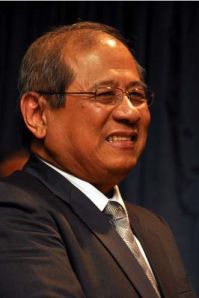
William Lucie-Smith
William Lucie-Smith

The idea that the CL Financial bailout is just like the one in the USA is a durable one, which has been very useful to those people who are seeking satisfaction.  Nothing could be further from the truth.  That is a false view and what is more, extremely misleading to the public, who rely on informed members of society to share that information conscientiously.  Rightfully or wrongfully, many people here look upon the USA and the doings of its government with a sense of approval, to the point that if Uncle Sam does it that way, there must be some good sense in that.  That idea that our bailout is ‘just like the one in America‘ must be challenged, defeated and put out of its misery.

On Wednesday August 18th, William Lucie-Smith, the Express columnist wrote on this very topic, his sub-title being ‘A new strategy required’.  That column can be found at http://www.trinidadexpress.com/commentaries/CL_Financial_A_new_strategy_required_.html
Lucie-Smith is a chartered accountant, former Managing Partner of PricewaterhouseCoopers and currently is a Director of both Republic Bank and Sagicor – he is described in his byline as ‘specialising in corporate finance’.

That article started with the claim that the CL Financial bailout was in some way similar to the US government’s bailout of its financial sector.

…The original plan was to guarantee policyholder funds and make loans available to Clico, so that confidence would be restored and the group businesses turned around. This is what happened in the United States with the vast majority of TARP funds being repaid in full with interest…

Given the huge stakes in this matter, the promotion of such misleading views is nothing less than public mischief.

Here are some of the main points of the CL Financial bailout which are, in every respect, completely different from the USA situation –

  • No Public Explanation – Apart from Duprey’s single, brief speech at the press conference to announce the bailout on 30th January 2009, there has been no proper forum at which the CL Financial chiefs have been made to give an account of this catastrophic collapse.  Neither has there been an attempt to set one up.  That is in direct contrast to the highly-publicised and televised Congressional hearings at which the chiefs of these failed financial institutions have been questioned as to their actions and the serious consequences.  We have all seen those TV shows.  Even the new CL Financial management is little better, compared with the USA where the Treasury must make a monthly report to Congress on the bailout.
  • No limit on quantum – No limits have ever been set on the CL Financial bailout.  Every firm in the USA bailout had its borrowing limits specified at the outset.  As an example, see Citigroup’s terms at http://www.financialstability.gov/latest/hp1287.html.  Or the wider bailout, at http://www.financialstability.gov/latest/tg13.html.
  • No interest – Neither of the Agreements specifying the terms of the CL Financial bailout even mention interest.  As Lucie-Smith himself stated, the recipients of the US bailout had to repay taxpayers’ monies with interest.
  • No pre-payment of creditors – An interesting feature of the US bailout was that the failing financial institutions were made to stand the first tranche of losses before any taxpayers’ monies were injected.  In other words, they had to sell some of their assets first before tapping into Uncle Sam’s Treasury.  In contrast, CL Financial has been able to tap right into Treasury funds without any significant asset disposals – yet another point that Lucie-Smith himself makes.
  • No time-limit for repayment – Neither of the Agreements specifying the terms of the CL Financial bailout give any stated payback period.  The US bailout set out repayment periods for all recipients of taxpayers’ funds.
  • No security taken – No significant CL Financial assets have been disposed of, as per the agreements – yet another point that Lucie-Smith himself makes.  In addition, the Governor of the Central Bank has himself confirmed that all of the CL Financial group assets are encumbered – see http://guardian.co.tt/business/business/2009/04/08/govt-left-empty-handed-cl-financial-bailout.
  • No dilution of equity position of CL Financial shareholders – Despite the massive extent of the CL Financial bailout – it is effectively an open-ended commitment – there is no dilution of the shareholders’ equity.  In the US bailout, the troubled  companies were forced to give equity to the Federal Government.  In order to receive taxpayers’ money in the USA, Fannie Mae (the huge mortgage company) gave 79.9% of its equity; while AIG (at that time the world’s largest insurer) gave over 85% of its equity; 36% of Citibank belonged to the US government in February 2009 – pages 229, 401-2 and 530 of Andrew Ross Sorkin’s ‘Too big to Fail’ refer.  CL Financial shareholders have not been made to dilute their equity.  If I, writing as an interested citizen, could know this, it seems that any specialist in corporate finance would also know these details.

The only resemblance to the US bailout is in name only.  Real Trini-ting.    Duprey and his cohorts negotiated a Blank-Cheque Bailout at zero interest, without losing any of their assets.  That deal is absolutely unique.

Our taxpayers have effectively made a huge single loan (probably the largest in the Region’s history) to the wealthiest individual in the Region at Zero interest.  Virtually every relevant professional body and Civic Society organisation has remained silent on this bold-faced attack on our Treasury.  Nothing from the Accountants, Lawyers, Bankers, Economists, Trade Unionists or Religious bodies.  The one recent exception to this has been the call by the Trinidad & Tobago Transparency Institute (TTTI) for investigations into the Angostura disaster.

The CL Financial bailout has been cloaked in the robes of benevolence and stability, resulting in a situation which has minimised the floods of lawsuits which would have been confronting some of those responsible parties – Auditors, Attorneys, Company Directors and Officers.  In reality, the common-wealth of our entire society has been pledged to rescue a fortunate few.

The CL Financial bailout is in urgent need of re-negotiation, to say the least.  “It wrong like a biscuit.

In the same way it was wrong for the last administration to use taxpayers‘ money to rescue the CL Financial chiefs from the real consequences of their decisions, it would be equally wrong for this newly-elected government to also bailout those affected by HCU’s demise.  Two wrongs could never make a right.

Cocktail of Consequences

Angostura Rums

Angostura is the Caribbean’s flagship rum and bitters company.  It was a Caribbean icon, manufacturer of Angostura Bitters, as well as classic rums like 1919, Royal Oak, 1824, VAT 19 and Old Oak – Angostura was acquired by CL Financial in 1998.

The 2008 audited accounts were finally published at the end of July 2010 and the extent of their losses are cause for grave concern, seemingly a harbinger of the state of the entire group, 18 months into the bailout.

Coming after an extended wait for the 2008 audited accounts, the Guardian headline on 4th August 2010 was stunning: ‘Angostura declares $1.28Bn loss’ – see   http://guardian.co.tt/business/business/2010/08/04/angostura-declares-128-billion-loss.

The Express headline, on the same date and story, made me smile – ‘Angostura sales rise’ – see http://www.trinidadexpress.com/business/99917894.html.

It was said to be the largest loss in the history of our stock market and it represents colossal destruction of investors’ capital and national wealth.  It seems that the source of the losses was a receivable due from its parent company, CL Financial – according to the Deputy Chairman’s report – see http://www.angostura.com/LinkClick.aspx?fileticket=JSMxolh%2bmC8%3d&tabid=144

…[the] precarious financial position of our parent company…impaired the collectability of circa $1,185M in receivables from the CL Financial group…

The Notice to Shareholders of 26th June 2009 – see https://afraraymond.net/wp-content/uploads/2009/11/26jun2009_angostura_notice_to_shareholders.pdf – stated that the receivable from the parent company was $633M.  So you have to wonder what is the reason for that receivable almost doubling.

The interests of the minority shareholders have been subordinated to those of the majority shareholder, CL Financial, which was able to acquire the leading Jamaican distiller, Lascelles Mercado, by deploying the Angostura assets.  This episode is one which raises issues of minority shareholder rights which are unlikely to disperse.  As Justice Carlton Best is reported to have said, in relation to his lawsuit against CLICO for a $57,000 fixed deposit they failed to honour upon maturity – ‘It feels like robbery without a firearm’.

Who advised the Angostura Board on this transaction?  How can we accept the declaration that those funds are now irrecoverable?  How could a parent company, said by its auditors to have assets worth in excess of $100Bn at the very same accounting date (31st December 2008) be unable to repay a mere $1.185Bn.

Yes, it is true, the same accountants – the esteemed international firm, PriceWaterhouseCoopers – are auditors for both CL Financial and Angostura.  But more on that in the sidebar.

It is almost a metaphysical query – can a responsible class always escape judgement?

SIDEBAR: Auditing the Auditors

PricewaterhouseCoopers (PwC) is the world’s largest professional services firm in the accounting and finance industry.  PwC audits the accounts for UDeCOTT, CL Financial, Angostura and at one point I can even recall the Hindu Credit Union announcing that that firm was to be their internal auditors.  Clearly, PwC is a main player in the big leagues here in Trinidad & Tobago.  Let me declare here that they are also my [Afra Raymond, not Raymond & Pierre] accountants.

On 30th June that firm issued a letter, under the hand of Colin Wharfe, its new Senior Partner, to announce four new appointments.  The letter also explained that four of the most senior Partners had all retired on 30th June, those were –

  • Graham Mitchell, former Senior Partner, after 28 years’ service;
  • Jewan Ramcharitar, after 34 years’ service;
  • Peter Inglefield, after 34 years’ service;
  • Gerald Olliverre, after 32 years’ service.

The new appointments were announced in full-page press adverts, which omitted the retirements. See letter here – https://afraraymond.net/wp-content/uploads/2010/08/pwc_resignations.pdf

A version of this commentary appeared in print on August 26, 2010, on page 17 of the Business Guardian.

Second FoI Application for Duprey Letter

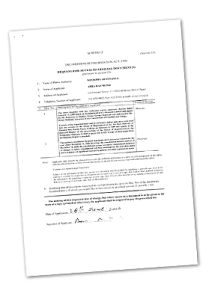
Application #2 for Duprey Letter

This is a second attempt to get at the Duprey letterthe first application was eventually deflected by the Ministry, who asked us to refer to the Central Bank. I believe that was a barefaced attempt to stifle our request with the fact that the Central Bank is exempt from the FoI Act.

My request for the 2008 audited accounts is based on the terms of the 12th June CL Financial Shareholders’ Agreement – Section 4 of the SA sets out the procedure for a proper system of accounts, culminating at 4.4.5 – “…shall ensure that an annual report of CLF is prepared and dispatched…in manner consistent with standard corporate practice…” The accepted interpretation of this language informs us that the word ‘shall’ denotes an obligatory, non-voluntary duty. If that is the case, when can we expect publication of the 2008 annual report, accompanied by audited accounts, as per ‘standard corporate practice’?

CL Financial bailout – Testing the terms

On Sunday 6th June the Trinidad Express’ Investigative Desk published yet another series of exclusive reports from Camini Marajh and those are once again, raising more questions than answers.

The reports revolved around some of the recent dealings of Home Construction Limited and their financing via First Citizens’ bank.  The Home Construction group of companies is an important part of the CL Financial empire – that CLF empire is being bailed out by the State.

The key issues arising from the reported information would seem to be –

  • Interest rate – It was reported that First Citizens’ bank extended a credit facility to Home Construction Limited in excess of $1.0Bn as a 5-year demand loan.  The interest rate was reported to have been at 7.5% and that seems very low when one considers that commercial demand loan facilities are being offered now by the banks in the 10-11% plus range.  But that interest rate could also be explained by other factors.
  • Markdown of Security – For example, there may have been measures taken by the lender to obtain beneficial markdown on the various securities held against the funds advanced.  In this case, it is being claimed that the property valuations obtained from a Miami-based firm were on the conservative side and that may be grounds to consider that HCL offered a greater measure of security for the funds advanced. The point here is that asset values are indeed lower than they have been in recent years and those are the current values, however uncomfortable that might make the borrowers.
  • State guarantee – The other aspect of the matter is that the terms of the bailout are tantamount to a State guarantee for the debts of the CL Financial group and that would have to include the HCL group of companies.  In the circumstances, the importance of the underlying, written guarantee is such as to almost eclipse the properties held as security.
  • Timing – An interesting point is that the deal is reported to have been signed on Thursday 20th May, virtually on the brink of the recent general election.
  • Over-concentration of risk – One of the fundamental guidelines to prudent financial behaviour is that one should avoid putting all ones eggs in one basket.  When one examines the CL Financial fiasco, over and over, this basic principle has been violated.  In ‘Taking in Front‘, published in the Sunday Guardian on 25th April – see also http://guardian.co.tt/business/business/2010/04/25/taking-front – I analysed how the NGC’s prudent rules for placement of deposits appeared to have been compromised by the attractively high interest rates offered by the CLICO Investment Bank.  As another example of this, there are people, who had put virtually all their savings into the CL Financial group.  In this case, we have yet another sobering example.  This demand loan was stated to have been for $1.073Bn to HCL for a period of 5 years at an interest rate of 7.5%.  According to the audited accounts which form part First Citizen’s 2009 Annual Report – see https://www.firstcitizenstt.com/dms/AnnualReports09/FC-Annual-Rpt2009-3/FC-Annual-Rpt2009-3.pdf – its total loan portfolio as at 30th September 2009 was $11.87Bn.  This single facility therefore comprises over 9% of its loan portfolio, to a single borrower, known to be in financial difficulties.  That seems to be an over-concentration of risk.  A related question would have to be whether the CL Financial group has further borrowings from First Citizen’s, apart from the load assumed from CLICO Investment Bank.
  • Crisis measures – We should not be surprised that the present financial crisis is being used to justify the unorthodox crisis measures being deployed to handle various situations.  The purpose of this demand loan facility was stated to have been for the restructuring of HCL’s existing facilities. Which means that this level of indebtedness pre-existed the collapse of the CL Financial group.
  • Related Parties – According to the Governor of the Central Bank, speaking at the press conference to announce the CL Financial bailout, one of the main causes of the collapse was ‘…excessive related-party transactions…’.  In this case we have the boards of CL Financial, HCL and First Citizen’s bank, all being appointed by government, with a huge single loan to a single borrower.
  • The State’s position – The most astonishing part of the entire Sunday Express story was the question as to whether the various Directors of the Boards of companies within the CL Financial group would be resigning.  Marlon Holder, CEO of the group and Chairman of CLICO is reported to have said that

    …there was no need since CL Financial was not a statutory State company, and the shareholders’ agreement signed between Lawrence Duprey and the Government required agreement by both sides before any change could be instituted…

      If I am reading that right it would seem that the terms of the June 12th 2009 Shareholders’ Agreement were being invoked to secure the positions of the present holders of high office in the CL Financial group.  If this position as outlined by Holder is indeed correct, then there seems to be an urgent  need for those terms to be re-examined and/or renegotiated.

SIDEBAR:  The importance of Critical Thinking

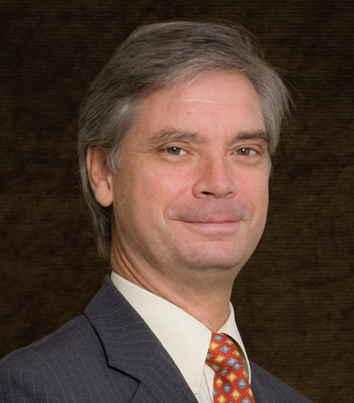
Dr. Bhoendradatt Tewarie
Dr. Bhoendradatt Tewarie is a former UWI Principal, Director of CL Financial and Republic Bank Limited.  In ‘People’s Partnership Position’ on 23rd May – see http://wp.me/pBrZN-fG – I was critical of his continued silence on the collapse of this, the Caribbean’s largest conglomerate.

Apparently Dr. Tewarie is also the Director of the Institute of Critical Thinking at UWI.  Listen to his conclusion to the Director’s Statement –

…The present in which we now live has already been created for us or we ourselves might have knowingly or unknowingly conspired to create it. But we live and we learn. The important thing is that we learn. When we learn we grow and evolve and are better able to deal with the inevitable new challenges. And so we press on…

see http://sta.uwi.edu/ct/foundir.asp

We need a proper account from Dr. Tewarie on the last days of the CL Financial group.  The people who are responsible for this  scale of collapse must render an account.  To fail to do so would only compound their failure and we would have to banish them to obscurity.

CL Financial bailout: The Peoples’ Partnership position

Kamla Persad-Bissessar, M.P. Photo courtesy Guardian Media
Kamla Persad-Bissessar, M.P., leader of the Peoples’ Partnership and newly elected Prime Minister

The CL Financial bailout has been a major public concern since it was announced on 30th January 2009 and I have been critical of the steps taken by the current administration to deal with the collapse of what was the Caribbean’s largest conglomerate.  The leader of the Peoples’ Partnership (PP), Kamla Persad-Bissessar, has been noted for her strong criticism of the actions of the then Minister of Finance in making early withdrawals from the CL Financial group before the collapse.  Her arguments in the Parliament are an important part of the story of this fiasco.

National elections are tomorrow, with the distinct probability of a victory by the united PP, so it is timely to consider the way in which that group might handle the bailout.

In addition to her major contribution to this debate, the opposition leader has recently promised to revisit the terms of the bailout and that is an intriguing development.

It is impossible at this stage to know what the PP will do on this important public matter, but I have been considering the role of certain major players.

The Insiders

For example, these are prominent people, formerly from the highest level of the CL Financial group –

The Insiders
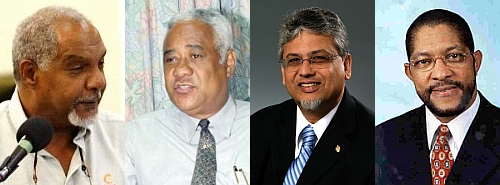
The Insiders: (l - r) Robert Mayers, Mervyn Assam, Dr. Bhoendradatt Tewarie, Carlos John
  • Robert Mayers – Deputy Leader of CoP and former Managing Director of CMMB – Mayers retired in November 2008 and was reportedly the financial adviser to Lawrence Duprey.  Mr. Mayers is not listed in the CL Financial Annual Return of 17th February 2009 as a shareholder.
  • Mervyn Assam – Former Trade Minister with UNC in the 1995-2000 period and UNC Senator up until the dissolution of Parliament in April.  Assam was a founder of CLICO Investment Bank (CIB) and its last Chairman before the collapse.  Despite the heat and temper of the election campaign, we have heard nothing on the role of Assam in the collapse of CIB.  Yet again, the ‘Code of Silence’ is suspected, by negative inference, as it were.  There seems to be some tacit agreement between the contending parties on this controversial matter. Mr. Assam is listed in the CL Financial Annual Return of 17th February 2009 as #22 of the 325 shareholders, holding 7,500 shares.
  • Dr. Bhoendradatt Tewarie – Former Principal of UWI (St. Augustine), Director of CL Financial and Republic Bank Limited at the time of the collapse.  The Foundation for Politics and Leadership, which was founded by some of the leading figures in the Congress of the People (CoP), headlined Dr. Tewarie to speak at their January 16th conference ‘Thinking Ahead – Governance in the 21st Century’.  Tewarie is reported to have been one of the Directors who was present at the last Annual General Meeting of CL Financial on 23rd January 2009 at Trinidad Hilton.  Yes, that is 7 days after they paid the final dividend; 10 days after they wrote the Central Bank and 7 days before announcing the bailout.  Again, Tewarie is also silent on those events in the CL Financial Boardroom. Dr. Tewarie is listed in the CL Financial Annual Return of 17th February 2009 as #290 of the 325 shareholders, holding 1,171 shares.
  • Carlos John – Former close aide of Lawrence Duprey and Director of CL Financial.  Now visible at political meetings and has reportedly been recently canvassing in support of the PP’s St. Joseph candidate, recently-retired High Court Judge, Herbert Volney.  Mr. John is not listed in the CL Financial Annual Return of 17th February 2009 as a shareholder.

It is easy to imagine these men playing an important part in any future PP government.

The Outsiders

The Outsiders
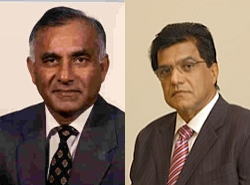
The Outsiders: (l - r) former MPs Trevor Sudama and Ramesh Lawrence Maharaj

In contrast, the two UNC MPs who, publicly and in advance, voiced serious concerns over the CL Financial group were economist, Trevor Sudama and  former Attorney General, Ramesh Lawrence Maharaj.  Both of those courageous individuals suffered the wrath of Mr. Panday and eventually found themselves sidelined.  Ramesh was an MP in the last Parliament and ended up backing the very Basdeo Panday in the UNC’s recent leadership contest.  A twisted road indeed, but ultimately, with Kamla’s victory, Ramesh has now been excluded from the ranks of PP candidates in tomorrow’s  election.  Only those two individuals in our public life had the foresight and fortitude to sound the alarm on CL Financial.  For whatever reason, we have now come to an arrangement of forces which has no room for those two men.

What is at stake?

Apart from the crucial Special Purpose Entities (SPEs), the CL Financial bailout has placed the entire group under State control.  There are  therefore substantial Directorships and contracts, within the very CL Financial group, to be dispensed.

SIDEBAR: FIXING the bailout

Some of the main issues which must be dealt with if the bailout terms are to be normalised would be –

  • Audited Accounts – There is an immense variance between the asset value of the group as per their 2007 audited accounts ($100.7Bn as published on 18th November 2008) and as stated in their letter of 13th January 2009 requesting urgent financial assistance (a mere 56 days later, the asset value was stated to be $23.9BN). We need to have the audited accounts for 2008 and 2009 published without further delay. In any case, that publication is mandated by clause 4.4.5 of the Shareholders’ Agreement.
  • Payment of CL Financial dividend – CL Financial paid a dividend of $3.00 per share to its shareholders on 16th January 2009, 3 days after writing to seek the urgent financial assistance of the State.  Steps need to be taken to recover those dividends from the shareholders.
  • Role of the Regulator – The Governor of the Central Bank has repeatedly told of the long-term concern over the risks inherent in CL Financial’s operations.  We need to know if those regulators were at fault and to what extent could all of this have been avoided.
  • Fit and Proper conduct of the Directors – The ‘Fit and Proper’ criteria which are essential qualifications for Directors and Officers of Financial Institutions, were clearly not followed, if we are to believe the public statements of the Governor.  What is to be done with the offenders? Will a PP administration be willing or able to dis-qualify those Directors?
  • Taxpayers’ protection for CL Financial shareholders – The Shareholders’ Agreement of 12th June 2009 extended the bailout protection to the shareholders of the collapsed group.  For the interests of shareholders to be protected in this situation is contrary to good sense and violates elementary principles of good public policy.  It is unprecedented anywhere else in the world, including Nigeria, as shown in ‘Finding the Assets‘, published in the Business Guardian on 19th November 2009. Literally, it is a case of ‘Only in Trinidad & Tobago’.  Question is, will a PP administration be reversing that corrupt decision?
  • The strategy behind the bailout – Most importantly – ‘What is the strategy behind the bailout?‘  On 31st March, there was a major press conference of the CL Financial leadership to announce the resignation of Dr. Euric Bobb and the appointment of Marlon Holder as the group’s new CEO.  The promise to provide accounts and a strategy was a key feature of that event and it is awaited.

SIDEBAR: The role of SPEs

There are about 65 SPEs and the terms of the CL Financial bailout bring another 65 companies in that group within the umbrella of State control.  That is a total of 130 companies and this could be an opportunity to re-shape the corporate culture of the place.

The opposition leader has been noted for her sharp questioning of the real role of the SPEs, even going so far as to suggest that they are deliberately used to avoid the norms of proper accountability in the spending of public monies.

The PM, Mr. Manning, also told us in his interview last Sunday that in some cases, the SPEs may have ‘cut corners’.

Both those statements seem to signal an acceptance of the need to change, but we will have to wait to see what actually happens.

The CL Financial bailout and the Special Purpose Entity fiasco – Joining the dots

Here we are…In the Land of the Mimic-Men,
You run from the pain,
But the jokes pull you back again,
But home is home,
So you say ‘Hail la Trinity!’,
Then yuh talk about the Love of Liberty,
But then ‘Forge’ is the first word of we Anthem,
Yuh see we so damn corrupt,
That is the problem,
So now dey tief but you ignore,
So now you workin,
And for yuh Children sake, man yuh eh jokin…
–David Rudder – ‘Another Day in Paradise’.
Lyrics © 1996, Lypsoland Music. Used by permission. All Rights Reserved.

On 12th March 2009, the Business Guardian published ‘Sagacity and Veracity’ as my attempt to compare the aspects being revealed by the unfolding collapse of CL Financial and the Uff Enquiry into the public sector construction industry.  At the time, quite frankly, it felt like a bit of a stretch to compare the two….what do we know now?
CLICO vs UDeCOTT
No need to burden readers, the last few months have been crammed full of shocking details of these situations.  Time for me to try putting them into some perspective.

Some threads to start pulling together –

  • CLICO, the biggest part of the Caribbean’s largest and most successful conglomerate, had not reconciled its bank statements for 3 years or established an audit committee.
  • UDeCOTT, the exemplary Special Purpose Entity, ‘back-fits’ invoices and is unable to publish its accounts for three years.
  • The Housing Development Corporation knowingly and massively over-states the numbers of new homes they have built – they have no signed contracts for any of their projects.
  • We have an entire Integrity Commission resign; having ignored expert advice only to lose a damaging court case, yet to date there is not even an attempt to offer an explanation for their bizarre, unseemly actions.
  • To cap it all, we have the sitting President of our Republic appoint a slate of candidates to replace that Integrity Commission.  That slate was questionable, including an intellectual accused of flagrant plagiarism and a prohibited person (being Chief of a State-controlled Agency).  So much so in fact that it caused me to question seriously, for the first time, the mental capacity of that office-holder.  I could scarcely believe my ears, when the President, addressing the nation after his month-long holiday in some undisclosed location, told us all that he did not have to explain anything.

In addition to the absence of consequence, there exists a potent Code of Silence…Only whistleblowers are punished in our Republic…Is almost like gangster business, where witnesses need special protection. Gangster politics.


What is obvious to me is that the absence of consequences is proving inimical to our national development.

In addition to the absence of consequence, there exists a potent Code of Silence which prevents us from getting a reliable account of what really went on inside any of these many situations.  I am speaking here of attributed interviews which can form part of our understanding the problems.  Nobody on the CL Financial or UDeCOTT or HDC Boards has spoken openly.  No one in any of the previous Cabinets.  Is like we walking in de dark (Thanks, Brigo).

There is no point in citing Cabinet secrecy or commercial confidentiality as reasons for the silence.  That would involve an attachment to principle which is not part of our situation.  In other countries with far more at stake – USA in its ‘War on Terror’, for example – it is normal to see detailed, open accounts of what has taken place at Cabinet and other top-level commercial meetings.  Our Code of Silence is a different thing.

One thing, we all know for sure, even with the national absence of consequence, is that one type of person will definitely be punished.  Yes, that is the ‘whistleblower’, the seeker after truth.  Only whistleblowers are punished in our Republic.

Is almost like gangster business, where witnesses need special protection.  Gangster politics.

Can we escape our culture?  Can we escape our culture?  Can we eclipse ourselves?

Do we need a big Witness Protection program?  Who is to Guard those guards?

A good example is worth a thousand words’, so my teachers used to say.  What kind of example are we setting for our young people?

The people responsible for this mess are our Leadership Class.  These are the people – yes, I know that I am one of them – who had the best schooling and opportunities.  We are witnessing a lack of responsible behavior by our leadership class – the best and the brightest.

We are living with the consequences of an absence of consequence.

Careless Chiefs

Imagine a parent, becoming aware that something improper is happening between one of their children and a responsible adult, someone like a teacher or coach.  Someone whose job it is to nurture your child in a responsible fashion.

A responsible parent will take immediate steps to deal with the problem.  Try to imagine what kind of parent will deal with a coach behaving improperly with one child, but leave their other children in that class, with the said ‘interfering’ coach.

Yes, we have a ‘Father of the Nation’ who has done just such a thing.  The fact is that the dismissed UDeCOTT Directors have not been removed from their other positions at State-controlled organizations.

That is the scale of the problem.

For the Party People

Some readers might see these columns as being critical of the PNM government and to some extent they would be right, since that is the party in power during these various episodes.  It being election season, nobody should be surprised that this stream of damaging revelations – on UDeCOTT, HDC, CL Financial etc – is very useful to the Peoples’ Partnership in the campaign.

As bad as the revelations of corruption, I am not at all sure, given their recent and indisputable record on these questions, whether the UNC would have done differently had they been in power in the last 8 years or so.  I can clearly recall the rejection suffered by Maharaj, Sudama and Maraj when they spoke out against corruption in the last UNC government.  The dissolution of Parliament and the calling of fresh elections soon followed, just like in this rounds.

No, this is not a political column, just an attempt to set out some points of view on our situation.  To stay on point, I agree with Transparency’s Chairman, Victor Hart, that the non-publication of the Bernard Report into the Piarco Airport project was a pity.  Hart, who was a Commissioner on that Enquiry, has also said that, had it been published, we would have been unlikely to have had the UDeCOTT situation.  Interestingly enough, PM Manning promised to publish it, but over 6 years later it remains concealed, for whatever reason.

The Peoples’ Partnership seems to be forging ahead on the winds of public disgust with large-scale corruption, so I am now calling on the leader to make us a public pledge to publish the Bernard Report into the Piarco Airport project immediately upon taking office.

The outline from ‘Sagacity and Veracity

https://afraraymond.wordpress.com/2009/03/12/sagacity-and-veracity/

An easy guide to the CL Financial and UDeCOTT Fiascos

Six quick pointers for our readers –

  1. Ambitious Empire-building
  2. Other peoples’ money
  3. Excessive borrowings
  4. No cogent planning or feasibility checks
  5. Real Profits? – Is it possible for CL Financial to pay dividends at the same time as writing to seek the State’s urgent financial assistance?  How could UDeCOTT be declaring improving profits as a property-development company, if every one of their projects is not feasible?
  6. Strategic Agenda – The common agenda is to privatize the benefits and profits while being careful to nationalize the losses.  We reject that agenda.  Moral hazard has to be upheld as a reality if we are to develop a progressive nation.

The CL Financial bailout: Taking in Front – The NGC element

One of the abiding questions on the CL Financial issue is – ‘What main event/s caused the group to fail?

One of the main rumours making the rounds at the time of the bailout was that the State-owned National Gas Company had made heavy withdrawals from CLICO Investment Bank.  Those withdrawals and the requests for the return of further deposits were said to have triggered the ‘crash’ within the CL Financial group.

Another major issue which was raised in the Parliament by the current leader of the opposition was the allegation that the Minister of Finance and Governor of the Central Bank had used ‘insider information’ to withdraw their own deposits from CIB.  Despite the explanations by these officials, which form part of this article, those perceptions persist among the population.

Ultimately, the questions have to be ‘What did they know?‘ and ‘When did they know it?‘  This article will delve into some of those issues, using the published record, as is my practice.

The main points are –

  • Frank Look Kin, Former NGC President
    Frank Look Kin, Former NGC President

    The NGC press release – This was published in the daily newspapers on 4 February 2009, as a corrective to the widespread and potentially-damaging rumours.  It was issued under the hand of the NGC President, Frank Look Kin – it is the penultimate item on its publications page, under the title ‘Press Release- NGC’s Management of Its Financial Investments‘.  Due to its huge revenues (stated to be $14.0Bn in 2008), over 90% of which are in US dollars, the NGC has established a policy for the management of its large-scale, short-term investments.  According to the press release, those funds are placed in either approved financial institutions or investment-grade rated foreign banks.  The placement of those deposits is guided by limits for the percentage of funds allocated to a financial institution or group of financial institutions.  The selection of deposit-taking institutions and the establishment of placement limits are both good financial practice in terms of risk management.

  • NGC’s placement limits – These were not disclosed in the NGC press release, but we are told that at the start of 2008, the CL Financial group was allocated 40% of the NGC’s deposits, which by the end of 2008 had been slightly reduced to 37%.  At another point we are told that in 2008, NGC withdrew an average of $151M USD per quarter, with CL Financial’s portion of that being 45.7% – more than the 2008 allocations stated earlier.The silence on the actual placement limits means that we cannot determine whether the 2008 deposits in the CL Financial group complied with that policy.  The only deposits for which we are told ‘…the deposits were within the maximum percentage limits…’ were CIB deposits in 2001, but no percentages were given in that case.We are also told that “…In the 4th quarter of 2008, deposits were recalled upon maturity from…seven financial institutions in Trinidad & Tobago and the USA…”  Even if we only count the local ones, there are 6 large banks and 19 other approved financial institutions available to accept deposits under NGC’s policy.  It is passing strange that up to 45.7% of NGC’s funds could be allocated to a single group.  If that allocation of funds in 2008 was in conformity with NGC’s deposit placement policy, it is indicative of a tremendous measure of confidence in the CL Financial group, to put it in its best possible light.  Even if CL Financial were a ‘blue-chip’ group, which they were not, such an allocation of deposits could be viewed as reckless behaviour by the responsible parties.Despite its claims of a policy to manage the risks associated with being responsible for such huge, short-term investments, it seems that the NGC may have yielded to the temptation of the unrealistically high interest rates offered by the CL Financial group.  Again, on a governance note, one has to ask – ‘What good is a prudent policy, if it is violated in practice?’It seems that we may need to examine more closely how our energy revenues are invested.
  • November 2008 – We are also told in that press release that “…In November 2008 CIB failed to return the principal and interest upon the maturity of an NGC deposit (US$10 million).  This deposit, plus interest, was paid in two amounts during the first week of December 2008…”  From that statement it seems certain that CIB’s inability to repay was known to NGC, a huge, State-owned corporation.  It is difficult to imagine that news of that importance would not have traveled to the very highest levels.  Indeed, one could argue that proper management of the State’s financial resources would have required such a piece of news to be formally reported to the relevant officials.When one juxtaposes the fact that CIB “…failed to return…” $10M USD to NGC with the measure of confidence one can infer from the extent of their dealings, it is impossible to imagine such an episode passing off quietly.
  • The Governor’s response – Ewart Williams’ written response to the allegations was unequivocal and made the very same day – it can be viewed at http://www.central-bank.org.tt/news/releases/2009/mr090204.pdf.
  • The Minister’s response – That was a statement in Parliament on the very day and it is at pages 626 to 631 of http://www.finance.gov.tt/documents/news/spF82F5F.pdf. At the time of the CL Financial collapse, the Governor was clear in identifying the prime cause to be “…excessive related-party transactions…” and this NGC/CIB situation bears a strange resemblance.We need to strive for better norms of governance and prudence if we are to avoid a recurrence.History is said to be rich in irony, never more so than in this situation, since the defensive statements by both officials were made on the very day the NGC published its own defence.  Wednesday 4 February 2009.

SIDEBAR

Approved Financial Institutions

Those are taken to mean the 25 companies licenced under the Financial Institutions Act 2008.  Those companies are all required to be members of the Deposit Insurance fund and their names can be viewed at http://www.dictt.org/deposit_insurance/index.php?pid=2006.  There are 6 main banks on the list – Citibank, First Caribbean, First Citizens’, RBTT, Republic Bank and Scotiabank.  Two smaller banks on the list are Intercommercial Bank and Bank of Baroda.

Interlocking Directorships

A continuing concern, in light of the growing challenges to the old order of the commercial and financial world, is the role of inter-locking Directorships.  That is the situation in which a very small group of people control most of the major companies and activities in a society.

Critics of that situation would say that such situations are a recipe for corruption and self-serving behaviour.  The small group of people can enrich themselves, leaving the leftovers for everyone else.  Those who support that situation would say that the emergence of such a small group of leaders is natural, particularly in a small society such as ours, and the real challenge is to develop rules and norms which limit the possible negatives.

This is an issue which I am exploring in the ongoing series to examine the governance implications of the UDeCOTT fiasco.  It is not surprising that it is also a feature of the CL Financial collapse and there is an example of that in the case of NGC and CIB.

The CIB Directors

At the time of the collapse, the Board of Directors of CLICO Investment Bank comprised –

Mervyn Assam (Chairman)
Amjad Ali
Anthony Rahael
Maria Thorne
Michael Callendar
Faris Al Rawi

The NGC Executive

At that time, the National Gas Corporation’s executive management included –

Ms. Olave Maria Thorne, Vice President, Legal and Corporate Management and Company Secretary – see http://www.ngc.co.tt/About/executive.htm. Yes, same person.

Ten to One is Murder

A Kaiso title for the Election season.  And yes, we are told that CL Financial will rise again.  The picture is even more clouded than a year ago and the rumours abound.

The latest developments are –

  • Press conference of 24th March
    Justice Carlton Best. Photo courtesy Trinidad Guardian
    Justice Carlton Best
    Following a front-page Express story, on the impending lawsuit by Justice Carlton Best to recover his $57,000 CLICO deposit – see ‘I want my Cash’ at http://www.trinidadexpress.com/index.pl/article_news?id=161613671 – the Governor of the Central Bank held a press conference that very day to tell us that those waiting for the return of their deposits would have to hold strain – see http://guardian.co.tt/news/general/2010/03/25/delay-your-redemptions.  The further shocking news, after all the emphatic official statements that the group had good assets, was that if those were liquidated there would only be 10 to 15 cents in the dollar available to pay claims.  Now how could that possibly be the case? How are we to reconcile these conflicting accounts of the situation with CL Financial’s assets?  Is it that they are fully-pledged, over-pledged, or is there actually any ‘headroom’ within which the taxpayer can have a chance to recover the huge sums advanced so far?  Which is it?  Please note that this is not an isolated situation, as shown by another threatened  lawsuit from a former Attorney General of Guyana for the recovery of over $500,000 from CLICO – see http://www.kaieteurnewsonline.com/2010/03/27/former-attorney-general-threatens-to-sue-clico-trinidad/
  • Post-Cabinet Press Briefing – The Minister of Finance confirmed the Governor’s position to the media the next day, as reported in this paper – http://guardian.co.tt/business/business/2010/03/26/tesheira-clico-policyholders-be-patient.  In that article, the Minister is reported to have affirmed, again, that “…“The CL Financial Group had sound assets that were valued at more than $100 billion…”  Both the Governor and the Minister took steps to recover their own funds before the group’s financial troubles were public knowledge and that sits awkwardly, in the public mind, with their current appeals for patience.
  • Dr. Euric Bobb – At a Central Bank press conference on 31st March, resigned as Chairman of CLICO and as a Director of CL Financial, of which he was the Chairman, until his resignation late last year.
  • Governance – His statements as to the poor governance at CLICO, the leading company in the CL Financial group, were astonishing, to say the least – see “Governance was an alien term in CLICO’ at   http://guardian.co.tt/business/business/2010/04/01/bobb-governance-was-alien-term-clico.  No reconciliation of the company’s bank accounts.  No audit committee.  Those are serious shortcomings in the basic accounting and governance controls in any company.  For one which had investment as its centrepiece, those are shocking.  They give the impression of unprofessional and haphazard management of a significant part of our nation’s savings.  They detract from the reputation of the CL Financial chiefs.  Surely these shortcomings found their way into the Management letter from the Auditor to the Board and Shareholders?  Was the Central Bank aware that these elementary controls were absent?  Even if there are serious shortcomings in the financial procedures at CLICO, are we not entitled to rely on the Supervisor of Insurance or Inspector of Financial Institutions to resolve those in favour of the investing public?
  • Marlon Holder – At the same press conference, we heard that he resigned his job as Executive Director of the Unit Trust Corporation to become CEO/MD of CL Financial and Chairman of CLICO – see http://guardian.co.tt/news/general/2010/04/01/utc-boss-takes-over-clico-chairman.  Mr. Holder has had a high-profile career in the financial services industry at Citibank, FCB and the Unit Trust Corporation, before this latest move and we await his recovery strategy.
  • Reporting the changes – Both the CL Financial Chairman and the new CEO/MD recently confirmed that one of their leading priorities was to furnish a report on the state of the group and the progress towards its re-structuring.  That report is anxiously awaited and must include the audited accounts for 2008 and 2009.  As stated before, this is not negotiable and will be most revealing as to the apparent discrepancies in the asset values.
  • The Private assets – We also read recently that former CL Financial chief, Lawrence Duprey, had taken steps to limit the information he was required to furnish to the liquidator of CLICO (Bahamas) as to his private assets, allegedly acquired with CLICO funds – see http://www.trinidadexpress.com/index.pl/nart?id=161623489.

Hence this week’s title.  We await the audited figures.

SIDEBAR: Leading Lawsuit

There were reports in the Sunday Express of 11th April that the Central Bank had initiated legal action against Andre Monteil and Richard Trotman, both formerly of CLICO Investment Bank, for the recovery of huge sums allegedly obtained improperly in the HMB takeover – see http://www.trinidadexpress.com/index.pl/nart?id=161626823 and http://www.trinidadexpress.com/index.pl/nart?id=161626819

Those moves by the Inspector of Financial Institutions represent, as far as I am aware, the first time that legal action is being taken on this scale to tackle those accused of ‘white collar’ crime.  It is a decisive step to tackle the widespread impression that jail is not for the rich or lettered class in this society.  The course of this trial will be closely observed as it is the first step in a very long and necessary journey.

Our notions of development are rooted in the aspiration toward equality and opportunity.  Those worthwhile concepts must be extended to include true equality under the law.

One of the really fascinating aspects of this unfolding financial debacle, which includes the UdeCOTT collapse, is the idea that those accused of this sort of wrongdoing have extensive rights.  That kind of consideration is seldom offered to those accused of run-of-the-mill crimes.  If nothing, else, the CIB trial will be a kind of long-overdue ‘Open University’ course in the boardroom dealings which are masked from most of our people.