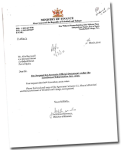
FOR YOUR INFORMATION: A copy of the official agreement between C.L. Financial Limited and the Government of Trinidad and Tobago has finally been delivered to me per my request under the Freedom of Information Act. This CL Financial Shareholders’ Agreement (SA) of 12th June 2009 which I requested on 16th November 2009 under the Freedom of Information Act was sent to me by the Ministry of Finance on 11th March 2010 and my emailed response to the Minister of Finance is on the home page of this blog.
My preliminary comments are –
- Quantum – The SA is silent as to quantum, which would seem to mean that the group will enjoy unlimited access to taxpayers’ funds. The 2010 budget statement on 7th September states an estimated allocation to the CL Financial bailout of $5.4Bn – but subsequent events have only added to the confusion. To wit, the $50M USD for the British-American Insurance recovery (as per 2nd November ECCU press release) and the ‘up to $510M’ announced to be available to meet the pensions due to ex-Caroni workers. Question being whether the $5.4Bn includes the subsequently-announced amounts or are those to be added-on?
- Security–At the preamble to the SA – on page 5 – we are told that “…valuable consideration…” is being offered by CLF as per the original MoU. Of course, given the Governor’s revelations on 7th April 2009 – see http://guardian.co.tt/business/business/2009/04/08/govt-left-empty-handed-cl-financial-bailout – that is simply not so. Indeed, it seems clear that the cupboard is bare and that this CLF group has no unpledged assets of any value.
- Interest–No mention of interest at all. We are therefore now advancing an unlimited quantum of taxpayers’ funds, for which no security has been provided and those funds are being advanced at ZERO interest. Given the well-established rule that late payment of taxes makes a taxpayer liable to 20% interest and the interest rate the Federal government charged AIG for their bailout funds – it was 8.5% above the benchmark LIBOR, which was at 3.0% – it is clear that this represents a massive concession to the CL Financial group. Quite apart from the bailout itself, the 325 shareholders of this group are also benefiting from this unprecedented and unexplained facility of ZERO percent interest rate.
- Accounting–Section 4 of the SA sets out the procedure for a proper system of accounts, culminating at 4.4.5 – “…shall ensure that an annual report of CLF is prepared and dispatched…in manner consistent with standard corporate practice…” The accepted interpretation of this language informs us that the word ‘shall’ denotes an obligatory, non-voluntary duty. If that is the case, when can we expect publication of the 2008 annual report, accompanied by audited accounts, as per ‘standard corporate practice’?
- The role of the Shareholders–The MoU of 30th January, at Para (c) of its preamble, spells out its aims as “…to protect the interests of depositors, policyholders and creditors of these institutions…” According to the second sentence of the Ministry of Finance press release of 12th June 2009 – this is the penultimate document in the ‘Quick-Guide’ in the CL Financial bailout section of this website – “This new agreement is designed to give substance to the Memorandum of Understanding (MOU) of January 30th 2009.” The SA of 12th June 2009 was the subject of that press release. The SA, at Para A. of its preamble, states the intentions of the parties as having been set out in the MoU of 30th January 2009 and ends by “…their stated understanding, inter alia, that certain steps be taken to correct the financial condition of CLICO, CIB and BA in order to protect the interest of depositors, policy holders, creditors and shareholders of these institutions…” (These two words are put in bold as my own emphasis). I questioned that official version in ‘Fit and proper?’, ‘Party of parties’ and ‘Figuring it out’ – all available on this blog. Now that we have the actual SA to work with, it is clear that the statement in 12th June press release is extremely misleading. The SA does not just ‘…give substance to…’ the original MoU, it in fact is an entirely different species of agreement. The SA constitutes a written guarantee to protect the 325 shareholders of this CLF group.
- Assisting the incoming Management–Clauses 2.3.3 and 2.3.4. of the SA, require the outgoing CL Financial chiefs to render all assistance to the incoming Board and Management in terms of all records and accounts etc. The question here is ‘Have the new Board and management been receiving the full assistance of the previous CLF chiefs?’ If not, what is being done about it? If yes, where is the $5.0Bn missing from the CLICO Statutory Fund?
- Analysing the lacunae–The events in the interregnum and their consequence are extremely important aspects of this matter. I say so because the intervening period – i.e. between 30th January and 12 June 2009 – was one in which several important and shocking facts came to light. Some of these were –
- Payment of Dividends – $3.00 per share paid on 16th January – i.e. three days after Duprey wrote to the Central Bank Governor for urgent financial assistance.
- Over-pledging of assets – As cited above, the Central Bank Governor revealed that CL Financial’s assets were all fully pledged.
- $5.0Bn is missing from CLICO’s Statutory Fund – According to the newly-appointed CEO of CLICO, Claude Musaib-Ali (he has since resigned, effective 14th February 2010) the CLICO Statutory Fund had $5.0Bn missing – see http://guardian.co.tt/news/general/2009/03/01/where-money-gone.
- Attempted sale of assets as per CLICO Energy – Also, CL Financial attempted to sell its shares in CLICO Energy, which was in breach of the terms of the MoU. At clause H. and 6.1, the outgoing CL Financial Directors agree to use their best endeavours to reverse the sale of those shares.
With the exception of the last item, none of these other three serious matters are addressed at all in the SA. Silence on the payment of dividends. Over-pledged assets are described as being ‘valuable consideration‘. Silence on the missing $5.0Bn from CLICO’s Statutory Fund.
Those four events, having been revealed in the gap between the MoU and the SA, should have informed the stances taken by the parties. To my mind, these actions by CL Financial are indicative of insincere behaviour intended to outwit and cheat the taxpayer. The Ministry of Finance press release describes the SA as ‘…giving substance to…‘. Nothing could be further from the truth, since the SA in fact creates new levels of entitlements and protections for the CL Financial shareholders.
As taxpayers, we ought to have been able to rely on the State negotiators to propose terms which would have extinguished the equity of the CL Financial owners and taken other steps to restore the correct position. Instead, the SA has not sought to address their assaults on good faith and ‘fit and proper’ behaviour. We have now been bound into a long-term arrangement to restore the fortunes of one of the Caribbean’s riskiest adventurers.
Readers, please take note. In terms of its size, timing and terms, this CL Financial bailout is a grievous attack on the very integrity of our Treasury.
SIDEBAR: Heads we lose, tails they win…
The EQUITY position
In a situation like this, where a company is effectively both illiquid and insolvent, the incoming investor/lender has enhanced rights. Effectively, such a company is dead – just like someone whose heart has stopped beating – and any assistance or lending is usually on very onerous terms. The only exception would be in the case of related-parties who are able to agree special terms which no one else could accept.
That seems to have been the case here, since we had the CL Financial group out of cash, with its assets fully pledged, but yet able to get the full financial assistance of the State, without being forced to relinquish the rights of its shareholders.
One is reminded of the telling statement by the Governor at the press conference to announce the bailout on 30th January 2009, as to the fact that one of the main reasons for the collapse of the CL Financial group was ‘…excessive related-party transactions…’. It seems to me that this is exactly what we, the entire nation of Trinidad & Tobago, have now entered into.
The capacity to learn from the past is one of the main signs of maturation, but we are not displaying those qualities here at all, at all.
We do not seem to have learned from the central lesson of that tragic collapse.
The PUBLIC position
Another troubling aspect of this SA is that it does not properly allocate risk and reward between the parties. Again, readers are asked to remember that the mis-matching of risk and reward was also one of the elements which brought down the CL Financial group.
- First example, let us use an Optimistic Modelin which the State intervention in CL Financial is successful. That would look like this –
- All policyholders’ and depositors’ claims are satisfied;
- All asset values are restored;
- Republic Bank Limited and Barbados National Bank continue to thrive as leading banks in their sectors;
- CLICO, British-American etc are restored as dynamic companies with healthy market share;
- Angostura, Methanol Holdings, Home Construction Ltd and the other non-financial parts of the CL Financial group are also restored to health;
- Overall, the CL Financial group returns to profitability.
If that happened, the State investment in CL Financial would have been beneficial to the 325 shareholders, but all the State would be entitled to receive, for having risked its own capital, would be a repayment of those sums, with no interest.
In this situation, the SA has allocated to the State all the risk, a massive injection of capital, responsibility for management, yet even in the case of a successful outcome there is no return either by way of interest on the funds advanced or equity in the rejuvenated enterprises.
- Second example, let us use a Pessimistic Modelin which the State intervention in CL Financial fails. That would look like this –
- Many policyholders’ and depositors’ claims are frustrated;
- Assets are sold by mortgagees and decline in value;
- Republic Bank Limited and Barbados National Bank are disposed of to meet the demands of creditors;
- CLICO, British-American etc fail to regain their place in the markets;
- Angostura, Methanol Holdings, Home Construction Ltd and the other non-financial parts of the CL Financial group are adversely affected by the group’s troubles and also decline or are disposed of;
- Overall, the CL Financial group is slowly broken up.
If that happened, the State investment in CL Financial would have been a loss for the taxpayer, since it would be impossible to recover our funds.
In this situation, the SA has allocated to the State all the risk, a massive injection of capital and responsibility for management. The only thing the State has to look forward to here is the blame and the losses.
Heads we lose, tails they win…
 VIDEO: Morning Edition Interviews – March 2010


 AfraRaymond.net