
Property Matters – State Housing Facts

hdc-logoThis is a continuation of my examination of the National Housing Policy (2002), its implementation and the associated implications.

Over the last year I engaged with HDC’s management who cooperated with me, much like the previous team. I asked about new homes produced by the National Housing Authority (NHA) and the Housing Development Corporation (HDC) in the period January 1st 2003 to December 31st 2015 to establish a) the output of completed homes; b) numbers of new homes distributed; c) the tenures of those homes and finally, d) compliance with the allocation criteria established by the 2002 policy.

Showing Trinidad and Tobago A New Way HomeThe 2002 policy is “Showing Trinidad and Tobago a New Way HOME” and it seems to have met the sorry fate of the 1992 national land policy, in that those important policies have both vanished from official websites. The headline of that Policy was the target of 100,000 new homes in ten years. That target was over-ambitious, given the bottlenecks in our system of planning and construction, even if, at that time, ‘money was no problem’. Continue reading “Property Matters – State Housing Facts” →

Property Matters – Invaders’ Bay part two

invaders-bay-artist-rendering
UDeCOTT artist’s impression of Invaders’ Bay development

There is a rising tide of confusion at Invaders’ Bay, so it is time to bring some understanding to this situation. The previous column delved into the Appeal Court rulings and the State’s application to appeal to the Privy Council. There is a lot more to be derived from those important rulings, but this week I am restating the case as to why this is a large-scale development of major importance.

Dr. Bhoendradatt Tewarie

In March 2012, Dr Bhoendradatt Tewarie, the then Minister of Planning & Sustainable Development, confirmed that the 70-acres of undeveloped land at Invaders’ Bay was worth $1.28Bn. This would be the largest single development in our capital city in living memory, the only questions being ‘On whose terms?‘ and ‘For whose benefit?‘

In 2012, the PP Cabinet decided to lease two parcels of land at Invaders’ Bay –

  1. Dachin: 10.2 acres for a Commercial/Residential complex, a boutique hotel, a cultural focus area and three (3) main event entertainment areas comprising a Museum, Bowling Alley and Movie Theatres. View video presentation here.
  2. Invader’s Bay Marina Group: Commercial Development on 13 acres for Hotel, Commercial Office Complex, Cruise Ship Complex; Gas Station; Residential Development and Light Industrial Development; a Marina.

Continue reading “Property Matters – Invaders’ Bay part two” →

Property Matters – Invaders’ Bay

invadersbay-bw

On 28 October 2016, the Appeal Court delivered its majority ruling upholding the decision of Justice Frank Seepersad on 14 July 2014 to order publication, under the Freedom of Information Act (FOIA), of the legal opinions on which the Ministry had been relying. The JCC had won its case at both the High Court and the Appeal Court, so I called for immediate publication of the requested information. The JCC made no such call, neither did any of my erstwhile colleagues.

At an Appeal Court hearing on 21 November 2016, the State obtained leave, with the JCC’s consent, to appeal this matter at the Privy Council. Whilst in Opposition, the PNM made repeated complaints against the secretive conduct of the Invaders’ Bay development by the Peoples Partnership. Now in Government, the PNM has elevated secrecy in public affairs to a new prominence.

Since Dr James Armstrong was appointed JCC President in December 2015, that organisation has been silent on the Invaders’ Bay matter. This had previously been of high importance as a major development in our capital city, which was proceeding illegally and improperly. The JCC now seems to have reversed its earlier position of pressing for publication of those vital, suppressed documents. Continue reading “Property Matters – Invaders’ Bay” →

Property Matters – Examining the PPP

The HDC launched its first housing Public Private Partnership (PPP) on 3 November 2016 at Mahogany Court, a 160-apartment complex at Eastern Main Road, Mount Hope. It is being designed, financed and built, at a cost of $145M, by NH International, led by my erstwhile friend and colleague, Emile Elias, with completion due in December 2018.
nh-hdc-ppp

The PPP approach to public procurement is one in which the private sector assumes the risks and constructs a project with repayment of that investment taking place over a period of time, usually from the State’s recurrent expenditure. This a controversial public procurement method, with the detailed reviews of completed projects being heavily criticised for the fact that the private sector has not actually taken much risk. It seems that these contracts often contain provisions which shield the private sector from serious risks. The introduction of PPP into our public housing program therefore deserves careful scrutiny, if we are to avoid the serious losses experienced in more advanced jurisdictions.

This PPP uses no Public Money, the State’s only investment being the value of the land, which was not mentioned thus far. The approach was outlined at pg 31 of the 2017 budget as being one in which the contractor will provide short-term finance to design and construct new homes, which will then be purchased by approved applicants on the HDC’s waiting-list. Those purchases will be funded by TTMF and the purchase prices will be used to repay the contractor. Continue reading “Property Matters – Examining the PPP” →

Property Matters – Tax Facts part two

property-tax
Further details on property tax are needed to understand the process and possibilities arising from its implementation. The 2010 estimate of revenue from that tax was $325M, as against a 2017 estimate of $503M, so it seems that there has been some allowance for inflation and new properties.

The innate effectiveness of this tax is that property is an immovable asset, so those persons and companies which are now evading other taxes will be unable to escape this new tax on the various properties in their ownership.

Property owners will be required to provide details of their properties to the Ministry of Finance so that the valuation process can be started. Owners who fail to provide details will have their properties valued without their input. The only efficient method of completing that number of valuations is by a mass-valuation approach which uses software to analyse details from owners, along with transaction details, to estimate the correct figures. Continue reading “Property Matters – Tax Facts part two” →

Property Matters – Tax Facts

property-taxesThe controversial property tax is now expected to be implemented in the fiscal year 2017 and is estimated to raise $503 million. That is a mere 1.7% of the total revenue estimate of $29.93 Bn from taxation. So why is it so controversial? How will it be implemented? How much can we expect to pay?
The property tax being proposed will tax the fixed assets and income streams of persons who are currently avoiding any payments of tax to our Treasury. It is relatively tiny in size, yet it can unlock disproportionate benefits in the public interest.

Our taxation system has done a poor job at levying on the self-employed and companies, as stated so often in the past. The proposed implementation of the Trinidad & Tobago Revenue Authority (TTRA) is expected to create a structure which can effectively tackle this widespread pattern of tax evasion. The previous attempt, during 2009, met with stiff opposition, so it remains to be seen if the current economic downturn will foster a different reaction. Continue reading “Property Matters – Tax Facts” →

Property Matters – Sole Selectives

sole-tendering
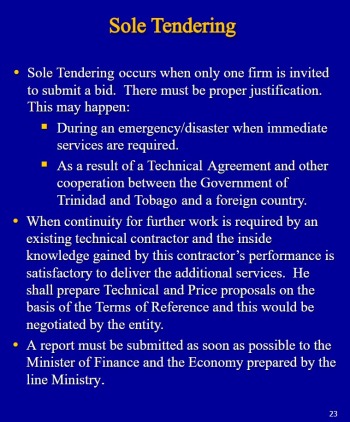
Source: “Tender/Procurement Policies and Procedures” Ministry of Finance and the Economy: Central Tenders Board Division. April 2014

It seems that the current administration intends to execute its three largest projects on the sole selective basis and in my view that is a serious concern.

Sole Selective is a non-competitive contracting approach in which a single firm is selected to participate in a commercial opportunity. I have not limited the definition to the provision of goods, works or services since there are many other ways in which commercial arrangements can operate.

The sole selective approach can be readily adopted if the provider is someone with a proven track record which has created a sound working relationship. The other side of the coin is that this approach can be difficult to justify on value-for-money grounds due to the lack of competition.

Continue reading “Property Matters – Sole Selectives” →

Property Matters – POS development prospects

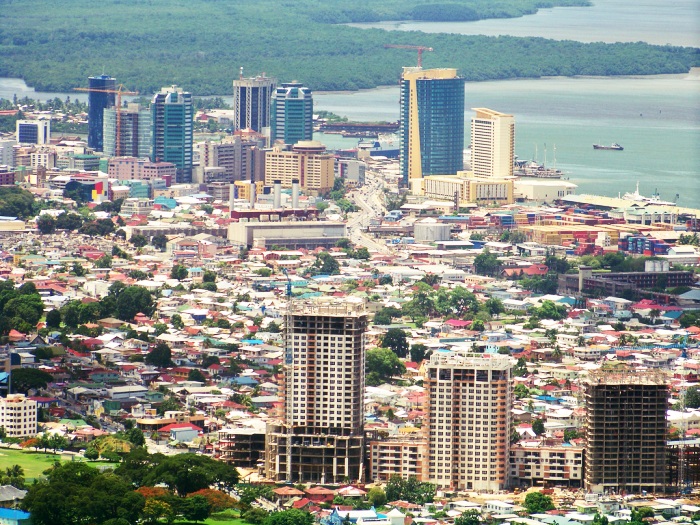
Port of Spain. Downtown in the background, One Woodbrook Place in the foreground

The state of our capital city, POS, is a serious concern to any proud citizen or even our visitors. A real nation would treat its capital with pride, but in my view Port of Spain presents a painful paradox in several respects. Despite that, there are now some real opportunities for us to reconsider just how we manage our capital city. A new approach is needed to rescue our capital city in this time of reduced financial resources.

Some of the negatives include –

Our capital has been severely depopulated in the past 50 years – as shown in the graph and table, its 1960 population was 94,000, while the most recent census in 2011 showed a figure of only 37,000. Given that there has been no natural disaster, war or plague it is sobering to consider this steady population loss and its causes during that period of relative peace and prosperity. No doubt that loss has been due to the mismanagement of the city’s planning, traffic, parking, vending, crime, homelessness and sanitation issues. That series of mishandled and interlocking growing-pains produced an increasingly dirty, unsafe and crowded city which eventually lost its appeal. Continue reading “Property Matters – POS development prospects” →

2017 Budget Review

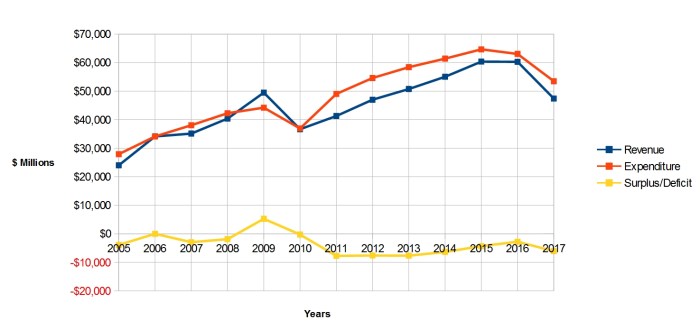
The 2017 budget was presented on Friday 30th September 2016, with the known decline in State revenue having the expected impact. As shown in the graph and table, the Estimate of Revenue is now down to $47.4 Billion, which is itself a doubtful figure as I will show, with Estimated Expenditure at $53.475 Billion. That means the 2017 budget is being deficit financed by $6.075 Billion.
05-17_budget

Year 2005 2006 2007 2008 2009 2010 2011 2012 2013 2014 2015 2016 2017
Revenue (millions TT$) $24,016 $34,129 $35,126 $40,381 $49,465 $36,664 $41,284 $47,000 $50,736 $55,041 $60,351 $60,287 $47,400
Expenditure (millions TT$) $27,918 $34,119 $38,054 $42,261 $44,206 $36,915 $49,016 $54,600 $58,405 $61,398 $64,664 $63,048 $53,475
Surplus/Deficit
(millions TT$)
-$3,902 $10 -$2,928 -$1,880 $5,259 -$252 -$7,732 -$7,600 -$7,669 -$6,357 -$4,313 -$2,761 -$6,075

Continue reading “2017 Budget Review” →

Property Matters – 2017 Budget Prospects

The 2017 budget is due to be presented on Friday, 30 September 2016 to an anxious nation. Having had to endure the literally unbelievable optimistic economic claims of the previous government prior to the September 2015 general election, we were told by then Central Bank Governor, Jwala Rambaran, in December 2015, that the nation had been in recession for 6 months. I tell you. Of course that message has now been repeated after the messenger was dismissed for various alleged offenses, but that is for another column.

Our levels of public expenditure have moved sharply upward, with only a single decline in 2010, as shown in the graph and table for 2005-2016. Those totals are derived from the estimates stated in the various budget statements and do not represent the actuals. In that period, estimated revenue was $534.57Bn with estimated expenditure of $574.6Bn. That balance between revenue and expenditure yielded a combined deficit of $40.125Bn – 84% of which ($33.67Bn) occurred under the Peoples Partnership government, 2011-2015. Continue reading “Property Matters – 2017 Budget Prospects” →