Afra Raymond’s main remarks are between 19:26 and 32:15
Category: CL Financial Bailout
Integrity Reflections – the background
SIDEBAR: THE MEANING OF THE LAW
“…legislation must be followed or driven by will. Laws are just what they are, convoluted and meaningless blocks of text until they are made alive/and relevant by human effort, human with a reasonable degree of collective/societal rectitude…”
—Quote from one of the several FaceBook convos emerging from last week’s column.
It was alleged, in a 2006 lawsuit (CV 2006-0817), that the Integrity Commission wrote to the Directors of TSTT to exempt them from filing declarations as required under the Integrity in Public Life Act (IPLA). The existence of that letter was never denied and that litigation ended by compromise at an Appeal Court Hearing on 28 October 2013.
It seems improper for any Public Authority to issue a letter which negates the law. I have on several occasions requested that the Commission publish the 2006 letter, but to no avail. Given the inaction on my complaint in respect of CL Financial’s Directors, these questions arise:
- Was that TSTT letter an isolated episode?
- Have there been other unspoken compromises in relation to the oversight of the Integrity Commission?
This article gives the detailed background to the Integrity Commission’s inaction in relation to the CL Financial Directors. At the very least, the facts in this matter speak to a severe lack of focus on the critical aspects of the Commission’s role to secure good standards of integrity in Public Life. It is my view that this is a matter of the first importance on which the Commission’s inaction could only have been detrimental to our collective interests. Continue reading “Integrity Reflections – the background”
Integrity Reflections
 This column sets out my reasons for seriously questioning the motivation and priorities of the Integrity Commission. Despite my doubts as to the way in which successive Commissions have operated the Integrity in Public Life Act (IPLA), I have continued to offer suggestions as to how their work could be made more effective.
The continuing Code of Silence on the CL Financial bailout, the sharp attack, from many quarters, on our substantial national institutions and the very doubtful history of the Integrity Commission are clear signs that the Public Interest needs to be safeguarded with utmost vigilance at this time.
TIMELINE – these points are detailed in here.
- 28 May 2009 – I pointed-out in ‘Judgment Time – Moral Hazard, Part III‘ that there was a link between the control the State was now exerting on the CLF group and the requirements of the IPLA.
- 12 June 2009 – CL Financial Shareholders Agreement is signed – clause 3.1 of which gave the Government the right to nominate four of the seven CL Financial Directors.
- 10 September 2012 – I formally wrote to the Integrity Commission with my concerns that the requirements of the IPLA are apparently being disregarded since CLF Directors were not filing declarations. The main document supporting that submission was the CL Financial Shareholders Agreement of June 2009.
- 20 March 2014 – I wrote to the Commission to request its update.
- 21 March 2014 – The Commission states that a reply was either sent or would be sent.
- 22 May 2014 – I wrote at length to the Commission to record my concern at their delay and ambiguity in dealing with my original complaint. The Commission’s Annual Reports contain details of how complaints are disposed of, but the 2012 and 2013 editions had no mention of my complaint.
- 22 May 2014 – The Commission replied to explain that my concerns had been classified as a query, not a complaint. In addition, the Commission stated that “…With respect to your query we have sought and obtained legal advice…” but that they were unable to proceed further due to the fact that they did not have the full number of members. To my astonishment, the Commission also requested a copy of the CL Financial Shareholders Agreement which had been attached to my original complaint. If the Commission did not have that fundamental document, which is available online at my blog, this request raised the question of ‘Just what were the instructions to the lawyer from whom advice obtained?’ I submitted the requested document the same day. The second issue arising from the Commission’s statement that it had sought legal advice, is the extent to which it appears to have lost sight of its proper ‘watchdog’ role. My point being that the CL Financial Shareholders Agreement was announced by the Ministry of Finance in June 2009, yet it was not until my complaint of September 2012 that legal advice was sought as to its implications for CLF Directors.
- 23 May 2014 – The Commission wrote to acknowledge receipt.
- 25 September 2014 – Pete London was appointed as the ‘Chartered Accountant’ member of the Commission, which means that the full number of members is now in place.

In relation to the Commission’s history, we need to note the shocking details unearthed during Dr Keith Rowley’s litigation against them. The Commission had made certain findings without giving Rowley the opportunity to respond, as recommended by its advisers and in 2009 the High Court made an historic finding that
“…The Court declares that the Integrity Commission has acted in bad faith in relation to Dr. Rowley and is guilty of the tort of misfeasance in public office…”
At Para 45 (i) of the 2009 ruling –
“…The Court does not accept the Integrity Commission’s explanation as to why it wrote to the Honourable Prime Minister on the 19th October, 2004, to ascertain whether an inquiry was to be undertaken and if so, the names of the persons to man the enquiry and their terms of reference. The Court notes that the Integrity Commission is an independent constitutional body which ought to act independently pursuant to its constitutional and statutory powers and duties…”
The entire Commission resigned immediately as a result of that High Court ruling.
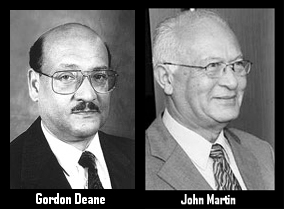 The Commission’s independence was fatally undermined by its decision to write to then Prime Minister, Patrick Manning, to seek his instructions on how the complaint against Dr Rowley was to be handled. At that time, the Commission was chaired by Gordon Deane, with John Martin serving as its Deputy Chairman.
The fateful and ultimately fatal compromises made by the Commission were only forced into the open by Dr Rowley’s litigation. Had Rowley not sued, we would likely never have learned of this betrayal.
This is the single largest expenditure ever undertaken on a project in our country, the reported sums are upward of $25 Billion, and the State is in control of the group of companies receiving those huge sums of Public Money.
The State has failed and/or refused to provide details of those huge sums of Public Money, no audited accounts and no other details have been provided in reply to my Freedom of Information requests. I am now litigating that failure or refusal in the High Court.
Some years ago, one of my few lawyer-friends told me of an old ‘coping mechanism’ – ‘Sometimes you get a case which is so wretched…the facts and the law are against your client, so the only thing to do is to hold on for dear life and dance it out by the sheer effluxion of time‘. For whatever reason, that phrase occurred to me in relation to this matter.
My original complaint to the Integrity Commission was made well over two years ago. The sobering conclusion, to my mind, is that the inaction of the Commission in this matter is entirely coincident with the secretive conduct of the State. Hence my title, Integrity Reflections – are we seeing a reflection of the Integrity Commission’s deplorable past?
AUDIO: 95 Mandate interview on i95.5FM – 6 Feb 2015
 Afra Raymond is interviewed on the ‘95 Mandate‘ show on i95.5FM with Ardene Sirjoo and Mariano Browne about the continuing impact of the CL Financial bailout on the economy and the pending Colman Commission report. 6 February 2015. Audio courtesy i95.5FM
- Programme Date: Friday, 6 February 2015
- Programme Length: 1:06:41
CL Financial – Bait & Switch
“They’ve got twelve Aces up their sleeve!
So who the Hell can we believe?”
—Rudder, David Michael. “Back to the Same Ole Same.” The Autobiography of The Now. Lypsoland, 2001. Used with permission
The CL Financial bailout seems to be entering its end-game, with repeated claims from the Minister of Finance that the recovery of the $25 Billion of Public Money spent is now on the cards. The consistent failure or refusal to publish any audited accounts and my ongoing research are telling. We are witness to yet another ‘Plot to Pervert Parliament’, this time it is the biggest project to ever hit this country. The CL Financial bailout.
Plots to Pervert Parliament
In January 2013, I identified the first of these, otherwise known as the ‘S.34 Fiasco’, which of course led me to the CLF Bailout Perversion, committed in January 2009 when our country was presented with its largest-ever public expenditure. The original bailout, presented to our Parliament, as a fait accompli, was the original Plot to Pervert Parliament.
I have come to the sobering conclusion, after much research and consideration, that the Colman Commission is not ever going to provide the details we were led to believe it would. I am now of the view that once again we have been misled and bamboozled by our Parliament. Yet another sick trick, a third ‘Plot to Pervert Parliament’.
The rationale stated for the Colman Commission of Enquiry is in serious conflict with the terms of reference for and consequently, the conduct of that Commission. This article will detail those assertions and show how the public interest is once again being subordinated to powerful private interests.
To understand this crime, one must take a stern view of dates and time.
- 30 January 2009 – The bailout is announced at a Press Conference on Friday 30 January 2009 at the Central Bank. At that time, we were told that the estimated cost was about TT$5 Billion.
- 12 June 2009 – Ministry of Finance signs the ‘CL Financial Shareholders’ Agreement’ which, for the first time, discloses that shareholders’ interests were to be specifically protected.
- 8 September 2010 – Winston Dookeran’s first budget statement as Minister of Finance, following the Peoples Partnership electoral victory in May 2010, was notable since Dookeran announced a dramatic policy shift. The entire CL Financial bailout was declared to be the first of the ‘great uncertainties’ to be resolved. Dookeran outlined the problem before reducing the rate at which Public Money would be paid for this bailout. A huge storm of protest erupted, with several ‘Depositors and Shareholders groups’ emerging to represent those interests. With Dookeran isolated and the government under mounting pressure from these new protest groups, laws were swiftly drafted to stifle the protestors’ legal options.
- 1st October 2010 – The PM’s historic address to Parliament on 1 October 2010 at which the Commission of Enquiry was announced. Most notable was the PM’s outrage at the mystery of the bailout – at pgs 25-26 –
“…The $5 Billion has been spent—we are advised—to repay matured EFPA policies in an ad hoc and unstructured manner where payment arrangements were entered into based on levels of funds invested. What criteria did you use to repay investors? Whom did you choose to pay? How were they chosen? These questions need to be answered. Because if it is today after the $7.3 Billion, all these EFPA people, the policy group and so on, they are out there, where is their money? Where is their money? Did you have a priority listing of who should be paid? Why did you go—and you are now crying crocodile tears about trade unions, credit unions, the poor man and the small man—why did you not pay them first? Why did you not pay them first? Where did that $7 Billion go? We need those answers, Mr. Speaker. We deserve those answers. The taxpayers need to know. Because when a parent has to buy school books and bags to send his/her children to school but they have to pay tax out of the little money, they need to know where that money has gone…Where, how and why; we need to know…”
The main argument made by the PM was that this was a case which needed serious investigation to establish what had caused this huge collapse and where had over TT$7 Billion of Public Money gone. I could not agree more.
- 17 November 2010 – The Colman Commission with its Terms of Reference published in the Trinidad and Tobago Gazette. Those were divided into two limbs, causes and consequences. The first to examine the causes of the crisis and the second to make recommendations for prosecutions or other policy changes to prevent a repetition of the crisis.
- In September 2011, the Parliament voted unanimously to pass two laws related to the CL Financial bailout. The first was to permit the Minister of Finance to borrow a further TT$10.7 Billion to fund the bailout and the second was to grant the Central Bank, which was administering the bailout on government’s behalf, immunity from any legal challenge. For those who consider these assertions of mine to be harsh, just look at Winston Dookeran’s closing words to the Senate on 16 September 2011 –
“…I just want to give you the assurance which I gave to the Lower House when we debated this, that already the Ministry, along with the Central Bank and Clico, have begun the preparation of a public document—many questions that are still to be answered—to provide the necessary information. In addition to that, we did present to the hon. Senators, for those who afforded us the opportunity to accept our invitation, a document that is in the vicinity of 57 pages as of now, outlining all the necessary information that led to the story that assess what is the current challenges and why the proposals to go forward have been put forward. This document, I assure you, along with the questions and answers, will be converted into a simple, easy to read, hopefully, document for the sake of establishing that this Parliament has mandated us to put this as an anchor document for the purposes of evaluating our performance in the future…”.
I requested that document via the Freedom of Information Act but it was not provided, which is why my litigation started.
In the course of recent research it became clear to me that the PM’s outraged demands for detailed information as to how the huge sums of Public Money spent in the bailout had been discarded, just like a flimsy Carnival Costume. At no point in its Terms of Reference was the Colman Commission required to examine the details of the actual Public Money spent on the bailout. A new species of lie is born here in T&T, once again…we used to have one called the ‘White Lie’ in those bad-old-days, now we have the ‘Bright Lie’. Right up in our face, as the Parliament is told one thing, with an entirely different thing being done. The Carnival was over, but the Ole Mas was now starting.
One can imagine the ebb and flow as these public promises were neutered in private discussions. Reasons are never given. I suspect that the influence of party financiers and voting blocks was a great element in this travesty. The public right to know how and why these vast sums of Public Money were spent is obviously of low priority for the highest public officials in this Republic.
Truth has a Power all of its own. At this point, in litigation against the Ministry of Finance for that information – the Ministry is represented by a five-member team headed by former AG, Russell Martineau SC and CL Financial is represented by three attorneys. Something resembling legal overkill to prevent publication of information which the PM told the Parliament it was her intention to unearth. Information which then Finance Minister Dookeran assured the Parliament he was compiling into a public document. Another writer has labelled the situation – ‘Afra, the Deviant‘. I tell you.
At every turn, the public interest has been subordinated to secretive private interests. The Courts are literally the last refuge to uphold the lawful rights of the public to obtain detailed information on these matters of the highest importance.
Accountability Calamity
| Safeguard | Status of query |
|---|---|
| Audited accounts for CL Financial? | NONE |
| Details of Management accounts, Estimates, Drafts or any figures used by Ministry of Finance? | NONE |
| Details of official briefing to Independent Senators in September 2011? | CLAIMED TO BE EXEMPT |
| Details of Public Money paid out to people and institutions owed money by CL Financial? | NONE |
| CL Financial is now under State control, so do its Directors comply with the Integrity in Public Life Act? | NOT ACCORDING TO MY EXAMINATION OF INTEGRITY COMMISSION RECORDS. |
| Do we understand why the CL Financial group is enjoying this beneficial exemption from the lawful obligation to file declarations? | NO WORD YET FROM THE INTEGRITY COMMISSION. |
All of the usual integrity, accountability and transparency safeguards have been disconnected. All.
The Code of Silence rules.
What Lies Beneath
The public is being told that the CL Financial bailout is being resolved, while at the same time the Minister of Finance & the Economy is withholding the fundamental information which any prudent person would need to make a decision. So, what is the secret?
Apart from the details I have been asking for, there are other questions which occur to me –
- Directors’ Fees – What is the comparative level of Directors’ fees before and after the bailout on 30 January 2009? In particular, what are the fees & expenses payable to CL Financial Directors? Have those increased? If so, to what level and on what rationale?
- Related Party dealings – We were told that one of the main causes of the CL Financial collapse was excessive related-party transactions. Has that pattern of dealings has really changed? What are the contracts between the group and companies in which Directors hold an interest? Does the group, or the Minister of Finance, keep a record of these connected contracts? Does the group have a robust procurement procedure which would ensure value for money in all its significant transactions?
- Asset disposals – Which of the group’s assets have been disposed-of since the bailout and on what terms? Were proper valuations obtained before these disposals?
The original complaint is here –
———- Forwarded message ———-
From: Afra Raymond <afraraymond@gmail.com>
Date: Mon, Sep 10, 2012 at 11:12 PM
Subject: Compliance of CL Financial Directors with the Integrity in Public Life Act
To: registrar@integritycommission.org.tt
From: Afra Raymond <afraraymond@gmail.com>
Date: Mon, Sep 10, 2012 at 11:12 PM
Subject: Compliance of CL Financial Directors with the Integrity in Public Life Act
To: registrar@integritycommission.org.tt
To – Mr. Martin Farrell, Registrar of the Integrity CommissionDear Sir,
The Integrity in Public Life Act requires that “Members of the Boards of all Statutory Bodies and State Enterprises including those bodies in which the State has a controlling interest” are required to file returns and declare interests with the Integrity Commission.
The Integrity in Public Life Act requires that “Members of the Boards of all Statutory Bodies and State Enterprises including those bodies in which the State has a controlling interest” are required to file returns and declare interests with the Integrity Commission.
Clause 3.1. of the CL Financial Shareholders’ Agreement of 12th June 2009 – see https://afraraymond.net/wp-content/uploads/2010/03/mou21.pdf – specifies that the Board of Directors of CLF shall consist of seven Directors, four of which shall be nominated by the Government. The GORTT has a controlling interest and it is public knowledge that the GORTT has exercised those rights, amounting to strong influence evidencing control.
It seems clear that the directors of CL Financial Ltd are therefore persons who should file declarations, and therefore also the directors of subsidiaries under their influence and control, but having visited your offices earlier today to examine the Register of Interests it seems that these Directors have not been filing returns with you.
For your information, your staff confirmed to me today that none of these people have filed declarations or been required to file such for 2009, 2010 or 2011 –
- Gerald Yet Ming (CLF’s current Chairman)
- Hayden Charles (CLICO Director)
- Ronald Harford (Republic Bank’s Chairman)
- Dr Euric Bobb (former CLF Chairman)
- Rampersad Motilal (Managing Director of Methanol Holdings Limited)
I am therefore requesting, in the public interest, your confirmation that Directors of CL Financial and the companies within its control are required to file declarations or your confirmation that those Directors are not required to file or such other informative response that will satisfy this complaint of apparent non-compliance.
I await your early reply.
Yours faithfully,
Afra Raymond
B.Sc. FRICS

SIDEBAR: Integrity and the CL Financial bailout – the nexus as noted by Afra Raymond on 28 May 2009
There is an interesting nexus between the Integrity in Public Life Act (2000) and the CLF bailout.
The Act obliges that public officials make a declaration of their income, assets, liabilities and interests to the Integrity Commission on or before 31 May of each year. There are penalties for non-compliance. We have seen high-profile investigations and prosecutions with the proposed amendments to the Act now being debated in the Senate.
The Integrity Commission website lists ten classes of persons in public life who must file declarations with them. That list can be found at http://www.integritycommission.org.tt/whofile.html. The ninth class of person is “Members of the Boards of all Statutory Bodies and State Enterprises including those bodies in which the State has a controlling interest.”
CL Financial has already signed over its shareholdings in Republic Bank Ltd. (55%) and Methanol Holdings Trinidad Ltd (56%) to the State under the MoU, and the State has taken complete control of CLICO. Will CLICO, MHTL and Republic Bank Directors be filing returns on or before 31 May?
From: Afra Raymond [mailto:afraraymond@gmail.com]
Sent: Thursday, 20 March 2014 09:56 PM
To: Registrar, Integrity Commission
Subject: Fwd: Compliance of CL Financial Directors with the Integrity in Public Life Act
Dear Mr. Farrell,
I am seeking an update from you on your progress in relation to this formal report made to the Integrity Commission on 10th September 2012.
Apart from a brief telephone conversation we had a few days after its submission, I have had neither acknowledgment or reply to this report.
I await your early reply.
Regards
Afra Raymond

On Fri, Mar 21, 2014 at 4:54 PM, Registrar, Integrity Commission <Registrar@integritycommission.org.tt> wrote:
Dear Mr Raymond
Our recollection in the office is that a response was sent to you and we are examining our records.
In any case, a response will be sent to you.
Registrar
On Fri, Mar 21, 2014 Afra Raymond <afraraymond@gmail.com> wrote:Hello Mr. Farrell,
I appreciate your early attention to my query.
Regards
Afra Raymond
From: Afra Raymond <afraraymond@gmail.com>
Date: Thu, May 22, 2014 at 11:44 AM
Subject: Re: Compliance of CL Financial Directors with the Integrity in Public Life Act
To: “Registrar, Integrity Commission” <Registrar@integritycommission.org.tt>
Hello Mr. Farrell,
I wrote to you on 20th March 2014 seeking an update to my formal report of 10th September 2012 to the Integrity Commission on this matter. You replied the next day indicating that you thought that a reply had already been sent but that in any case a reply would be sent to me.
To date I have had no response to my formal complaint or the request for an update as to its status. In the interim, I have carefully examined the Commission’s 2012 and 2013 Annual Reports and found no mention of my complaint in the sections which provide an outline of the various investigations being undertaken. According to those Reports, the status of those investigations seem to fall into three categories – ‘Closed’ – denoting those matters which have been effectively dismissed, due to lack of evidence or irrelevance; ‘Completed’ – denoting those matters which have been investigated or ‘Continuing’ for those matters which are still under investigation. I am starting to wonder if my formal complaint has been relegated to some new, as yet undisclosed, category.
I am also going to point out that, according to the Integrity Commission’s Public Notice at pg 49 of the Sunday Express of 6th October 2013, the Integrity in Public Life Act applies to State Enterprises. At the fourth para of that Public Notice, which was intended to clarify published concerns as to the implications of the Appeal Court ruling in #30 of 2008, you state that State Enterprises are companies which are controlled by the State, so I would again invite your attention to the particulars of my original complaint in this matter. As you would appreciate from my published analysis, the position taken by the Commission in that Public Notice is one with which I strongly disagree, nonetheless, that position is the Integrity Commission’s formal statement on the matter.
For ease of reference, that Public Notice is here –
https://afraraymond.net/wp-content/uploads/2013/10/ic-response2013.pdf – since I was unable to locate it on the Commission’s website.
I am closing by pointing out that this is a matter of the gravest possible public concern, since CL Financial has been the recipient of over $25 Billion TTD in Public Money and its affairs remain shrouded in an intentional obscurity which does violence to the modern notions of Transparency, Accountability and Good Governance. That obscurity includes the channelling of those huge sums of Public Money via the Central Bank which is exempt from the Freedom of Information Act; new laws to approve the exemption of the Central Bank from any judicial review of its actions in this matter (that has now been ruled as unconstitutional by the High Court in #4383 of 2012, of course the State has appealed that, so the fight is on); the failure/refusal of CL Financial to publish audited accounts and the failure/refusal of CL Financial’s Directors to comply with the Integrity in Public Life Act.
That is the factual background against which I lodged my formal complaint. The delay and ambiguity with which the Integrity Commission appears to be treating my complaint on this most serious matter is sobering, to say the least.
I trust that you can give this matter your early attention, in the meantime, I will be publishing this as a record of these developments.
Afra Raymond
|
May 22 | ||
|
|||
Dear Mr. Raymond
On behalf of Mr. Farrell I do apologize for not responding to your query. Please note that your query was not classified as a compliant so you would not find it in the complaints section of the 2012 or 2013 Annual Report. With respect to your query we have sought and obtained legal advice. However the Commission is not properly constituted ( a Commissioner having resigned and not yet replaced by his Excellency the President) at this time and therefore cannot make decisions. As soon as the Commission becomes properly constituted the matter will be placed before the Commission for a decision.
In the interim I would appreciate if you can provide us with a copy of the CL Financial Shareholders Agreement.
Yours respectfully
Lisa Phillips
Acting Registrar
Integrity Commission
From: Afra Raymond [mailto:afraraymond@gmail.com]
Sent: Thursday, 22 May 2014 05:12 PM
To: Registrar, Integrity Commission
Subject: Re: Compliance of CL Financial Directors with the Integrity inPublicLife Act
Hello Ms. Phillips,
I thank you for your swift reply and trust that this matter can now receive proper attention.
The Ministry of Finance made a Press Release on 12th June 2009 -http://www.afraraymond.files.wordpress.com/2011/03/minoffin_pr_12jun2009.pdf – which I received prior to the actual Shareholders Agreement being released to me pursuant to my Freedom of Information request. As requested, the actual CL Financial Shareholders Agreement of 12th June 2009 is here – https://afraraymond.net/wp-content/uploads/2010/03/mou21.pdf – for your consideration.
I await your reply.
Afra Raymond
On Friday, May 23, 2014, Registrar, Integrity Commission <Registrar@integritycommission.org.tt> wrote:
Dear Mr. Raymond
Thanks for your understanding. However used the link provided but most of the pages of the Agreement are blank.
Regards
Lisa Phillips
Acting Registrar
From: Afra Raymond [mailto:afraraymond@gmail.com]
Sent: Friday, 23 May 2014 09:06 AM
To: Registrar, Integrity Commission
Subject: Re: Compliance of CL Financial Directors with the Integrity in PublicLife Act
Hello Ms. Phillips,
The Shareholders’ Agreement is showing ok at my end, the scanned copy I was sent seemed a little faded, that was all.
The link I sent you yesterday was included in my original email of 10th September 2012, so it’s not clear whether that actually received proper attention.
I suppose that the Finance Ministry would provide a copy if you asked, seeing that they sent it to me.
Thank You
Afra Raymond
Registrar, Integrity Commission May 23
to me
Mr. Raymond
Noted. Thanks
Lisa
Everything but the Truth
On 1st June 2014, my former colleague and Business Guardian Editor, Anthony Wilson, made a call for a ‘national debate’ on the proposed disposal of CLICO’s traditional portfolio of insurance business. This is the first of my responses.
We are now entering the chaotic endgame of this epic CL Financial bailout fiasco. Some of the recent official statements are –
- CL Financial’s other assets, including majority shareholdings in Republic Bank Limited and Methanol Holdings to be sold;
- Full repayment of Public Money advanced in this bailout is expected.
- CLICO’s traditional insurance policy portfolio is being professionally valued prior to its intended disposal;
- Atrius Ltd., set up in 2013 as an alternative vehicle for CLICO’s continuing business, is to be effectively abandoned;
- All of CLICO’s sales agents are to be terminated by the end of this month, June 2014;
 The recent statements of both the Minister of Finance, Larry Howai, and the Governor of the Central Bank, Jwala Rambarran, could give the public an impression that this financial disaster has now been mostly resolved and we are on some kind of smooth track to a complete solution.
I remain sceptical as to the extent to which these problems have been resolved. The complete lack of detailed information, despite many requests by myself and others, leaves one to wonder just what is the basis for these serious decisions.
So, why am I saying this?
The money being used in the CL Financial bailout is ‘Public Money’, which we sometimes call tax-payers’ dollars. The leading learning from which we have to draw serious lessons is Lord Sharman’s 2001 Report to the British Parliament ‘Holding to Account‘, which was a thorough examination of the definition, role and need for control of ‘Public Money’. In the Public Procurement campaign we expanded on Sharman’s definition of ‘Public Money’ so as to capture the full range of possibilities, but we have accepted his key finding as to the requirement that ‘Public Money’ is to be managed to a higher standard of Accountability and transparency than Private Money – see 2.23 on pg 15.
The contemporary, best-practice position in respect of the management of and accountability for Public Money being that the private sector rules are the bare minimum.
CL Financial Ltd. is a holding company for the Duprey empire, comprising major companies such as Republic Bank Ltd.; the Angostura Group; Methanol Holdings Trinidad Ltd; Home Construction Group of Companies; British-American Insurance Company Ltd; Lascelles-Mercado Ltd. (the Jamaican owners of Appleton and Wray & Nephew rums).
The last audited accounts for the CL Financial group were published on 18 November 2008, for the financial year ending 31 December 2007. The function of consolidated audited accounts is to give investors and management the necessary information with which to make decisions as to the future of the company.
Since 2009 I have been making requests under the Freedom of Information Act for these items of information –
- Audited Accounts for the CL Financial group, or the basis of the various statements by successive Ministers of Finance;
- Senate Briefing – details of the high-level briefing given to Independent Senators in September 2011 prior to the vote on the two new laws – one to allow the State to borrow an additional $10.7 Billion to settle the bailout and the Act to shield the Central Bank from the supervision of the Courts;
- Payments – details of the payments to the various claimants under the terms of the bailout, in particular EFPA-holders;
- Integrity Commission – confirmation of whether the Minister of Finance was requiring the CL Financial Directors to file declarations as required by law.
I have effectively withdrawn the last of those requests and am now in litigation against the Minister of Finance & the Economy for the first three items. The State has resisted those claims and the litigation continues. I have continued my quest on the compliance of CL Financial’s Directors with the Integrity in Public Life Act with the Integrity Commission, despite the serial delays and unresponsiveness which have beset those requests.
The question before us now is, “How can the State and our government be making these serious, long-term decisions in the absence of the basic information?” Put another way, “How can we continue to allow these serious decisions to be made in our name on our behalf and supposedly, for our benefit, while the State continues to withhold the basic information?”
We have now entered the unimaginable territory of unexamined State power being exercised on an unprecedented scale in the pursuit of an unknown agenda.
This is the big picture and it is an ugly one.
Try to imagine the Board of a major, privately-owned, holding company proposing to its Shareholders that its major assets be disposed-of without the basic information, such as audited accounts or details of meetings with major stakeholders. Such an action would be seen as a gross violation of elementary norms of corporate governance and quite likely be rejected with swift, high-level dismissals. Yet, here we have our government (the Board of Directors) proposing these actions while refusing the reasonable requests of shareholders (citizens such as myself and others) for the rationale for and basic information underlying this process.
The fundamental, best-practice principle that Public Money is to be managed to and accounted for to a higher standard than Private Money has seemingly been rejected. Rejected by the Minister of Finance & the Economy and the Governor of the Central Bank.
That is the scale of this ‘thing without a name’. I tell you.
We, the citizens and taxpayers of this Republic, are being told that this unprecedented expenditure of Public Money of $25 Billion is to be resolved by a questionable process. The long-time saying is buzzing through my head – ‘What eh meet yuh, eh pass yuh‘.
Some points to remember in thinking about this issue –
- CL Financial Shareholders’ Agreement expires at the end of June 2014;
- Asset Sales have continued with the unadvertised sales of Valpark and Atlantic Plazas;
- No Interest was charged on the huge sums of Public Money spent to settle the indebtedness of the CL Financial group. The Board of Inland Revenue is a Division of the Ministry of Finance & the Economy and annual interest of 20% is charged to taxpayers who are late in their payments.
- ‘Fit & Proper’ regulations have never been applied to this CL Financial collapse, as mandated by Central Bank’s regulations, despite my continuing calls. One has to wonder if the stage is being set for a return of Lawrence Duprey & his cohorts to our country’s high-level corporate lifestyle.
On 28 May 2014, the Business Express ‘Opinion‘ was entitled ‘Bringing closure to the CLICO debacle‘ and one of the statements in that editorial was stunning –
“…Thus far, Rambarran and Finance Minister Larry Howai have been forthcoming in their handling of the CLICO issue…”
I could not agree less. The taxpayers and citizens of Trinidad & Tobago are being abused in this entire process.
Compliance of CL Financial Directors with the Integrity in Public Life Act – a correspondence
From: Afra Raymond [mailto:afraraymond@gmail.com]
Sent: Thursday, 20 March 2014 09:56 PM
To: Registrar, Integrity Commission
Subject: Fwd: Compliance of CL Financial Directors with the Integrity inPublic Life Act
Dear Mr. Farrell,
I am seeking an update from you on your progress in relation to this formal report made to the Integrity Commission on 10th September 2012.
Apart from a brief telephone conversation we had a few days after its submission, I have had neither acknowledgment or reply to this report.
I await your early reply.
Regards
Afra Raymond
http://www.afraraymond.wordpress.com
==================================================================================
On Fri, Mar 21, 2014 at 4:54 PM, Registrar, Integrity Commission <Registrar@integritycommission.org.tt> wrote:
Dear Mr Raymond
Our recollection in the office is that a response was sent to you and we are examining our records.
In any case, a response will be sent to you.
Registrar
===================================================================================
On Fri, Mar 21, 2014 Afra Raymond <afraraymond@gmail.com> wrote:
Hello Mr. Farrell,
I appreciate your early attention to my query.
Regards
Afra Raymond
===================================================================================
From: Afra Raymond <afraraymond@gmail.com>
Date: Thu, May 22, 2014 at 11:44 AM
Subject: Re: Compliance of CL Financial Directors with the Integrity in Public Life Act
To: “Registrar, Integrity Commission” <Registrar@integritycommission.org.tt>
Hello Mr. Farrell,
I wrote to you on 20th March 2014 seeking an update to my formal report of 10th September 2012 to the Integrity Commission on this matter. You replied the next day indicating that you thought that a reply had already been sent but that in any case a reply would be sent to me.
To date I have had no response to my formal complaint or the request for an update as to its status. In the interim, I have carefully examined the Commission’s 2012 and 2013 Annual Reports and found no mention of my complaint in the sections which provide an outline of the various investigations being undertaken. According to those Reports, the status of those investigations seem to fall into three categories – ‘Closed’ – denoting those matters which have been effectively dismissed, due to lack of evidence or irrelevance; ‘Completed’ – denoting those matters which have been investigated or ‘Continuing’ for those matters which are still under investigation. I am starting to wonder if my formal complaint has been relegated to some new, as yet undisclosed, category.
I am also going to point out that, according to the Integrity Commission’s Public Notice at pg 49 of the Sunday Express of 6th October 2013, the Integrity in Public Life Act applies to State Enterprises. At the fourth para of that Public Notice, which was intended to clarify published concerns as to the implications of the Appeal Court ruling in #30 of 2008, you state that State Enterprises are companies which are controlled by the State, so I would again invite your attention to the particulars of my original complaint in this matter. As you would appreciate from my published analysis, the position taken by the Commission in that Public Notice is one with which I strongly disagree, nonetheless, that position is the Integrity Commission’s formal statement on the matter.
For ease of reference, that Public Notice is here –
https://afraraymond.net/wp-content/uploads/2013/10/ic-response2013.pdf – since I was unable to locate it on the Commission’s website.
I am closing by pointing out that this is a matter of the gravest possible public concern, since CL Financial has been the recipient of over $25 Billion TTD in Public Money and its affairs remain shrouded in an intentional obscurity which does violence to the modern notions of Transparency, Accountability and Good Governance. That obscurity includes the channelling of those huge sums of Public Money via the Central Bank which is exempt from the Freedom of Information Act; new laws to approve the exemption of the Central Bank from any judicial review of its actions in this matter (that has now been ruled as unconstitutional by the High Court in #4383 of 2012, of course the State has appealed that, so the fight is on); the failure/refusal of CL Financial to publish audited accounts and the failure/refusal of CL Financial’s Directors to comply with the Integrity in Public Life Act.
That is the factual background against which I lodged my formal complaint. The delay and ambiguity with which the Integrity Commission appears to be treating my complaint on this most serious matter is sobering, to say the least.
I trust that you can give this matter your early attention, in the meantime, I will be publishing this as a record of these developments.
Afra Raymond
http://www.afraraymond.wordpress.com
===================================================================================
|
May 22 | ||
|
|||
Dear Mr. Raymond
On behalf of Mr. Farrell I do apologize for not responding to your query. Please note that your query was not classified as a compliant so you would not find it in the complaints section of the 2012 or 2013 Annual Report. With respect to your query we have sought and obtained legal advice. However the Commission is not properly constituted ( a Commissioner having resigned and not yet replaced by his Excellency the President) at this time and therefore cannot make decisions. As soon as the Commission becomes properly constituted the matter will be placed before the Commission for a decision.
In the interim I would appreciate if you can provide us with a copy of the CL Financial Shareholders Agreement.
Yours respectfully
Lisa Phillips
Acting Registrar
Integrity Commission
===================================================================================
From: Afra Raymond [mailto:afraraymond@gmail.com]
Sent: Thursday, 22 May 2014 05:12 PM
To: Registrar, Integrity Commission
Subject: Re: Compliance of CL Financial Directors with the Integrity inPublicLife Act
Hello Ms. Phillips,
I thank you for your swift reply and trust that this matter can now receive proper attention.
The Ministry of Finance made a Press Release on 12th June 2009 -http://www.afraraymond.files.wordpress.com/2011/03/minoffin_pr_12jun2009.pdf – which I received prior to the actual Shareholders Agreement being released to me pursuant to my Freedom of Information request. As requested, the actual CL Financial Shareholders Agreement of 12th June 2009 is here – https://afraraymond.net/wp-content/uploads/2010/03/mou21.pdf – for your consideration.
I await your reply.
Afra Raymond
http://www.afraraymond.wordpress.com
===================================================================================
On Friday, May 23, 2014, Registrar, Integrity Commission <Registrar@integritycommission.org.tt> wrote:
Dear Mr. Raymond
Thanks for your understanding. However used the link provided but most of the pages of the Agreement are blank.
Regards
Lisa Phillips
Acting Registrar
===================================================================================
From: Afra Raymond [mailto:afraraymond@gmail.com]
Sent: Friday, 23 May 2014 09:06 AM
To: Registrar, Integrity Commission
Subject: Re: Compliance of CL Financial Directors with the Integrity in PublicLife Act
Hello Ms. Phillips,
The Shareholders’ Agreement is showing ok at my end, the scanned copy I was sent seemed a little faded, that was all.
The link I sent you yesterday was included in my original email of 10th September 2012, so it’s not clear whether that actually received proper attention.
I suppose that the Finance Ministry would provide a copy if you asked, seeing that they sent it to me.
Thank You
Afra Raymond
http://www.afraraymond.wordpress.com
===================================================================================
Registrar, Integrity Commission May 23
to me
Mr. Raymond
Noted. Thanks
Lisa
The original complaint is here –
———- Forwarded message ———-
From: Afra Raymond <afraraymond@gmail.com>
Date: Mon, Sep 10, 2012 at 11:12 PM
Subject: Compliance of CL Financial Directors with the Integrity in Public Life Act
To: registrar@integritycommission.org.tt
To – Mr. Martin Farrell, Registrar of the Integrity Commission
Dear Sir,
The Integrity in Public Life Act requires that “Members of the Boards of all Statutory Bodies and State Enterprises including those bodies in which the State has a controlling interest” are required to file returns and declare interests with the Integrity Commission.
Clause 3.1. of the CL Financial Shareholders’ Agreement of 12th June 2009 – see https://afraraymond.net/wp-content/uploads/2010/03/mou21.pdf – specifies that the Board of Directors of CLF shall consist of seven Directors, four of which shall be nominated by the Government. The GORTT has a controlling interest and it is public knowledge that the GORTT has exercised those rights, amounting to strong influence evidencing control.
It seems clear that the directors of CL Financial Ltd are therefore persons who should file declarations, and therefore also the directors of subsidiaries under their influence and control, but having visited your offices earlier today to examine the Register of Interests it seems that these Directors have not been filing returns with you.
For your information, your staff confirmed to me today that none of these people have filed declarations or been required to file such for 2009, 2010 or 2011 –
Gerald Yet Ming (CLF’s current Chairman)
Hayden Charles (CLICO Director)
Ronald Harford (Republic Bank’s Chairman)
Dr Euric Bobb (former CLF Chairman)
Rampersad Motilal (Managing Director of Methanol Holdings Limited)
I am therefore requesting, in the public interest, your confirmation that Directors of CL Financial and the companies within its control are required to file declarations or your confirmation that those Directors are not required to file or such other informative response that will satisfy this complaint of apparent non-compliance.
I await your early reply.
Yours faithfully,
Afra Raymond
B.Sc. FRICS
CL Financial bailout – Paying the Devil
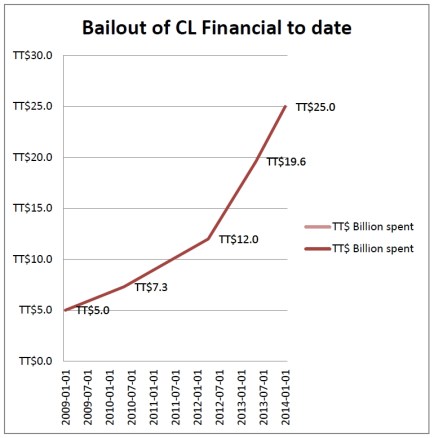 Today is the 30th of January 2014: five years since the State bailout of CL Financial was announced to a shocked nation and region. It is necessary to mark this moment in time with solid facts and stern meditation.
The Carnival season is upon us, so J’ouvert is near the front of my thoughts. J’ouvert is simple, yet tremendous, because of the experience of passing from night into daylight and of course those around you becoming clearer as the light overcomes the darkness. For me, the defining feature of Jouvert is the terrifying portrayals of ‘Devil mas‘ in its various forms – ugly and dirty, covered with mud, oil or paint; real noisy, beating pitch-oil tins and such; forceful, in demanding payment from you before you could pass. You have to pay the Devil to go away. Pay the Devil, so he could leave without dirtying you up.
The vast amount of detail which has emerged in the last five years, means that I can only focus on one key aspect of the CL Financial bailout scandal.
My main theme is that vast amounts of Public Money have been committed to repay the debts of CL Financial, while the chiefs who directed and controlled that conglomerate seem free to come and go as they please. Or, in the case of Duprey, who refused to testify at the Colman Commission, to go and refuse to come. Once again, Trinis in the running for some awards for innovation and so on, with Duprey being the world’s first ‘Penniless Philanthropist‘.
How much Public Money has been spent on this exercise? How much of that Public Money will the State recover? That is my focus.
When the Memorandum of Understanding was signed on 30th January 2009, it was on the basis that CL Financial assets would be sold to recover the Public Money being advanced, which was estimated to be about $5Bn.
Winston Dookeran’s first budget speech on 8th September 2010 was a critical turning-point, as it appeared to me that he was attempting to stem the flow of Public Money out of the Treasury. Dookeran made a case which was based on the huge and unprecedented liabilities facing the State at pg 9 –
“…The total funding provided as at May 2010 by the Government and the Central Bank, excluding indemnities and guarantees to First Citizens Bank amounted to approximately $7.3 billion. As of June 2010, CLICO and British American combined total liabilities were approximately $23.8 billion but total assets were $16.6 billion…” .
Immediately, in protest at Dookeran’s attempt to limit the cost to our Treasury, there were several ‘Policyholders’ and Depositors’ groups‘ formed. The word ‘Depositors’ was soon omitted when it was realised that it would not suit their purposes.
With Dookeran isolated and the government under mounting pressure from these new protest groups, there were new laws drafted to stifle the protestors’ legal options. At this point, we had the historic address to Parliament by the PM on 1st October 2010 – historic because even with the required majority of votes to pass the intended new laws, the PM chose to explain and persuade the public. The bailout was extended to Hindu Credit Union and the Commission of Enquiry was announced to find the causes of the collapse of the CL Financial group and HCU.
Most notable was the PM’s outrage at the mystery of the bailout – at pgs 25-26
“…The $5 Billion has been spent—we are advised—to repay matured EFPA policies in an ad hoc and unstructured manner where payment arrangements were entered into based on levels of funds invested. What criteria did you use to repay investors? Whom did you choose to pay? How were they chosen? These questions need to be answered. Because if it is today after the $7.3 Billion, all these EFPA people, the policy group and so on, they are out there, where is their money? Where is their money? Did you have a priority listing of who should be paid? Why did you go—and you are now crying crocodile tears about trade unions, credit unions, the poor man and the small man—why did you not pay them first? Why did you not pay them first? Where did that $7 Billion go? We need those answers, Mr. Speaker. We deserve those answers. The taxpayers need to know. Because when a parent has to buy school books and bags to send his/her children to school but they have to pay tax out of the little money, they need to know where that money has gone…Where, how and why; we need to know…”
In September 2011 Parliament approved a new law authorising the State to borrow an additional $10.7 Billion to fund the bailout.
Winston Dookeran’s affidavit of 3rd April 2012 specifies that $24 Billion of Public Money is committed to the bailout, at paras 21 & 22…
Para 21         (a)      $5.0Bn already provided to CLICO;
                (b)      $7.0Bn paid to holders of the EFPA and
Para 22                  $12.0Bn estimated as further funding to be advanced.
Recent estimates have now risen to ‘$25b and counting‘ according to the Sunday Express report of 4th May 2013. Given the shock with which the estimated bailout cost of $5 Billion was received a mere five years ago, it is sobering that $25 Billion can now be bandied-about by Public Officials in this fashion.
Will our money ever be repaid? If so, how and when?
Now and again, official statements are made to assure the public that the matter is being resolved and the CL Financial Shareholders Agreement is extended for this reason or that. There is an appearance of diligence and purpose, but there are also other statements which we must consider.
Finance Minister Howai is recorded in Hansard of 30th January 2013, speaking about the CL Financial bailout – at pgs 16-17
“…Mr. President, we shall never recover all the funds that have been put into the group, but our focus is to try and maximize what we can and to reduce the borrowing that we need to do…”.
Even more concerning is that there has been secretive disposal of assets of the CL Financial group – to cite one example, Valpark Shopping Plaza was recently sold to Courts, without any public advertisement.
All the while, the State is mounting strong resistance to my lawsuit to force publication of the details of this bailout. The secrecy is inimical to the wider public interest, which is being sacrificed for the comfort and benefit of the ruthless few.
Every single established mechanism for oversight, transparency and accountability in public affairs has been sidelined in this sordid CL Financial scandal. Integrity in Public Life Act – nothing. Audited Accounts – not available. Freedom of Information Act – legally disputed. Briefing to Parliament – exempted.
Ask yourself – “Would you trust a public official with $1M to spend if there were no requirement for them to account properly?” If not, why should we trust any public official or institution with the authority to spend 24,000 million dollars with no oversight or accounting.
Hence my title – we really Paying the Devil.

CL Financial bailout – Really learning from the past
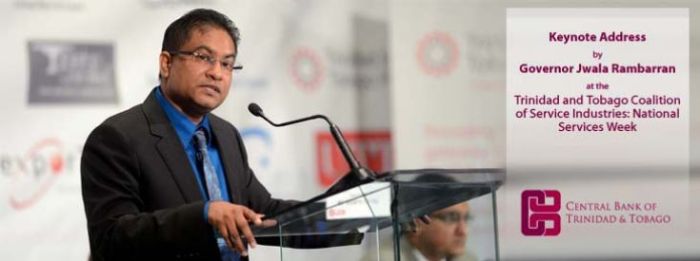 I am responding to the points made by Central Bank Governor, Jwala Rambarran, in his 6 November speech to the T&T Coalition of Service Industries.
This speech attempted to both re-affirm the Central Bank’s important role in our economy –
…as the country‟s prime financial regulator, the Central Bank has an almost fifty year record of maintaining the safety and soundness of the financial system…
and to distinguish Rambarran’s tenure as Governor since July 2012 –
…These are just a few of the initiatives the Central Bank has been working on over the last fifteen months to rebuild confidence, strengthen financial stability and to help create our future financial system…
Rambarran’s focus was “…First, “How did it all happen?” and, second…“What is being done to prevent a similar event from happening again?…” Continue reading “CL Financial bailout – Really learning from the past”
 AfraRaymond.net