Nothing but the truth

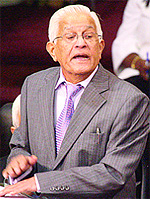
Basdeo Panday
Basdeo Panday, MP

The Leader of the Opposition, Basdeo Panday, recently laid a motion in Parliament seeking for HCU depositors to be granted a ‘bailout’ of the kind given to those who had invested with the failed CL Financial group. On Friday 30th October, the Minister of Finance made a major statement to Parliament, seeking to defend the government’s actions in the cases of these two failed Financial Institutions.

In terms of race, politics and finance, that statement by the Minister deserves our most sober consideration.

Before going further I need to make two things clear – firstly, I am not intervening on behalf of Mr. Harry Harnarine or the HCU. I am not a supporter of that cause. Not at all. Secondly, I do not support the bailout of either group – CL Financial or HCU. The idea that State resources should be deployed to assist investors who have lost money is a dangerous one. As a matter of principle, the concept of moral hazard has real weight in economic behaviour. The idea that investors should be rescued without paying the consequences of their choices is inimical to proper development. That general principle has been done violence by the CL Financial bailout.

As I have stated in my previous articles on this bailout, the record of the government in terms of separating the interests of depositors, policy-holders and shareholders is turbid.

The Minister’s rationale was set out in two limbs – the first being that the HCU dealings were not straightforward – indeed, one newspaper carried the headline ‘Devious HCU’– and secondly, that the CL Financial dealings were marked by “…tangible co-operation…”. This bailout is an extremely serious act being carried out by the government in breach of fundamental principle and we deserve nothing but the truth.

There are deep contradictions on every single point cited by the Minister to support the actions taken.

Here is what the Minister is reported to have said, together with the contradictions –

  1. Ample collateral – The Minister is reported to have said that HCU failed to offer ample collateral to the State. The Central Bank Governor is reported to have said, on 7th April, that all of CL Financial’s assets were otherwise committed – This was reported at http://guardian.co.tt/business/business/2009/04/08/govt-left-empty-handed-cl-financial-bailout.
  2. The Ernst & Young report – The Minister is also quoted as saying that “The auditors’ assessment was that the Hindu Credit Union was facing not a liquidity problem, but a solvency problem and all its assets were overestimated in value and encumbered.” As a rationale for the government’s actions, that is completely at odds with the 7th April statement of the Central Bank Governor. In fact we were told that the CL Financial group and various of its parts were being examined by Ernst & Young, KPMG and Bob Lindquist, the renowned forensic accountants. To date, no results of those accountants’ work have been released. We are being told that the CL Financial chiefs showed “…tangible co-operation…” in their dealings, so where are the audits? Why has the 2008 audit of the CL Financial group by PriceWaterhouseCoopers not been published?
  3. “…What is the Government to do? You dealing with…the major players, and they are not levelling with you…” That was the Minister’s statement about HCU, made in apparent exasperation. As I wrote in my column ‘Who is Who and What is What’ published here on 30th April – “At the beginning of this process we were led to believe that CL Financial was being pro-active and cooperative in their dealings with the State. Indeed the Governor even made this point directly in his prepared remarks at the 30th January press conference “…I would like to acknowledge the high level of cooperation that we have received from Mr. Duprey…” Since then CLF has now been exposed as paying dividends after requesting the State bailout, challenging the injunction obtained by the State over their assets with a powerful legal team and, to top it all, pledging the same assets twice. The Governor spoke on 23rd April – ‘If you ask me whether CL Financial did everything that was honourable and beyond reproach, the answer is no! The answer is no!’”

Obviously, some one of the major players is not levelling with us.

SIDEBAR

So the government bails out policyholders and depositors of the CL Financial group. That is widely welcomed, except for a few objectors, like myself. It seems to me that the interests of the CL Financial shareholders have been promoted in preference to those of the taxpayer. I am subject to correction, but if that is so, it would be a monumental mis-allocation of public funds and a seriously questionable act. The terms of the bailout are now being deliberately concealed from public view, although it is at our expense and supposedly being carried out for the benefit of the public.

That secrecy is toxic to notions of transparency, accountability and modernity. I will return to that secrecy issue.

Suffice to say that the terms of the bailout, the subsequent revelations and the concealment of the second MoU have combined with the Minister’s contradictory statement to yield a very unhealthy series of precedents.

The unspoken question at this moment is ‘Who is next?’. Last week’s BG View editorial highlighted some pertinent concerns as to the health of private pension plans and the strength of the regulatory process.

No one knows if CL Financial is just the first in a chain-reaction or simply a ‘one-off’. The burning question is, if there is another collapse of a large investment house – ‘Will they also be bailed-out?’ and, if yes, ‘On what terms?’
CL Financial subsidary British -American Insurance Company has “gone through.”

GOVERNMENTS OF THE EASTERN CARIBBEAN CURRENCY UNION (ECCU) AGREE ON STRATEGY FOR BRANCHES OF BRITISH AMERICAN INSURANCE COMPANY IN THE EASTERN CARIBBEAN

Introduction
For several months, the Governments of the Eastern Caribbean Currency Union (ECCU) have carefully monitored growing public concern about the financial situation of British American Insurance Company Limited (BAICO) and other subsidiaries of its Trinidadian parent company, C L Financial. BAICO itself is a private, limited liability company incorporated in the Bahamas. Nevertheless, the sheer size of BAICO and the significant exposure of the Eastern Caribbean have made it imperative for the ECCU Governments to adopt a proactive and collective approach to this challenge.

Continue reading “CL Financial subsidary British -American Insurance Company has “gone through.””

Duprey’s Fate

The Business Guardian editorial of 15th October raised the topical question as to ‘Will Lee Chin avoid Duprey’s fate?‘  http://guardian.co.tt/business/business-guardian/2009/10/15/will-lee-chin-avoid-duprey-s-fate

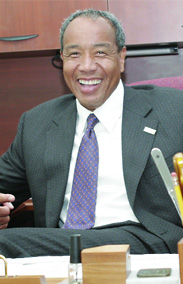
Michael Lee Chin. Photo courtesy Trinidad Guardian
Michael Lee Chin
Of course, one interesting feature of this entire affair is the fact that these two groups were headed by Black Caribbean men.  That is exceptional, as a matter of fact and it required a serious break from our past to develop the required levels of investor confidence.

But the differences are even more interesting than the similarities – for example, it seems that AIC Finance has declared the true position and alerted its stakeholders properly as to its exit strategy.

The characterisation of this situation as being ‘Duprey’s fate’ made me smile.  Quite frankly, that phrase seemed to be a device to create some public sympathy for Duprey when the facts are of another type altogether.

If the terms of the CL Financial bailout are examined, they are truly remarkable, even by our declining national standards.  The principal terms are –

  1. Amount – The amount of public money to be advanced is unspecified. Despite various official statements, this did not form part of the first MoU.  The press release on the second MoU of 12th June 2009 was also silent as to the amount of money to be advanced in this CL Financial bailout.
  2. Collateral – The original MoU specified that certain assets were to be disposed of to repay the funds advanced from the Treasury.  That position was soon overtaken by reality when the Central Bank Governor announced on 7th April that all of CL Financial’s assets were already pledged – http://guardian.co.tt/business/business/2009/04/08/govt-left-empty-handed-cl-financial-bailout. The second MoU and recent statements by Mariano Browne, Minister in the Ministry of Finance, make it clear that no fire sale of assets will be undertaken.  To quote the Minister, speaking on 15th October – “One needs to be judicious in terms of the managing of the assets at CL Financial Group, given the depressed state of the market both here and internationally. There is certainly no intentions (sic) of selling the assets. The position is to manage them and manage them well” http://guardian.co.tt/business/business/2009/10/16/browne-no-plans-govt-increase-shares-rbl.  If we are to believe the Central Bank Governor and the Minister, there being no good reason to doubt either one, it seems that these advances are taking place without security.
  3. Interest rate – The first MoU and the press release on the second MoU are both silent as to the interest rate charged.
  4. Payback period – There is no stated period for repayment of the public funds advanced.  There have been recent announcements as to the government taking over management of the CL Financial group for 3 years.
  5. What fate? – Having arranged an urgent package of rescue financing on those terms, it seems that the shareholders of CL Financial have not had their equity position diluted and further, that Mr. Duprey has been allowed to keep all his personal assets. That is Duprey’s fate.

That summary is the best I can give, based on the limited information available to me.  If it is an accurate one, the CL Financial bailout is tantamount to a huge injection of public funds to bolster the private interests of only 325 shareholders, the main one being Lawrence Duprey.

That is a real shame, given the state of our nation’s finances.   The greater pity is that this is all taking place without proper public accountability or transparency.  So far the Minister of Finance has not replied to my various attempts to get further information on these matters.  But how much blame can we place on our rulers?

Our society is shaped by our collective aspirations, attitudes and actions.  But the notion of collective values is an increasingly doubtful one in this arena.  Insofar as the national economy is concerned, do we actually possess collective values and if so, who can say with certainty what those are?  More and more, it seems that the real question is ‘Whose values will prevail as we go forward’?  The progressive people in the society have a duty to make their voices heard, if we are to have a chance of influencing others.  If we influence others to improve standards, then that is a positive move towards the inescapable future.

This CL Financial fiasco has been marked by the silence of the responsible people in the society.  The nation seems to have been so heavily invested in the CL Financial group that the bailout was greeted with widespread relief.  So much relief, that we seem to have taken our critical eyes ‘off the ball’.  On 19th October I wrote an Open letter to the Institute of Chartered Accountants of Trinidad & Tobago (ICATT) to seek their involvement in calling for greater transparency and accountability in this entire bailout.  That letter can be found at www.afraraymond.com.  The week 19th to 23rd October was Accountants’ Week.  The President of the ICATT, Anthony Pierre, writing to open that Week, stated that ‘We have the opportunity to raise the bar on new standards in corporate governance, accounting, auditing and ethics” and “We do so mindful of our continued responsibility to contribute to the further development of our people, our institutions and our country”.

I also intend to seek the involvement of other civic society organizations in promoting the calls for greater transparency and accountability in this entire bailout process.

Afra Raymond

This series on the CL Financial bailout can be viewed or readers’ comments made at www.afraraymond.com.

Open letter to the Institute of Chartered Accountants of Trinidad & Tobago

Anthony Pierre
Anthony Pierre, president of ICATT

From: Afra Raymond <afra@tstt.net.tt>
Date: Sun, Oct 18, 2009 at 4:19 PM
Subject: ICATT and the CL Financial bailout
To:  Anthony Pierre, President

Dear Mr. President,

I am writing to you, as President of the Institute of Chartered Accountants of Trinidad & Tobago, to urge your involvement in the calls for greater transparency and accountability in the bailout process involving the CL Financial group.

Anthony, on the many occasions on which we have interfaced, I developed considerable respect for your integrity and sense of purpose.  Most recently, I took note of your critical intervention on the proposed new regulatory regime for the credit union movement.

I am of the view that we citizens and civil society organisations, such as ICATT, need to be active in promoting higher standards of professional and public conduct.  I know that those are values within which we can find common ground, because in so many respects we can do better.  Yes, we can.

As you know, I have been publishing a critical review of the CL Financial bailout in the pages of the Business Guardian and that now forms the core of my blog at www.afraraymond.com.  The collapse of the CL Financial group is certainly the largest financial crisis to beset our nation and the first MoU of 30th January 2009 was widely welcomed as offering relief to depositors and policyholders.  I expressed doubts on the grounds that we seemed to be ignoring moral hazard.

The second MoU, signed on 12th June 2009, has now apparently been deemed ‘confidential’.  That designation is inimical to vital concepts such as transparency and good governance, both of which form important themes of ICATT’s work generally and in this Accountants’ Week in particular.

I appreciate that your time is very limited, so there are only two articles to which I would invite your attention, both available on my website – ‘Finding the Assets‘ (published on 23rd August) and ‘Open letter to the Minister of Finance‘ (published on 5th October and also in that issue of the Trinidad & Tobago Review).  For ease of reference, I have attached copies of these articles.

My specific questions to the Minister of Finance, on which I am here lobbying for ICATT’s support and involvement are:

  1. CL Financial 2008 Audited Accounts – When are these to be published? What is the reason for the delay in doing so?
  2. The second MoU with CL Financial – The first MoU was published on the Ministry of Finance website on 9th April, 9 weeks after it was signed.  Using even that slow timetable, the new MoU is overdue for publication.  Some 18 weeks have now elapsed.  What is the reason for its omission from the Ministry’s website?  The second MoU creates new and onerous commitments for the country and its publication must no longer be delayed.  I emailed the Minister of Finance on 19th September to request clarification on this, but there has been no reply.
  3. Forensic Audits – We have seen various official reports of forensic audits being carried out at CL Financial and some of its subsidiaries.  Have these been completed?
  4. The interest rate – What is the interest rate being charged to CL Financial for this open-ended financial assistance?
  5. Status Reports – We have had no interim reports as to the disbursement of State funds or the disposal of CL Financial Assets.  When does the Ministry of Finance intend to start providing regular reports on the progress of the bailout to the public?
  6. The equity position – How is the equity position of the shareholders being adjusted in this deal?  Has their shareholding been diluted to reflect the position?  Has the State now taken an equity position in the group?  If not, what is the upside for the State in all this?

For the avoidance of doubt, given the recent confusion amongst our learned friends, please note that this is being published to my website.

Afra Raymond

Open letter to the Minister of Finance on The CL Financial bailout

Honourable Minister,

This government agreed a bailout of the CL Financial group and announced that on 30th January 2009.

It was an historic step and the stated reasons for so doing were to ensure the stability of the national/regional financial system.  The size of the CL Financial group at some $100Bn, as well as the sheer reach of its activities, were cited as part of the rationale for the bailout.  The interests of depositors and policyholders were to be safeguarded by this State intervention.

Since the signing of the Memorandum of Understanding on 30th January 2009, several serious concerns have come to light and those have been highlighted in the press.

This letter is intended to form part of the formal record in this matter.  Its principal concern is the actual size of the bailout commitment.  According to your statement to Parliament on Wednesday 4th February 2009, the Executive Chairman of CL Financial estimated its assets as being worth $23.914Bn.  That statement is taken from page 628 of Hansard and can be accessed at http://www.ttparliament.org/hansards/hh20090204.pdf.  Mr. Duprey’s estimate was stated by you to form part of his letter of 13th January, as Executive Chairman of CL Financial, to the Governor of the Central Bank.

What possible justification could there be for repeatedly stating that the CL Financial group had about $100Bn of assets, if Mr. Duprey estimated the figure to be $23.914Bn?

There are 3 possibilities here –

  1. Firstly, PWC’s Consolidated Balance sheet for the CL Financial group is accurate in disclosing an Asset Value of $100.666Bn.  CL Financial’s Consolidated Balance Sheet is at page 23 of their Annual Report 2007 ‘The Next Wave of Growth’ – http://www.clico.com/pdf/AR07/CL%20Financial%20Annual%20Report%202009.pdf.  Those audited accounts, as at 31st December 2007, were published on 18th November 2008.
  2. Secondly, CL Financial’s letter of 13th January 2009 to the Governor of the Central Bank, signed by its Executive Chairman, Lawrence Duprey, is accurate in disclosing an asset value of $23.914Bn.
  3. Thirdly, if we accept that the first and second statements are both correct, we would have to somehow account for the dramatic decline in the CL Financial Asset values.

In his prepared address to the 30th January press conference to announce the CL Financial bailout, the Central Bank Governor was clear in his appreciation of Mr. Duprey’s stance in the matter “..I would like to acknowledge the high level of cooperation that we have received from Mr. Duprey in our efforts to address what must be a very difficult period for the CL Financial Group.”  It is reasonable to assume that the high level of cooperation referred to by the Governor would have been accompanied by levels of frankness, good faith and full disclosure.  It is therefore all the more puzzling when one considers the Governor’s statement, made in that very address –

“…For the record, ladies and gentlemen, the CL Financial Group has an imposing presence with potentially systemic consequences for the financial sector and the economy of Trinidad and Tobago and the entire region.

For example,

  1. The Group controls over ($100) billion of assets in at least 28 companies located throughout the Region and the world.
  2. The Group’s financial interests cover several industry sectors including banking and financial services, energy, real estate and manufacturing and distribution. The four largest financial institutions in the Group manage assets of over $38 billion, over 25 per cent of the country’s GDP.”

How can one possibly reconcile that official account, made to justify the bailout, with Duprey’s letter, clearly stating that the assets are worth $23.914Bn?

What could have caused such a dramatic decline in CL Financial’s asset values?  The intervening period could either be 12 months and 13 days or 56 days, according to how you count it.  Either way, it is a tremendous decline.  Our Treasury is now committed to restoration of asset values – as per the Angostura Notice to Shareholders of July 2009 – we must understand the reasons for the decline in asset values.

The audited accounts of the CL Financial group for 2008 are now easily overdue and it would be instructive to consider the Balance Sheet as at 31st December 2008.  That would be a mere 13 days before Mr. Duprey wrote to the Central Bank Governor.  Has CL Financial’s audit for 2008 been completed?  If not, why not?  If yes, why the delay in its publication?
This is an aspect of the fiasco which has not been discussed in public, so far.

Your urgent and public response is now needed on these important points –

  1. CL Financial 2008 Audited Accounts – When are these to be published?  What is the reason for the delay in doing so?
  2. The second MoU with CL Financial – The first MoU was published on the Ministry of Finance website on 9th April, 9 weeks after it was signed.  Using even that slow timetable, the new MoU is overdue for publication.  Some 16 weeks have now elapsed.  What is the reason for its omission from the Ministry’s website?  The second MoU creates new and onerous commitments for the country and its publication must no longer be delayed.  I emailed you on 19th September to request your clarification on this, but there has been no reply.
  3. Forensic Audits – We have seen various official reports of forensic audits being carried out at CL Financial and some of its subsidiaries.  Have these been completed?
  4. The interest rate – What is the interest rate being charged to CL Financial for this open-ended financial assistance?
  5. Status Reports – We have had no interim reports as to the disbursement of State funds or the disposal of CL Financial Assets.  When do you intend to start providing regular reports on the progress of the bailout to the public?
  6. The equity position – How is the equity position of the shareholders being adjusted in this deal?  Has their shareholding been diluted to reflect the position?  Has the State now taken an equity position in the group?  If not, what is the upside for the State in all this?

Afra Raymond

Email to Minister of Finance

From: Afra Raymond <afra@tstt.net.tt>
Date: Sat, Sep 19, 2009 at 2:38 PM
Subject: CL Financial second Mou dated 12th June 2009

To: Nunez-Tesheirak@gov.tt

Honourable Minister,

After your address to the CMMB Budget Breakfast on Thursday 10th September, I asked you when the Ministry of Finance intended to publish the second CL Financial MoU.

You replied that there was no intention to publish that document and you went on to say that the Ministry was seeking legal advice on this. I am relying on my memory here and that is, of course, subject to correction.

For the avoidance of doubt, I am here making a written request for your reply as to when the Ministry of Finance intends to publish this second MoU with CL Financial, signed on 12th June 2009. I would add, for your information, that the original press release on that MoU was emailed to me by the Ministry of Finance upon my request.

Thank you.

Afra Raymond

Finding the Assets

This week, I am at last able to answer two queries which have bedeviled this series for some time.

Firstly, several readers have pointed out that there was  significant repetition of details in this series.  While it is true that that repetition was deliberate on my part, it is also true that there was a growing question…”When are you going to give us some fresh information?

Secondly, my repeated requests for publication of the initial letter from CL Financial seeking the state’s financial support.  It seemed that those calls were being ignored and I did wonder why.  On June 11th, in ‘Do what is Right’, I wrote – “Could it be that that letter contains information which reveals too much about the true background to this tangled affair?  Madam Minister, what is your interest in further secrecy on this aspect?”.

In the course of researching another aspect of the bailout, I came across the letter about a week ago, so that is the fresh information for presentation this week.  Given that the Minister of Finance revealed that information in the first week after signing the Memorandum of Understanding, I was clearly wrong to suggest that she had any intention to conceal the letter.

The Minister of Finance was speaking in Parliament and seeking to rebut the allegations by opposition politicians that she had benefited from insider information.  This extract of her statement is taken from page 628 of Hansard of Wednesday 4th February 2009 – this can be found at http://www.ttparliament.org/hansards/hh20090204.pdf

With your leave also, I would like to read into the record of Hansard, a letter from Clico Investment Bank addressed to the Central Bank. That letter is dated January 13, 2009. It is on the letterhead of CL Financial, addressed to Mr. Ewart Williams, the Governor and signed by Lawrence A. Duprey, Group Executive Chairman.

“Dear Governor,

The severe global financial crisis has begun to impact our local and regional markets and is causing strain on liquidity in certain parts of the financial system in Trinidad and Tobago.

CL Financial being a significant part of the financial sector has been disproportionately impacted by these adverse conditions. Many of our customers are also affected and are consequently calling on their reserve cash positions.

Thus far, all our member companies have been able to deal with their commitments.  However, we wish to develop a comprehensive contingency plan to meet any further developments, if this trend were to follow a similar pattern to other countries.

As a result, CL Financial is taking urgent and decisive action.

We have conducted a review of the Group’s assets and the projected liquidity needs. While the Group remains strong in terms of the quantum and quality of its assets, these assets are not in a form that can be liquidated in short order without significant loss in value.”

And they gave a table setting out the estimated value, just by sector:

Real estate –          $2,505,000,000
Manufacturing Sector –          $6,300,000,000
Energy –          $7,048,993,014
Financial Services –          $8,060,000,000
Total:             $23,913,993,014

We are in the process of realigning the asset-liability structure of the Group to better match the current liquidity situation. This is a complex action plan that we are embarking on immediately, including initiatives such as merger of certain entities within the Group with strategic partners and/our sale of certain assets in order to raise liquidity.

As you would appreciate, these initiatives would need some time before they yield the desired results. In the event that the financial crisis deepens in the local market we may need urgent liquidity support to be made available to the group.

In this regard, we would like to discuss the approach of the Central Bank toward supporting the financial sector and by extension the CL Financial Group, if conditions were to deteriorate.

I thank you for your understanding in this matter and look forward to your continued support.”

That letter, as I said, was dated January 13, 2009

CL Financial Consolidated Balance Sheet is at page 23 of their Annual Report 2007 ‘The Next Wave of Growth’ –

http://www.clico.com/pdf/AR07/CL%20Financial%20Annual%20Report%202009.pdf

That Consolidated balance Sheet discloses Total Assets, as at 31st December 2007, as being $100.666 Bn – those financial statements were published on 18th November 2008.

Given accounting conventions as to intervening events and their reporting, it is startling, to say the least, that this balance sheet should have declined to $24Bn just 12 months and 13 days after their reporting date. Only 56 days after publication.  This is an aspect of the fiasco which has not been discussed in public, so far.

We need to hear some accounting of this extraordinary situation.  Just to select one item of interest, Loans and Advances are shown as $21.975Bn in the CLF 2007 accounts and yet only $8.0Bn is there at 13th January 2009.

My reading of this is that CL Financial’s assets declined in value from $100.7Bn at the end of 2007 to $23.9Bn at the beginning of 2009.  We have now agreed to restore asset value to the shareholders of CL Financial on terms which are as yet unpublished.

SIDEBAR: Out of Africa

The dominant media coverage of the wealthier countries can sometimes mask interesting developments.  I had been wondering how other developing countries were handling their own financial crises.

I was struck last week by extensive reporting of the action of the newly-appointed Governor of the Central Bank of Nigeria (CBN) in bailing-out 5 large, publicly-listed banks.  There is a widely-held view that Nigeria is one of the most corrupt countries.  CBN Governor Lamido Sanusi has taken several bold actions to restore confidence in the banking sector.  The main ones were –

  • Dismissal of 19 of the top executives of the rescued institutions, deploying seldom-used powers.
  • Publishing lists of defaulting borrowers, many of whom are prominent citizens and leading companies, along with a strong warning that all these loans must be repaid now.  Those who do not comply will face the Courts.
  • Making it clear to shareholders that the bailout funds are not for dividends at all, but to restore banking confidence.
  • A special police unit, to deal with Economic and Financial Crimes, is questioning the dismissed executives.  Those who are not being questioned are forbidden to leave the country.

This story is in the Wall Street Journal, The Financial Times and Reuters.

Condonation

The word Condonation has been turning through my mind since the start of this fiasco.  It refers to a pattern of conduct in which someone who could, or should, have done something to stop wrongdoing does nothing.  The silence of the person practicing condonation effectively allows the continuance of the wrongdoing, even if that person’s actions do not quite amount to conspiring with the wrongdoer.

To put it plainly, in those families where children are abused by one parent, it is almost always the case that the other parent knew.  The continued silence of one parent allows the abusive one to continue.  Even if the other parent did not commit any act of abuse, theirs is a series of inactions which allow wrongdoing to continue.  It could be argued that the silence can imply forgiveness.  Yes, that is condonation.

In relation to the CL Financial bailout, there is plenty of apparent condonation.  So much so that fresh perils could now be coming toward us.

My starting-point for these concerns was the startling story that a group of investors in the Stanford International Bank Limited have filed a lawsuit against the Antiguan government, claiming some $8.0Bn USD.  The lawsuit also alleges that the Antiguan authorities “became a full partner in a fraud and reaped enormous financial benefits from the scheme“.  My main reading for that case came from the Trinidad Express column by David Jessop on 18th July 2009 ‘A case that hits home’ – that column can be accessed at http://www.trinidadexpress.com/index.pl/article_opinion?id=161505942.

One of the telling points in that Antigua situation is that that case is filed in the USA and so one has to wonder whether the small-island arrangements can withstand a US-style court case.

Some people might even be asking what has this Antigua case got to do with us here in T & T.  After all, our government has pledged to bailout all policyholders and depositors, right?  Not so fast, because it is a condition of the CL Financial bailout that we are not assisting overseas policyholders and depositors.  Whatever the level of comfort being enjoyed by locally-domiciled policyholders and depositors in CLF Financial, those who invested from overseas will have to get compensated in some other way.  Will they choose a Stanford-type lawsuit?

The implications of this possibility are sobering, when we consider the Antigua case further.  When we consider the tangled web of connections here in our country, can we seriously expect to survive US-style litigation?

We have a Minister of Finance who is also a shareholder of the failed group, together with a Governor of the Central Bank who warns of investments which are ‘too good to be true’, yet holds deposits with CIB.  The Minister of Finance, in her defensive statement to those accusing her of conflict of interest, makes it clear that when she realized that the group was in trouble, she put her family interests before those of the nation.

In addition we have a ruling party which accepted substantial donations from the CL Financial Group and yes, the party’s Treasurer was also the Finance Director for the group.  The CL Financial group distributed dividends to its shareholders after writing to the Central Bank for urgent financial assistance and as yet, none of its Directors have been censured.  The shareholders of CL Financial have also been allowed to keep their dividends as the group drifted toward the rocks.

Some of the assets pledged to match the cost of the bailout are already pledged elsewhere, something the CL Financial negotiators must have known.  The Governor of the Central Bank is reported to have said that all the assets are pledged elsewhere – see http://guardian.co.tt/business/business/2009/04/08/govt-left-empty-handed-cl-financial-bailout .  Despite the prohibition against selling any assets, CL Financial is found to have been trying to sell its shareholding in CLICO Energy just 5 days after signing the MoU.  This was reported at http://guardian.co.tt/news/general/2009/03/24/duprey-energy-fire-sale-raise-severance-money .The ‘fit and proper’ guidelines published by the Central Bank are not implemented in the CL Financial case.

In addition, the new CEO of the principal company, CLICO, tells us that some $5.0Bn is missing from that company’s statutory fund and cannot be found.  This was reported at http://guardian.co.tt/news/general/2009/03/01/where-money-gone .  There has been no further official word on the missing funds, despite the involvement of Bob Lindquist, KPMG Forensic and the continuing assistance of the CL Financial chiefs.

None of this has been denied or contested.

It is all so incredible that no fiction writer, not even one of the more outlandish ones, could ever concoct such a story.  A perceptive editor might even reject it, but the fact is that we have to deal with these elements.

In an earlier column in this series, I commented on the democratic deficit which allowed our elected rulers to proceed with virtual carte blanche, the law being the only impediment.  Some would say that that arrangement is a workable one which allows the ruling party appropriate scope within which to run the country.  That is not a debate for this space, suffice to say that the CL Financial situation is posing a fresh series of questions.  Those questions arise in the aspect of scale – to get proverbial for an instant

Q – ‘Where does an Elephant sit?’

A – ‘Anywhere it wants, silly!’

Point being that an elephant is so huge that if it decided to sit, we would all have to make way for it, whatever the inconvenience.  In both cases, the Stanford Investment Bank and the government of Antigua, as well as the CL Financial group and our own government, the company was so huge that it exerted a serious influence on national affairs.

Economists use the terms ‘externalities’ or ‘external costs’ to refer to quantifiable costs which are not directly considered as an aspect of the matter under examination.  In this case, the externality is that none of the 3 major political parties are speaking on this monumental event.  The silence is choking and even the government, with all its huge publicity machinery, is only speaking when it has to.  Apart from some early ‘sound-bites’, the UNC is absolutely silent.  Even a party with such a stable of noted ‘firebrands’ is silenced by the deep relationship between Lawrence Duprey and its leadership.  In the case of the ‘third party’ CoP, it is even more galling since they have a ‘front bench’ of unmatched depth in the fields of finance and economics.  One can only wonder at the reason for their silence.

That silence is a huge externality imposed on us all by the very size of the CL Financial group.  The irony is that the very issue which needs to be debated is the one on which we are silent.  That is a colonial pattern of public discourse and it is inimical to our nation’s development.  Such are the consequences of condonation.

Emancipation

This week the meaning of Emancipation is considered alongside the CL Financial fiasco.  It is a painful, but necessary, task.  Those of us concerned to commemorate the Emancipation of African people from slavery must have the courage and clarity to reflect on our past, both the distant and the recent.  In reflection we can find direction and perhaps, the beginning of a solution.

How, if at all, is the CL Financial fiasco connected with the story of Emancipation?  I deliberately use the word ‘story’ since it is clear that there are many versions of this period in our history.  I say ‘our history’ because, whatever the race of today’s readers, the Emancipation journey is of vital concern to the progress of humanity.

There were notable and honourable African leaders who put up strong resistance to the efforts by Europeans to enslave their people.  But the sad and inescapable fact is that there were others who thought of the process differently.  It is a painful matter to discuss, but the fact is that some African rulers collaborated with the European slave-traders to capture and sell their people.  Not all, but enough to make the difference.  Without getting into the entire history, which is way beyond the scope of this column, the actions of that group of rulers were enough to ensure the success of the entire monstrous project.  The Atlantic slave-trade shaped large elements of today’s world and we have been trying to build a new one ever since.  Yes, an immoral and greedy group of rulers put a greater value on their personal enrichment than the well-being of those they were entrusted to lead.

The entire society paid the price for the selfish ambitions of these rulers.

One of the most striking things about the CL Financial fiasco is that Lawrence Duprey is one of us, an indigenous Caribbean man. Yes, a black man, with African blood flowing through his veins and that is something that has not formed part of our public discussion so far.  One of the strangest features of these times is how, despite the over-supply of media, critical issues are not discussed.  When one considers that the vast majority of the population of the region comes from an African background, it is striking that Lawrence Duprey is the only such tycoon in the region with his level of profile.  But wait, I almost forgot that there is another one.  Yes, I am speaking about Michael Lee Chin.

Whichever way you slice it, this is extremely telling and as a result Duprey carried a peculiar set of expectations.  Because of his unique profile as a black man, the fact is that Lawrence Duprey was the recipient of widespread admiration, envy and wonder.  That is our society and that is one of the ways we deal with its ugly realities.

To go further, the leading people in the CL Financial team were also black.  Yes, most of the CL Financial team have African blood flowing in their veins.  Yes, by now I can hear some readers saying things like – ‘But X or Y doesn’t think that they are Black’ or ‘So what?’ or ‘Exactly what is your point?’.  That kind of skepticism is expected when one discusses this kind of issue.  In fact it is my view that the underlying attitude is the very problem.

At the same time, let us note that the regulators are themselves black people.  Yes, the picture I am painting is that the main players are virtually all black people – the Cabinet, the Central Bank and the CL Financial/CLICO chiefs.

We African people have come from far, both metaphorically and physically.  We now find ourselves in a sorry place with this CL Financial fiasco.  We have a particular responsibility to do better this time around.  There is no escaping that fact.

CLICO was built around the ideal, by its founder Cyril Duprey (Lawrence’s cousin) that ‘Give a man service, give a man value and he will give you more business’.  Simple, but strong, those were the foundation stones of CLICO.  Truth prevailed and with hard work the company prospered.  CLICO developed unprecedented levels of investor confidence, as a black company (indigenous) in which one could have faith.  Given our history as African people, that level of investor confidence is no small or incidental thing.  It could only have been the result of solid vision and diligent long-term application, to name just two of the qualities of the founder.

CL Financial was established as a holding company and rapid diversification followed, with investments in a number of areas unrelated to conventional insurance business.    As a result of its success, CLICO was able to provide most of the cash to pay for the group’s unorthodox expansion.

At that stage, the activities of the group shifted to reflect the new ambitions of its new chiefs, most notably its Executive Chairman, Lawrence Duprey.  Those activities ultimately undermined the stability and health of the whole.

The Emancipation story has many lessons, but the central one, from my point of view, is that many of our rulers lost sight of the balance between private wealth/privilege and the public good.  Are we doing better now?  For us, in this Emancipation week, it is useful to consider the extent to which we have learnt from our past.

The actual behaviour of the CL Financial chiefs and the group’s shareholders in this moment is instructive.  At every turn, the public good has been shafted in favour of private wealth.  From the payment of dividends while CLICO’s Statutory Fund was in deficit to the payment of dividends to CL Financial shareholders after they wrote for urgent financial assistance from the State.  The pledging of assets which had already been pledged and the attempted sale of assets contrary to the original MoU.  The shocking statement of CLICO’s new boss that $5.0Bn was missing from its Statutory Fund and the utter silence subsequently as to its whereabouts.

All this shocking behaviour and no sign of any reprimand, charge or censure from our rulers.  Instead, we are told that our entire Treasury has been pledged to assist savers and restore shareholder value.  Trinidad & Tobago is a land of many firsts, but this is a tragic one.

How did we get to the point of pledging our common wealth to restoring value to a few privileged people who are showing no proper regard for the public good?

Do we have the moral fibre to recognize what has gone wrong in our past and behave differently?

Figuring it out

“We are not serious,

Very few conscious,

So I cannot agree wid mih own chorus!”

from ‘Trinidad is Nice, Trinidad is a Paradise’ by Brother Valentino (Emerol Philips)

The 12th June agreement is to be voted on by CL Financial’s shareholders on Wednesday 15th July.  By the time this is published, there ought to have been a decisive vote on the matter.

I maintain my position that the 12th June agreement is taking us in a completely different direction to that outlined in the original MoU of 30th January.  I am also saying that the new direction is a detrimental one for this country with not even an attempt being made to explain the underlying rationale.

The flagship of the CL Financial group was CLICO, according to the Central Bank Governor, on 13th February – “In the CL Financial business model, Clico was a major source of cash much of which was used to finance investments held in the name of other entities in the Group.  In this model, Clico has ended up as guarantor for many of the Group’s assets most of which are heavily pledged.”  CLICO’s most successful product in this model was a high-interest one which promised more than any other investment available in the market.  Even at those high rates of interest promised to their investors, it was cheaper for CL Financial to raise funds in this way than to borrow.

CL Financial is no longer able to rely on CLICO for a source of cheap funds, so we are all thrust into a new, perilous position.

CLICO is now unable to offer the highest rates of return which once distinguished its products and is suffering an unwelcome migration of its better sales agents.  What future for CLICO?

We were often regaled with stories of Lawrence Duprey’s prowess, as a commercial negotiator, in securing the best terms.  It seems to me that CL Financial has arranged a new line of finance from the Treasury to go forward.  We are not told what, if any, interest rate is being charged by our Treasury for this massive line of unsecured borrowing.  Overdue Tax payable to the BIR attracts a punitive interest rate of 20% per annum, being rightly regarded as the taxpayers’ unsecured borrowings from the Treasury.  Are we seeing a plain case of double-standards?

As part of the new agreement, Lawrence Duprey has resigned from his Directorships of the companies in the CL Financial group.  He has retained his significant shareholding and it is clear that Michael Carballo, the group’s finance director, continues as his representative.

Some of you may think this is all OK, since the public funds being advanced to clean up this fiasco are ultimately protected by CL Financial’s agreement to sell assets so as repay.  Time to think again.  The assets which were pledged in the original MoU, were already pledged elsewhere.

Yes, the CL Financial chiefs tried to sell the same thing twice.

But what about the assets which were not pledged?  Oh, those were treated differently.  For example, CL Financial agreed to sell its majority shareholding in CLICO Energy Company less than a week after agreeing to seek the State’s prior written approval to any asset sales.  That action triggered the Central Bank’s legal action to both halt all further assets sales and demand a declaration of all assets.

Yes, CL Financial chiefs tried to sell off one of the remaining assets, contrary to the terms of the MoU.

So we have Republic Bank and Methanol Holdings shares being effectively unsaleable, since they are reliably reported as having been fully pledged before the original MoU.  Next we have the aborted attempt to sell other assets, not yet pledged.

So what is left?  Wait, what about the Liquor and spirits brands, the Angostura and Jamaican rum companies and such?  Well, according to its most recent Notice to Shareholders, Angostura is itself owed some $633M by CL Financial.  Given that its 2007 accounts disclose sales of $818M, that is a colossal amount of money for Angostura to be owed.  So much for that.

As for those Jamaican Rum assets, Lascelles de Mercado is Jamaica’s leading spirits company, controlling the top rum brands of Wray & Nephew and Appleton.  CL Financial owns about 87% of Lascelles de Mercado, which still has some 1,500 minority shareholders.  The Jamaica Gleaner of 17th June (at http://www.jamaica-gleaner.com/gleaner/20090617/business/business1.html and http://www.jamaica-gleaner.com/gleaner/20090617/business/business4.html) contained two instructive reports on that CL Financial subsidiary.  The first one highlights the payment of dividends to holders of ordinary shares for the first time in 2 years – Lascelles de Mercado said Monday it would pay dividend amounting to $14 per share, ending a drought for ordinary shareholders who have received no returns for at least two years. That subsidiary appears to be doing well.  The second report tells us  –

  • Duprey…has bowed out as chairman of CLF, but remains chairman of Lascelles.
  • Referring to the 12th June agreement – “Carballo said the government was in control of the management and running of the Caribbean conglomerate, but what has not changed is the ownership.

“The shareholding hasn’t changed. There is no intention to change the shareholding. It’s an agreement for about three years whereby the assets are managed and restructured and then the company will be returned to the shareholders,” he said.

  • There is more – “”So the question of selling does not arise,” he (Carballo) added, referring in this instance to Lascelles.”

So there you have it.  If we are to believe Michael Carballo – and I see no reason to doubt him – the good assets which are not pledged are to be retained by CL Financial.

Having lost grip of CLICO and its positive cash-flows, the CL Financial chiefs have now negotiated a new survival strategy.  On the other hand, we have now agreed to finance the recovery of the CL Financial group on terms which are unknown, to restore the value of its assets and return it to its shareholders.

The rueful regulator

The Governor’s statements on 13th February are really perturbing. On 13th February, at his first (and only) CL Financial briefing, the Governor of the Central Bank said – “Meanwhile, with the assistance of the Manager appointed to Clico by the Central Bank, we have made much progress in clarifying the present financial position of CLICO, which unfortunately, appears to be much worse than we had envisaged.”  How could it be much worse?  Are we being told, in not so many words, that CLICO’s filings and accounts were misleading?  Or did the regulator make a poor reading of the information?