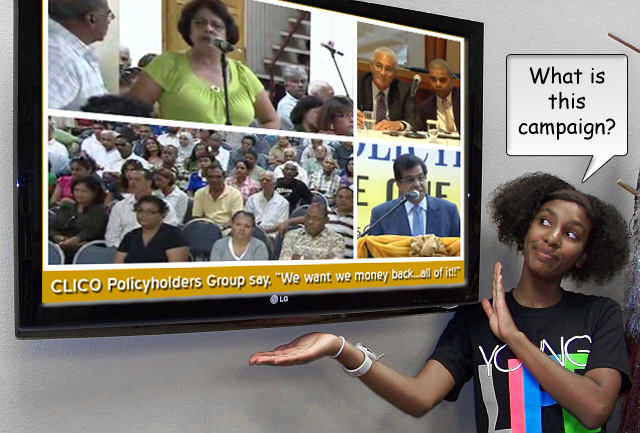
 We are witness to a second wave of assault on our Treasury. Let us be sure, those of us who are not in line to benefit directly from the bailout, that the picture is complicated and it contains perils for the entire country.
The original bailout was an unjustifiable and colossal facility granted to the CL Financial Chiefs and the shareholders of that failed, privately-owned, group. I say facility because the taxpayers’ money in our Treasury was pledged to repay the debts of the CL Financial group. The deal was hatched in secret and fact is, upon reflection, its terms were never formally debated in our Parliament. What was debated was a series of amendments to the laws governing distressed Banks and Insurance companies. A lot was said about the issue and many notable contributions were made to the debate in Parliament, but the agenda item for debate was not the terms of the bailout.
The 30th January 2009 Memorandum of Understanding had already been signed and was on its way to implementation when our Parliament debated and agreed to amend the legislation. The nation had witnessed a ‘Quiet Coup’ to draw from the title of Professor Simon Johnson’s seminal article (in the May 2009 edition of The Atlantic) on this process in the USA – see http://www.theatlantic.com/magazine/archive/2009/05/the-quiet-coup/7364/.
I have no intention of arguing the legal merits of the case being advanced by the CLICO Policyholders’ Group (CPG), leave that to the learned. I just note that we are yet to hear the voice of the traditional policyholder in the declarations of this Policyholders’ Group.
The bare facts need to be laid out for consideration, it would be far better to conduct this discussion in a more informed manner, with some of the missing details requested at the close of last week’s column. But is best to start from where we are. So, the bare facts –
- CIB’s insolvency is estimated, according to the winding-up petition being heard in the High Court, to be of the order of $4.7Bn
- According to the Finance Minister in his budget speech, the combined insolvency of British American and CLICO is of the order of $7.2Bn. It is not possible to tell from that speech if those estimated figures included the monies already drawn from the Treasury in pursuance of this bailout.
- The amount said to be spent on the bailout, up to May 2010, was $7.3Bn.
- The amount being owed to the 225,000 policyholders is estimated to be $6Bn. That covers traditional insurance products such as pensions, health plans and life insurance – it works out at an average of $26,666 owed to each person.
- The amount being owed to the 25,000 depositors is estimated to be $12Bn, which works out at an average of $480,000 owed to each person. But there is another way to look at that information and that is in the sidebar.
- The Governor of the Central Bank, the very official the CPG is seeking to have affirmed as the proper decision-maker in this matter, in April last year made public statements that all the assets of the group are encumbered.
In the absence of the accounts and operating with the available information, it seems reasonable to believe that the CL Financial group is insolvent and further that our Treasury has swallowed an impossible series of obligations. Furthermore, there is no obligation on the borrowers – the CL Financial shareholders – to pay one cent of interest. Even worse, Para ‘A’ of the 12th June 2009 CL Financial Shareholders’ Agreement actually obliges the State to protect the interest of the shareholders – see http://wp.me/pBrZN-bP.
Of course this leads to yet another ‘$57,000 question’ – ‘If the CL Financial group is insolvent, then how are we paying for all this?’ Yes, that is the big one.
It seems that the CPG is intent on advancing its sectoral interest and while we know that is how things work, it is even more important to be watchful of our nation’s wealth. We are actually being asked to put out an additional $12Bn to rescue the 15,000 CPG members, with no reasonable hope of recovering those monies.
For the record, no one from the previous government or the Central Bank, for that matter, has ever even attempted to justify the rotten terms of this bailout. Not even an attempt to explain the interest-free, unlimited, unsecured loan to that lucky group of 325 CL Financial shareholders.
Even now, with the new terms being hotly debated, please note carefully that no new terms are being announced for the ultimate borrowers, the CL Financial shareholders.

Professor Selwyn Ryan of UWI, who was, last year, a strong critic of the bailout process and its glaring conflicts of interest, now appears to have become a leading party in the CPG, calling for that suspect deal to be honoured. A deep contradiction in terms, I tell you. How do you honour a rotten deal? Politics does make strange bedfellows and yes, history is truly rich in irony.
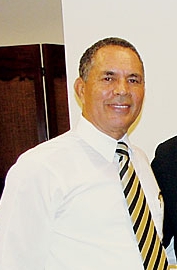
Even stranger still, is the presence in the CPG of Emmanuel ‘Manny’ Lawrence, former Sales Director of CLICO and now head of one of its sales agencies. In the three years before the CL Financial group collapsed, all the CLICO agents I knew made intense efforts to get deposits from me. Not once did these agents even attempt to sell me a life insurance plan or health plan. These agents consciously and deliberately coaxed many of those people who are now protesting to place all or most their investments in this one instrument. That is the kind of irresponsible behaviour which led many people to be in breach of the basic investment guideline against over-concentration of risk – to avoid putting all ones eggs in one basket. That is the kind of biased and unsound advice which no proper professional would render to a client. It is a decisive factor in this entire scenario.
The ingredients included the requirement for cash by an expanding industrial/commercial group, the resulting lucrative commissions being paid, the trust of the investors and the poor level of general financial literacy. Those factors all contributed to this appalling picture. To be fair, despite the titles adopted by some of these salesmen, they were not true Investment Advisers, since they were selling CLICO products.
Also, as to the discussion about the sophistication of the investors, the fact is that even an organisation as large as the National Gas Company, could be seen to have placed undue reliance on the high-interest/high-risk products being offered by the CL Financial group. At one point, according to its 4th February 2009 Press Release, over 45% of NGC’s funds were in CL Financial – see http://wp.me/pBrZN-ec .
SIDEBAR: The depositors re-examined
I just made the point that the 225,000 ‘traditional, long term policyholders’ are owed an average of $26,666 per policyholder.
Also, that the 25,000 depositors are owed an average of $480,000 per depositor. It is interesting that if you subtract the maximum of $75,000 which would be due to each of the 10,000 ‘small-scale’ depositors, the total owed to the remaining 15,000 depositors is reduced to $11,250,000,000. That adjustment carries the average amount due to the real protestors in this CPG to no less than $750,000 per depositor. Yes, that is twenty-eight times the amount due to the traditional policyholders.
Ironically enough, the voice of the traditional policyholders, who outnumber the depositors nine-to-one, is virtually silent in all this. I am yet to hear anything from the CPG on behalf of those traditional policyholders. But then again, it is clear that by far the larger amount is owed to the depositors and further, that they appear, on average at least, to be owed about 18 times more than the typical policyholder. Yes, as Growling Tiger did sing “Yuh know very well that Money is King’’.
 Winston Dookeran’s budget proposals to re-order the ongoing CL Financial bailout have sparked considerable controversy. Dookeran stated his first priority to be “…Stop the drift and indecision…” – ironically enough, it appears that the sentiments of the public are moving in another direction entirely. A new mood of protest and threats of impending lawsuits have emerged. This is a live example of the law of unintended consequences.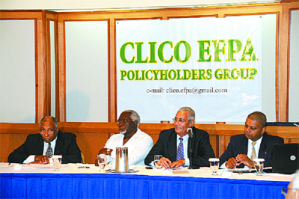
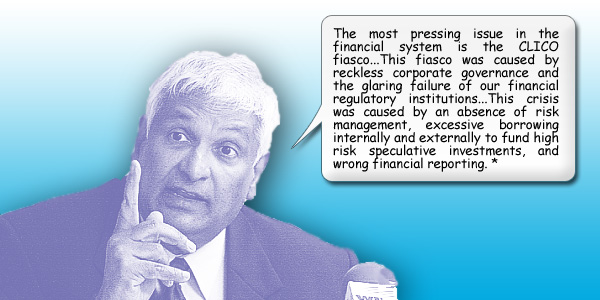

 Compare and contrast the different results of the PwC 31 December 2007 audited Balance Sheet and the E&Y 31st January 2009 Statement of Affairs. The discrepancies between the CIB Management Accounts and E&Y’s Statement of Affairs of 31 January 2009 are astonishing.

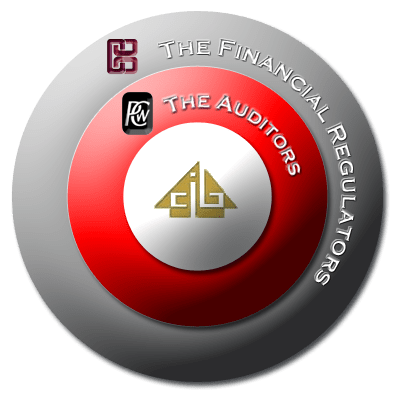 For the purposes of this article, CIB is at the centre of the page, with its Directors and Officers being in charge of its strategy and management. They bear primary responsibility for the company’s affairs on behalf of the shareholders and other stakeholders.

 PricewaterhouseCoopers (PwC) is the world’s largest professional services firm in the accounting and finance industry. PwC audits the accounts for UDeCOTT, CL Financial, Angostura and at one point I can even recall the Hindu Credit Union announcing that that firm was to be their internal auditors. Clearly, PwC is a main player in the big leagues here in Trinidad & Tobago. Let me declare here that they are also my [Afra Raymond, not Raymond & Pierre] accountants.
 VIDEO: First Up Interview – 8 July 2010
 AfraRaymond.net