CL Financial bailout: A Season of Unreason

We are now entering a bizarre endgame in this rounds of musical chairs.  The children’s game has returned for us adults, but with a vengeance.

As I wrote on 10th September in this space, the real question is ‘When exactly did the CL Financial group collapse?’.

To understand this huge matter we need to put things in the correct order –

  1. Firstly, the CL Financial chiefs left others holding the risks.  Some dates and names, to support the theory –
    •  L.A. Monteil – retired at the end of March 2008
    • M.A. Fifi – retired in August 2008
    • Robert Mayers – retired in December 2008.

    What did they know and when did they know it?

  2. Secondly, there was a series of large-scale, rapid withdrawals of funds which preceded the start of the bailout.  That pattern of activity would have speeded-up the collapse.  It would be very interesting to see details of who broke their deposits and failed to ‘roll-over’ in that crucial final stage.
  3. Thirdly, post-January 2009, we have the massive payout of State funds, as detailed in the Guardian editorial of 25th October.  Who was the recipient of those funds?  Who benefited?  On 1st October, the Prime Minister promised to publish that list and we await with interest.
  4. Now, with the PP government taking the decision to review the bailout process, we have entered a truly bizarre stage of this matter.  This is the part where all those trusting people who were told to wait and have faith, are realizing that the people in the know have already withdrawn and secured themselves.  Some of those people in the know were the same ones who were telling the faithful to keep on waiting.  What a thing.

There now appear to be at least four groups representing these investors –

  •  The Clico Policyholders’ Group (CPG) – which is the most visible one with Peter Permell, Manny Lawrence and Norris Gomez etc.
  •  The Clico Policyholders’ Protection Association (CPPA), which is the one with Harold Sookhan and Ramesh Lawrence Maharaj.
  •  South Action Group – with Solomon Hem Lee
  •  Denbow Group – a small number of Clico investors who are being represented by Dr. Claude Denbow SC.

Some of the positions being taken by the various groups are indicative of the degree of desperation of the parties, hence the title of this article. The general view emerging from these groups seems to be that the CL Financial group is basically healthy and profitable, so there should be no issue about returning their investment. 

I do not know what those views are based on and it is impractical to continue basing our discussions on the series of rumours and draft reports and suchlike.  We need good quality information to make a quality decision and that is not negotiable.  We need to insist on that as a minimum.

After the first round of organizing and attorneys’ letters, followed by the Prime Minister’s important address on 1st October, we are now into what appears to be an even stranger place.

Two of the stranger proposals emerging from the CPG’s Port-of-Spain meeting on 24th October were –

  •  Prem Beharry of the CPG was reported in the Trinidad Guardian to have said – “…Ryan ALM are saying they would take US$600 million and would convert it to the best debt instrument in the world which is US Treasury Bills,” Beharry said.
    “The Ryan ALM group is saying, within three months if they are engaged, they would be able to sell those bonds and get in cash of US$1.8 billion which is equal to the debt of TT$10.5 billion—that money would be used to pay all the policyholders…” That is literally too good to be true.  It is the same approach that created this mess in the first place – both at the CL Financial group and Hindu Credit Union.  It seemed to me that the CPG was recommending that the government put $600M USD of our taxpayers’ money into this scheme.  Yes, I said scheme.  Maybe if it was really so good they should have just accepted the discounted rates being offered in the budget and invested those funds with Ryan ALM.  After one time is really two times, yes.  I recently read that one Prem Beharry was appointed to the National Gas Company Board. 
  •  Another proposal, this one reportedly stated by Peter Permell, the CPG’s most prominent spokesperson was for the state to pay 40% immediately with the balance being payable in 5 to 7 years.  The persons waiting for delayed payments would earn interest of 4-4.5% on those unpaid balances and also be entitled to a 51% share of any uplift in the value of sold assets.  No, there was no proposal for those CPG members to share in any losses if assets had declined in value.

It may all just be a series of negotiating positions, but it seems pretty clear that no one from these various investors’ groups intends to take a discount or ‘haircut’ on the monies owed to them.  The unstated assumption is that if someone has to stand the bounce or take a haircut, that someone must be the taxpayer.  That could never be the correct position.  So, we need the facts.

The most startling development is the Central Bank’s full page adverts on Thursday 28th October, repudiating the claims that it had offered any guarantees in this situation.  The reaction was immediate, with the CPPA publishing large adverts in opposition the next day and a new anti-bailout group emerging for the first time – at last!  The CPG’s response was a nadir in their campaign, with the Trinidad Guardian reporting that – “…Permell went on to say that they do not care where the Central Bank gets the money from once they guarantee the policyholders’ contracts…” – I could scarcely believe what was on the page before me.  Even the most militant Trade Unionists use more reasonable language.

Which brings us right to the meat of the matter, the order of things.  What is the reason that the investors’ groups are now at the front of the line for assistance from this government?  I could be wrong, but it is easy to get that impression when one hears of Cabinet discussing the matter twice in one week, certain groups giving threatening timetables and so on.  I do not know if our Cabinet – PNM, UNC or PP – has ever given such a total priority to any matter in the past.

There are other claims on the limited monies available to the State.  All of those claims existed before these investors groups.  All.

Many people have poor water supply.  Outstanding payments to contractors and suppliers are in excess of $7.0Bn, according to Central Bank estimates. Insufficient money for OPVs – the estimated cost of $3.0Bn is too much for the country to bear, so national security is falling behind.  More guns and drugs entering our homeland.  Public Servants claims are about $3Bn and that is also a strain on the Treasury.  Not enough police cars.  Sad situation in the public hospitals.

The CPG issued a 2 page advert in the Guardian on Thursday 4th November and it deserves careful reading.  It was good to see their call for the publication of the correct financial information before making a decision.  They set out their proposals for the relief of CPG members – those are the latter of the two above, with the added condition that they be given two seats on the boards of CL Financial and Clico.

The CPG claims that its proposals place no additional burden on the taxpayers, which is a good thing, if that is truly so.  The CPG’s proposals are silent as to how the monies already spent are to be recovered.

The real test will be if the accounts and asset valuations reveal the group to be insolvent.  Will the various investors’ groups accept that or are we in for a long, bitter fight?

SIDEBAR: The Commission of Enquiry

The Attorney General recently announced that he had withdrawn Sir Gavin Lightman QC as the sole Commissioner, due to an apparent conflict of interest.  Lightman had appeared for Clico in a 1991 court case and the PNM did well to have stopped this before it went too far.

Two important further points, though –

  1. Firstly, this is the second such occasion.  In the first case, the Commission of Enquiry into 1990 was announced with retired Appeal Court Judge Mustapha Ibrahim as its chair, until he pointed out that he too had a conflict of interest.  There needs to be some more care taken on this count.
  2. Secondly, the terms of reference need to be qualified, since the AG was reported to have said that “…The COI, he said, covers CL Financial, Colonial Life Insurance Company (Clico), Clico Investment Bank, British American Insurance Company and the HCU…” Having been frustrated in my efforts for the past fortnight to get confirmation of the Terms of Reference from the AG’s Ministry, I am forced to rely on press reports.  Question being, why is CMMB being omitted?

CL Financial bailout: These Turbid Times

Last week I wrote about the Code of Silence observed by our ruling class.  I gave examples to support my idea, but there was not enough space to mention everyone.

The Bankers Association of Trinidad & Tobago (BATT) and the Association of Trinidad & Tobago Insurance Companies (ATTIC) are also part of the situation.
We have a long history of our rulers making huge, stupid, destructive decisions without any commitment to transparency or accountability.  That lack of transparency is what allows corrupt to flourish.  We can never eliminate corruption, but if we are serious about reducing it, we need to proceed differently.

Maybe, just maybe, this is the kind of colossal event which could force some of us to drastically change our ways, despite the positions we now assume.  This is a moment of national peril and the continued observance of the Code of Silence is going to cost our country plenty money.

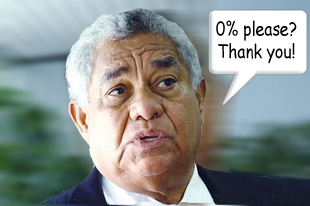
lawrence dupreyAs it is, we already have been bound to a rotten bailout of the wealthiest individual in the Caribbean by our Treasury at ZERO interest.  Anybody looking to set up a small business has to face the bank and pay interest. None of that for Lawrence Duprey and the CL Financial chiefs.  They have been able to enrich themselves and when the entire thing went wrong, they were able to negotiate a handsome handshake for themselves and then leave the mess for our government to clean-up.
That is the plain meaning of the bailout.  Is not policyholders we bailing-out, is the richest, smartest characters in the country.  The bailout script is unfolding so well that almost the entire discussion is now about the fairness/unfairness of the government’s position with respect to retired policyholders etc.

Real Anansi antics.

The CLICO Policyholders Group (CPG)
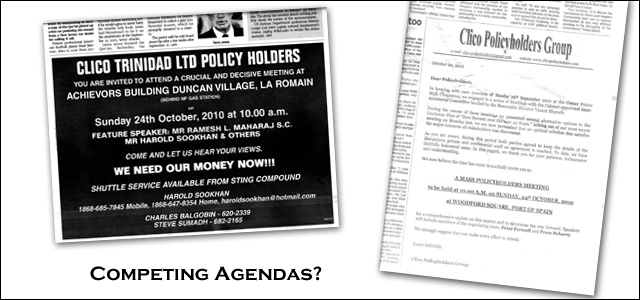
Competing agendas?There was an EFPA group and a CLICO Policyholders group formed just after the budget on 8th September, but they soon merged under the latter name.  I am now seeing what appears to be a substantial split with 2 competing meetings being organised for 10am today – one in Port-of-Spain and the other in San Fernando.

The CPG group has been very successful at getting their views known and making the media circuit, with the eventual meetings with the advisory group set up by the PM.

The main concern being advanced by the CPG is for the recovery of the funds deposited with CLICO and there has been no reply whatsoever to the point that, despite its labelling, the EFPA was largely sold and understood as a deposit.  The accounting rule of thumb as to ‘substance over form‘ in interpretation is an irrefutable part of the debate on this, but CPG have been silent on this point.

Almost all the many people with whom I have discussed this issue, have been very plain in their language – ‘I had my money deposit with CLICO‘ and so on.  But the word Policyholder is more likely to attract sympathy, so the games continue.

We already spent $7.3Bn in cash since the bailout was announced.  Please note that nobody is even talking about how the State is going to recover that loan.  The only talk is about how are they, the depositors, going to recover their monies.

There is a real principle of financial equity being shredded to pieces in the conduct of this bailout and it was disappointing that Mr. Dookeran, as an Educator in the field, did not take the opportunity to expand on this.

The intent is plainly to deprive the Treasury of its limited funds so that the assets of 15,000 people can be preserved.

So, What about those negotiations?

Sen. Vasant Bharath
Sen. Vasant Bharath

When the Prime Minister spoke on 1st October, she created an advisory group (headed by Minister of Food Production, Vasant Bharath)  to meet with the policyholders to seek other options.

The Prime Minister was to meet with concerned persons and activists on Wednesday 7th October in Chaguanas, but that meeting was cancelled at short notice, with no alternative dates given.

What we are left with is lengthy, secret meetings to discuss the review of the bailout terms, with no concrete information emerging.  That secrecy is totally unsatisfactory.  It smacks of secret deal-making and does nothing to inspire the confidence which is supposedly the very purpose of this exercise.

The last regime, with all of their noble intentions and devout Ministers, lost their way in a morass of muddled purposes, secret deals, mixed-up with misleading and false public statements from the highest office in the land.  We all know how that ended.  The question is whether we have learned anything from that bitter experience.  The Peoples’ Partnership were the main beneficiaries of those PNM errors, have they learned from that?

Our money is being spent on this massive exercise and it is not good enough to emerge from these closed meetings with agreed phrases like ‘constructive or meaningful’.  This emerging pattern speaks of disrespect for the acumen of our people.

To re-state my equation:

Expenditure of Public Money – Accountability and Transparency = CORRUPTION

Imagine these bold-faced people declaring that when they are done and settled, the terms will be announced to us who paying for the whole thing.  The first sign of a bad marriage is when the husband is the last to know – some say, the wife.  But the main point is that the public cannot be the last to know.

The simple and painful fact is that public confidence in our leaders is at an all-time low.  The time-honoured notion that a leader is someone wiser, more mature, less reckless and  of overall higher ideals has been tested to destruction by events.  In this particular case, it is easy to understand the charged atmosphere, hence the need for extra ventilation and transparency.

I was recently emailed by a well-meaning group asking that I start setting out some ideas of how CLICO might be rescued and I had to remind them that without basic information, all we can do is argue emptily with each other.  All to the amusement of the masterminds of this, the greatest economic crime in our nation’s history.

I was even ‘phoned, while writing this, by an acquaintance who is a leading member of the CPG to join him and an un-named UK guest in a TV studio on Monday morning to discuss all this.  Yes, I dismissed the request – too much secret-thing for my taste – and challenged the caller to name the person, supposedly a top UK expert.

What would be ‘constructive and meaningful’ would be to publish these long-outstanding reports so that we in the public can inform ourselves on the vital issues –

  • The original Duprey letter of 13th January 2009.
  • The audited accounts of the CL Financial group for the years ending 31st December 2008 and 2009 – Have PwC completed that?  When are they to be published?
  • Wendell Mottley, Colin Soo Ping Chow, Steve BideshiThe Mottley Report – There was a team of three advisers – Wendell Mottley, Colin Soo Ping Chow and Steve Bideshi – appointed to examine the CL Financial group and we need to know what were the findings of this group.
  • Given that we are being asked to bailout and clean-up Mr. Duprey’s crisis, I feel we need to be told  the names and details of those who benefitted from the $7.3Bn paid out so far, as well as those details for the borrowers of the $1.0Bn of ‘non-performing loans’ in CIB’s portfolio.
  • Finally, we also need to have the position of the CLICO Policyholders’ Group published.  What exactly are they claiming?

We have seen reports in the press about the very long Cabinet meeting on Thursday 21st at which the CLICO issue was said to be part of that agenda.

It would be totally unacceptable for a deal to be sealed without properly informing us, the taxpaying public, as to the true background.

The People’s Partnership has already distinguished itself, positively, by announcing Commissions of Enquiry into the attempted coup in 1990 and the Financial collapse (CL Financial and HCU).  This is no time to get diverted into back-room deals.

I am working for betterment and from you, our elected rulers, I expect better.

CL Financial bailout: Disturbing Arrangements in the 2011 Budget

A Bailout Cheque payed by taxpayers to CLICO was stoppedWinston Dookeran’s budget proposals to re-order the ongoing CL Financial bailout have sparked considerable controversy. Dookeran stated his first priority to be “…Stop the drift and indecision…” – ironically enough, it appears that the sentiments of the public are moving in another direction entirely. A new mood of protest and threats of impending lawsuits have emerged. This is a live example of the law of unintended consequences.
The budget’s revised proposals are –

  • Immediate stop on all interest payments;
  • $75,000 claims from depositors to be settled immediately;
  • Balances exceeding that threshold to be repaid over 20 years, with no interest payable. For an example, click here;
  • The group to be re-structured, with CLICO and British-American Insurance Company (BAICO) to be merged and prepared for divestment;
  • …Those responsible for this crisis must be held accountable.…

Clearly, Dookeran took the decision to review the MoU of 30th January and the Shareholders’ Agreement of 12th June 2009. He reduced the burden on the State by increasing the sacrifice of those who were anticipating the return of all their funds under the terms of the original agreements. The latter aspect is arousing serious protest, but there are other areas which also deserve attention.

The entire picture is very confused, which seems to be deliberate.  There were two main types of investments made in this situation – firstly, the basic and traditional insurance products such as pensions; life, health and general insurance and secondly, the depositor who was seeking high returns.  It is true that the pension products offered an optimistic 12% rate of return, but the short-term depositors were different.

Much of the current discussion and argument is actually about the repayment of the depositors, not the traditional insurance policyholders.  The fate of the policyholders is often invoked by people who are actually arguing for the return of their own deposits and that is why the separation between the two, which Dookeran makes, is so important.

To quote  – “The number of traditional, long term policyholders affected by this crisis, covering pensions, life and health insurance, is around 225,000 persons and accounts for $6 billion in liabilities…”  That is an average of $26,666 per policyholder.

Again – “…There are approximately 25,000 customers holding these short term contracts, and the liability to this group is in the region of $12 billion…”  That is an average of $480,000 per depositor.

Ironically enough, the voice of the traditional policyholders, who outnumber the depositors nine-to-one, is virtually silent in all this.  But then again, it is clear that by far the greater liability lies with the depositors and further, that they appear, on average at least, to be owed about 18 times more than the typical policyholder.  Yes, I am aware that there are depositors who are also policyholders and so on.

For those of us who did not invest with CLICO, the mere idea of our taxpayers’ funds being used to rescue those who placed high-return deposits is deeply offensive. Both the CL Financial chiefs and the depositors who took the chance at investing at those incredible rates of return are being spared the consequences of their decisions by the bailout process. But those groups are being differently treated from each other and that is the point in this commentary.

On the principle, the absence of consequence is inimical to any development, personal or national.

When I consider the appeals from Credit Union and Trade Union leaders, as well as individual investors, it makes me wonder if there is a live concept of responsibility in this place. All those people withdrew money from the slow-but-steady accounts of the traditional banks and put it into the high-interest accounts at CL Financial and HCU were indulging in riskier choices. How can they be so bold-faced as to tax the rest of us for their adventure?

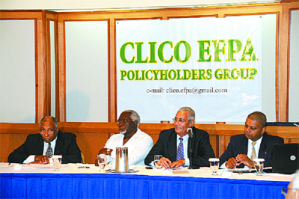
Some members of the CLICO EFPA group including (l-r) William Aguiton, Selwyn Ryan, Norris Gomez and Peter Permell
CLICO EFPA Policyholders group at press conference on Sept. 21

There are now two groups organized to lobby for the interest of the disappointed depositors – the ‘CLICO EFPA Policyholders’ and the ‘CLICO Depositors Interest Group.’ Some of the leading members are themselves leading CLICO sales agents, so the decline continues. They are asking for an urgent meeting with the Minister of Finance and litigation is threatened, so this will form part of this ongoing series.

Credit Unions fear collapse’ was the headline of a story in this newspaper on 17th September – at http://guardian.co.tt/news/general/2010/09/17/credit-unions-fear-collapse – reporting on the concerns of the Credit Union League (CUL), given the scale of their investments in the CL Financial group. Figures were presented for four large credit Unions and those have an average of less than 4% of their assets in CLICO. See the table here:

CREDIT UNIONS’ reported CLICO Holdings
Credit Union CLICO Deposits Total Assets Proportion
Eastern CU $17,000,000 $1,234,000,000 1.37%
Teachers’ CU $24,000,000 $503,000,000 4.77%
Rhand CU $28,100,000 $395,000,000 7.11%
Venture CU $21,000,000 $333,000,000 6.29%
Summary $90,100,000 $2,474,700,000 3.64%

Note – The data in this table is taken from the Guardian article cited, except for the Eastern Credit Union Asset Value which is from its 2009 Annual Report.

The CUL has not made any convincing case for a possible collapse and it seems reckless to even suggest further collapses on the basis of these figures.

But the confusion is continuing, with contradictory positions being taken on this issue. The idea that the Credit Union movement is under threat is a very serious one, which would be of great public concern, so we need to examine these statements carefully.

At page 10 of the Express of 22nd September ‘Credit Unions seek help from Rowley’ – see http://www.trinidadexpress.com/business/Credit_unions_seek_help_from_Rowley-103498744.html?corder=reverse – the Credit Union League met with the Opposition Leader, Dr. Keith Rowley. Once again, the idea that Credit Unions are in serious trouble was advanced – “…They said they would not be able to sustain daily operations. …” That is a very startling statement, this time given without any attempt to provide evidence.

To add to the confusion, the Guardian of that same day (22nd September) reported, at page 13 “CFF welcomes move to meet with CU on Clico” – see http://guardian.co.tt/news/general/2010/09/22/cff-welcomes-move-meet-cu-clico – on statements by Esme Raphael, President of the credit union’s Central Finance Facility (CFF) on this situation – “…Raphael said while the credit union movement was under no threat of collapse, the 20-year repayment plan would make it less competitive in delivering credit union services…”.

These contradictory messages will detract from the credibility of the Credit Union movement and must be clarified.

The idea that there is any such thing as a ‘guaranteed investment’ is preposterous. An absolute oxymoron is generating all this argument.

Yes, the last government made certain pledges and I have been critical of those, but here we are entering an even more turbid situation.

As outlined above, the PP government has decided to alter the terms of the existing bailout agreement as to refunds to depositors, so it is clear that it regards the terms of those agreements to be negotiable.

In my view, the most odious aspect of the entire bailout is that the wealthiest individual in the Caribbean was able to negotiate the largest-ever loan from our Treasury at zero interest on the basis of a letter. If the terms of the bailout agreement are negotiable, why are we not insisting on charging a proper rate of interest to compensate the State for these massive loans? Who is protecting our country’s wealth? In view of the fact that they are essentially unsecured loans, the only proper interest rate would be a punitive one.

There are live, cogent notions of financial equity and economic justice which are being abused in this entire scenario, but that is for a separate series.

The amounts involved are massive – “…The total funding provided as at May 2010 by the Government and the Central Bank, excluding indemnities and guarantees to First Citizens Bank amounted to approximately $7.3 billion” Emphasis in the original. That equates to over $456M a month to rescue Mr. Duprey. I wonder how much is the total of the indemnities and guarantees?

The bailout terms were revised to reduce the amount of the State payout to the depositors, but no additional pressure is being put on the CL Financial group in terms of interest payments. It is resembling a comfortable arrangement for Duprey.

Another aspect of the budget which was difficult to follow was the shifting focus between CLICO and CL Financial.

The proposal to merge and prepare CLICO and BAICO for divestment needs a fuller explanation. That is because the leading insurance ratings agency, AM Best, just de-listed CLICO, due to its failure to provide financial data – see http://insurance-technology.tmcnet.com/news/2010/09/14/5004871.htm. In addition, BAICO was declared insolvent in November 2009 – see https://afraraymond.net/wp-content/uploads/2009/11/baico_resolution_strategy.pdf – and filed for bankruptcy in the Florida courts in March – see http://www.thevoiceslu.com/local_news/2010/march/02_03_10/British_American_Files_for_Bankruptcy.htm. To quote Dookeran – “…As of June 2010, CLICO and British American combined total liabilities were approximately $23.8 billion but total assets were $16.6 billion” Emphasis his. That is an insolvency of the order of $7.2Bn and it is not at all clear how, if at all, that can be divested.

We need a better quality of information to move ahead with this, so it was encouraging to hear Dookeran’s clear post-budget statement “…No more shall we have secret government,…” – see http://www.newsday.co.tt/news/0,127330.html.

Minister, these facts need to be made public if we are to eliminate secret government :

  • The original Duprey letter of 13th January 2009 – I have applied twice under the Freedom of Information Act for this and the second application has been in your Ministry since 28th June, unacknowledged.
  • The audited accounts of the CL Financial group for the year ending 31st December 2008 – Have PwC completed that? When are they to be published?
  • The Lindquist Report – Bob Lindquist was reportedly appointed to examine CLICO. Has he submitted a report? Are we to be told of any of his findings?
  • The Mottley Report – There was a team of three advisers – Wendell Mottley, Colin Soo Ping Chow and Steve Bideshi – appointed to examine the CL Financial group and we need to know what were the findings of this group.
  • The Central Bank’s winding-up petition for CIB in the High Court has given us a disturbing insight into the operations of ‘The House on the Corner’. When are we going to get reports into the collapses at CMMB, British-American or CLICO?
  • Given that we are being asked to bailout and clean-up Mr. Duprey’s crisis, I feel we need to be told who are the borrowers of the $1.0Bn of ‘non-performing loans’ in CIB’s portfolio. The fact is that these are some of the delinquents we are being asked to bailout and the names would surprise the public. Local banks customarily publish the names etc of people who have non-performing loans, so why can you not do the same thing in this case?
  • To quote the budget statement – “…This crisis was caused by…wrong financial reporting…” False Accounting is a criminal offence under our laws – When are criminal charges to be laid? Those people – the accountants who were accused of that grave offence – belong to professional bodies, both here and overseas. Is there any intention to make formal reports to these professional bodies?
  • Quoting again – “…This fiasco was caused by reckless corporate governance and the glaring failure of our financial regulatory institutions…” What action is to be taken against these slack regulators?
  • Is there any intention to invoke the ‘Fit and Proper’ provisions against any of the CL Financial Directors or Officers?
  • Finally, do you intend to insert an interest clause into the ‘sweetheart bailout agreement’?

Mr. Dookeran, you have the opportunity to inject notions of solid responsibility and proper conduct into this sorry situation.

Next, I am going to delve into the promise to ensure accountability of the responsible persons.

SIDEBAR: The Hindu Credit Union peril

Amidst all this and completely to be expected, the PP government is bailing-out HCU depositors on identical terms to those now being offered to CL Financial depositors. For the record, the Finance Minister’s statement was as plain as it was unsettling –

“…Although the failure of HCU did not carry a systemic risk to the financial system since it represents less than one percent of the total assets of the financial sector, this Government is of the view that these funds of these small investors must be protected…”

We were told directly that this HCU collapse is not a risk at all to the system, but these disappointed savers are still to be rescued by the Treasury.

This is a poor precedent, since when the next Financial Institution collapses, the then Minister of Finance would have to deal with those unrealistic expectations.

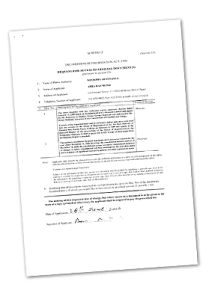
Second FoI Application for Duprey Letter

Application #2 for Duprey Letter

This is a second attempt to get at the Duprey letterthe first application was eventually deflected by the Ministry, who asked us to refer to the Central Bank. I believe that was a barefaced attempt to stifle our request with the fact that the Central Bank is exempt from the FoI Act.

My request for the 2008 audited accounts is based on the terms of the 12th June CL Financial Shareholders’ Agreement – Section 4 of the SA sets out the procedure for a proper system of accounts, culminating at 4.4.5 – “…shall ensure that an annual report of CLF is prepared and dispatched…in manner consistent with standard corporate practice…” The accepted interpretation of this language informs us that the word ‘shall’ denotes an obligatory, non-voluntary duty. If that is the case, when can we expect publication of the 2008 annual report, accompanied by audited accounts, as per ‘standard corporate practice’?